Davisite Banner. Left side the bicycle obelisk at 3rd and University. Right side the trellis at the entrance to the Arboretum.

Category: Bicycling

  • DISC 2022 Transportation – Planning Commission falls for Developer’s Trick

    TrapBacThe trap was set likely shortly after "DISC  2020" was defeated by voters.  When the developers of this peripheral sprawl – or I'll be nice and call it West West Sacramento – were planning to re-introduce it last year for a vote this year – they realized that a key demand was a grade-separated crossing of Mace. So they removed it from the Baseline Features… fully-intending to agree to do it as a concession.

    Back story

    The City Council-approved Street Standards (2016) don't mention e-bikes at all. What this means is that the width, curvature, and proper siting of infrastructure that would optimize the use of e-bikes – in particular the Type 3 variant that has assistance up to 28 mph – is totally missing in Davis, or more immediately in concepts, plans as well as development agreements and baseline features in current and near-future projects.

    To address this, over two-and-a-half years ago when I was on the Bicycling, Transportation and Street Commission (BTSSC) I got support for adding an item to the long range calendar which would address it; this first appeared on the LRC in September 2019, with a possible date of December 2019 for the agenda. (It is abbreviated somewhat erroneously as "intersection design guidelines / standards"). It has been pushed back repeatedly since then, and the BTSSC did not support forming a sub-committee about it during 2020.

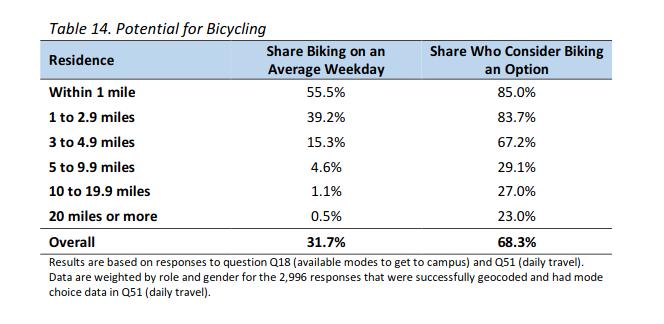
    What this means is that significant concepts and projects which could alleviate transportation problems, such as Reimagine Russell, the new-ish Class I multi-user path on the south side of Russell (chronically and clinically-referred to as a "bike path) or smaller projects all over the city are not future-proofed for the increase of modal share for cycling we desperately need to improve everything from climate impacts to conviviality to fitness to transportation crashes. Our city is simply too large now in size to have a significant modal share with "acoustic" bicycles. Not convinced? Look at the low bike modal share from peripheral areas of town in the UCD Campus Travel Survey, which shows low share even for people with campus destinations where car parking is not always convenient, and not fare-free. It's not hard to extrapolate – necessary, as the City has essentially refused to do its own counts for years – that almost no one regularly rides from Mace Ranch or some other peripheral areas to Downtown for a coffee or beer – sort of the most normal thing in the Universe in a bicycle-branded cycling city.

    SurveyCycling

    UCD Campus Travel Survey 2019-2020 (pg. 30) – By bike, DISC is just over four miles from ARC, a central point on campus when considering agricultural facilities. This distance has about a 10% modal share for cycling, and includes mostly students, many who don't have their own cars.

    However, as we can see from the example above, the faster type of e-bikes are quite expensive. I've seen nothing lower than just over $3,000. Though important – or all – major arteries in Davis – should be optimized for this type of bike – the idea is not only to optimize for them but make safe for all users, including on acoustic bikes – it cannot mean that this type of bike should be essentially required to live here and enjoy the purported high quality of life. Infrastructure optimized for fast bikes is also a significant improvement for all bikes, as it's direct, requires a minimum of stops, is not shared with motor vehicles… or pedestrians and dogs.

    To be more precise, the goal should be the 15-Minute City. This is a relatively new standard or classification of a very, very old sometimes organic strategy to make key locations in a city within 15 min from anywhere else, for all means of transportation. This seems to also serve as a kind of proof of the bicycle modal share results in the Campus Travel Survey. It's definitely something that should be part of our new General Plan, or even worked on earlier by a joint Commission process (BTSSC, Planning… perhaps Natural Resources and Social Services…). I would argue that it should also be about effort, so a 5 or perhaps 7-minute walk is the equivalent of a 15 min bike ride. I've said that if kids can't walk unaccompanied 5-minutes from where they live to buy ice cream cones, it's a failure (and that's just one example, a single ice cream place or a truck at DISC doesn't make it sustainable.)

    It's also quite important to be reminded that the City of Davis has for over four years not had a senior civil engineer with a transportation focus. Many projects have gone forward – sometimes to completion, often with significant flaws – without the benefit of this experienced and wise counsel.


    Last Night

    At the Planning Commission review of Disc 2022 last night – and early this morning – I was actually quite impressed by the comments from multiple Commissioners regarding negative transportation issues of the planned project, and even the general discussion about its unavoidable impacts and uncertainly of benefits from transportation demand management… well, at least earlier in the discussion. Commissioner Shandy was particularly right on with her criticism of planned widening of Mace – presented by the developer as a kind of unquestioned religious observance – contradicts claimed benefits for people cycling and walking. There were other positive and thoughtful comments by a majority of Commissioners.

    I knew that the grade-separated crossing of Mace was a kind of sneakily-hidden prize and tried to point out in my sort of sloppy recorded comment that that a safer crossing of Mace would not on its own make DISC 2020 excellent for cycling (this is better than "cycle-friendly"), because of distance from Downtown and places further west, and besides that, safe crossings directly to the south along Mace across 80 would cost many millions and be very complicated (and at least in my head I know that Caltrans District 3 and the Yolo County Transportation District have withdrawn the earlier plan – it was supposed to be built first! – of a new bike and ped bridge across the Bypass as part of the I-80 Managed Lanes Project.)

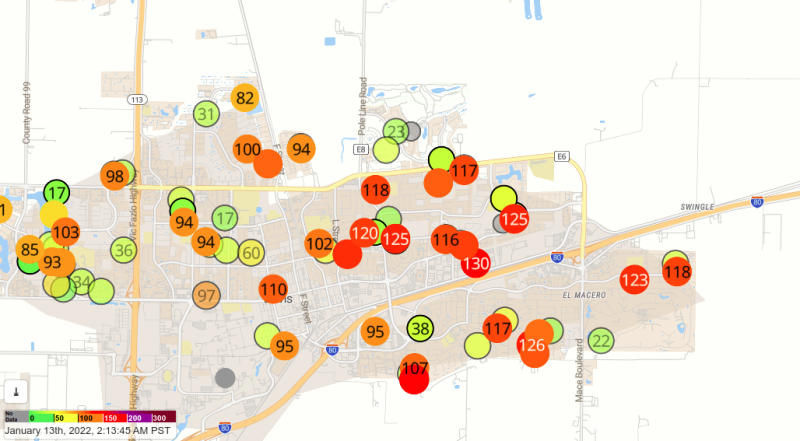
    Screenshot from 2022-01-13 02-14-21

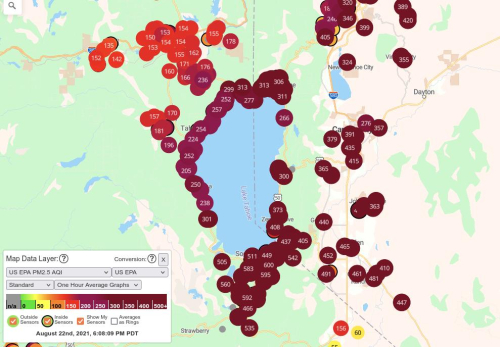
    Just an aside about the bandied about "globally-known sustainability of Davis": This was the air quality last night shortly after the meeting was over (via Purple Air)


    The Trap is Sprung

    Though it was fully-intended to be a positive thing and I will give credit to Commissioner Shandy, the discussion and lead-up to a vote turned sour when she proposed that a grade-separated crossing of Mace and a Class I trail across the undeveloped land south of Harper Junior High would make her feel better about the planned Mace widening and other traffic impacts. She suggested nothing about safe cycling and walking connections to other places, such as the Nugget and popular restaurants across 80. But the problem is that, for example, the area planned for housing at DISC 2022, on the north and eastern side of the project area, is more than 15 minutes away by bike from Downtown and at leat 20 to 25 minutes away from the UC Davis campus that is the raison d'être for DISC 2022! Moreover, the route has almost no optimized cycling infrastructure the whole way (varied from local streets to arteries, no protected bike paths, lack of priority at stops, etc… there is no proposal for any of this in any proposed development agreement or baseline features). But mainly it's too far by bike… never mind walking! Most of the time people – with free or with un-bundled parking – will take I-80 between campus and DISC, even more so to many facilities etc on the west side of campus related to agriculture. I-80 is such a fantastic route much of the day that nothing can compete with it, including shuttles and express buses, which I am sure will at best have a tiny modal share.  This creates huge challenges for any development more than 15 min away from key locations, and it means simply that they should not even be considered. (Oh, wouldn't it have been great if staff were directed to work on the General Plan and told the developers that there was no capacity to work on stuff that would very likely be in violation of a progressive outcome for it?)

    So the Planning Commission has recommended the two elements mentioned above that are supposed to address problems on Mace to the City Council. My conclusion is that the developers will signal their intention to accept them – perhaps with a little drama – and the Council will praise them for doing so. But again, even with everything promised (e.g. shuttles, TDM) and not promised (e.g. e-bike-optimized infrastructure) there's still no place for DISC. Still no way to successfully do something better than I-80 via private vehicle for anything but a minority. There's really nowhere to walk to from DISC. Hopefully the voters will see through this ruse and others and reject DISC 2020.

    Galadrieltempted

    In the ALTERNATIVE timeline, Lady Galadriel was tempted by but in the end did not succumb to the Power of the Grade-Separation ring


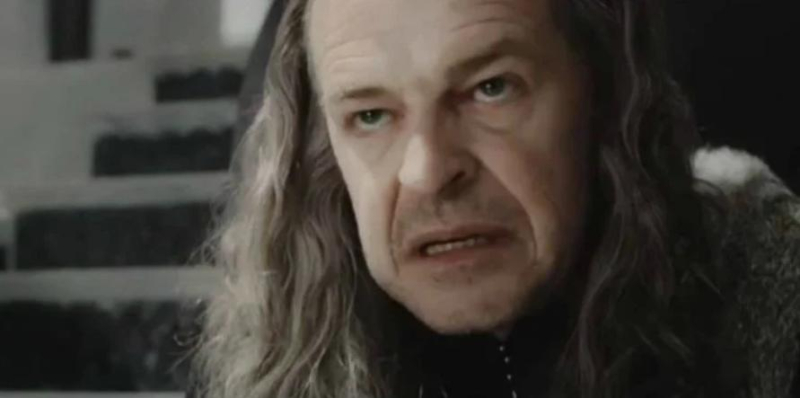
    Denethor

    In the REAL timeline, Lord Denethor, Steward of Gondor, was consumed by the Grade Separation Ring and driven mad.


    Question

    Last night I was quite surprised when the developer said with much conviction that baseline features were not necessary to enforce the creation of certain designs and programs at DISC 2022, as these would be required by CEQA. Then why have baseline features as a solution for any of these things, in all the discussion for years up until now? If a reader could enlighten me I would truly appreciate it.

    Afterword

    I am all for more housing – for all income levels, but with a significant proportion below market and lower income – and workplace and related development in Davis. I have never said I was against these things in any local discussions, for example in the Davis Vanguard. But they have to be infill, they have to be on greyfields such as parking lots, industrial areas along 5th St – not only the PG&E yard – and in the eastern side of South Davis and other areas much closer to Downtown and especially for what DISC 2022 purports to be about much closer also to campus. With electric shuttles on fixed routes, optimized cycling infrastructure, a new connection across 80 around L St., mixed-use above (existing) parking lots and so on many if not close to all of the actual benefits of a project like DISC 2022 can be realized. It's not impossible, it's not rocket science, it simply requires conviction, creativity and less b.s. and false claims about sustainability. Hopefully Council, Commissions… local media… and organizations such as Bike Davis and Cool Davis re-direct the citizenry towards an alternative to DISC or a truly sustainable version of it… closer to and integrated with the City of Davis and the UC Davis campus.

  • Russell Sprouts Little Imagination

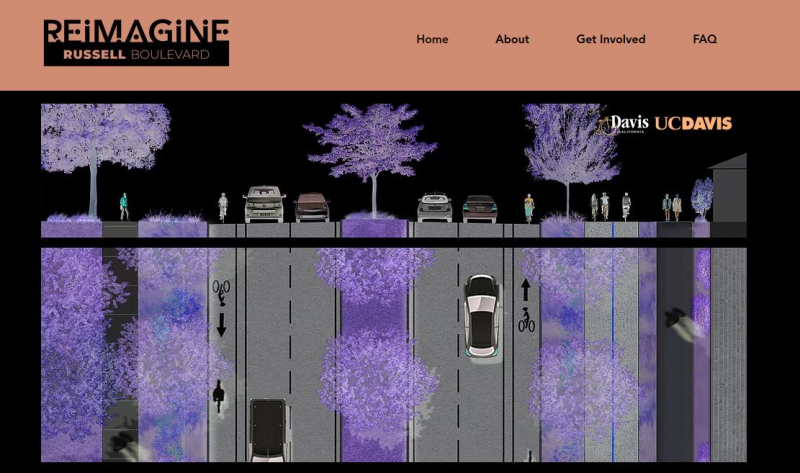
    ReimagineInvertedDoes imagination require or at least benefit by transparency and a truly robust public process?

    For a year or so the City of Davis, UC Davis and Yolo County have been working with the private consultancy Toole Design and the public to "Reimagine Russell Boulevard".  City of Davis staff plan to update the City Council at this Tuesday's Council meeting.

    Following are comments I made on the survey which was planned to close on November 12th but is open as of this moment…

    My comments are split into two parts: First I focus on the process, next on the design. Process, today. Design, tomorrow (or Tuesday morning).

    *****

    1 – The project inexplicably has two websites, one for "administrative" reasons. There's never been an explanation for this.

    2 – On the admin. website there is a list of representatives of some sort from the city, the Community Steering Committee.  Two of them told me that they were not happy that it was only a sounding board and not really official – and there's no way specific way indicated to reach them. Additionally I was informed by a Committee member that they were not provided access to raw data from the first survey earlier this year. My impression is that the City learnt its lesson from the Downtown Plan process and decided to formally reduce democracy in the project. If no one visits the admin. website they won't even know about these people. At the very least the budget of nearly half a million dollars (!) didn't allow the consultants and so on to do more than a few public sessions over a year's time.

    (more…)

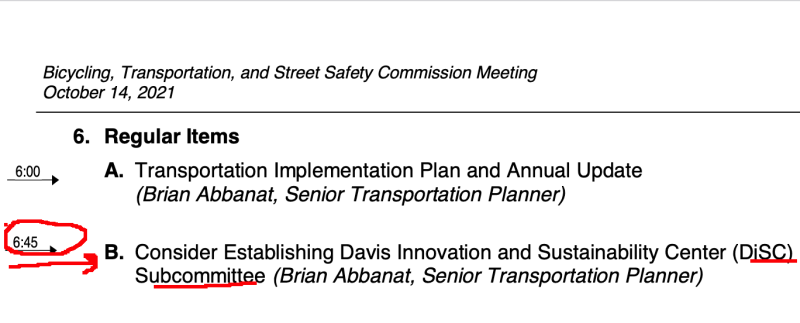
  • Bicycling, Transportation, and Street Safety Commission needs a DiSC 2022 Subcommittee

    Screen Shot 2021-10-12 at 9.28.28 AM

    The following letter was emailed to the BTSSC this morning.

    Dear members of the Bicycling, Transportation, and Street Safety Commission,

    I am writing to you as a former commissioner (10+ years) and Chair of the Open Space and Habitat Commission (OSHC), having completed my term last December. I was involved in analyzing what is now being called the DiSC 2022 project in all of its iterations, so I hope you find my comments helpful in your discussions.

    I understand that at your meeting this Thursday, Oct 14, you are only deciding whether to establish a Davis Innovation and Sustainability Center (DiSC) Subcommittee, with the meeting to discuss the project as a commission to come later.  I am writing to strongly urge you to establish a subcommittee now.  The OSHC reviewed the project last week and expressed frustration that there were many issues that they did not have time to discuss; see this report of the meeting.

    Given the changes in the project – which you have not been fully presented with, but I believe that they are more extensive than you might imagine – and your commission's thoughtful and considerable recommendations from the last time, a subcommittee is absolutely essential for sorting through all the documents to figure out what has changed and how your recommendations might change as a result. 

    I note that your packet for this meeting only includes a two-page description of the project.  The OSHC was given a more extensive project description that you might find helpful; see Attachment 2 of this document.

    Here is an example of one large change that the BTSSC might be interested in commenting on and that a subcommittee could consider. The original proposal stated that "DISC will construct a grade-separated bicycle and pedestrian crossing on Mace Boulevard connecting to local and regional trails (see p. 14 of this document).  This was to be a baseline feature, meaning it was a guaranteed part of the project; indeed, the only way to guarantee that a promised feature will be in the actual project is for it to be designated as a baseline feature. 

    However, in the current DiSC 2022 proposal, the developer promises only to "acquire and dedicate land to accommodate a future grade-separated bike/ped crossing of Mace Blvd to be located north of the Mace Drainage Channel" (see p. 18 of the document given to the OSHC that I linked to above).  As I read this – and I encourage you to ask the developer about this directly – if the project were to go forward, there may or may not end up being a grade-separated bike/ped crossing of Mace Blvd as part of it, since they are only promising to acquire land to make a crossing possible in the future, and it's not even clear that the acquisition of land is a baseline, i.e. guaranteed, feature.  If I am right, this would be a loss of a significant feature of the project, one that I expect your commission would want to weigh in on.

    Again, this is just an example – I imagine that there are other such changes that a subcommittee could find, but that it would be difficult to discover if only one meeting is allocated to the issue, with materials appearing just a few days before.

    So again, I urge you to vote now to form a subcommittee, to look at the materials I have provided, and to ask if there are other relevant materials that would help you in your decision making.

    Sincerely,

    Roberta Millstein

  • Particle Wars in Davis –  What you can’t see can kill you, Part II…

    Screenshot from 2021-08-19 17-42-32

    The militarization of gardening?

    A conversation about the proposed – and not – restrictions on toxic micro-particle hyper-distribution -  a.k.a. “leafblowing” – by three of your favorite local activists!

    (COVID is Part I)

    This evening the City of Davis Natural Resources Commission (NRC) will hold the first of two hearings on possibilities for leaf blowing restrictions. Here’s the memorandum – a supplement to Council’s approval of temporary leaf blowing restrictions from last October. It includes Commission and Staff proposals and results of the surveys on leaf blowing taken which were taken in June.

    In summary, they are proposing a gas LB ban, time restrictions and user restrictions. Staff and Commission (sub-committee) proposals are broadly similar. 

    What’s very important, however, is that there is a strong likelihood that there will be a complete ban at the state level on gas-powered equipment such as lawn mowers, edgers and so on… including leaf blowers and vacuums, or combined units. This means that any equipment-related ban in Davis that only affects gas blowers will be nothing unique in just a couple of years. 

    The meeting is at 6:30pm


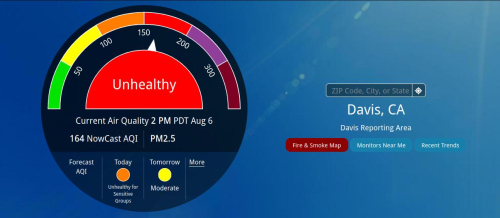
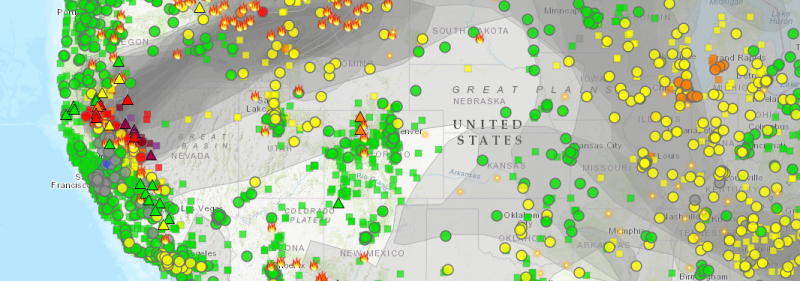
    AirNow08062021

    Leaf blowing prohibited on this day?…

    AIR QUALITY and wildfire fallout:

    Todd Edelman: There is no explanation of why the air quality-based restriction due to wildfire fallout  is based only on official AQI according to current City policy. For example, the very popular and relatively inexpensive Purple Air system could be used.  And Purple Air isn’t only used at private residences: The UC Davis environmental engineering dept has one on its roof for experiments. Lake County Air Quality Management District (AQMD) uses them for official monitoring outside of wildfire situations. The New Jersey Transit Authority seems to also use them for official purposes. Sutter Davis Hospital has them on their roof and inside. The elementary school at Beale Air Force Base has one, as does the Yolo Solano AQMD office in south Davis – they say they use it to recognize “trends”.

    But perhaps the most important use of Purple Air is to determine local impacts of leaf blowing…

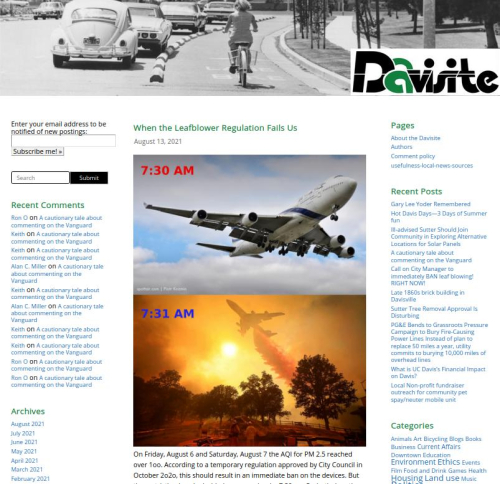
    Previewonleafblowerstoryno2

    Nope… no new restrictions if the air's bad AFTER 7:30am…

    Darell Dickey: I have trouble with the concept that we can only ruin our air quality when the air is otherwise pretty good. We’re going to avoid dirtying the air when it is already bad? And then there’s my favorite part: Blowing will always create a local situation of AQI over 100, which should result in an immediate ban on blowing. 

    I’m thinking that a good, logical way to present this is that if we’ve all agreed that 100 AQI is “bad enough” for us to ban activities that make it worse, then we should never be allowing the use of devices that make the AQI 100+. And this circles back to local air quality vs. relying entirely on one spot of data that’s outside of town to determine what we’re breathing in our neighborhoods at any given moment. 

    If AQI 100+ is bad anywhere, then stop creating AQI 100+!

    TE: There is nothing about how they determine how much ash is on the ground, though this is a condition of the lift of any AQI-based restriction according to current City policy. I have voiced this concern many times.

    There were several times when the official AQI went over 100 during the day but not before 9AM; this was not mentioned in the memorandum, though I brought it up repeatedly in August in emails to the NRC.

    LEAF-BLOWING, WILDFIRE SMOKE AND COVID-19

    The proclamation from October 2020 that resulted in temporary leaf-blower restrictions mentions “COVID-19” 10 times, yet the current memorandum only mentions it once, and not directly in relation to smoke effects on those with who have COVID. Further, the October 2020 mentions no specific research at that time on wildfire smoke and COVID, but there’s new research not mentioned in the memorandum. 

    AIR QUALITY, general:

    TE: As far as I can tell leaf vacuums distribute lots of dust, and as they pick up inorganic matter as mentioned in the memorandum, I don't see how they will be allowed. But still, do people think that these things work as HEPA interior vacuums?

    DD: True. But “lots of dust” from a vacuum situation is still way better than any blowing. It all needs to be in perspective as we’ll never arrive at “perfect.” Same way that electric cars aren’t perfect, but are better than gas cars, etc.

    TE: Well, I think at least all the most dangerous and invisible stuff comes out the back…

    DD: “Most dangerous” is not easy to defend. If the crap being stirred up produces a violent health reaction (allergies, asthma, etc), then the acute “most dangerous” thing is probably coming out the front. At least for those people who are severely affected.

    The only way to call any of this “better” is if less crap is being put into the air…. As compared to doing it another way. And IMO, a vacuum is better than a blower. And leaving stuff where it is, is better than all of it.  The timing of the device usage is also important. I vacuum up deep leaves to mulch them and put them where they’ll help the yard vs. choke the plants. And I do it when the leaves are not dusty. It is a relatively benign activity.

    Tahoe08222021

    Purple Tahoe


    LABOR:

    TE: There's no suggestions related to the labor issue except for what may eventually be affected by a ban on gas-powered blowers. What are their wages, by the way? This is a basic question for labor related actions or studies.

    DD: I hate the question where they ask the company how much it will financially destroy them. Of course the answers are all opinion, but it is presented and answered as fact. 

    TE: Yes they should give figures or something. Is there possible funding from AQMD to transition out of all leaf blowing?

    DD: Also, a significant percentage of landscaping businesses do not use any blowers. 

    TE: Why is this? How is this influenced by opinions of consumers and of workers or their managers/companies?

    DD: From what I can tell, the biggest concern from the citizenry is that they may have to pay more to the poor, under-paid folks. You know… the folks that they’re really concerned about harming with…. low wages.

    Asking the yard-care business owners how bad it will be if blower use is restricted is like asking El Macero drivers how bad it will be if Mace loses one of its travel lanes. It is a total guess. It is based on everything else not changing. And they simply have no idea what the result would be. Might be higher health and better hourly wages for everybody. But of course most claim that it will just be devastating to their business. I didn’t hear one response about how it would be better for the workers who might get paid more for doing healthier work.

    TE: I’ve repeatedly brought up this part of the issue, not only with the NRC, but also the Social Services Commission — it needs to agree to provide feedback. Though leaf-blowing is not a job based on sustainable practices, there are many related jobs which are, and they require a higher skill-set. Tree trimming, building on-site composting facilities, triage of soil situations? No one should lose their jobs. 


    LABOR AND PHASE-IN:

    TE; There seems to be no scientific reasons for only phasing out gas blowers in City properties except for protecting some companies. Nothing about increasing wages, etc. The proposed start date Jan 1 (2023) is after most of the "leaf season", and over two years since the temporary regulations came into effect. This seems to be about giving enough time to buy new equipment, but this seems like a tiny expense compared to labor.


    Screenshot from 2021-07-24 05-43-02

    Purple Nation

    VIBRATION (Sound):

    Roberta Millstein: You two are rightly focused on the air quality. But for a broader audience, you might also mention that these things are f*cking loud. Really f*cking loud. And that is for some a big part of why they are hated.

    TE: I know that traffic noise is very bad for human health. One thing that’s worse about leaf blowing noise is that it can be unpredictable, especially if one’s neighbor is doing it — but then also who memorizes the leaf blowing schedules of their neighbors or their yard sterilization services?

    While most electric leaf blowers are quieter than gas-powered ones, it’s not guaranteed. And if an electric leaf blower is less powerful than a gas one, people may use it for longer.


    OTHER:

    DD: And the main reason that some give for the “need” of leaf blowers? No other practical way of clearing large paved parking lots. 

    TE: Exactly, what are uses of LB's in terms of square footage or acres, etc?


    CULTURE: 

    TE: Yard work is good exercise if the air is clean. It connects one to their yards – even in a rental property – that other exercise outside cannot.

    Leaf blowers and vacuums didn't exist in significant numbers until what, the 1980's? What did people do before that? Die, in their yards, under piles of leaves?


    EFFECT ON TREE AND SOIL HEALTH:

    TE: In the Memorandum there's nothing from the Commission or Staff in the recommendations about the benefits of leaving leaves where they fall, even though it’s already recommended on sources linked from the City's Tree pages and others.

    The Tree Commission will hopefully offer feedback.


    EXAMPLES / Best Practice in Other Places:

    TE: There is mention of the other jurisdictions which have done partial to full bans, but not by name. They clearly have this list. There is no indication how many suffer significant wildfire fallout, though as many are in California certainly some have, and there's an assumption about why most didn't respond. Two have complete bans… who are they?


    EFFECT ON OTHER USERS OF ROW (street, greenbelt, or another public space):

    TE: There's nothing about how use of blowers contributes to the always non-permitted piles of yard waste in bike lanes. At the October meeting of BTSSC we need to pressure them into agreeing to providing an opinion on this, especially as a related item on yard waste in bike lanes has been sitting in the long-range calendar for many months as TBD. This issue has been going on for many years.

    Proposed ban during the week is only til 8AM, even though many are commuting to school or work by then, by pedal or foot. So then they will be exposed full-on as they traverse the City.

  • Davis is Home of Northern California’s Zombie Bike Ride!

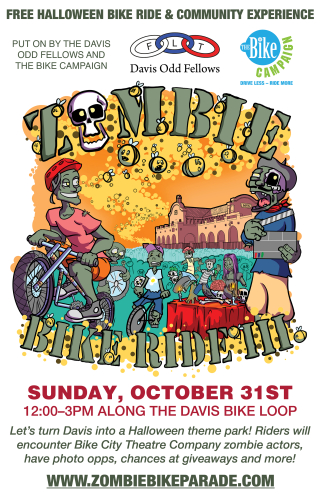
    Graphic(From press release) On Sunday, October 31st between 12pm–3pm ride along the Davis Bike Loop and encounter Zombies, brought to you by The Davis Odd Fellows Lodge, The Bike Campaign and nearly 70 sponsors, collaborators and media partners!

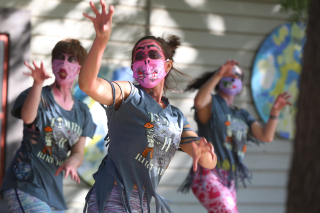
    DancersWe are delighted to be partnered with Bike City Theatre Company and their team of sketch writers, directors and actors to provide an unforgettable experience! Join us for fun, laughs, photo ops, and a Mirror Image Dance Company Thriller performance!

    SkydivingTHAT'S NOT ALL – Watch zombies fall from the sky, compliments of Skydance Skydiving (details to come)! Finally, join our after party in downtown Davis at Davis Common, at 500 1st Street, where attendees can enjoy a live DJ as well as a fantastic array of food, drink and dessert options from 3:30-5:30pm. Then it is time for the kids to trick-or-treat ? at dozens of downtown businesses!

    There are NO ADMISSION FEES. This is a FREE community event. There is no starting or ending point for the bike ride. Riders can hop on the Davis Bike Loop at any location and ride in either direction. Details on Skydance Skydiving's zombie skydiving performance to come.

    (more…)

  • City of Davis and the (Near) Future of Rail Travel

    L21spanish

    Virtual Public Workshop! Thursday, July 15 from 530 to 7pm


    I wrote the Bicycling, Transportation and Street Safety Commission (BTSSC) earlier today:

    To the BTSSC,

    I strongly suggest that the BTSSC set up an ad-hoc sub-committee about Link21 so that it can stay engaged long-term, receive and process community input and then at the appropriate time make recommendations to the City Council.

    The City of Davis is a small tomato in a huge pot of soup in this matter, but the railway proportionately bisects the City of Davis more than other town along its current route between Oakland and Davis. Davis grew around the rail and I-80 corridor in a way that – especially in the last 60 years – did not facilitate multi-modal travel based on the railway. A typical regional or suburban station like Davis in much of Europe would have multiple bus lanes that terminate at the station and hundreds of secure bicycle parking space for all kinds of bikes, suburb connections for walking and cycling for all directions, and a lively place for activity in front of the station, instead of a parking lot. The City has made some progress in this area of late, but, for example, there are still many who want a new parking structure at the station, and voters thankfully – but only narrowly – disapproved a new development project far from the station with no good cycling connections to it, lots of parking and imagined good access to I-80.

    I had tried to form a sub-committee nearly three years ago about the I-80 Managed Lanes Project, but it was terminated shortly after Commission approval because the second member moved to Sacramento. While I appreciate the healthy skepticism the BTSSC had about the Managed Lanes Project at the last meeting, I believe it prudent to get ahead of the game as much as possible for this even larger project that relates to both the Managed Lanes Project as well to our Downtown and General Plans, as significantly improved rail service would facilitate the creation of a lot more carfree or carlite households in town. As you seem to recognize, the worst outcome of the Managed Lanes project will do nothing but worsen traffic in town and literally throw a rotten tomato at our forming Climate Policy. The worst Managed Lane implementation will not support railway travel until perhaps many years from now, and indirectly, when thousands of Davis residents, frustrated with increased congestion and pollution, surround Caltrans District 3 HQ and bombard it with stinky, rotten tomatoes genetically-modified to annoy "deaf" state officials and narcissistic automobilists.

    TomatoesAs a robust railway powered by renewable energy is a key tool in fighting Climate Change, I would also suggest you consider making the sub-committee a joint one with NRC, and Social Services too in order to help ensure that the system is accessible for all households.

    The person who seems to be the current project manager for this part of the Megaregion, Jim Allison from Capitol Corridor, is very approachable and helpful. The Link21 sub-committee would be wise to also connect with other – especially smaller – communities along the corridor in order to create common, expected and seamless last-mile connections to their stations, and dense and proximate housing that makes good public transportation possible. All the pieces are necessary, but the puzzle has to be solved by everyone. I think that I prefer the tomato to the puzzle metaphor.

    Thanks,

    Todd Edelman"

  • 15 mph DESIGN SPEED in Davis!

    SD15
     
    My strong feeling is that all local streets – including Downtown – should have a 15 mph design speed. This is already a number most are familiar with, as it's used alongside e.g. speed tables on school routes and even the sharp turn from 2nd St to L St.

    The design speed is a speed that most people feel comfortable moving at in motor vehicles. People on bikes can also feel a design speed, but they are nearly infinitely more inherently safe than motor vehicles to others in the public ROW. 15 is also a bit faster than most cycling speeds.Traveling by bike on most greenbelt paths in Davis at 15 mph feels too fast – the paths are under-built – and perhaps the biggest design flaw in post 1970's Davis, sadly and ironically complemented by the clinically-insane wideness of many streets in West Davis, Mace Ranch and South Davis… but also much older streets in Old North, etc.

     
    Does it seem slow? Perhaps. However, consider that for most journeys by motor vehicle a relatively short distance is on local streets. So any journey lengthening will be minimal.
     
    Or can it even be shorter? Yes! 15 mph speed design is best complemented by elimination of existing mandatory stops; to be replaced by yields. It's these often unnecessary stops that lengthen journey time the most. Getting rid of them also decreases pollution (gas, particles and noise) and makes people less likely to feel the need to speed to the next stop sign.
     
    So it can be both safer and faster!

    (more…)

  • Big problems at BTSSC meeting tonight!

    2nd StRailway modification project along 2nd St. leads to subverted process and disrespected City policy.

    The item "CCJPA 2nd Street Improvements 30% Design" is on the Consent Calendar for the Bicycling, Transportation and Street Safety Commission (BTSSC) today.

    The Capitol Corridor Joint Powers Authority (CCJPA), which runs the eponymous rail service with partner Amtrak, is planning to make modifications to the railway parallel with 2nd St, roughly between L St and the Pole Line. A significant part of the project will also raise, repave and re-stripe 2nd St – there's long been a problem with railway ballast making its way to the street – and include installation of an ADA-compliant sidewalk on the north side of the street, where no sidewalk currently exists up to the west end of Toad Hollow.

    So far, so good? Unfortunately not. The item involving a significant infrastructure modification is only on the Consent Calendar and the changes to the street itself – aside from the new sidewalk, which is clearly a good thing – are not following the 2016 Street Standards, and the whole length of 2nd St is not compliant with the 2013 General Plan Transportation Element.

    (more…)

  • Debrief on Debris in the Bike Lane?

    IMG_20210203_073619

    South-bound Pole Line just south of East Covell. Convenient to pick-up, not so convenient for people who want to use the lane
    IMG_20210203_062949

    An hour earlier – most bikes are not equipped with headlights and the person on a bike might not see it.

    UPDATE: The piles I've described in this post which were on or near the East Covell corridor have been removed. There are some others in the bike lane on Loyola between the entrance to Korematsu Elementary and Alhambra, and still nothing either here or in general to communicate to people driving motor vehicles that people on bikes may deviate from the bike lanes….

    *****

    Last week's storm was the worst in ten years by many accounts, with serious damage to trees and property, a significant loss of perishable food and other problems caused by lack of power.

    Obviously city staff, private contractors and others had their work cut out for them and certainly we applaud their efforts, though many cheered PG&E field staff and they pooped on their bosses (and shareholders).

    From what I saw, arterial streets in Davis were cleared for the most part by January 28th, the day after the storms mostly ended. When out then to photograph the weird non-standard lane design on Lake at Russell I passed the dangerousafety radar speed sign on East Covell Blvd. that I blogged about last week.

    I noticed that street sweepers had made at least two passes on the traffic lanes of East Covell, because there was a consistent line of debris that started a  foot or two into the bike lane from the number two lane. I noticed the same, um, edging on other arteries.

    (more…)

  • Better main shot cropped_REDCity is blocking bike lanes?

    The City of Davis' only response to recent crashes in the vicinity of Pole Line Road and East Covell Blvd has thus far been Enforcement1. Actively, the Davis Police Department has been monitoring some locations in the area.  Passively, the City has placed a radar speed sign on WB East Covell between Manzanita and Baywood Streets, right about here.

    Why is the radar speed sign in the bike lane? The City places similar signs – and they and private contractors place various construction signs – off to the side on streets when there's space to do so, so they clearly understand the advantage of doing so. But when there's no space, they place the signs on the side of the street, and on most collectors and arterial streets in Davis this means it's in a bike lane.

    "Putting a radar feedback sign on Covell to invite drivers to slow down: good. Putting a sign in bike lane: not good," says Nicolas Fauchier-Magnan, the President of Bike Davis, who usually goes by Nico.

    "Obstructing the bike lane, on a street where drivers routinely go 50 mph or more is simply irresponsible. 

    "Come on, City of Davis," continues Nico. "You should know better, and you can do better. Please fix this terrible blunder before someone gets hurt. There is plenty of space on the grass, outside of the bike lane, to safely place this sign."

    (more…)