

[This article was originally published by the SF Chronicle and then the Times of Israel. It is re-posted here with permission of the author].
By Reuven Taff
On Jan. 10, a synagogue in Jackson, Miss., was torched — a stark reminder that antisemitism is not just words in a hateful social media post but continues to be a threat with real-world consequences.
But just as last month’s Hanukkah massacre at Australia’s Bondi Beach exposed with brutal clarity the consequences of unchecked antisemitic incitement, the events in Jackson should provide further evidence that there’s a connection between violent attacks and the rampant, incendiary online rhetoric directed at Jews. History has shown that ignoring such threats risks emboldening perpetrators, normalizing antisemitism and making Jewish communities less safe.
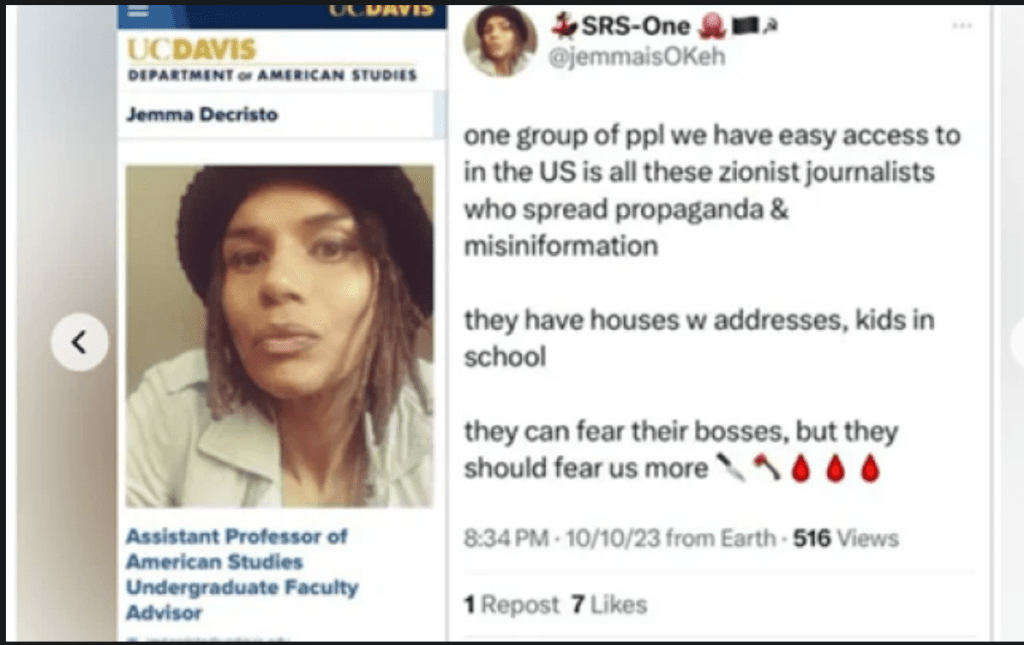
This context makes UC Davis’s handling of American Studies professor Jemma DeCristo’s now-deleted Oct. 10, 2023, social media post on X all the more alarming.
Just three days after Hamas’ deadly rampage that killed at least 1,219 people and the kidnapping of 251 hostages, DeCristo wrote that
“one group of ppl we have easy access to in the US is all these zionist journalists who spread propaganda & misinformation … they have houses w addresses, kids in school … they can fear their bosses but they should fear us more.”
Her words were accompanied by emojis of a knife, a hatchet and three drops of blood.
That post left Jewish students, faculty and families scared, isolated and angry — yet the university’s response, after a nearly two-year investigation, amounted to little more than a slap on the wrist.
The most public account of the DeCristo case appears in an investigative story by Katherine Mangan in the Chronicle of Higher Education. Drawing on UC Davis’s confidential investigative report obtained through a public-records request, Mangan documents the harm caused by DeCristo’s words — and the university’s inadequate response. [Note: see also Monica Stark’s account in the Davis Enterprise].
DeCristo told investigators that her post on X was “sarcastic” and not meant to be taken seriously. For Jewish students and parents, the professor’s explanation lacks credibility. Language threatening Jews and their children does not read as sarcasm. It reads and feels like a direct threat.
In an Aug. 21, 2025, letter to DeCristo, UC Davis Chancellor Gary S. May faulted her for failing to acknowledge the “deep pain and significant disruption” her post caused. He stated that this failure conflicted directly with the professor’s obligation to maintain a safe and respectful learning environment.
And yet, despite the investigation’s findings documenting significant harm, it concluded that DeCristo “did not intend” to spark anxiety or fear when she posted her words to X. The chancellor declined to terminate her employment, opting instead for a temporary suspension, partially unpaid and a letter of censure. During the nearly two-year investigation, DeCristo was suspended for one academic quarter and a letter of censure was added to her file, but she remained on the university payroll despite not teaching any courses, losing pay for only two months.
That token disciplinary action is especially difficult to defend, given DeCristo’s complete lack of contrition. She offered no apology, showed no regret and made no effort to address the fear her words caused. Nonetheless, the chancellor accepted her claim that the post was “satirical,” allowing her asserted “intent” to outweigh the impact of her words.
As a rabbi, I view this case through a moral lens shaped by Jewish tradition. In that tradition, teshuvah — repentance — requires acknowledging wrongdoing, expressing genuine remorse and taking concrete steps to repair the damage caused. Forgiveness is always possible, even encouraged, but it is never automatic. For nearly two years, DeCristo has had repeated opportunities to express regret and address the fear her words inflicted on Jewish students, faculty and their families.
She has refused to take responsibility, leaving students’ fear unaddressed, a mindset reflected in the worldview she articulates in her recently published book. In the acknowledgments, she writes:
“Like many people publishing in academia, I needed to write this book to theoretically keep my job. Although if we’re being honest, this is hardly enough to ‘keep’ a job in a fascist-zionist, racist, transphobic, able-ist career path in a glorified settler-colonial real estate hedge fund known as a university.”
When a professor characterizes her workplace in this manner, it raises serious concerns about her ability to engage responsibly with students whose fear she has refused to acknowledge.
The DeCristo case is not an isolated example of faculty using their positions to intimidate students. By contrast, some universities have taken decisive action when faculty speech crosses a clear line.
In 2025, Texas State University fired a tenured history professor after he made public statements that the administration said could incite violence. While the case has been legally contested, it illustrates that there are colleges willing to enforce the most serious disciplinary measures when faculty speech threatens the well-being of members of the community.
UC Davis has a choice. It can continue to treat this as an academic “misstep,” or it can act to protect Jewish students and faculty. By retaining DeCristo, the university sends the message that explicit threats against Jews do not rise to the level of misconduct — and are acceptable behavior.
True accountability would draw a clear line: Threats against Jews are not protected speech, not academic debate and not without serious consequences — anywhere.
Reuven Taff is rabbi emeritus of Mosaic Law Congregation in Sacramento. His opinion pieces have been published in the Sacramento Bee, the Wall Street Journal, USA Today, the Jerusalem Post and other publications.

 Davisite
Leave a reply to Suzie Dee Cancel reply