

“Don’t think of a hateful elephant.“
By Alan Hirsch
“Love is the only force powerful enough to turn an enemy into a friend” M.L. King Jr.
Next week, the Davis Hate Free Together program will hold an all-day strategic summit to evaluate its progress and plan its future direction. This collaborative effort—originating from the City of Davis, UC Davis, and Yolo County—was initially created to address bigotry and prejudice toward individuals based on identity (e.g., being gay, Black, Hispanic, or Jewish).
However, the program now needs to evolve beyond addressing individual prejudice and begin tackling the deeper and more complex challenge of intergroup conflict.
UC Davis is currently under intense pressure from the Trump administration to dismantle its diversity programs and respond to what has been labeled an “epidemic of hate” focused on one group: Jews. This new directive highlights the limitations—and potential harms—of the Hate Free Together framing. Not only may it be ineffective, but it might also worsen group conflict.
More fundamentally, the “Hate Free” framework contradicts well-established findings in cognitive science about how the human mind works. If I tell you, “Don’t think of an elephant,” you will, of course, think of an elephant. Similarly, if a government tells people, “Don’t hate those other people,” the instruction may backfire. Talking about the Holocaust has not ended antisemitism.
The program also treats hate, prejudice, and bigotry as if they were medical conditions, rather than social or psychological phenomena. But tribalism is something all humans are susceptible to, especially under certain environmental and cultural pressures.
The choice of this “don’t think about hate” framing was likely unintentional. The Hate Free Together branding emerged in 2022, created by a PR team just coming off the Healthy Davis Together COVID testing initiative. Indeed, the hatefreetogether.org website describes hate as a virus, setting a goal of “total eradication”—implying the program will functions like a vaccine.
But when hate exists at the group level, this disease/victim metaphor sets the stage for a dangerous contest: Who will be politically defined as the viral “haters,” and who as the innocent “victims”? This dynamic incentivizes groups to highlight their own trauma and victimhood while blaming others—rather than accepting responsibility for working to a safe, welcoming, and pluralistic community. There is even an incentive to traumatize your own people: stoking fear is a well-known political tool. This is not ‘victim’ blaming (again who is the victim?) but suggests the tactics “victims” choose count.
This is the polarity everyone argues against while maintaining they have “moral clarity”.
The ongoing conflict in Davis between pro-Palestinian and pro-Zionist communities over U.S. support of the Gaza war is a clear example of the need. Both groups carry generational trauma. The black-and-white framing played out in the Human Relations Commission’s handling of the MAPA report put this on display. Neither side acknowledged harm done to the other, nor did either side show introspection that they—or their allies—might have made the opposing group feel vulnerable or threatened.
The Hate Free Together framing encourages this kind of zero-sum dynamic.
At a time when civil rights are under threat, the greatest danger is this: if one group “wins” the argument and is politically declared the sole victim, the opposing group—now branded as “haters”—could be censored, marginalized, or even face deportation through the use of state power.
A Better Way Forward
I urge the Hate Free Together program to rebrand and reframe itself—moving toward a more positive and inclusive framework rooted in the spirit of “we-ness” found in the Principles of One Community, which are already embraced by UC Davis, the City of Davis, and DJUSD.
While unintentional, the Hate Free Together program’s focus to date has leaned heavily on “group pride” activities that often emphasize differences and historical grievances. What’s missing is a focus on what unites us.
Going forward, there should be more multicultural events and intergroup forums that build bridges and foster shared understanding. Rather than merely celebrating your identity, the goal should be to cultivate empathy, curiosity, and community across lines of difference.
We should not set ourselves up to fail via disease metaphor by saying our goal is to eliminate the virus of hate but accept conflict and difference– especially those emanating outside of Davis we won’t resolve. Instead, we should teach techniques of dialog and discuss guard rails on civil discourse that have clearly been lost at the national level.
I recommend that the attitude adjustment incorporate the language and vision of Dr. Martin Luther King Jr.’s “Beloved Community”—a concept he championed even while confronting the deep injustices of apartheid in the American South during the 1960s. This vision promotes pluralism and shared values: creating a safe, just, and inclusive community for all.
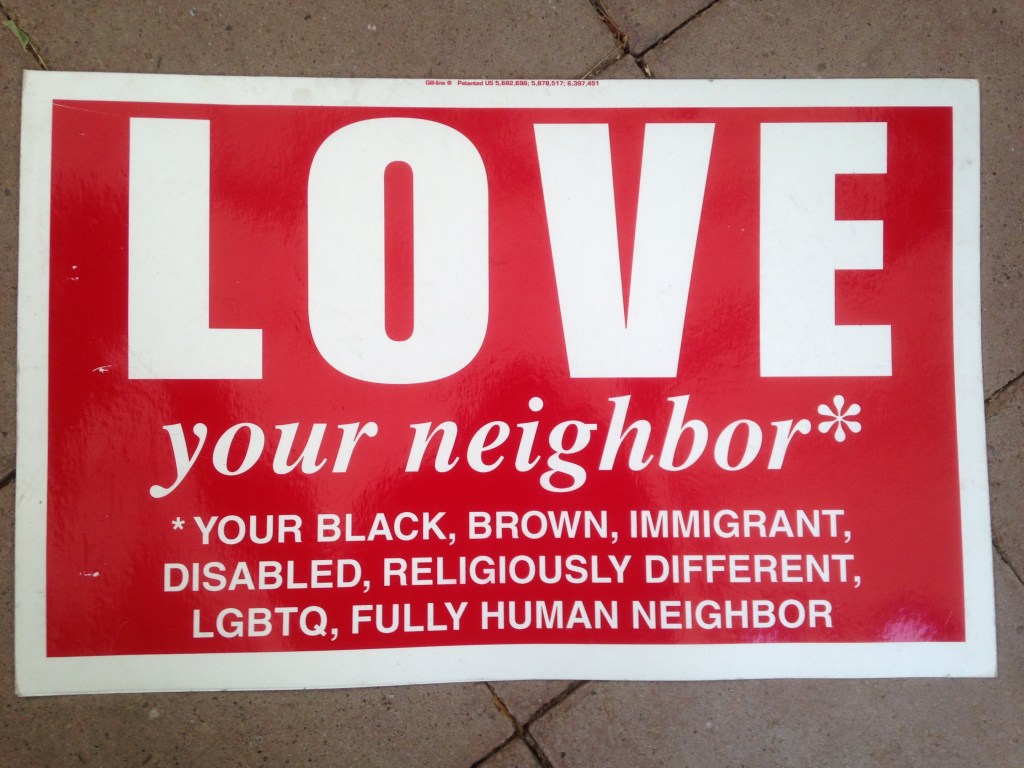
Alan ‘Lorax” Hirsch can be seen handing out “Love your Neighbor- no exceptions” lawn signs in the Saturday Davis farmer’s market.

 Davisite
Leave a reply to Roberta Millstein Cancel reply