

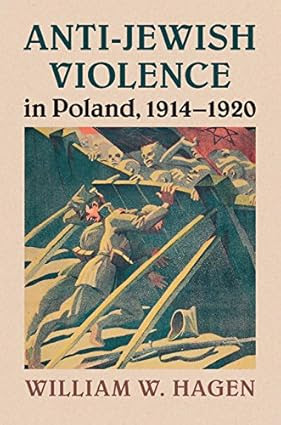
By William W. Hagen
Antisemitism has sung many tunes in willingly open or gullible ears. But its keynotes are fear and resentment. Historically, it often arose from the mysterious thought that the children of Israel were, collectively, a negative and even dangerous presence. Such fear had primordial roots, but took long-lasting anti-Jewish shape in early Christian attitudes, transmuting later into modern prejudices.
It now slumbers in Western culture, waking now and then to foment small or big trouble. The resentment arises in hostile minds from bafflement that a numerically weak and historically persecuted people should, as a group, flourish materially and culturally – and, seemingly, possess power inimical to the aggrieved antisemite.
Now, in the midst of atrocious conflict between Palestinians and Israelis, many Jewish college students and their elders are shocked to find themselves the targets of critics of Israeli warfare and celebrants of Palestinian freedom, whatever that might mean. The Anti-Defamation League’s surveys show towering levels of Jewish students’ alarm and emotional distress at the Palestinian defenders’ loudly voiced anti-Zionism, Outsiders might suppose that such “anti-Zionist” rage is directed at specific policies of the Israeli government and military. They do not understand that subjectively to many, probably most, American Jews, anti-Zionism is merely veiled antisemitism. For in the last century, attachment to Israel has become very widely constitutive of American Jewish identity.
But do threats to Jewish life in America rumble mainly among pro-Palestinian progressives? Let’s consider this question in the light of the history of the worst persecution Jews ever suffered, which was at the hands of European Nazis and other fascists in the 1918-1945 years.
Antisemitism inhabits the mind and heart in two ways: as folk beliefs learned at the kitchen table and fireplace, and as ideologies propagated in print and through organized politics. Folk antisemitism could — and still does — explode in grassroots violence, as in pogroms, and in sporadic and chaotic street violence aimed at individual Jewish targets. Print antisemitism focused political movements against Jews and their gentile defenders. It could prove a punishing weapon against liberals and leftists, as in the infamous Dreyfus Case (1894-1906) in France.
In the Nazi movement, the sharp spearhead of ideological antisemitism were the brownshirted paramilitary fighters, organized in the eventually millions-strong stormtroopers. Before Hitler came to power as German chancellor, they battled their opponents on the left in the streets and terrorized Germany’s Jews and other citizens with torchlight demonstrations of hatred for liberalism and leftism and for Germany’s economic and cultural elites supportive of the new democracy.
It was organized antisemitism, united with and serving a drive to overthrow liberal democracy, that doomed Germany’s and eastern Europe’s Jewish millions. And a comparable danger occasionally flickers here in the United States, in the form of armed right-wing fighting organizations and their political protectors and inciters. Who has forgotten the torchlight parade in 2017’s “Unite the Right” rally in Charlottesville, Virginia, in which young men marched while chanting “Jews will not replace us”? These were young men whom then-president Trump ill-advisedly included in the category of ‘very fine people.” This is the fascist template in purest — though still minuscule — form, and it found a certain replication, accompanied by dark threats (music to antisemitic ears) against “globalists,” in the Jan. 6, 2021, storm on the US Capitol by right-wing practitioners of violence.
To guard American Jews against violence, there must be instruction of students in understanding of antisemitism, not merely as “hate” — moral or emotional error — but as a historically channeled set of irrational fears and indefensible resentments. When protests arise, they should be transformed into non-violent teach-ins, or protected in non-violent form within the boundaries of the law and decisively halted beyond them.
More importantly, the emergence of civilian or paramilitary, politically shielded organizations propagating antisemitic and other xenophobic or racist goals must be stalwartly policed by the organs of justice of a strong democratic state. It was Germany’s misfortune that its democratic system, born late out of World War I, lacked the inner strength and popular backing to resist more firmly the rise of Hitler’s movement, which seized the levers of democracy to overthrow it and install a deadly dictatorship.
If we agree that, right now, pro-Palestinian protest organizations, including Students for Justice in Palestine, are engaging in antisemitic actions — through their denunciations of Zionism and the many hostile implications they attach to that concept — then we must call for intervention by university and civil authorities to curb such activities within the boundaries of allowable free-speech activities. For it is not only such organized anti-Jewish or anti-Zionist actions that menace the Jewish community. The existence of such organizations is sure to inspire the ever-recurrent lone-wolf syndrome, in which unrestrained aggressors — seething perhaps with folk antisemitism picked up through ordinary American life — take up arms against Jewish groups or individuals, committing mayhem or murder, as has repeatedly happened in recent years. In other words, organized antisemitism has its spin-offs in the minds of violence-prone, irrationally minded outsiders.
The USA is now perilously polarized between red and blue. It is dangerously susceptible to the discrediting and breakdown of the rule of law. In such unstable times, one hears an echo, still faint, of the rise of fascism in 1920s Europe. We are not yet near the abyss’ brink and can hope to rely on the institutions that protect our individual safety and collective freedom. But not by whistling past the graveyard. We must face the threats that confront us.

 Davisite
Leave a reply to Alan C. Miller Cancel reply