

Study: Average speed difference trivial if toll lanes added; HOV lanes don’t work.
By Alan Hirsch, Yolo Mobility
If you read deeply and critically into Caltrans documents, you will often find a number of things acknowledged- inconvenient truth not always shared with elected officials.
City and County elected officials rely on agency staff to give honest and complete presentation of objective findings. However, the reality is elected official are very vulnerable if an agency’s staff is committed to pursue a pre-ordained solution. Staff can bending their analysis or make strategic omissions of information in their presentation. These are rarely caught by elected official who don’t have time to read, much less understand the reports.
Then it’s up a rare whistleblower and or nerdy gadflies to protect the public interest by catching this, and making public comments to elected who otherwise don’t have time to read everything.
But in the end, it up courageous electeds, who are willing to both listen to the outsiders, and are then open to changing their minds, if the agency solution is be questioned if its pre-ordained solution is in the public good.
This manipulation of data does come from all Government agencies, or even most, but this Machiavellian approach to public policy can hard backed into the culture of some.
Dance between Caltrans and Local Electeds
A dance of credibility and accountability is now begun between Caltrans and the local city council members who sit on Yolo Transportation District Board.
Just two weeks ago a Whistleblower at Caltrans, a hi Level Deputy Director of Planning at Caltrans resigned stating Caltrans methods to advance YoloI-80 state violated environmental laws. This fit into a bigger picture concern about Caltrans’ veracity: a UC Davis study has shown Caltrans consistently overstates the benefit of freeway widening to elected officials by understating Induce Traffic Demand. And thirdly, UCD Professor Susan Handy, head of the National Center for Sustainable Transportation has written a letter stating the Caltrans Widening plan not only won’t fix congestion, but will hurt transit ridership and the environment.
Adding to this now is fourth finding: a close reading a hidden Caltrans report on alternatives to improve travel on the full I-80 corridor show how upgrading the Capitol Corridor rail service to 100 mph is 15 times more cost effective than road widening.
Public should watch to see If elects on the 5 member YoloTD board, including Davis’s Josh Chapman and Lucas Frerich have the courage to revise their positions taken based on Caltrans information.
What Caltrans Own Numbers Show
The three data tables below are from the larger Caltrans I-80 Comprehensive Multimodal Corridor Plan (I-80 CMCP). It considered five alternatives to improve mobility for the entire I-80 corridor-from the Carquinez Bridge into Sacramento. The plan ranked the alternatives based on travel impact-including one that upgrading the neglected Capitol Corridor rail service to 100 mph. Others encouraging more carpooling via adding HOV carpool lane or adding managed toll lanes -aka HOT or “express lane” (a Caltrans marketing euphemism.) There was also TDM option: Transportation Demand Management strategy of mostly supporting shift to carpooling, or promotion of fixed routed or shuttle or micro transit bus without unimproved infrastructure.
It’s also worth note Caltrans did not study a regional (3 or 4 county) bus rapid transit (BRT) option to use freeway express lanes as another transit alternative: interregional/intercounty bus travel in the “capitol corridor falls between the cracks of county bus services, or possibly because Caltrans does not want competition for it rail service.
Still, the flawed study does give a perspective comparing freeway widening with 100mph passenger rail service—even with only 4 or 5 stations along I-80 corridor.
Caltrans in their I-80 CMCP then estimated the travel speed difference for the average traveler for each of the “scenarios”, along with it costs and benefits, generating a benefit/cost ratio.
To cut to the chase: the Capitol Corridor upgrade option is 15x more cost effective. And that the average speed improvement for drivers is only around 2-4 mph even for most extensive road widening proposal. And vehicle hours traveled difference between them all is also just few percent different even with maximum road widening. The un-peer-reviewed report also seems to once again underestimate the Induce Traffic compared to what independent academic studies, so the numbers in these table are likely overestimate benefit of wider freeways, meaning the 100-mph rail alternative might likely be ever more advantageous.
Report Hidden from Elected when deciding on I-80 Alternatives
Conveniently for the advocates road widening at Caltrans on I-80Yolo widening, these results were not released until after EIR alternatives for Yolo I-80 widening were chosen by electeds. While the report was finalized in January of 2023, it was not released to public in final form on Caltrans website until May of 2023. This is long after YoloTD electeds and Caltrans agree to EIR alternatives in early October of 2022 by signing the YoloTD/Caltrans MOU document.
The CMCP has never been presented to YoloTD Board. Supervisor Lucas Frerichs did ask one question about it at the board’s September 2023 meeting, though he did not follow up to ask about the contents.
Below screen shots are pages from Caltrans’ full I-80 CMCP multimodal corridor study, finalized 1/26/2023 but not made public until May 2023 — long after I-80 EIR alternatives were considered, and meaningful transit options rejected.
Source: https://dot.ca.gov/caltrans-near-me/district-3/d3-projects/d3-i80-cmcp
Rail upgrade to 100 mph 15x more cost effective than freeway widening: Caltrans Table 5.13
Source: Caltrans I-80 CMCP Page 103
Note bottom line in chart: CC cap corridor scenario 4 is 3.05 vs 0.22 for best road widening option scenario 3. HOT (Tool/HOV lanes)
This chart raises questions as to why full corridor rail transit alternative (not just buses in the short segment within Yolo County) were not included in Yolo80 EIR study, particularly because 95% of traffic on the Yolo Causeway begins or ends in Solano County and points west. In the below chart Segment 6 is Davis and segment 7 is Causeway, but of course the rail upgrade (Scenario 4 CC) needs to be analyzed for entire corridor (last line of table).

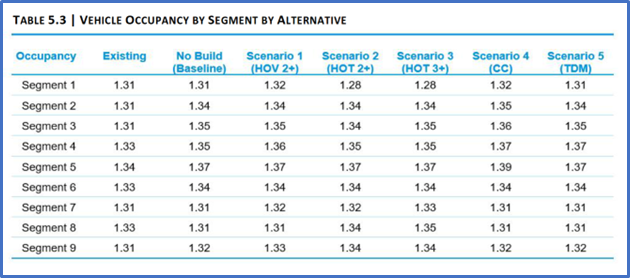
New carpool lanes do not make freeway use more efficient. Caltrans Table 5.3
Source: Caltrans CMCP page 95
Chart shows less than 1-4 % increase in carpooling if HOV lanes are added shift from (1.32-to max 1.37 people in the average car). This is change in average vehicle occupancy between current “no build” vs scenario 2 & 3 HOV and HOT scenarios ). This mean the user of car pool lanes are not due to a behavior change: they are “dates” or family or groups who were going to travel together regardless of the existence of the lane. This mean HOV lanes have not environmental advantage, they just add lane capacity to the freeway. Note also that “Carpool only” is in practicality just a theory: With tinted window and enforcement minimal one can believe this is just Caltrans justifying on paper building another lane- maybe to prevent shift of money to a local transit agency. On highway 99 in Sacrament it was found 48% of car pool lane users were single occupancy vehicles- so they become as congested as the other lanes: there is no reliable automated way to enforce HOV lane useage.
Only 2-4 mph faster travel if widening nearly the full length of I-80 — i.e., only 2- to 4-minute average travel time decrease with Express/HOT/HOV managed lanes: Table 5.9
Source: Caltrans CMCP page 97.
Note: Data in this table should be accept know this is Caltrans “best shot” to show the freeway widening—which is already begun– was the right thing to do.
Then begin do a critical analysis Caltrans’ record of overstating benefits of freeway widening by understand induced traffic effect. According to UC Davis ITS study, Caltrans historically has chronically understated induced demand from freeway widening. The small VMT increase in this chart due to adding many miles of HOT/HOV lanes seems highly suspect. The induced demand for the Yolo80 project predicted by the UC Davis induced demand calculator for just that 17-mile segment is about 450,000 vehicle miles per day. Caltrans’ induced demand estimate for adding at least twice as many lane miles in CMCP study is 400,000 miles (no build vs both HOT/HOV). The UC Davis model is not controversial: it is accepted by Caltrans as accurate within 20% .
Recall also that the Caltrans CMCP is not formally peer reviewed and is not subject to legal challenge so there is no outside quality control of it modeling.
The table also gives the VHD: Vehicle Hours of delay. Note the small difference in delay between managed lanes compared to the rail alternative: less than 3%. The difference in VHD Hours between no build and HOT2+ is 14,000 hours. This sounds like a large difference, but it is less than a 6% increase in average travel time.
Caltrans typically pushes the “absolute” number (e.g., 14,000 hours here), but it’s more useful to normalize this to a 6% increase for the average drive time and then weight this tradeoff for against the sprawl and climate change impact of the extra freeway lane. Again, this CMCP is not a peer reviewed document, but reflect Caltrans “best shot”- likely to justify widening it already started. So, it does not surprise that if resulting induced demand was understated for build options (1,2 & 3) , VHD, VHT and VMT are likely understated relative to rail (CC) and TDM options. Thus, the benefits of HOT/HOV alternatives are likely overstated—meaning rail might be even a better investment.

Will YoloTD Board turn from advocacy role for Caltrans and revisit what is in best interest of county?
A substantial among to data questioning has surfaced about the road widening and transit option, and Caltrans method .
We will now see if YoloTD board and staff have the courage to be more critical Caltrans data.
Best Practices would be for the board should hire an independent traffic expert— one not dependent on Caltrans for future work — to review Caltrans DEIR and CMCP before it is released. They should not depend on privately funded Environmental lawsuit to once again exposure Caltrans questionable methods.
The public should also ask of the YoloTD board: Why have you already lawyered up? -Is this to defend Caltrans again private environmental law from group ECOS does, that has time and again have force locals confront inconvenient truth of Caltrans and invest in transit, or are these taxpayer-paid lawyers to protect the public interest in Yolo County from Caltrans questionable methods?

 Davisite
Leave a comment