Davisite Banner. Left side the bicycle obelisk at 3rd and University. Right side the trellis at the entrance to the Arboretum.

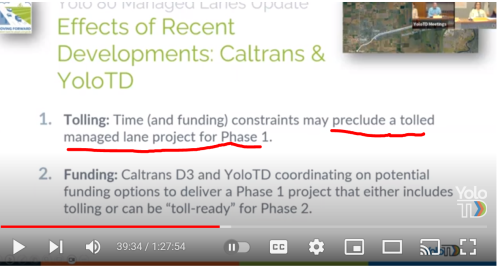
I-80 update: Caltrans proposes cutting mitigation for Phase I

Image001 1525

by Alan Hirsch

  1. At the Yolo Transportation District (YoloTD) board meeting 7/17, it was shared that Caltrans is considering a plan to save the I-80 widening project by trimming it back from $210m to the $86 mil fed funds they have so they can spend them before the funds time out: Their plan would be to widen a few miles of the freeway as HOV without adding tolling infrastructure.  i.e., no source of revenue for more transit or other mitigations. This is the core project Caltrans assumably was after anyway as they originally had Congress ear mark the $86m in grant money to only be used for an untolled  HOV lane.  Assumably full tolling and mitigation would be implemented when and if money for a now larger Phase II is found sometime in the future.
  2. YoloTD staff using Caltrans numbers have said even a complete 17mile long HOV lane would be congested day 1. Arguing now for a widening just a short section blows apart any logic that Caltrans want to fix a “bottle neck”.
  3. Three of the five YoloTD members objected to Caltrans toll-less plan for the new lane expressing concern they want money to spend locally. Board member Jesse Loren of the Winter Council was very concerned about not having toll lane revenue funds for a social equity program- assumably a program needed to mitigation of inequity of having that self-same toll lane. At risk for Davis is the Micro transit service- i.e.  93% subsidy required for $40/trip service as well as financial help the developer of the Nishe project and downtown Davis.
  4. Most Board members asked how much widening they can buy after inflation impact cutting the buying power of the money. Lucas Frerichs raise a question if a CEQA environmental lawsuit might slow or stop the project (response: likely not if EIR is certified by Caltrans but it could retroactively affect the mitigation program and tolling policy.)
  5. The board raised no question about staff’s Plan B other that cuttings scope: i.e. fund the phase I  short fall created when California Transportation Commission failed to fund on 6/26. YoloTD Staff report noted they were considering local Muni-bond or obtaining Federal FHWA Loan to be guaranteed locally. YoloTD staff said this is still being explored but the time frame is challenging.(see previous Vanguard article)
  6. Silence continues on the Climate Change Elephants in the Room: In discussions by YoloTD Board that night, the terms Climate Change,  VMT, GHG or induced demand were not used in reference to-I-80 project.  There was no acknowledgement or response to letters by Professor Stephen Wheeler, signed by 20 Davis resident on climate change asking for reopen EIR with transit alternatives or a similar letter by Professor John Johnson of CSUS.
  7. No one directly acknowledge or publicly responded to powerful letter from head of National Center for Sustainable Transportation Professor Susan Handy that said based on decades of studies the I-80 extra lane- even if tolled — won’t fix congestion but will hurt the environment. This letter was privately shared with the board but not shared with the public (see coming Vanguard article that will reprint it)
  8. YoloTD chair Tom Stallard gave a statement “for the record” He references generic “letters” which might include that from Wheeler and Handy.  Not bothering to reference any science to studies, he that the board need to be realistic and simply widen the freeway as this would fix congestion.  He used examples of his grandchildren’s need to get to piano lesson and sporting event as evidence of important needs that need be addressed. His argument is a tour de force of how common sense should overrule science out of the university. No member of board contradicted his statements as chair. Tom Stallard is one of the richest men in Yolo County having given over $50,000 to the Mondavi Center, so a managed toll lane that never congests would work well for his family to avoid congestion.
  9. Josh Chapman, the Davis Council rep failed to show.  Davis City manager/council does not seem to have appointed an alternate-to YoloTD unlike other JPB bodies the city is a party to.
  10. -I 80 Draft EIR release will again be delayed again to the end of August per Caltrans statement at YoloTD meeting. Caltrans originally scheduled the DEIR to be release in January of 2023. Caltrans has no email list to inform stakeholder of delays and does not update such information on the project’s website, so continue to read the Vanguard or Davisite to keep informed.

The Meeting: Video of July 17, 2023 board meeting is at  https://youtu.be/O7odnLgxuF4  The I-80 agenda item begins at 33 minutes in. Tom Stallard’s statement that effectively denies university science of “induced demand” is at about 1:06

 

Davisite logo

Did you enjoy reading this article? Then subscribe to the Davisite for free and never miss a post again.

Comments

11 responses to “I-80 update: Caltrans proposes cutting mitigation for Phase I”

  1. Ron O

    “At risk for Davis is the Micro transit service- i.e. 93% subsidy required for $40/trip service as well as financial help the developer of the Nishe project and downtown Davis.”
    So again, I’m failing to understand why “financial help” for the developers of the Nishi and downtown proposals is a “benefit” (or appropriate or legal) in the first place.
    How often does this type of thing occur regarding such taxpayer-funded “benefits”?

  2. Tuvia LLC

    Great work, Alan. Seems like anyone who’s not a coward in this mess is a chicken with their head cut off, and half of them are in soundproof rooms.
    In the following link, I tried to demonstrate how the previously discussed mitigation to create Nishi is more or less technically impossible: Union Pacific is requiring an overcrossing for vehicles, and there’s simply not enough room on the project side of the tracks to do this, especially if it’s going to be useful at all for people cycling and walking.
    So we could blame Union Pacific for the situation, but the project development went forward and was voted on before it was clear which type of grade separated crossing would be allowed.
    At this point some may be thinking that Union Pacific should be taken to court, or that some future mitigation possibility is not guaranteed and therefore has no substance…
    But I think that the real issue is that we shouldn’t have anyone living close to noisy and otherwise polluted major highways. I-80 is a horror even when it’s not congested, and will be the same even if most of the vehicles on it are electric.
    So we need to move it, or bury it or otherwise cover it…. And implement the rail solutions that have already been partly planned, and consider some type of long distance bus service that utilizes some of the already constructed or in construction widening in other parts of the corridor.
    The status quo is not sustainable. Politicians and staff should be focused exclusively on a way to spend the referenced money on truly sustainable transportation initiatives, inclusive of starting some parts from scratch. I have a sense that the Secretary of Transportation will be responsive to something that starts with an apology.
    https://www.davisite.org/2023/06/a-tale-of-two-crossings-nothin-from-nothin-leaves-nothin.html

  3. I think there are many who believe — have believed since Nishi II was proposed — that the ultimate outcome of whatever lawsuits, etc., might transpire, is to open up Nishi to Olive Drive, as was originally proposed in Nishi I and rejected by voters (after the over/undercrossing proposal is clearly dead).

  4. Nancy Price

    We need the rail solutions especially reducing commuter and day trip rates to get more people our of cars and onto the train to Sacramento and Bay Area. And, we need electric buses now with good schedules for am and pm commuters. These sustainable solutions are long overdue. Let’s stop all the talking and get to the “implementing.”

  5. Ron O

    I sort of admire those who think that what they have to say about this is going to make any difference regarding the result.
    This isn’t exactly a “Measure J” type of choice.

  6. Ron O

    I think there are many who believe — have believed since Nishi II was proposed — that the ultimate outcome of whatever lawsuits, etc., might transpire, is to open up Nishi to Olive Drive, as was originally proposed in Nishi I and rejected by voters (after the over/undercrossing proposal is clearly dead).
    Wow – just noticed this.
    Are you referring to the “over/undercrossing” to the campus (in regard to the railroad tracks)?
    Oh, that would be hilarious – the entire “situation”.

  7. Yes, that over/undercrossing. There have always been rumors that it was not viable and that the end result would be the developer suing the City with the claim that they need their project to be accessible by car. Of course other sorts of lawsuits/maneuvers are possible.
    It would seem that some businesses along Olive Drive, at least, thought this would be the case and fought against Nishi II accordingly.
    I suppose it’s a bit funny, but one might also see it as manipulative — assuming the rumors are correct, that is.

  8. Ron O

    Wow – sounds like Measure J votes “don’t make any difference”, either.
    I suspect that’s true regarding any land that’s annexed into the city, in regard to the new state laws. I envision the possibility of 400 acres of “builder’s remedy” at Covell Village, for example.

  9. It’s all speculative, Ron. We’d have to see what the lawsuit would be — if there is one — and then what the ruling would be. That’s anyone’s guess.

  10. Ron O

    If UCD wanted to help its students with housing (resulting from their pursuit of enrollment increases), it might get involved with that crossing. I suspect that UCD has “connections” that aren’t available to the city.
    But if the Nishi development team (which I believe includes the same developer as the Covell Village site) seeks an end-run around the baseline features presented to voters via Measure J, I would think that they might not be happy with the result of the upcoming “Covell Village, Redux”.
    So in that sense, I say “go for it” (access to Nishi via Olive).
    In fact, I suspect it would sink ALL future Measure J votes.
    Their only “choice” at that point would be to attack Measure J, itself.

  11. Ron O

    Their only “choice” at that point would be to attack Measure J, itself.
    Of course, the more-obvious option would be to try to get Covell Village Redux approved before attempting to gain access to Nishi via Olive.
    And since Covell Village Redux is supposedly going to appear on the 2025 ballot, they would not have to wait that long anyway.

Leave a reply to Ron O Cancel reply