Davisite Banner. Left side the bicycle obelisk at 3rd and University. Right side the trellis at the entrance to the Arboretum.

How Big Does Davis Need to Be? A Lot Smaller Than Growth Advocates Want You To Think

College-comparisons
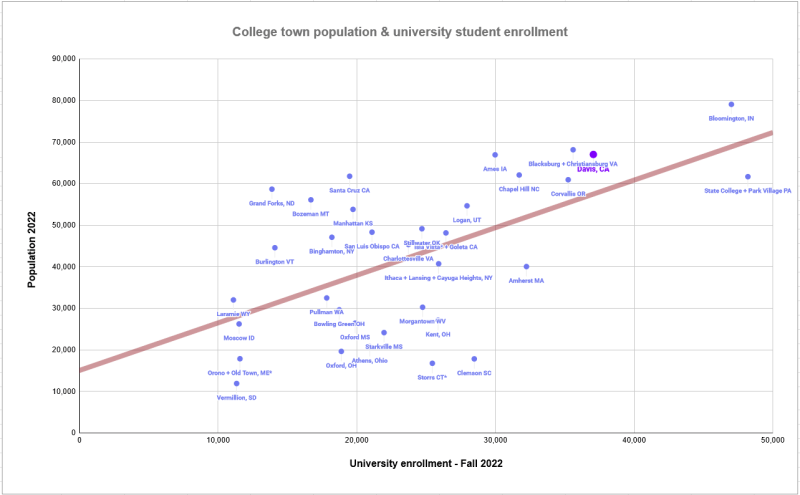
Criteria for inclusion: stand-alone college towns with a population less than 90K and a public university larger than 10K enrollment. Dataset may not include every example of this, but diligent efforts have been made to be as complete as possible. The orange line shows the best-fit linear regression model. Any place above the line has more than its projected population based on enrollment. (Added 7:30 PM, June 23, 2023)

By Rik Keller

Tim Keller (no relation) stated in the article “Guest Commentary: How Big Does Davis Need to Be? College Towns Analysis Part 3 – Long-Term Planning” that “In previous articles we saw evidence that suggests that a population of 120,000 might be entirely appropriate for a university town such as Davis: It is the size of Ann Arbor, Michigan (home of the University of Michigan), Champagne-Urbana (home of the University of Illinois), and Lafayette Indiana (home of Purdue). These are all well-regarded and well-funded research universities of very similar size and character to UC Davis.”

For reference, the 2022 population of Davis was 67,048, and Tim’s number is a huge 179% increase above that.

The so-called “evidence” that he based this on was a very incomplete, cherry-picked, and in some cases factually-inaccurate, list of 17 universities and host towns to compare to Davis.

He stated “The trend that emerges immediately is that the population of a “university town” such as ours tends to be about 3x the size of its student body.”

I have access to a more complete database of 40 public research universities with enrollment of at least 10,000 students (and up to 50,000), located in distinct host towns with populations less than 100,000. Tim ignored the vast majority of these. It turns out that the median population-to-student enrollment ratio of these 40 college towns is almost identical to that of Davis (Davis is slightly higher), which completely undermines his argument that Davis needs massive population growth to support current university enrollment.

If Tim hadn’t approached the exercise with an endpoint in mind—his preconceived notion that Davis need to be much larger than it is—he could have done a more credible analysis. His limited cherry-picked data had some basic facts wrong. The 2022 population of Corvallis was actually 60,956 (not 95,184), and the population-to-enrollment ratio is actually 1.73. And he drastically understated the enrollment for the University of Indiana at 35,253, when Fall 2022 enrollment was actually 47,005. The population-to-enrollment ratio for Bloomington is actually 1.68. With Davis at around 1.9, these two cases, as well as the median of 1.82 for the larger dataset, indicates that Davis has more population per enrollment than the norm.

I won’t get into a critique right now of Tim’s notion that a simplistic and crude comparison of population size to university enrollment should provide prescriptive guidance. But suffice it to say for now that a more through examination of the facts using a more complete dataset of college towns, points to the opposite conclusion that he had.

Should we be surprised that one of the people behind the “Sustainable Growth Yolo” organization is advocating for massive amounts of growth based on faulty analysis and assumptions? I’m not sure why they aren’t more honest and just delete the “sustainable” part.

Rik Keller is a university instructor in communication studies and social work. He has two decades of professional experience in demographic analysis and housing policy & analysis in Texas, Oregon, and California after obtaining his master’s degree in city planning. He is also a 15-year Davis resident.

Davisite logo

Did you enjoy reading this article? Then subscribe to the Davisite for free and never miss a post again.

Comments

48 responses to “How Big Does Davis Need to Be? A Lot Smaller Than Growth Advocates Want You To Think”

  1. R Keller

    I found a couple of other errors in Tim Keller’s data table. He claims that the combined population of Ithaca NY + Lansing + Cayuga is 105,740, when actually Ithaca + Lansing + Cayuga Heights actually has a 2022 population of 40,735. That makes the population-enrollment ratio 1.57 rather than 4.83 as he claimed.
    Virginia Tech is listed with a falsely low enrollment number. Using the correct enrollment brings the population- enrollment ratio down from 2.21 to 1.92, almost exactly in-line with Davis
    It’s quite remarkable that he cherry-picked his data to such an extent that he only listed 4 college towns out of 17 with less population than Davis. I have 32 of those in my dataset.

  2. Ron O

    I’m not sure that folks paid much attention to (Tim) Keller’s “analysis” in the first place.
    The truth is that places like Spring Lake are accommodating a lot of the sprawl that cities like Davis “normally” pursue, with more to come. (Including 1,600 additional housing units at the planned “technology park”.) And it’s a pretty easy/direct route to UCD, from there.
    There is no “housing shortage”. We’ve been fed a pack of lies regarding this (not just in Davis).
    There is a discrepancy between what some can afford, vs. what the market offers. Again, not just in Davis. And yet, there’s been no discussion or consideration of rent control, which would at least benefit long-term renters.

  3. Walter Shwe

    “And yet, there’s been no discussion or consideration of rent control, which would at least benefit long-term renters.”
    Landlords would shut down any serious discussion of rent control by simply contributing to the election campaigns of City Council members and their challengers.

  4. R Keller

    WS said “Landlords would shut down any serious discussion of rent control by simply contributing to the election campaigns of City Council members and their challengers.”
    Agreed. And to add to that: Landlords and developers would also (and do) shut down any serious discussion of strengthening affordable housing requirements by simply contributing to the election campaigns of City Council members and (some of) their challengers. And the Davis Vanguard is right in lockstep with them, getting money from the same landlord and developer lobby.
    See:
    https://www.davisite.org/2021/06/the-city-of-davis-housing-element-update-developer-web.html
    https://www.davisite.org/2023/01/comments-on-inclusionary-multifamily-rental-housing-ordinance-review.html
    https://www.davisite.org/2021/05/davis-housing-element-comments.html
    https://www.davisite.org/2021/07/you-might-be-a-yimby-if.html
    https://www.davisite.org/2019/04/davis-enterprise-chastises-city-council-and-davis-vanguard.html

  5. David J Thompson

    No matter what growth we are discussing the two proposed projects do not look like the housing we need.
    Should we look to replicate past planning to guide our future planning. Climate Action requires different practices and better outcomes.
    And with the Interim Ordinance at 15% for VLI and LI Davis would need to spread immeasurably to meet the RHNA numbers. The lower the actual results the more sprawl we will need.
    We need to build up both within Davis and outside. and we need different policies that will meet and carry out our RHNA targets.

  6. Walter Shwe

    “And the Davis Vanguard is right in lockstep with them, getting money from the same landlord and developer lobby.”
    More whining about the Davis Vanguard.

  7. Tim Keller

    Rik, I’m happy to see where you might have corrections for my data or might have a better feeling for an approach here. I published my data, which was collected simply through googling for the desired figure, enrollment, population etc, and it’s very possible that some of the figures I found in such a way migh have not been the most current.
    But what I did not do was “cherry pick”. I looked for cities the most similar to ours and looked for what makes them tick. Again, happy to have a discussion about which ones are truly in a comparable set.
    What I found is that the colleges where the population relative to the student body was at a low ratio like davis are ALSO towns where there is nothing else nearby.. places like Pullman WA or Stillwater OK.
    There might be more like that too. But cars unfortunately make populations highly mobile, and Davis isn’t in the middle of nowhere like Stillwater, we are 20 min from the state Capitol of the 6th largest economy in the world…. Which means we have a commuter population to deal with.
    I’ll be getting into that discussion in my next article, but if you want to take issue with my data, let’s do that transparently and collaboratively. Let’s not cherry pick, like you did in this article where you conveniently forgot to mention that my 120k was proposed as a population level we might get to in 30 TO 50 YEARS.

  8. Richard McCann

    What was most illuminating about Tim’s analysis was a realization that college towns differ significantly by their geographic relationships. The population/student ratios are much lower for isolated ones compared to those integrated into a metropolitan area. Davis close relationship with Sacramento and the Bay Area, as is Boulder to Denver and Ann Arbor to Detroit. It’s not at all like Pullman, nor is it like Berkeley, so those comparisons don’t work.
    So when we look at these college towns that have this tighter relationship, we find that many more commuters live in these towns so the population to student ratio rises. We can’t keep these commuters out of town and they tend to have more income than those working either at the university or local businesses, so if there’s a restriction on housing, the commuters push the other out of town. The university staff and local workers have to commute into town because they can’t live there. This is the dilemma we face that because much more apparent when running through the numbers.

  9. R Keller

    TK: At this point, your first move should be to publish a correction/retraction on the Davis Vanguard regarding the egregious data errors, and to do that on all of the articles in this series so far. At a minimum that would include the specific errors I point out here, but given the likelihood of other errors, you need to correct/confirm all of the data for all of the entries or at least make a statement that you were unable to. If you are unable to locate accurate data for 2022 population estimates and Fall 2022 enrollment numbers that match the numbers I have provided here, I can point you to accurate and valid data sources.
    After you take that first basic step towards accountability, we can discuss transparency and collaboration later.
    Your data is faulty and misleading in so many places that it renders it useless. It is really sloppy work. I pointed out the most egregious errors here, but there are others.
    The conclusions you drew from this bad dataset are not valid. You have a pre-set agenda that calls for massive growth and you have been flailing away at a couple of poorly-conceived and -constructed so-called “analyses” in the past couple of years to try to support that agenda.
    And the data is either cherry-picked or you were incredibly negligent in not including dozens of comparable college towns that you should have. You additionally included a number of cities with populations far exceeding Davis that have far more diverse economies and different relationships to regional metro areas, and therefore aren’t valid comparison points–your statement that “I looked for cities the most similar to ours” is really misleading given the massive population sizes of some of the comparables you included and the many smaller cities you left out altogether.
    I don’t know what to tell you other than that as someone who has decades of experience in working with socioeconomic projections in the context of long-range city and regional planning, you are barking up the wrong tree in trying to determine a prescriptive analysis of the population a college town like Davis would need based on a simplistic comparison to university enrollment–there are simply far too many variables that you aren’t considering, and there is far too much variation in the stats for different cities.
    But if you continue to think such a thing is possible and desirable, you should know that the best-fit linear regression model of the dataset I am working with that contains about 35 college towns shows that Davis currently has a population number about 9,200 more than it “should” to support the current UCD enrollment (and that’s after the massive enrollment growth at UCD over the past decade plus). A graphic showing this is being appended to the article above.

  10. R Keller

    R McC said: “What was most illuminating about Tim’s analysis was a realization that college towns differ significantly by their geographic relationships. The population/student ratios are much lower for isolated ones compared to those integrated into a metropolitan area.”
    The problem is that you are drawing that conclusion from a dataset that had massive errors. It also excluded many small college towns as well as including many really large cities that should have never been there in the first place with the stated criteria that the university was the only main industry.
    Using a more comprehensive and accurate dataset, a different conclusion should be drawn: towns that have universities with lower enrollments have a higher population-to-enrollment ratio than those with larger universities. See, for example. Moscow ID (2.28 ratio; ~11.5K enrollment)) and Laramie WY (2.89 ratio; ~11K enrollment)) vs Bloomington IN (1.68 ratio; ~47K enrollment) and Corvallis OR (1.73 ratio; ~35K enrollment)).
    With TK’s faulty data, you would have been working with the false presumption that Bloomington has a ratio of 2.33 and that Corvallis has a ratio of 2.87. It turns out that his conclusions were the opposite of what the data actually shows.
    Your conclusions are also derived from looking at much larger cities than Davis and then trying to apply them to us. Boulder and Ann Arbor aren’t good comps to Davis.–both are much larger in population. And Ann Arbor is adjacent to Ypsilanti which contains another large university (Eastern Michigan).
    As I state above, I don’t think it is a worthwhile exercise to begin with to derive prescriptive guidance for how much Davis should grow from such a dataset. If all you are trying to say is that different places have specific different dynamics based on proximity to urban areas (“a realization that college towns differ significantly by their geographic relationships”), then OK, sure. I learned that in Urban Land Economics 101 in planning grad school.

  11. Colin walsh

    Next up, a pro developer activist will analyze how Davis’s population must grow because the bike/human ratio is out of line with national averages and dramatically favors bikes over humans thus requiring a massive influx of humans or exodus of bikes in order to make Davis more like everywhere USA.

  12. Ron O

    Tim Keller: “I’ll be getting into that discussion in my next article, but if you want to take issue with my data, let’s do that transparently and collaboratively.”
    I’m glad to see you commenting on here, and appreciate your recent comments regarding “density”. However, I’ve noticed a pattern with you, in which you seek “collaboration” with people who have entirely different views and goals. This is not going to be successful.
    Richard McCann does this to a lesser degree, as well. Seeking “collaboration” (for example) with Keith Echols. Unfortunately for Richard, Keith does not share Richard’s view regarding the city of Davis and its residents “owing” something to UCD. (I’ve never met with either of these individuals – just basing this on the comments that each have put forth.)
    The recent poorly-attended meeting at Sudwerk was yet another failed attempt at “collaboration” that you initiated.
    Just an observation. My conclusion is that the development activists are desperately seeking “collaboration” (anywhere they can find it) to support their goals.
    But Tim, you don’t (personally) need the city to expand outward to support your own business. You can accomplish this without continued sprawl.

  13. Walter Shwe

    “And the Davis Vanguard is right in lockstep with them, getting money from the same landlord and developer lobby.”
    If you believe that David and the Vanguard are corrupt, why do many of the commenters here regularly visit that site and comment there thereby increasing its web traffic and its revenue? You would completely boycott the Davis Vanguard. Maybe the Vanguard is not corrupt in any significant manner.

  14. R Keller

    WS: the Vanguard routinely violates ethical journalism standards and refuses to adopt industry-standard statements of ethical practice such as these:
    https://inn.org/about/membership-standards/
    “Any person relying on a nonprofit news site’s reporting should be able to easily learn the major financial supporters of the news outlet, and about its values and leadership. INN member newsrooms commit to financial transparency, letting the public know the institutions and individuals that provide significant levels of funding to support the journalism. INN members do not rely on anonymous donations or “dark money” to fund their journalism. INN members make it easy for the public to identify board members and key leaders of a news outlet, publish board and staff conflict of interest policies…”
    And:
    “ Deny favored treatment to advertisers, donors or any other special interests, and resist internal and external pressure to influence coverage.
    Distinguish news from advertising and shun hybrids that blur the lines between the two…
    Acknowledge mistakes and correct them promptly and prominently. Explain corrections and clarifications carefully and clearly.
    Expose unethical conduct in journalism, including within their organizations.“
    https://www.spj.org/ethicscode.asp
    The Vanguard also routinely violates federal nonprofit laws on electioneering, but that’s a whole other story…

  15. R Keller

    … and here are those stories:
    https://www.davisite.org/2020/02/is-the-vanguard-following-no-profit-law.html
    “For a list of examples of the types of political campaign activities by nonprofit organizations that are banned by federal law, see: https://www.nolo.com/legal-encyclopedia/limits-political-campaigning-501c3-nonprofits-29982.html
    These include:
    “criticizing or supporting a candidate on the organization’s website”
    Publishing “materials that support (or oppose) a candidate”
    Even publishing statements supporting or opposing candidates for office written by others is a violation: Federal code states that nonprofits may not “participate in, or intervene in (including publishing or distributing of statements), any political campaign on behalf of (or in opposition to) any candidate for political office.” (see 26 U.S.C. Section 501(c)(3)) https://www.councilofnonprofits.org/tools-resources/political-campaign-activities-risks-tax-exempt-status”
    And:
    https://californiaglobe.com/articles/attorney-says-non-profit-davis-vanguard-news-service-continues-to-violate-despite-irs-complaint/amp/
    Rather than complaining here, Walter, why don’t you take a stand for ethical and legal journalism? For starters, you could pressure the Vanguard to publish a retraction/correction of TK’s articles containing false information. Then you could move onto stopping their political lobbying efforts that violate federal nonprofit law.

  16. Walter Shwe

    Why don’t you do that holier than thou R. Keller that doesn’t give his/her first name?
    No one has answered my question regarding contributing to the Vanguard’s web traffic?

  17. Umm, R Keller is Rik Keller, the author of this article? It seems he assumed that the reader would be smart enough to figure that out.

  18. C Walsh

    W Shwe – that’s a pretty minor point you bring up compared to what RK has provided you about the massive ethical chasm that is the Davis Vanguard. Why do you support the Vangaurd?

  19. R Keller (Rik, but you knew that, right?)

    WS: bringing up advertising on the Davis Vanguard website is an important point. Since you are so buddy-buddy with DG (David Greenwald: but you knew that, right?) as his #1 yes-man, maybe you can find out if the DV (Davis Vanguard, but you knew that, right?) is properly paying taxes on its advertising revenue to the IRS (Internal Revenue Service, but you knew that, right?) as required by federal nonprofit regulations. In their on-line filings the DV fails to mention that and they seem to illegally classify their advertising revenue as tax-exempt.
    See:
    “ As for your bottom line, the IRS rules around sponsorships are equally important.
    That’s because sponsorship revenue is tax-exempt, but advertising revenue generally is not, and that means (with a few, narrow exceptions) that you’d have to pay taxes on anything the IRS considers advertising, even as a nonprofit.”
    https://www.lionpublishers.com/sponsorship-vs-advertising-whats-the-difference-for-a-nonprofit-news-business/

  20. Alan C. Miller

    RK: “The recent poorly-attended meeting at Sudwerk”
    What number do you consider ‘poorly-attended’ ?
    I went just out of curiosity as to who would attend such an event and thus for the entertainment value. I ended up having some interesting conversations.
    It is almost always of value for people to talk in person rather than YELL on the internet. For instance, imagine if the two sides of the transgender issues at the City Council meetings had a beer at Sudwerk instead of arguing points at public comments? Nevermind, I withdraw everything I said.

  21. Walter Shwe

    I am not the person complaining about the Davis Vanguard. It is THE point if you contribute to the Vanguard’s revenue! Pathetic false outrage!
    Normal people use their first and last names Roberta

  22. “Normal people” read and take note of the author of an article, so they can see the obvious, that Rik Keller is the same as R Keller — doubly obvious given the content of his comments.
    Other folks would just say “oops, I goofed.” But you double down on your gaffe. Says a lot about you, Walter.
    I don’t contribute to the VG’s revenue, but I do read the comments and very rarely I skim an article. I leave that as a Google exercise for the reader to figure out how I am able to do that.

  23. Alan C. Miller

    There was a saying we’d use when dealing with non-rational entities at WEF years ago: “Ignore Alien Orders”
    Get my drift, y’all ?

  24. Walter Shwe

    Keller is a rather common last name.
    Roberta Keller
    Roberto Keller
    Robert Keller
    Ronald Keller
    Randy Keller
    Raymond Keller
    Ralph Keller

  25. Walter Shwe

    As far as I know Roberta, you can’t post comments on a site unless you actually visit that site.

  26. I believe that is correct. And I don’t post comments on the Vanguard — not since I left the site when they refused to ban the person who was repeatedly doxxing and attacking me, which has been a few years now.

  27. Walter, I see that you are attempting to discuss the character of one of the commenters in your recent comment. The purpose of this site is not to discuss the character of the commenters. It is to discuss the issues. Please return to the topic of the post. I won’t be posting any comments of the sort that you propose.

  28. Colin Walsh

    I for one find the considerable flaws in T Keller’s article series and the refusal to correct the mistakes more problematic than if someone chooses to post with an initial.
    The reality is, if the discussion is about ideas, rather than the character of the commenter or author then it really doesn’t matter very much what the name of the commenter is.

  29. Richard McCann

    “The problem is that you are drawing that conclusion from a dataset that had massive errors.”
    I don’t think that the errors in the Vanguard article reach the level of “massive” and I also downloaded and corrected the population values where I found them. For example, I corrected Michigan State to being in East Lansing and added the two cities populations together.
    As for Ann Arbor, Eastern Michigan in Ypsilanti is about as far away as Sacramento State is from UCD (having run that distance when I was at Michigan.) So the parallel is quite apt.
    Unfortunately, the analysis presented here arrived at the answer before doing any analysis by truncating the population in the data set at 90,000. Further, all but three of the cities listed (Chapel Hill, Clemson and Santa Cruz) are more than an hour from a major metropolitan area. Most are isolated college towns that are neither residential centers for commuters, as Davis is, or regional economic centers like Eugene or Bellingham. The designations used here appear to be arbitrary and not reflective of the geographical forms that cover the universe of college towns like Davis. No applicable conclusions can be drawn from this data set as presented. In addition, a simple single variate regression or relationship is unlikely to reveal a useful value–a multivariate analysis that includes other factors such as travel time to other population centers and importance to other economic activity unrelated to the university is required to arrive at an appropriate quantitative analysis.
    A

  30. George Galamba

    I’m sorry to see this site descend into the personal bickering that infects Next Door. If we can’t all get along, can we at least agree to state our druthers and move on? My concern is that Pole Line Road and Covell Boulevard are already terribly impacted and the idea of adding thousands of additional car trips on them is nuts. Furthermore, the argument that people will ride bikes or walk to work is equally fanciful. Unless the developer is willing to add lanes to Pole Line Road and Covell, Covell Village should not be permitted.

  31. R Keller

    R McC said: “I don’t think that the errors in the Vanguard article reach the level of “massive”
    Actually, the errors in TK’s article are massive. Here are the entries in his shoddy dataset that have the most egregious errors followed by the accurate number:
    – Corvallis/Oregon State: 2.87 — 1.73
    – Bloomington/U. of Indiana: 2.33 — 1.68
    – Ithaca + Lansing + Cayuga Heights/Cornell: 4.83 — 1.57
    – Blacksburg + Christiansburg/ Virginia Tech: 2.21 — 1.92
    Based on his highly inaccurate data, TK stated “The trend that emerges immediately is that the population of a university town such as ours tends to be about 3x the size of its student body.” This statement is false. And it is made more false by his exclusion of 26 of the college town/university pairs included in my dataset. This is cherry-picking or negligence to the extreme: you can decide which.
    Your comments on the Vanguard are notable for their Pollyannish acceptance of TK’s data and his conclusions.
    As far as your statement directed towards me that “Unfortunately, the analysis presented here arrived at the answer before doing any analysis by truncating the population in the data set at 90,000” actually, the opposite is true. TK stated that his analysis was intended to look at “geographically distinct towns… where the university is the primary industry of the town.” You echoed this and added suggestions that are “similarly isolated and are economically dominated by the university.” (although several of yours actually weren’t). Looking at a broader set of data, it is very clear that towns above 90K in population are no longer economically dominated by the university and have a broader and more diverse set of industries–in other words, they are no longer “college towns”. Including a set of larger cities with much larger populations in about half of his dataset of is not valid and merely served his purpose of driving up the average population-enrollment ratio so he could reach his pre-ordained conclusion that Davis needs to grow massively.
    You stated that “As for Ann Arbor, Eastern Michigan in Ypsilanti is about as far away as Sacramento State is from UCD (having run that distance when I was at Michigan.) So the parallel is quite apt.” Your memory is quite faulty. It is actually only a 6.9-mile drive from the student unions/centers at U Mich to Eastern Mich U. That is more than 3x the 21.3-mile driving distance from the UC Davis to Sac State student unions/centers.
    In running terms, you thought you ran a marathon when you actually ran a 10K.
    And if we are talking about including neighboring jurisdictions as close as Ann Arbor and Ypsilanti, let’s go ahead and lump in Dixon and Woodland with Davis. You’ll then find then that the population ratio to UC Davis enrollment is 3.99, which is twice the average of comparables. In other words, according to TK’s concept, the Davis area has much more population than it needs.
    Finally you state that “no applicable conclusions can be drawn from this data set as presented. In addition, a simple single variate regression or relationship is unlikely to reveal a useful value–a multivariate analysis that includes other factors such as travel time to other population centers and importance to other economic activity unrelated to the university is required to arrive at an appropriate quantitative analysis.”
    You’ll find that in the article I already stated my skepticism with TK’s notion that a prescriptive size of Davis could/should be drawn from such an analysis. I also stated to him that “you are barking up the wrong tree in trying to determine a prescriptive analysis of the population a college town like Davis would need based on a simplistic comparison to university enrollment–there are simply far too many variables that you aren’t considering, and there is far too much variation in the stats for different cities.”
    The only difference in what you and I are saying is that you were enthusiastic about TK’s ham-handed attempt to do exactly that, but it was only after seeing the more inclusive dataset that I presented that leads to the opposite conclusion that you threw cold water on the idea.
    By the way the R-squared value in the linear regression model of my dataset is 0.365, which means it explains 36.5% of the variation in population numbers as a function of enrollment. Obviously, as I have previously stated, there are many other factors involved in the variability of population. However, it is also clear, that the giant multiplier that TK threw out as a target for a massive increase in the population of Davis is not valid. A realistic analysis based on accurate data shows that Davis is very much in line with the average of many comparable college towns.

  32. Thanks for the additional elaboration, Rik.

  33. Tim Keller

    Rik,
    Can you explain your rationale for limiting your analysis to cities under 90k? I think that decision is pretty amusing given the criticism you levied at me.
    Regardless, I am open-sourcing the spreadsheet I used so that errors can be fixed, and the breadth of the study can be widened. if you can share the dataset you have access, or point me to its source, to it would be greatly useful ( I had to manually compile each datapoint from a google search, which is the source of the errors you pointed out)
    The shared spreadsheet is here:
    https://docs.google.com/spreadsheets/d/1MvLhY2Sc29vtBlnIF6sBXSmMC7zVXSkF/edit?usp=sharing&ouid=105692108556343377491&rtpof=true&sd=true
    If we can get enough data into that sheet, then I think the data will speak for itself. obviously there are a lot of things that go into the size of a city, (including its local politics which I don’t know how we can quantify) but if at the end of the day we are talking DATA, it is going to be a better conversation than the status quo, no matter where that data leads us.

  34. R Keller

    TK said: “Can you explain your rationale for limiting your analysis to cities under 90k? I think that decision is pretty amusing given the criticism you levied at me.”
    Actually what’s amusing is that you didn’t bother to read my explanation/rationale immediately above. It’s sound and data-based. The real question is why you included a number of very large cities that don’t meet your own stated criteria. As the data clearly shows, actual college towns don’t exceed 90K population. At that point they are well past the point of being dominated by a single industry. The data has already “spoken for itself”, and it says that your conclusion about how large Davis “should” be is wrong. Moreover, your idea that you can provide prescriptive guidance for how large Davis should be right now and how big it should become in the future using the primary input of university enrollment is wildly misguided.
    Where is your published retraction for all of your errors and falsehoods in your articles the Vanguard? We can talk after that. You can add to the growing list your wild assertion that a reasonable annual growth rate for Davis for the next 50 years is 1-2%, as we face an upcoming “demographic cliff” in the state and nation.
    It is less amusing that your “Yolo Growth” organization didn’t provide any coverage of the City staff’s attempted slaughter (with complicity of the Council) of affordable housing requirements last night on your Twitter, nor does it apparently have any issue with the minuscule amount of moderate-income units (and no low income units at all) proposed for the Ace site downtown.
    Where are your personal comments on yesterday’s article on the Affordable Housing Ordinance in the Davisite?
    Y’all always breathlessly cheerlead for any development proposal, but somehow don’t get worked up over actual equity and sustainability issues.

  35. Colin walsh

    Last nights council meeting helped demonstrate who is just for growth for growths sake and who is actually for affordable housing.

  36. R Keller

    TK: I just looked at your shared spreadsheet. Seriously: just throw it away. You are now apparently trying to do a multivariate prescriptive formula that will tell you what you have already decided in terms of the “need” for massive growth for Davis.
    Before you even get into the data, you start making false statements in your notes on top. One of these is “ Cal Poly SLO for example, has a research budget of $25k as opposed to UCD’s near $1 Billion.”
    Not true. The Cal Poly Corporation lists $23,900,000 in research for 2021-22. Did you somehow miss that? How were you off by a fat or of almost 1,000 times?
    In the data tables themselves, you also didn’t bother correcting the most egregious bad information I have already called out regarding population and enrollment figures.
    Your attempted 30-mile radius population tally is ridiculously crude and arbitrary. It simply serves to highlight the meaninglessness of your analytical framework: what are we to take from this? That because there are supposedly 1.7 million people within a 30-mile radius according to your count, Davis doesn’t need to grow anymore?
    Your future threatened addition of lots of variables into the “analysis” has no reasoning behind it. At this point you don’t know what you are doing anymore or why you are doing it.
    I have done a lot of consulting work for Oregon cities. Under State planning laws they have to maintain a 25-year land supply (but not more) within their Urban Growth Boundaries. The land needs have to be based on legit projections and approved by the State. Cities were always trying to get more land but would get shot down. Let’s just say your “analysis” of growth projections/needs would get laughed out of the room. I have also done analyses of the RHNA needs for many California cities and counties, as well as overall growth projections for General Plan Updates, and the same comment applies. Yours isn’t a serious attempt at an analysis.

  37. Colin Walsh

    Unfortunately people willing to use incorrect data and distort results like what is going on in the Tim K. spread sheets will bamboozle some people and once repeated often enough will have a ring of truth for others. Though it is a completely unethical way to advance the Pro-Growth at all costs agenda, it is likely to have some success. And that Tim is why you need to publish corrections and retractions. If you don’t one must assume a complete lack of ethics to advance an agenda.

  38. R Keller

    CW said: “ Last nights council meeting helped demonstrate who is just for growth for growths sake and who is actually for affordable housing.”
    Awhile back I emailed “[Sustainable] Growth Yolo” saying “I am interested in joining your group and advocating for inclusive, equitable, and affordable housing solutions in Yolo County. I have decades of experience in drafting Housing Elements and affordable housing plans for state and local governments since the mid-1990s. Recently I published a series of articles looking at local exclusionary and discriminatory housing practices and advocating for addressing HUD Affirmatively Furthering Fair Housing provisions; see: https://www.davisite.org/2018/10/keeping-davis-white-land-use-policy-is-a-civil-rights-issue.html
    Their response: “…I am not sure there is a lot of agreement on policy goals with our team and your views.”
    That’s all I needed to know from them regarding their lack of seriousness in advancing equitable affordable housing solutions.

  39. Ron O

    Their response: “…I am not sure there is a lot of agreement on policy goals with our team and your views.”
    That’s all I needed to know from them regarding their lack of seriousness in advancing equitable affordable housing solutions.

    “Sustainable Growth Yolo” – what a joke.
    I’d definitely trust Rik Keller to (actually) advocate for Affordable housing, more than that group.
    And I’m not even necessarily an advocate for Affordable housing. But I respect the fact that Rik is.
    (I’m more of an advocate of rent control.)

  40. R Keller

    Tim Keller has not only not published a retraction, he has bumbled forward with a 4th installation in the Vanguard in his push for massive growth for Davis. In this articlr published this morning, he states “When looking at the data I complied more closely it was clear that a simple analysis was not sufficient; another truth emerged…” WTF? His prior “truths” were pure fiction based on bad data and cherry-picking.

  41. Keith

    “Tim Keller has not only not published a retraction, he has bumbled forward with a 4th installation in the Vanguard in his push for massive growth for Davis.”
    Is anyone really even reading his articles or taking his pro-growth opinions seriously?

  42. Ron O

    I read Tim Keller’s articles enough to know that there’s a “5th installation” forthcoming.
    Keeping in mind that Tim Keller is the same guy who pushed hard for DISC, despite the fact it would have created a “housing shortage”.
    Apparently, the pro-growthers think everyone has a short memory, as they continue grasping at straws.

  43. Keith

    For that matter who cares what David Greenwald thinks? The only difference between DG’s opinions and any other Davisite is DG has a blog and therefor a bigger megaphone to voice his views. Otherwise his thoughts aren’t any more important than anyone else’s. Why do people care what the Vanguard thinks?

  44. Walter Shwe

    “Why do people care what the Vanguard thinks?”
    Ron Oertel in particular and Keith Olson definitely do care what David Greenwald says as evidenced by their frequent comments on the Davis Vanguard.

  45. Ron O

    Walter: It’s not that anyone is concerned about what the “Vanguard” thinks. It’s more-related to a concern regarding their potential influence, though that’s tough to measure.
    For sure, some of the recent, successful council candidates seem to have close ties to the Vanguard (and/or, its views). However, support for Measure J or its outcomes are a different matter.
    With the demise of Al’s Corner, there’s no other place to immediately challenge those views (other than on the Vanguard, itself).
    Though not “everything” results in a disagreement (see today’s article, for example). Something that you seem to avoid acknowledging.
    Not everything is a “fight”.
    Perhaps “Al’s Corner” will arise again, under a different name and objective.

  46. Keith

    Exactly Ron, David is just one person. His views should not have anymore weight than any others. I’m not surprised that Shwe doesn’t get that.

  47. R Keller

    As detailed in this summary — https://www.davisite.org/2023/07/population-growth-stall.html — the most recent California Department of Finance projections show population growth of only 19,943 for the year 2060 for all of Yolo County. Even assuming as much as 30% of this countywide growth would occur in Davis, this would yield only a population growth of 6,000 for Davis over the next almost 4 decades, or 9-14 times less than TK’s/Yolo Growth’s prescription for 120,000 to 150,000 for Davis for the next 30-50 years above the current population of 67,000.
    This demonstrates how out of touch with reality they are.

Leave a comment