Davisite Banner. Left side the bicycle obelisk at 3rd and University. Right side the trellis at the entrance to the Arboretum.

Comparison of Village Farms Davis and Shriners Proposed Developments

Comparison of Village Farms Davis and Shriners Proposed Developments

by Alan Pryor

I. Introduction – Recent online comments suggested a side-by-side comparison of the features of several currently proposed development projects subject to a Measure J vote would be useful to allow readers to do an “apples-to-apples” comparison of the salient features of the projects. As a result, I prepared such a spreadsheet showing what I considered to be the most important features of the Village Farms Davis and the Shriners development projects.

The following general categories were considered in this analysis;

  1. Total Project Size and Buildable Acres
  2. Number of Market Rate and Affordable Housing Units and Density
  3. Area of Open Space, Roadways, and Proposed Mitigation
  4. Distances to Important Local Destinations and Public Transit Access
  5. Infill Potential vs. Sprawl
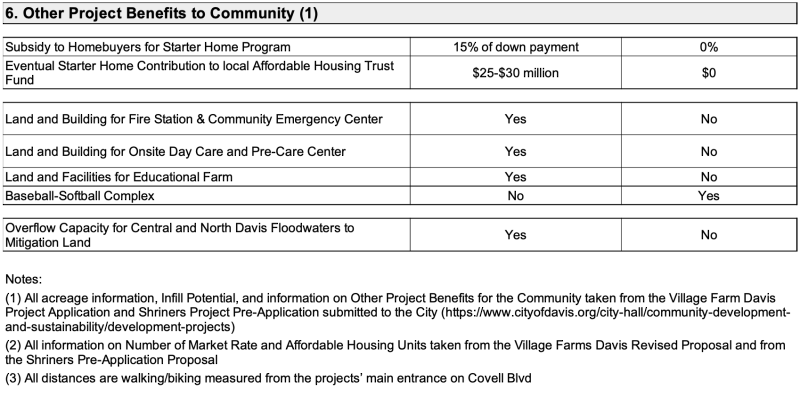
  6. Other Project Benefits to the Community

Information for the analysis was derived from public sources and/or filings made by the project developers and follow-up inquiries when additional information was sought.

________________________________________________________________________________

II. Results – The results of this effort is shown in the following spreadsheet:

Villagefarmsshriners-table1
Villagefarmsshriners-table2
Villagefarmsshriners-table3

______________________________________________________________________________

III. Discussion

1. Total Project Size and Buildable Acres – The total project size at Village Farms Davis is 390.5 acres while Shriners total project size is 234.3 acres. A little over 50% of the Village Farms Davis site (197 acres) is deemed “buildable” and planned for housing (residential parcels and apartments) and building sites for other public use facilities. The buildable use of land at Shriners is about 140 acres or about 60% of the total project acreage.

The differences in buildable percentage of land at the projects are due to the greater percentage of Village Farms Davis devoted to either parks, greenbelts, and other open space habitat including ponds (to accept storm water overflow ) or to other non-residential uses including the planned fire station, pre-K school and day care center, and the Educational Community Farm.

2. Number of Market Rate and Affordable or Attainable Housing Units and Density – There are substantial differences between the projects in terms of the number and types of housing mix offered.

Total Units – Village Farms Davis has approximately 63% more total units compared to Shriners (1,800 total units for Village Farms Davis compared to 1,100 total units for Shriners) assuming single-family homes (vs duplexes as otherwise allowed by law) are constructed on all non-multifamily residential parcels.

Market Rate and Affordable Rental Apartments – Village Farms Davis also offers a total of 200 market rate apartments and 270 subsidized affordable apartments for rent (15% of total units) while Shriners offers 200 subsidized apartments for rent (18% of the total units).

Deed-Restricted Subsidized Housing – Village Farms Davis additionally offers 310 units of attainable housing in which the developer will provide 15% of the down payment required for the initial homeowner purchase through First Northern Bank. This contribution requires the buyer to occupy the deed-restricted home (i.e. it cannot be rented) and it cannot be resold until after 2 years after which deed restrictions are lifted. Upon resale, the original 15% down payment and 15 % of all equity increases are then paid into a local Affordable Housing Trust Fund.

Market-Rate Parcels – The total number of non-deed restricted market rate residential parcels at Village Farms Davis is 1,020 vs. 900 at Shriners. Single family homes or duplexes can be constructed on these lots.

3. Area of Open Space, Roadways, and Proposed Mitigation

Parks, Greenbelts, and Ponds – Village Farms Davis has a total of 107.5 acres (27.5% of total project size) of open space including parks, greenbelts, and habitat ponds providing overflow capacity for Central and North Davis floodwaters (in addition to providing overflow to adjacent mitigation land) and a small Educational Community Farm. Shriners has a total of 75.2 acres (32.1% of total project size) of open space including parks, greenbelts, a habitat pond and a baseball/softball complex.

Roadways – Village Farms Davis has a total of 21.3 acres of roadways (27.5% of total project size) and Shriners has a total of 19.1 acres of roadways (32.1% of total project size).

Mitigation – Village Farms Davis’ proposed mitigation is adjacent to and contiguous to the project extending from the north of the project to County Road 29. This land is planned for habitat and seasonal agriculture and will accept excess floodwater flows from central and north Davis during heavy winter rains. Mitigation for Shriners is not specified.

4. Distances to Important Local Destinations and Public Transit Access – All distances between the project site and destinations was obtained using the <Measure> function in Google Earth which reports approximate distances between a starting and ending point along specified routes. The starting point for determination of distances from the Village Farm Davis project is the proposed L. St entrance to the proposed development from Covell Blvd. and from the proposed west entrance to the Shriners project from Covell Blvd. These are the main entrances to each project. The selected routes were the closest along walking or biking routes rather than “as-the-crow-flys”.

  1. Distances to Shopping – The Oak Tree Plaza at Poleline and Covell is the nearest full service shopping center to each project. It is directly across Covell from the proposed Village Farms Davis site and about 1.3 miles from Shriners.
  2. Distance to Downtown Davis – Village Farms Davis is approximately 1.3 miles from 5th and G St (considered the northeast corner of the downtown area) while Shriners is about 2.75 miles from the same downtown location.
  3. Distance to Amtrak Station – Village Farms Davis is approximately 1.4 miles from the Amtrak station while Shriners is about 2.9 miles from the station.
  4. Distance to UC Davis – Village Farms Davis is approximately 1.6 miles from 5th and A St (considered to be the northeast corner of the University) while Shriners is about 3.1 miles from the same location.
  5. Distance to Davis High School – Village Farms Davis is approximately 1.6 miles from the administration building at Davis High School while while Shriners is about 2.5 miles from the same location.
  6. Distance to Junior Highs – While Village Farms Davis is substantially closer to Holmes Junior High and Shriners is substantially closer to Harper Junior High, enrollment at any particular Junior High cannot be guaranteed to residents of either Village Farms Davis or Shriner. So the average distance to the administration buildings at the two Junior Highs was determined. Village Farms Davis is 1.15 miles, on average, from the administration buildings at the Junior High Schools while Shriners is 1.02 miles, on average, from the administration buildings at the schools.
  7. Distance to Elementary Schools – Village Farms Davis is closest to Birch Lane Elementary School while Shriners is closer to Korematsu Elementary School. However, similar to the situation with Junior High Schools, attendance at the school closest to each development cannot be guaranteed for residents of those developments. So the average distance to the administration building at the 3 nearest elementary schools (Korematsu, Birch Lane, and North Davis) was determined. Village Farms Davis is 1.06 miles, on average, from the administration buildings at these 3 elementary schools while Shriners is 1.3 miles, on average, from the administration buildings at the schools.
  8. Distance to Major Medical Facilities – There are two major medical facilities in Davis – Sutter Hospital in West Davis and the Kaiser Medical Center in South Davis. Village Farms Davis is an average of about 2 miles from these facilities while Shriners is approximately 3 miles away, on average.
  9. Distance to Existing Below Grade Crossings of Covell – Each of the development projects is near a below grade crossing of Covell Blvd. Village Farms Davis is about 0.4 miles from it’s main entrance to the existing F. St under-crossing while Shriners’ main entrance is about 0.25 miles away from the existing East Covell under-crossing adjacent to the southwest corner of the development.

Number of Bus Routes Running Immediately Adjacent to the Developments – Village Farms Davis has 8 Yolobus and Unitrans routes stopping at 7 stops directly adjacent to or across the street from project perimeters while Shriners has 3 Yolobus and Unitrans bus routes running along Covell Blvd. with 2 stops directly adjacent to or across the street (and within 1 block) from the project perimeters 

Existing Transit Stops and Bus Routes directly adjacent to or across the street from Village Farm Davis project site

  1. Covell Blvd & J St.: Unitrans P, Q, and E and Yolobus 43
  2. Pole Line Rd & Covell Blvd: Unitrans P, Q, and L and Yolobus 43
  3. Pole Line Rd & Picasso Ave: Unitrans L
  4. Pole Line Rd & Donner Ave: Unitrans L
  5. Pole Line Rd & Moore Blvd: Unitrans L and T
  6. F St & Grande Blvd: Unitrans F
  7. F St & Anderson: Yolobus 230

Existing Transit Stops and Bus Routes directly adjacent to or across the street and within 1 block from Shriners project site

  1. Covell Blvd & Alhambra St.: Unitrans P and Q
  2. Covell at Monarch Yolobus 43 (actually 1 block west of Shriners property line)

5. Infill Potential vs. Sprawl – The Village Farms Davis property is within the Sphere of Influence of the City of Davis while the Shriners property is not in the designated Davis Sphere of Influence. The state definition of an in-fill project is that 75% of the property is contiguous with existing City boundaries or city-owned property. 88% of the Village Farms Davis is contiguous with existing City boundaries or city-owned property while 51.6% of Shriners is contiguous with existing City boundaries or city-owned property.

6. Other Project Benefits to Community – In addition to the $25 – $30 million expected to be transferred to a local Affordable Housing Trust Fund to benefit Davis on eventual resale of the 310 “attainable” homes, the 2.5 acre Educational Community Farm, and the overflow capacity for excess flood water from central and north Davis directed to the mitigation land as described above, Village Farms Davis is also offering the land and construction costs for a North Davis Fire and Emergency Response Center and a Pre-K/Day Care Center for Davis Joint Unified School District. Shriners is offering a softball/baseball complex on its site.

Davisite logo

Did you enjoy reading this article? Then subscribe to the Davisite for free and never miss a post again.

Comments

31 responses to “Comparison of Village Farms Davis and Shriners Proposed Developments”

  1. Alan C. Miller

    I haven’t looked at this yet, but like Carnac the Magnificent, I’m going to hold the envelope containing this article to my head and say, “What is incredibly verbose, over-analyzed, and un-surprisingly favors Village Farms ?”

  2. Keith

    Alan, that’s funny, I didn’t read it either but that was my first thought too.

  3. Eileen Samitz

    Well gee… What an interesting sales pitch for Village Farms, but looks like there is misinformation stated in this article and some other important comparisons which were conveniently left out of the article, including but not limited to:
    Village Farms is not infill, it is a peripheral development just like all the other four peripheral proposals, per our General Plan:
    City of Davis General Plan, Chapter 1: Land Use and Growth (page 53)
    “Infill is defined as urban development or redevelopment on vacant or “underutilized” urban-designated land within a city’s boundaries, as an alternative to accommodating growth through expansions of city boundaries.”
    But then, there is a laundry list of other significant problems that the Village Farms project has that Shiner’s does not have, nor the most of the other peripheral proposals. Here is a short list of Village Farms problems and issues:
    1) The history of leakage of toxics and other contaminants from the adjacent former unlined City landfill and sewage treatment plant, onto the Village Farms site. How many people would want to live on the Village Farms site, which is adjacent to a former City unlined landfill and sewage treatment plant with a history of leakage of toxics and other contaminants onto the Village Farms site?
    2) The Village farms proposal of massive groundwater retention ponds adjacent to the former unlined landfill and sewage treatment plant. These groundwater basins which would re-charge potentially contaminated groundwater into our aquifers and impact the wildlife and habitat as well.
    3) The massive 200-acre FEMA 100-year flood plain that Village Farms has on its 390.5-acre site. Good planning principles and common-sense call for no building on enormous flood plains. Natomas had disastrous flooding due to building on a huge flood plain causing massive damage and cost millions to repair.
    4) The lack of safe access across Covell Blvd. and F St. for the Village Farms proposal, due to existing infrastructure and barriers like the railroad track along F St. Railroad do not often give access over of under their tracks due to liability amongst other reasons. In contrast, Shriners has an existing bicycle/pedestrian access under Covell Blvd. currently right on its frontage property line.
    5) The enormous infrastructure costs that would come with Village Farms such as for the proposed Pole Line overcrossing for the project. Village Farms is more than likely going to try to get the City (therefore Davis residents) to share these costs. And whatever the developers’ share of the costs would then be passed along to the project homes, increasing their cost.
    6) The massive gridlock that 1,800 Village Farms units would create at the Covell Blvd. and Pole Line Road intersection, particularly with the Spring Lake and other Woodland traffic now impacting that intersection.
    7) The bare minimum of 15% affordable housing on Village Farms despite the enormous Village Farms 390.5-acre parcel. Meanwhile, Shiner’s is offering at least 18% affordable housing.
    8) The Village Farms disingenuous “free 15% down payment” for “affordable units” is just a scheme. All the developer has to do is increase the cost of the home at least 15% to cover that “gift”. Does the developer really think Davis residents will not see through this? . Further, there is no “benefit’ to the Housing Trust Fund until the house sells. What if the original owner never sells?
    9) Village Farms will develop far more ag but preserve less. The Village Farms project will develop 390.5 acres of ag land, but states it will only provide 340 acres of ag land mitigation, which is not even a 1:1 ag mitigation. In contrast, Shriners would use only 235 acres of ag land but then will preserve twice as much ag land with 2:1 ag mitigation preserving 470 acres of ag land. The other peripheral project proposals would need to provide 2:1 ag mitigation as well, but Village Farms is proposing to provide even less than 1:1 ag mitigation land.
    10) This same Village Farms developer got entitlements via a Measure J/R/D vote over 5 years ago for the Nishi project proposal, yet has still not delivered on it. Why should the City even consider allowing this developer to apply for entitlements for another project when he has not even broken ground the Nishi project after so many years? The same situation could happen again with Village Farms.
    So, again, this is just a short list of some of the problems and issues not raised or discussed in the article regarding Village Farms, which is clearly the worst project proposal of all the project proposals.

  4. Steve Kahn

    Thanks Eileen,
    Just a note on traffic: Yesterday around 4PM, my wife and I started out for South Davis. Traffic was backed-up around the Covell Curve and up onto the overcrossing. It reminded me of Howe/Arden traffic. None of these proposed developments really addresses this issue. I hate to think of how heavy traffic will be if only one of the projects is built out, let alone two!
    Frankly, I can’t see a way to mitigate these issues. Even if they widen Hwy 80 (questionable at best). Traffic is choked off at the overpass.
    Steve Kahn

  5. George Galamba

    Alan, last year in your official capacity as spokesperson for the Sierra Club, you penned an excellent article defending farmland against develop, a position supported by the Sierra Club. Now it seems the Sierra Club is arguing for the paving over of prime farmland. Could you please clarify this discrepency?
    https://www.davisvanguard.org/2022/04/sierra-club-endorses-no-on-measure-h/

  6. George, in case Alan doesn’t see your comment, I want to clarify that Alan is not speaking for the Sierra Club in this article, only for himself. The Sierra Club Yolano Group has yet to take up this proposal (or any of the recent proposals) in part because the proposal is still in flux.
    Full disclosure: I am on the Management Committee for the Sierra Club Yolano Group and I am only speaking for myself.

  7. Ron O

    I’m glad that George brought up the Sierra Club. I dropped my membership a long time ago, when they started becoming more concerned about “social equity” than the environment (at the national level).
    Locally, you’d think they would have “learned their lesson” when they endorsed Wildhorse Ranch – which went down to a flaming defeat, and has now “re-emerged” as the Palomino Place proposal. But at least that small site makes some sense for dense development.
    If the Sierra Club ends-up endorsing the 400-acre Covell Village II proposal (which also reportedly results in a LESSER amount of agricultural mitigation land per acre compared to some of the other proposals), the local chapter of the Sierra Club will lose even more credibility. It will essentially be toast, after that.

  8. Ron, as I said already I don’t know — no one knows — if the Sierra Club will decide to endorse one or more or none of the proposals currently in front of the City.
    But I can tell you (as a former member of the Open Space and Habitat Commission) that the number of acres mitigated is not decided by the applicant but rather by the Right to Farm ordinance (https://www.cityofdavis.org/city-hall/community-development-and-sustainability/open-space-program/acquisitions/agricultural-mitigation-requirements). It is a complicated formula, but the rough idea is that the farther away that the mitigation land is from the City, the more acreage is needed in mitigation. Adjacent land is, if I recall correctly, a 1-1 mitigation (not less than 1-1, as I think I read somewhere — that would be in violation of the ordinance). The idea is to preserve as much farmland close in as possible, which is subject to who is willing to sell their land for this purpose or who already has land for this purpose. So if the adjacent land that Whitcombe has available isn’t sufficient for 1-1, he will have to have provide additional land in mitigation, determined by how far away it is that that mitigation land is.
    And soil quality has to be very similar (I don’t recall the exact language). That is, you can’t mitigate good soil with crappy soil.

  9. Eileen Samitz

    Roberta,
    Thanks, but how is it possible that 340 acres of ag land is supposed to mitigate 390.5 acres of ag land developed for the Village Farms project proposal?
    Is Village Farms trying to use the groundwater detention basins planned for the ag land directly adjacent to the west side of the former City landfill and sewage treatment plant, which has has a history of toxics and contamination leakage onto the Village Farms site? That groundwater recharge could potentially contaminate the groundwater aquifers and impact the wildlife and habitat as well.
    Otherwise, how is Village Farms getting away with less than a 1:1 ag mitigation by stating that they are only mitigating 340 acres of ag land for the 390.5 acres of ag land being developed for the Village Farms project proposal?

  10. Eileen, I have not looked at the proposal in detail so I can’t say. All I can say is that if they are proposing only 340 acres of land to mitigate 390.5 acres, they will need to provide additional land elsewhere in order to satisfy the Right to Farm ordinance. To state that more explicitly, 340 acres to mitigate 390.5 acres is out of compliance with the Right to Farm ordinance.
    I don’t know anything about the groundwater situation or if they are trying to use that land as part of their mitigation.
    Remember I am not on the Open Space and Habitat Commission anymore, although I suspect that the OSHC hasn’t looked at the project either, given that the City has not yet decided to go forward with an EIR for it.

  11. Ron O

    I’d suggest that the Sierra Club stop endorsing ANY particular development proposals – but especially a 400-acre one on prime farmland.
    Now, if the Sierra Club comes out with a general statement (e.g., “in cases where development may be considered, we support dense infill on underused, previously-developed sites within city limits”), that would be more-aligned with its supposed mission.
    (The Cannery might even “qualify” under those guidelines.)
    But again, if the Sierra Club is seeking to further harm its own reputation, by all means “consider” the 400-acre proposal on prime farmland. Again, I gave up my membership a long time ago, when they ventured into social justice and became obsessively-concerned about what kind of light bulbs we use, rather than addressing population growth (and the corresponding “number” of light bulbs that are needed in the first place).
    There’s other organizations (including at least one local one) that do far more to protect and promote the environment than the Sierra Club does at this point. Environmentally-oriented land trusts come to mind.

  12. The Sierra Club often weighs in on local measures and candidates, or in some cases decides not to endorse anyone/anything. Again, there has been no discussion of any of the current proposals. IMO it would be premature to do so. The Sierra Club did recently endorse an “infill first” approach.

  13. Eileen Samitz

    Roberta,
    Thanks for your feedback and yes, it will be interesting to see how Village Farms tries to explain how they think they can get away with preserving only 340 acres of ag land for developing 390.5 acres of ag land. This 340 acres of ag mitigation is stated in their Village Farms project description.
    Further, the Village Farms project description states that they plan to “re-charge groundwater” into their groundwater retention basins planned for immediately adjacent to the former City landfill and sewage treatment plant. But they are silent on how they think they are allow to do that. This is particularly concerning due to the history of toxics and other contaminants documented on the old landfill site and the leakages onto the adjacent Village Farms site. This situation could result in the City groundwater aquifers being contaminated, but also be deadly to the wildlife who use the retention basins for water, such as water fowl, and impact the surrounding habitat as well.

  14. Ron O

    Roberta: When the chair of the local chapter of the Sierra Club chapter starts actively endorsing a proposal in the way that Alan Pryor does, it’s concerning.
    It can also lead to accusations that he’s attempting to influence the club in various ways, regarding that. (I am not putting forth any accusations.)
    Regardless, I’d suggest that the club stay-away from endorsing any particular development proposal, for those same reasons.
    But it’s up to those running it, to make those decisions. Again, I’d suggest that it’s further risking the club’s reputation, which was already questionable (e.g., in regard to the Wildhorse Ranch proposal).
    Look at George’s comment if you think it’s a good idea for the chair of the local chapter of the Sierra Club to be endorsing a proposal in this manner, let alone for the rest of the chapter to consider it.
    Sierra club members would (normally) “overlap” with those who opposed Covell Village the first time it appeared. Really? The club is considering working “against” its own natural allies? Well, good luck with that.
    (Not sure if George remembers, but I met him several years ago when we both went to support the Berryessa Snow Mountain National Monument. I recall that show of support (in the Napa area) being arranged by Tuleyome, not the Sierra Club – which didn’t surprise me in the least.)

  15. Alan has the right to speak as an individual. He did not present his view as that of the Sierra Club and is always (as far as I am aware) very careful about not presenting his personal views as those of the club. Alan and I agree on some things and disagree about others, and I am sure the same can be said for any two other members of the group.
    There is nothing to be done about those who choose to infer that Alan’s view reflects the view of the group, other than to point out that they are mistaken, as I have done here.
    The Sierra Club isn’t going to jump to any sort of conclusion, yay or nay or abstain, without analysis and deliberation first. I would not be part of the organization if it behaved any differently. To say that the Sierra Club is “considering” supporting the project is extremely misleading. It is considering whether to take a stand on that project and if so, what sort of stand that would be. Or rather, it will consider it at some point — it is not on any agenda yet that I am aware of.

  16. Ron O

    Roberta: One way that an organization can be influenced is via the selection (or blocking) of board members in the first place, by someone with the power to influence that.
    I recall this being an issue with city commissions.
    This isn’t even necessarily done “on purpose”.
    In any case, I think many of us are surprised with the “enthusiasm” that Alan Pryor has already advocated for this proposal – and apparently before the proposal was even announced, publicly.
    I don’t know what to make of it, but it seems at odds with what he’s advocated for in the past.
    I’ve appreciated most of what Alan P has done, and found him to be personable and likeable. But knowing that this proposal would be controversial (among his natural allies and friends), I find this baffling.
    (As a side note, I also appreciate everything you’ve done.)
    I do try to avoid making any of this “personal”, and I’m usually pretty successful with that. (For example, there’s another “Alan” in a particular “corner” of this blog who doesn’t even support Measure J, but he seems like a “stand-up” type of fellow. (Actually, he could be a “stand-up comic”.)
    I also view this as a key difference between the Davisite and the Vanguard, with the latter encouraging “blood sport” type of comments.

  17. There is no way to take the human element out of politics, it is true. By definition, you might say, it is a human endeavor, for good and for bad.
    Again, I would just ask everyone to avoid reading one person’s views into the views of the group, and to wait until the Sierra Club has actually made a statement.

  18. I didn’t mean to start a feud, but there is a bit of irony here: A year ago, the county leader of the Sierra Club argued, in his capacity as local director of the Sierra Club, that farmland must be preserved. This year, speaking in his capacity as a private citizen, he argues that farmland must be destroyed in the interest of housing. In short, if his personal interests coincide with those of the Sierra Club, he is a Sierra Club leader. If not, he is a private citizen. I’m not sure it works this way. I mean, it is as if the pope on Sunday said that abortion was a mortal sin, but on Monday said that, as a private Italian citizen, it is a matter of personal choice.
    But there is a larger issue. Last year, we all pretty much agreed that DISC was bad largely because it sacrificed farmland. This year the argument seems to be which piece of prime farmland we should sacrifice. I don’t get it. If farmland was sacred last year, shouldn’t it be holy this year?

  19. The Pope isn’t a good analogy because, for many Catholics, what the Pope says goes. A better analogy is, e.g., a Senator, who may have their own personal opinion about an issue — and express that opinion — but might or might not agree with the legislation that was passed. Even so, if they disagree with it, they might support it as a lesser form of what they had hoped to achieve, or the best compromise available, or something like that. In any case they are just one voice among the others, and that voice can be outvoted. As I keep repeating, whether that will happen here remains to be seen.
    Now whether Alan himself is being consistent, that is a different issue and is really for Alan to answer. But I will say that both Alan and the Sierra Club each cited a variety of issues, not just the one (farmland). Apparently Alan believes other issues outweigh the farmland issue.

  20. Eileen Samitz

    Roberta,
    Regarding the variety of issues cited, just to clarify, I am assuming this is in regard a previous article published a few weeks ago in the Davisite on factors to consider for peripheral projects which Alan and you co-authored with others (and not this current article by Alan) .
    I have just looked at that article again and one thing that is notable is that the list includes only factors that are desirable in considering a peripheral project.
    However, it does not include factors which are not desirable for peripheral projects which are equally, if not more important to consider when evaluating a peripheral project. So, I added some of these considerations missing in the list as a comment after that article, but here is a short summary of it:
    These non-desirable factors include, but are not limited to. the following are important to consider when evaluating a peripheral project:
    1) enormous flood plains covering half of the project,
    2) proximity to an and adjacent unlined former landfill and former sewage treatment plant with a history of toxics and contaminants leakage onto the land being proposed for development,
    3) locating groundwater detention basins adjacent to these former landfill and sewage treatment plant sites which would re-charge the groundwater potentially contaminating the aquifers and impacting the wildlife and habitat,
    4) lack of safe access for bicycle and pedestrian access across surrounding arterials, and costs associate with major infrastructure needed involving that which may pressure the City to help pay for it, while also increasing the cost of the homes in the project,
    5) a majority of the housing units being McMansions, rather than housing units which are more affordable for local residents,
    Again, this is just a few of the other factors which need to be considered when evaluating a peripheral site for development as well.

  21. Eileen, no, actually I was referring to the issues that the Sierra Club cited when it opposed DISC and the list of issues cited by the No on DISC campaign. I don’t recall how close those were, but in any event, that’s what I meant.
    Of course, different lists are relevant and I appreciate your sharing your additional items, as I welcome community dialogue.

  22. Eileen Samitz

    Roberta,
    Oh, I see. And thanks much for this clarification, and I really do appreciate your feedback as well. 🙂

  23. Eileen Samitz

    Also, I meant to include the factor of considering the amount of ag land used , and the amount of ag land preserved for mitigation, to evaluate projects proposing to use ag land for development.

  24. Eileen, I tried to make clear already that the amount of ag land that is used for mitigation is dictated by ordinance. I mean sure, I suppose we could ask for more than what the ordinance requires, but then we’d have to add in the criteria that the ordinance considers: the quality of the soil and the location of mitigation land — whether it is adjacent or close in to the city or farther away. (Size isn’t everything, one might say). And that gets complicated, just as the ordinance gets complicated.

  25. Eileen Samitz

    Roberta,
    Just to clarify, my comment on this was in regard to evaluating peripheral sites for development. So, the amount of ag land for mitigation and its proximity to other potential impacts (i.e. landfills, sewage treatment plants with a history of toxics and contaminant leakage) would be factor #7 added to the list of considerations I listed in my earlier comment. Further, we need to make sure that groundwater detention basins are not being counted as ag mitigation land, which would certainly be illegal as well as an attempted abuse of the ag mitigation ordinance.
    It would be great if the ordinance could be updated to include this concept as well, but even if it is not spelled out in the ordinance it is a factor to consider, particularly comparing potential projects proposing the development of ag land.

  26. Well, then I disagree that the mere size of the ag mitigation and proximity to other hazards are the only issues.
    I think it’s important to consider soil quality and proximity to the city as well, as the ordinance does. A smaller parcel with better soil quality that is closer in to the city might be more desirable than a larger parcel. Here I speak in general and not with respect to any of the projects that are currently in front of us.
    But I think it’s also important to remember that mitigation land has not in the past been specified at the outset. There is no requirement that it be specified at the outset. It’s good that it is, but realistically, it won’t always be. That’s because the mitigation land is often not owned by the person doing the project. Then there has to be willing sellers.
    And you need to keep the process in mind: If voters approve a project, then any proposed mitigation would be evaluated at that time. The Open Space and Habitat Commission/City Council evaluates to make sure that it is in compliance with the Right to Farm ordinance. I would hope and expect that any worrisome toxics would be taken into account as well.
    I guess what I am saying is that the mitigation land isn’t strictly part of the project, so that the project can be approved but then the OSHC/CC might take issue with the mitigation and require additional or different mitigation land than what has been proposed.
    When WDAAC was approved, it wasn’t until afterward that the mitigation land was settled. They came to the OSHC with some proposals, some of which the OSHC signed off on and some of which they didn’t. All had to meet the requirements of the ordinance.

  27. Eileen Samitz

    Roberta,
    I think that the size of the ag mitigation is not a”mere” issue but a very important issue, but I agree it is not the only issue. I am saying that adding proximity to hazards of ag mitigation land is important as a consideration as well.

  28. Kelvin Williams

    I actually read the original article. It doesn’t outright favor Village Farms. The article presents itself as an objective comparison between the two projects, without an editorial or “executive summary” conclusion or recommendation.
    It’s quite possible that the stated facts are skewed towards Village Farms, and it’s also possible that they’re scrupulously neutrally analyzed. I’m not going to check the work or ask for the underlying data.
    DISC, Village Farms, and Shriners are all very different projects. They all involve building on farmland. The end purpose of building on farmland is different in each case.
    I also read Alan P’s advocacy piece for Village Farms from a few weeks ago. This one:
    https://www.davisite.org/2023/05/city-council-is-jeopardizing-their-proposed-tax-measure-on-the-november-2024-ballot-by-withholding-a.html
    He explains why he now supports a housing project. How do I, KW, know that Alan P is addressing the issue of why he supports Village Farms, whereas he opposed DISC 2: The DISCening a year ago? I know that because of, among other things, this section heading in Alan’s article:
    “Why I Now Support Placing a Peripheral Housing Project on the Davis Ballot in November 2024”
    Could other people commenting on this post please go back and read the previous article before wondering aloud why Alan P, private citizen and also Sierra Club member, is advocating for something?
    He drops some great lines in the previous piece also. “Can our City Council and Government Walk and Chew Gum at the Same Time?”
    (KW: If it looks like a duck that can’t walk and chew gum at the same time… and it quacks like a duck that can’t walk and chew gum at the same time……)
    I myself don’t yet have a personal position on any of the specific housing projects being floated. But reading some of the comments gave me a headache. And made me want to swear off reading local news until autumn.
    In conclusion, “KW for Davis City Council 2024: This Town Needs An Enema.”

  29. Alan C. Miller

    “KW for Davis City Council 2024: This Town Needs An Enema.”
    Wait a minute, that’s MY campaign slogan for my run for City Council 😐

  30. Eileen Samitz

    Kevin,
    Sorry , but there is nothing objective about this article. Plus, the article has misinformation in it as well as its obvious effort to advocate for Village Farms, even though Village Farms has serious problems and more impacts than any of the other peripheral project proposals, including Shriners. For instance:
    Village Farms is in the County, and is not in the City of Davis. Therefore, Village Farms is not infill, it is a peripheral development just like all the other four peripheral proposals, as is pointed out by our City of Davis General Plan:
    City of Davis General Plan, Chapter 1: Land Use and Growth (page 53)
    “Infill is defined as urban development or redevelopment on vacant or “underutilized” urban-designated land within a city’s boundaries, as an alternative to accommodating growth through expansions of city boundaries.”
    So, again, Village Farms, IS a peripheral project, just like the other four project proposals.
    And so here we go, just like its failed Covell Village predecessor, is Village Farms starting off with another disinformation campaign. Same seriously flawed project as Covell Village, with the same problems, (just worse now, such as more traffic, bigger flood plain, etc.), just a different name.

  31. Kelvin Williams

    To start with, I at least agree that Village Farms’s name is disinformation. I mean, really? “Village” AND “Farms”?! They couldn’t fit “ranch” in there somewhere too?
    Ye Olde Country Village Ranch Farms, people. Make it happen.
    YOCVRF at least sounds better than Suburban Cheesecake Factory Mini-Eco-Mansions (upgrade on McMansions).
    Mmmmm, cheesecake.

Leave a comment