

Misinformation persists even after the author and board members are notified
 By Colin Walsh
On Monday February 3rd the Davis Vanguard published a story titled “Monday Morning Thoughts: Strange Decision on Commissioner Punctuates a Strange Night for Council” by David Greenwald (link). This is not a big groundbreaking story; it mostly focuses on the Council’s decision to suspend a Commissioner for two meetings and takes the opportunity to make fun of people who spoke at public comment. Sadly, it also had the effect of again dragging a hard-working City of Davis volunteer Commissioner’s name through the mud. What is most notable about the Vanguard article is that it has specific false information that distorts what actually happened.
The third paragraph of Greenwald’s article about the January 28th City Council meeting states,
The council then attempted to split the baby so to speak – instead of ousting Mr. Edelman, they suspended him for two meetings, February and March, with some sort of conflict resolution process. That was not enough for the three commissioners who all resigned, leaving the commission short of a quorum.
The second sentence is demonstrably false. This sentence clearly states that three commissioners resigned after the January 28th Council meeting, but the January 9, 2020, BTSSC agenda had already announced the departure of Commissioners Andrews and Gudz (link). If it was on the January 9 agenda, then the announcement was made at least several days before, possibly as far back as the December BTSSC meeting (link).
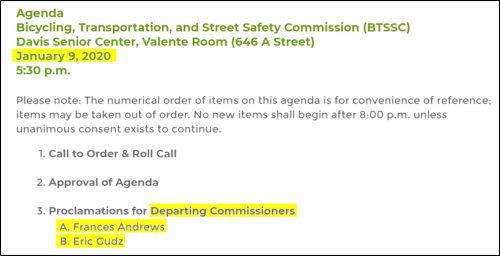
We know which three commissioners had threatened resignation because they sent a letter to the council on October 16th (link). The letter was signed by Frances Andrews, Eric Gudz, and Mike Mitchell. Notably the BTSSC voted in November to censure Edelman rather than remove him (link) with Andrews, Mitchell and Gudz all voting in favor of censure at that time. Andrews and Gudz went on to announce they were leaving the commission before the January 9th meeting, but they did not link their departure to Edelman.
BTSSC Commissioner Mike Mitchell alone resigned on January 29th. Thus, a single Commissioner, Mitchell, resigned after the January 28th Council decision, not three as stated by Greenwald.
A refusal to correct articles even when faced with specific, accurate, and uncontested evidence
David Greenwald was not present for the Council discussion of the BTSSC on January 28th, but he claims in the comment section of his Feb. 3 article that he, “saw Ms. Andrews went before the council and state that she had already resigned.” Perhaps he watched the video of the meeting, but even in the video there is specific evidence that contradicts Greenwald’s article.
Had Greenwald watched the video however, he would have seen that his statement claiming Andrews resigned AFTER the council decision was untrue. Not only had Andrews “already resigned,” she had announced her resignation prior to the January 9 meeting and she said as much before the Council on January 28th. She specifically stated that the Jan 9 BTSSC meeting was her last meeting, and that because it was her last meeting, when it came to the vote on Edleman she abstained from the vote. She explained that at the time she “thought that was the proper thing to do because she was no longer on the council [commission].”
It is also very notable that Andrews did not state that she resigned because of Commissioner Edelman.
Sadly, this gets worse.
In the comment section of the Feb 3rd Vanguard article Rik Keller pointed out the problem with Greenwald’s article.

Rather than fix the article, the Vanguard deleted Keller’s comment within 15 minutes. (There is much more that could be written about the Vanguard’s blatant efforts to censor opposing viewpoints, but that will have to be covered at another time.)
At 4:39 on Feb 3, Ron Oertel posted a comment stating, “Ms. Andrews had already planned to leave the commission, prior to the council’s January vote. Ms. Andrews had already decided to leave, by then. Therefore, in no way was the council’s decision in January (to suspend Todd, instead of “removing him”) the motivating factor for Ms. Andrews’ resignation.” Oertel also posted a link to video of Andrews from the January 28th Council meeting supporting his claims.
Rather than fix the article, Greenwald responded to Oertel, with what can only be described as obfuscation. Greenwald claimed that somehow “this wasn’t a done deal” despite the fact Andrews and Gudz had already received departure proclamations at the BTSSC on January 9. While it is true that Commissioner Mitchell had yet to resign and that may not have been a “done deal” as of the 28th, there is no support for Greenwald’s statement in the Vanguard article that Edelman’s two meeting suspension “was not enough for the three commissioners who all resigned, leaving the commission short of a quorum.” So even faced with video evidence Greenwald refused to update his article.
Oddly Greenwald went on to seek shelter with more obfuscation and a vague reference to a Davis Enterprise story, but there is nothing in the multiple Enterprise stories on the subject to support Greenwald’s contention that three commissioners resigned after the January 28 Council meeting.
A history of publishing false and misleading information
This is not the first time the Vanguard has published demonstrably false information, but this serves as a good example of just how unreliable the Vanguard’s reporting is.
Another example is the Vanguard December 29th headline declaring, “driving is trending down” (link), despite the fact that driving is trending up. This story was also written by David Greenwald.
Rik Keller pointed out in the comment section on the same day, “Driving is actually trending upward based on U.S. Federal Highway Administration data. In the past 5 years, per capita VMT in the U.S. has increased by about 5%. Add in a population increase of about 4% over the last five years, and that’s about a 9% increase in total driving miles.”
Matt Williams went on to provide more details including a graph demonstrating that driving is indeed trending up.
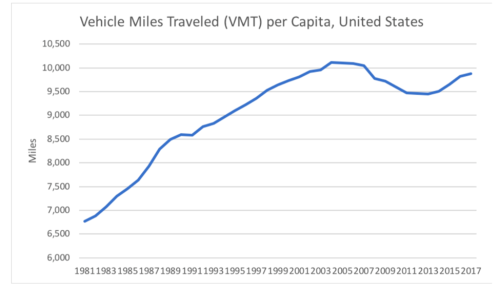
In the face of specific well-sourced evidence, Greenwald refused to fix the article, claiming without substantiation or providing any link to his source that his information came from the Wall Street Journal.
Keller on the other hand posted a link to the department of transportation.
“The U.S. Department of Transportation’s Federal Highway Administration (FHWA) released new data today showing total U.S. driving in 2018 surged to a record-setting 3.225 trillion vehicle-miles traveled (VMT).”
“Record-setting vehicle-miles traveled reflects a robust economy, lower gas prices and is another reason to ensure that America’s roads and bridges are well-maintained and modernized to improve safety,” said U.S. Transportation Secretary Elaine L. Chao.
https://www.fhwa.dot.gov/pressroom/fhwa1905.cfm
The Vanguard and Greenwald have to date not fixed the article, but 2 days after his detailed comments showing Greenwald’s errors Keller was banned from posting on the Vanguard without explanation.
Both the December 29th “driving trending down” and February 3rd BTSSC articles are strong example of the Vanguard’s unwillingness to fix errors in Vanguard articles even after it has been brought to their attention. These instances demonstrate that not only does the Vanguard publish false information, it willfully includes false information in its articles even when confronted with hard evidence that statements are false.
The situation is even worse because the Vanguard Board knows about the problem yet does nothing.
On the morning of February 3rd, I personally wrote to 2 Vanguard board members to alert them to the false and misleading information the Vanguard had published. I would have written to the entire board, but the Vanguard does not publish contact information for their board. I provided the board with direct evidence that their blog had published a false statement. I asked one of the board members to share this information with the entire board. Neither board member bothered to even reply to my email. The false statement remains in the article at the time of posting this article. One can only conclude that the Vanguard board is complicit in the willful distribution of false information.
Why does it matter?
There is no doubt that this specific false information may not be earth shattering but in both instances it dramatically affects the meaning of the articles. There are 2 reasons this glaring and willful publication of false information matters. They can be defined as the short-term and long-term consequences.
In the short term, the Vanguard’s false statement about three commissioners apparently leaving after the January 28 City Council decision to suspend Commissioner Edelman for two meetings and not remove him from the BTSSC makes it seem like there was more in the balance at the time of the January 28th decision. It gives cover to Commissioner Mitchell who is the lone commissioner to resign when confronted with the possibility of going through a mediation process with Commissioner Edelman rather than have Edelman removed (Edelman had agreed to mediation). It also overlooks that two commissioners voted to remove Edleman from the BTSSC despite the fact that they themselves had already resigned. Was their vote because they had a personal grudge against Edelman or because they thought it was best for the BTSSC, or some combination of both? We won’t know for sure – neither Gudz nor Andrews gave many clues as to why they wanted Edelman removed at the January 9th BTSSC meeting. Commissioner Mitchell on the other hand stated that he had been on a “Crusade” for over a year to have Edelman removed.
In the long term it is the Vanguard and David Greenwald’s credibility that are the real casualty. A self-proclaimed “community-based watchdog and news reporting organization” is unlikely to survive if the information it provides is not credible. Frankly a so-called “news reporting organization” that insists on publishing articles about driving trends that state the opposite of what data shows even when confronted with actual data from the Department of Transportation does not deserve to persist.
Publishing a false statement can not be seen as a simple mistake if once confronted with solid evidence to the contrary there is no retraction or correction. In this most recent instance, because members of the board were notified of the problem and failed to even respond to the emails, it is also clear that this problem goes much deeper than just the author of these stories.
If the Vanguard is willing to leave up false and misleading information as in these 2 examples even when confronted with specific, accurate, and well sourced evidence to the contrary, even when the board knows that false material is being published, then they are willing to do it in other stories.
Without efforts to right the ship, the Vanguard can only be seen as a flawed organization with a loose relationship to facts. This large and growing credibility problem tarnishes ALL of the so-called reporting that appears in the Vanguard.

 Davisite
Leave a comment