

By Nancy Price
The Founding of Earth Day
During the 1960s, the concerns of environmental and anti-war activists began to converge as they’d had enough of corporate environmental disasters, epitomized by Love Canal (1953) and wide-spread harm to nature from indiscriminate use of DDT and chemicals that Rachel Carson revealed in Silent Spring (1962). There were also the assassinations of President Kennedy, Malcom X, Martin Luther King, Jr., and Robert Kennedy, and the increasing violence of the War in Vietnam and at home – the tragic My Lai Massacre (March 1967), police brutality at the 1968 Democratic Convention in Chicago, and the widening carpet bombing, extensive use of Agent Orange, and move into Cambodia.
Finally, in 1969, two iconic disasters galvanized the public and legislators into action: in Ohio, the alarming fire on the Cuyahoga River in downtown Cleveland, long polluted by industrial waste and sewage; and in California, the huge Santa Barbara Channel oil spill, at that time the largest oil “blowout” in U.S. waters that covered 30 miles of pristine sandy beaches and greatly impacted marine life.
It was no surprise that after Wisconsin Sen. Gaylord Nelson proposed Earth Day for April 22, 1970, 20 million people turned out to peacefully demonstrate. Anti-war protests continued, however, to escalate at university and college campuses and tragically, less than a month after Earth Day, four students were killed by the Ohio National Guard at Kent State University, Ohio (May 4, 1970).
A positive response to Earth Day led to Congress under Pres. Nixon to create the Environmental Protection Agency (1970) and pass legislation for the Clean Air (1970), Clean Water (1972) and Endangered Species (1973) Acts. These efforts were an extension of what municipal and state governments, and Congress had already accomplished in the 1960s to limit corporate harm to ecosystems and public health, but now hoped to be broadly protected by Federal laws.
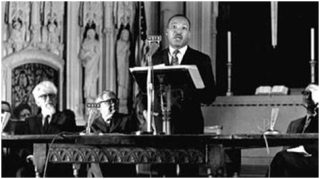
Martin Luther King’s “A Revolution of Values”
On this first Earth Day, Sen. Nelson expressed his hope to “build bridges between man and nature’s systems, instead of…new weapon systems that escalate the arms race.”
Clearly, Nelson was echoing Martin Luther King, who three years earlier in his speech at Riverside church, “Beyond Vietnam: A Time to Break Silence, moved from civil rights to a critique of capitalism and war, calling for a “revolution of values” – saying, “a nation that continues year after year to spend more money on military defense than on programs of social uplift is approaching spiritual death.”
King envisioned a “worldwide fellowship that lifts neighborly concern beyond one’s tribe, race, class, and nation,” saying: “when machines and computers, profit motives and property rights are considered more important than people, the giant triplets of racism, extreme materialism, and militarism are incapable of being conquered.” He knew that to realize this revolution of values would require “national policies that quite frankly will interfere with what many have considered their right to use and abuse the air, the water, and the land, just because that is what we have always done.”
Nelson, too, knew that “new standards for progress” were needed, emphasizing human dignity and well-being rather than an endless parade of technology that produces more gadgets, more waste and more pollution. Both men understood that the change needed for people and the planet threatened those in power. They were right.
The U.S. Chamber of Commerce and Lewis Powell Memo
Immediately, the business establishment launched its counter attack. It began when Eugene Syndor, Chair of the U.S. Chamber of Commerce Education Committee, invited his friend Lewis Powell, corporate lawyer and member of 11 corporate boards, to write a memo for the Chamber.
In this memo titled “Confidential Memorandum Attack on American Free Enterprise System,” dated August 23, 1971, Powell stated that the “American economic system is under broad attack. He labelled legitimate critics as outright opponents, who “preferred socialism or some form of statism (communism or fascism).” This is a familiar tactic being used today to discredit any opposition to the status quo and criticizing unrestrained corporate power, money in politics, and US militarism and wars.
Powell was alarmed not about “sporadic or isolated attacks” from a few “extremists on the left,” but attacks from the “perfectly respectable elements of society, including leading intellectuals, the media and politicians” that were “gaining momentum and converts.” He singled out Yale Professor Charles Reich’s book, “The Greening of America” (1970) as an example of the “frontal assault on…our government, our system of justice, the free enterprise system” and “individual freedom.” Sound familiar?
Powell, convinced that the “ultimate issue was survival of the free enterprise system,” described how the Chamber could regain influence on “the Campus” and in Secondary education, and control politics, elections, public opinion, the media and the courts. With no hesitation, he concluded, “There should not be the slightest hesitation to press vigorously in all political arenas for support of the enterprise system. Nor should there be reluctance to penalize politically those who oppose it.”
Powell nominated by Pres. Nixon was sworn onto the Supreme Court early January 1972, and the Chamber’s Board of Directors adopted Powell’s program on Nov. 8, 1973. Immediately a “passive” business group became a powerful political force. In short order, the business elite founded the Business Roundtable (1972) and American Legislative Council (ALEC 1973), foundations and think-tanks such as the Heritage Foundation (1973), the Cato Institute (1977), Citizens for a Sound Economy (1984 – now Americans for Prosperity), and more such groups determined to use today the almost unlimited amounts of money to get legislation passed to enact the Chamber’s broad agenda laid out in Powell’s memo.
Soon, the Chamber and allies launched their Supreme Court strategy to get conservative judges confirmed and to get cases before the Court to begin overturning long-standing restrictions on donations to political campaigns and candidates. This began with Buckley v. Valeo (1976) that help that the limits on election spending in the Federal Election Campaign Act (1971, amended 1974) were unconstitutional. In 1978, Justice Powell wrote for the majority in Bank of Boston v. Bellotti1978 when the Court ruled that the free speech of corporations was protected under the First Amendment. The Court continued to lift restrictions on donations to political campaigns and candidates to the benefit of corporations and wealthy allies with Citizens United (2010) and McCutcheon v. FEC (2014).
The historic amount of money that today pours into political campaigns helps elect candidates who do the business of the corporate, financial and political 1%. Once in office, they appoint their cronies to cabinet and court positions to roll back regulations and court decisions for the common good.
2020 is the 50th Anniversary of Earth Day. It’s time for a “Revolution of Values” to end to almost 50 years of this U.S. Chamber agenda.

 Davisite
Leave a reply to Nancy Price Cancel reply