

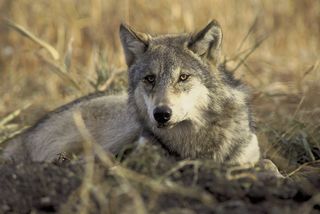
 According to a press release from the Center for Biological Diversity, this past week the U.S. Fish and Wildlife Service (FWS) announced that it is considering a proposal to strip Endangered Species Act protection from nearly all wolves in the lower 48 states.
The FWS tried to do the same thing back in 2013. The proposal was (as I described in a blog post for a different blog) arbitrary, capricious, and inconsistent. It received a huge pushback from the scientific community as well as many environmentally-minded individuals. But then the proposal was never acted on. I have been wondering what had happened to it – was it shelved because it was so poorly crafted, or was there some other reason?
The recent press release clarifies that issue. The 2013 proposal to delist gray wolves (Canis lupus) was put on hold due to successful court challenges to a 2011 proposal to remove protections for gray wolves in the Great Lakes Region. But for some reason the Trump administration is now pushing forward again with a more sweeping attempt at delisting.
I have to wonder whether the new proposal will be as ill-conceived as the 2011 one. I suspect that it will be. The basic issue is this: wolves are endangered for one reason and one reason alone: humans kill them. It’s not lack of habitat or food, it’s not disease, and it’s not pollution, as it for other endangered species. Without the protection of the Endangered Species Act – without something to prevent humans from killing wolves – they will go extinct. In that sense, there is no question that they are endangered.
A few years ago, California granted endangered protections for the gray wolf under state rules. Only a handful of wolves have visited the state. One has done so very recently: OR-54 was spotted 30 miles north of Lake Tahoe earlier this month.
But a state-by-state approach, while commendable, isn’t enough. Some key states are not likely to pass endangered protections. And wolves are very mobile. They flourish in metapopulations – groups of populations that interact and exchange members. They need fluid borders, not a patchwork of states where they can live surrounded by states where they will be shot on sight.
Some people value wolves as individuals; some value them for the role that they play in ecosystems (there is a cool video that discusses this role, although a recent article claims that the video is overstated). Regardless of the reason, those who care about wolves should keep a close eye out for the new proposal from the FWS, because there is little doubt that it is coming.

 Davisite
Leave a reply to Roberta L. Millstein Cancel reply