

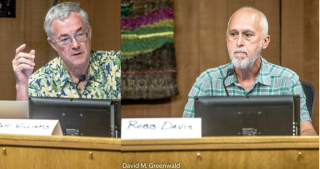
By Matt Williams
As follow-up to the May 6th CivEnergy forum on Measure J, I published my personal reasons why I oppose Measure J as an article for the Davisite and as a comment to the Vanguard. Prompted by my list, Mayor Davis took the time to respond to all eleven (11) of my comments one-by-one. I thank Robb for doing so, and particularly thank him for the structured format he used to reply. This is the third in a series of articles on Nishi's financials in which I respond to Robb Davis's replies to me. The first article is here and the second article is here.
Matt: Nishi 2018 has no dollars for deferred maintenance of capital infrastructure.
Robb: See previous point. We don’t need it because the developer is responsible.
Matt: That is the same short-sighted, politically-driven thinking that created the current dilapidated state of our roads and the $8 million annual shortfall in the City Budget.
Robb: That is an editorial comment to which I will not respond.
The interchange above is at the heart of the City’s current unsustainable fiscal situation. Past Councils for well over a decade have ignored the advice of Staff regarding the maintenance of the City’s capital infrastructure. The year-by-year individual circumstances have differed, but the behavior pattern was the same. Over and over again, the Council chose to avoid a public dialogue about the fact that our City’s appetite for spending exceeded its annual income.
When faced with a choice between (1) spending the Staff-recommended dollars on roads and buildings maintenance, and (2) telling the citizens/taxpayers that we needed to draw down the City’s General Fund Reserve below 15%, they chose not to have the public dialogue. Why?
Public discussions about the fiscal sustainability of a City you were elected to serve are always difficult. Politicians see them as politically dangerous, because voters have been known to shoot the messenger. So the “wise” political move is often to maintain the illusion of a healthy General Fund Reserve balance by ignoring the professional advice of Staff about spending money on capital infrastructure maintenance. The result is an increase in Deferred Capital Maintenance. After a decade of deferred capital maintenance the roads begin to develop serious cracks and potholes, and the new Fire Chief, Nate Trauernicht, when conducting a winter inspection of the 5th Street fire station during a rain storm finds water pouring into the station through holes in the roof.
The circumstances are different, but Robb is falling into the same pattern of behavior when he says “We don’t need it because the developer is responsible.” He is only looking at the on-site capital infrastructure. Under the provisions of the Development Agreement, the Nishi site owners are indeed responsible for roads and bike paths maintenance. They are also responsible for the on-site parks and open space (their urban forest, the proposed mitigation of the air quality impacts of I-80). However, as EPS clearly outlined for the City in its Nishi 2016 fiscal analysis, capital infrastructure maintenance is not limited to the boundaries of the site. By applying for annexation into the City of Davis, the Nishi developers are clearly, and explicitly, saying that they see value in becoming part of the whole community of the City of Davis. They see value in their residents being part of that whole community.
The Nishi developers are not being forced to seek annexation to Davis (although there are definitely are practical reasons to do so … I wouldn’t want to be accused of a red herring-ism) They have an alternative. They can file their project application within their current jurisdiction, YoloCounty. However, they have chosen not to do so. That is their choice … just as it is the City of Davis’ choice to look at the application with the whole City in mind, not just the boundaries of the specific site in mind.
That means the maintenance of the whole capital infrastructure of the City needs to be considered, for example
- the network of roads that the 700 cars in the 700 Nishi parking spaces will use
- the network of greenbelts and greenbelt pathways that are so much a part of the “whole community”
- the system of parks with their soft and hard surfaces and structures
- City Buildings, and their components like roofs.
- Police cars
- Fire trucks
These are the components of capital infrastructure maintenance that have been deferred by past Councils, with the result being the $8 million recurring annual shortfall identified by Bob Leland in the Forecast chapter of the 2017-2018 City Budget. Our current Council is attempting to be open and transparent about the magnitude of that shortfall. They are working hard to not repeat the errors of past Councils that created that shortfall, which makes the willingness to be short-sighted about Nishi all the more bewildering. The City’s economic/financial consultants EPS/Plescia/Goodwin,working with the FBC mapped out a plan for Nishi’s financial contributions to the City that was at the same 1.6% Effective Tax Rate of the just recently completed Cannery development (and Cannery wasn’t even asking for the value of annexation). The question that Robb and the Council have not answered is Why are we not analyzing the financial contributions of this current Nishi development with the same thorough fiscal thought process.
Matt: Guess who picks up the fiscal difference … Davis taxpayers.
Robb: Which fiscal difference?
The simple answer to that question is … the fiscal difference between the narrow perspective of the specific site versus the broad holistic perspective of the whole community. That whole community that the Nishi developers see value in being annexed into.
Past Councils looked at the costs of maintenance of the City’s capital infrastructure from the narrow perspective of the political consequences of drawing down the General Fund Reserve in order to pay for the maintenance Staff was recommending. If they had look ed at those maintenance costs from the whole community perspective, we probably would not be in the current situation of both crumbling roads and buildings and a budget shortfall.

 Davisite
Leave a comment