Davisite Banner. Left side the bicycle obelisk at 3rd and University. Right side the trellis at the entrance to the Arboretum.

Category: Politics

  • Explaining how RFK Jr.’s recent remarks were racist

    It’s a good reminder that “hate” is a very limited way of talking about racism.

    By Roberta Millstein

    I recently got into a conversation with some people on Facebook about whether Robert F. Kennedy Jr.’s recent remarks about Chinese people and Ashkenazi Jews regarding COVID-19 were racist.  The conversation was too hard to have on Facebook, so I stopped engaging, but I think it’s worth looking at his remarks in more detail because I think they are quite damning, and yes, racist. 

    I take his remarks personally because I myself am an Ashkenazi Jew, but since RFK Jr. is running for President of the United States, and since apparently some Davisites think he is a good candidate, it’s important for all of us to take a second look.

    The video of his remarks is here.  The quotes below are my transcription.  I edited lightly (removing stutters, etc.), and may have missed a small word here or there, but I am confident that I have it mostly correct.

    (more…)

  • Response to I-80 update piece by Alan Hirsch

    Note: The following email was sent to the Davisite, asking for a correction to Alan Hirsch's recent articles.  As the email contains some misunderstandings about the nature of the Davisite, a new article has been written that tries to correct these misunderstandings and other common misconceptions – see More about the Davisite.  Just as with Alan Hirsch's articles and with any other article on the Davisite, the volunteers who operate this blog do not vouch for the correctness of what is written below.

    The Davisite has recently posted a series of guest-authored pieces by Alan Hirsch about the Yolo 80 Managed Lanes project containing a pattern of significant inaccuracies, potentially causing confusion about the project among the general population. Providing a forum for vigorous policy debate is an important role of blog-based local media, however, informal media should aspire to post accurate information, even from guest authors.

    As Caltrans’ partner on the Yolo 80 Managed Lanes project, the Yolo Transportation District (YoloTD) responds to two inaccuracies in Mr. Hirsch's most recent July 24, 2023 article posting titled, "I-80 update: Caltrans proposes cutting mitigation for Phase I".

                   Article Title and Article List Item #1: Mr. Hirsch's title “I-80 update: Caltrans proposes cutting mitigation for Phase I” is inaccurate. Caltrans has not proposed in any way to cut mitigation for Phase 1 of the Yolo 80 Managed Lanes project. Any version of the project that moves forward will be subject to CEQA. The Draft Environmental Impact Report has not yet been released, and any speculation about its contents is just that — speculation. Mr. Hirsch has speculated that funding will not be available for mitigation, which is an opinion, not a fact.

                   Article List Item #2: YoloTD's statement that an HOV lane would be congested on day 1 requires additional background. The comment refers to "peak" hours at bottleneck locations under a specific HOV2+ scenario where high-occupancy vehicles with two or more people (HOV2+) are allowed access to the lane, which is one of several scenarios that could advance. Other scenarios with higher occupancy requirements could result in lower congestion levels on the new lanes.

    (more…)

  • I-80 update: Caltrans proposes cutting mitigation for Phase I

    Image001 1525

    by Alan Hirsch

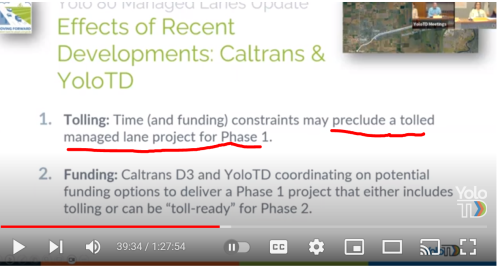
    1. At the Yolo Transportation District (YoloTD) board meeting 7/17, it was shared that Caltrans is considering a plan to save the I-80 widening project by trimming it back from $210m to the $86 mil fed funds they have so they can spend them before the funds time out: Their plan would be to widen a few miles of the freeway as HOV without adding tolling infrastructure.  i.e., no source of revenue for more transit or other mitigations. This is the core project Caltrans assumably was after anyway as they originally had Congress ear mark the $86m in grant money to only be used for an untolled  HOV lane.  Assumably full tolling and mitigation would be implemented when and if money for a now larger Phase II is found sometime in the future.
    2. YoloTD staff using Caltrans numbers have said even a complete 17mile long HOV lane would be congested day 1. Arguing now for a widening just a short section blows apart any logic that Caltrans want to fix a “bottle neck”.
    3. Three of the five YoloTD members objected to Caltrans toll-less plan for the new lane expressing concern they want money to spend locally. Board member Jesse Loren of the Winter Council was very concerned about not having toll lane revenue funds for a social equity program- assumably a program needed to mitigation of inequity of having that self-same toll lane. At risk for Davis is the Micro transit service- i.e.  93% subsidy required for $40/trip service as well as financial help the developer of the Nishe project and downtown Davis.
    4. Most Board members asked how much widening they can buy after inflation impact cutting the buying power of the money. Lucas Frerichs raise a question if a CEQA environmental lawsuit might slow or stop the project (response: likely not if EIR is certified by Caltrans but it could retroactively affect the mitigation program and tolling policy.)
    5. The board raised no question about staff’s Plan B other that cuttings scope: i.e. fund the phase I  short fall created when California Transportation Commission failed to fund on 6/26. YoloTD Staff report noted they were considering local Muni-bond or obtaining Federal FHWA Loan to be guaranteed locally. YoloTD staff said this is still being explored but the time frame is challenging.(see previous Vanguard article)
    6. Silence continues on the Climate Change Elephants in the Room: In discussions by YoloTD Board that night, the terms Climate Change,  VMT, GHG or induced demand were not used in reference to-I-80 project.  There was no acknowledgement or response to letters by Professor Stephen Wheeler, signed by 20 Davis resident on climate change asking for reopen EIR with transit alternatives or a similar letter by Professor John Johnson of CSUS.
    7. No one directly acknowledge or publicly responded to powerful letter from head of National Center for Sustainable Transportation Professor Susan Handy that said based on decades of studies the I-80 extra lane- even if tolled — won’t fix congestion but will hurt the environment. This letter was privately shared with the board but not shared with the public (see coming Vanguard article that will reprint it)
    8. YoloTD chair Tom Stallard gave a statement “for the record” He references generic “letters” which might include that from Wheeler and Handy.  Not bothering to reference any science to studies, he that the board need to be realistic and simply widen the freeway as this would fix congestion.  He used examples of his grandchildren’s need to get to piano lesson and sporting event as evidence of important needs that need be addressed. His argument is a tour de force of how common sense should overrule science out of the university. No member of board contradicted his statements as chair. Tom Stallard is one of the richest men in Yolo County having given over $50,000 to the Mondavi Center, so a managed toll lane that never congests would work well for his family to avoid congestion.
    9. Josh Chapman, the Davis Council rep failed to show.  Davis City manager/council does not seem to have appointed an alternate-to YoloTD unlike other JPB bodies the city is a party to.
    10. -I 80 Draft EIR release will again be delayed again to the end of August per Caltrans statement at YoloTD meeting. Caltrans originally scheduled the DEIR to be release in January of 2023. Caltrans has no email list to inform stakeholder of delays and does not update such information on the project’s website, so continue to read the Vanguard or Davisite to keep informed.

    The Meeting: Video of July 17, 2023 board meeting is at  https://youtu.be/O7odnLgxuF4  The I-80 agenda item begins at 33 minutes in. Tom Stallard’s statement that effectively denies university science of “induced demand” is at about 1:06


  • Council set to mis-spend $400,000 on Arroyo Park

    By Janet and Joe Krovoza

    In another instance of the consent calendar shielding requests for large financial commitments, city staff are asking Council Tuesday to approve more than $409K to build a "shade/picnic structure" at Arroyo Park.

    When the Recreation and Park Commission voted to recommend its construction back in April of 2022, the estimated cost was $257K. Public bids revealing a far different cost estimate were opened only last month.

    Should we really be spending scarce public dollars on this scale on a new "amenity" such as this, especially when people can't even walk their dogs at Arroyo without risking injury to their pets from burrs and thistles ($300 to pull a thorn from my dog's foot), broken irrigation pipes take literally months to repair, and ruptured pathways make it difficult if not impossible for people with mobility issues to get around?

    This strikes us as a lot of money for what is basically six picnic tables, two barbecues and a roof. At a minimum, such a major commitment (which will incur ongoing expenses, consume turf, and threaten adjacent trees) certainly deserves the "separate discussion" its inclusion on the consent calendar precludes.

    Let's also put this in context. The park already has two shaded open-air group barbecue areas  They are used, but don't seem overly so or impacted. Maybe we could add a few more picnic tables, update the barbecues that were put in 20 years ago, and save ourselves something close to $400K?

    In any event, if a cost estimate is 60 percent higher than what was represented to the Recreation and Park Commission, it ought to go back to them for review. And such an item certainly shouldn't go straight to the City Council on consent.

  • Letter to Yolo County Transportation District concerning adding a lane to I-80

    July 14, 2023

    Board of Directors
    Yolo County Transportation District 350 Industrial Way
    Woodland, CA 95776

    Dear YCTD Directors:

    We write to express our concern about Caltrans’ plans to add a lane to Interstate 80 between Dixon and Sacramento, referred to as the “Yolo 80 Managed Lanes Project.” Such freeway capacity expansion will raise greenhouse gas (GHG) emissions and vehicle miles travelled (VMT) in the I-80 corridor while inducing motor-vehicle-dependent suburban sprawl. It is contrary to GHG-reduction goals set by the State of California, the Sacramento region, Yolo County, and many local cities. Any congestion relief will be short-lived due to induced demand, as shown by many past freeway expansion projects.

    At your meeting on July 17, 2023, we request that you ask Caltrans to study additional options for this project that would substantially improve transit, keep freeway capacity within current limits, stabilize or reduce VMT, reduce GHGs and local air pollution, and improve equity.

    Such options might include

    (more…)

  • Breaking news: Yolo I-80 Widening Not Funded!

    Advocates who steamrolled project scramble to save it

    IMG_8626

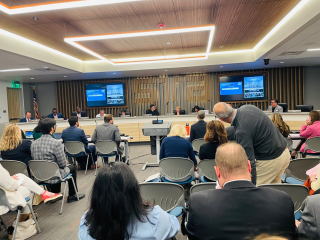
    The June 28th California Transportation Commission meeting in Suisun gave out $3.3 billion with mantra “get it built”.  It was standing-room only, squeezing 15 commissioners on the dais, 20 staff and 60 local transportation agency officials from around the state in a room 2/3 the size of the Davis City Chambers. Activists should note that while the monthly meeting location moves from venue to venue around the state, the public can zoom call in. Photo by Alan Hirsch.

     By Alan Hirsch

    The Yolo I-80 widening project was not given the missing 54% funds ($103 million) at the California Transportation Commission meeting (CTC) on Wednesday 6/28. This means the initial $87 million earmarked federal funds for the project will be lost as it will time out before it is spent. At least this was what was represented on 6/6 to Davis City Council.

    At the June 6th meeting the Council wanted to delay the EIR to add transit options, but were told this was not possible, due to the fact the initial money would time out if EIR was completed and an alternative chosen by January 2025. What was not discussed with Council was the $87 million in earmarked Federal money could ONLY be used for widening, i.e. was a pre-wired choice from congress. So if an EIR instead choose a transit alternative that Davis want to add, it might have be a poison pill for the funding already lined up.

    Was this knowledge behind what was going on that evening when Davis Council attempted to interrogate the EIR project alternatives, and add a new one, but was discouraged?  We may never know. But it’s a new process now.

    CTC Meeting is the Major Leagues

    I was the only “civilian” public commentator speaking on this or any projects at the CTC meeting though there were many letters from public opposing Yolo I-80 project were received. It notable no one showed up in favor of project– or submitted late letters of support (note: some Yolo Cities had quietly written letter for support in winter and spring 2023).  A  number of local agencies reps and elected official from elsewhere in the state comment uniformly support on their projects, which affirm CTC staff recommendation  to fund. I note even a state Assembly member called in a comment – he was monitoring the 4-hour meeting.

    The CTC gave out $3.3 Billion, so funding the $103 million gap in the Yolo80 project was almost rounding error. The I-80 project itself got no CTC commissioner questions or discussion. Not surprising as it was one of 48 in the "Trade Corridor Enhancement" tranche – … item 17 on 18 item agendas just that afternoon. There were only funds for 25 of the 48 in that tranche so it was competitive, but rarely are CTC staff suggestions overruled.

    (more…)

  • Council bamboozled at 6/6 meeting

    I-80I-80 Widening rated last for funding by Caltrans.

    By Alan Hirsch

    Preface: Just 46 hours after Davis Council was forced into a shot gun wedding with Caltrans on the Yolo80 freeway widening, the gate keeper organization on transportation projects, the California Transportation Commission (CTC) staff made public a: “do not fund”  recommendation. The next chance for making up these state matching funds is in 18 months. It would be unusual if the staff recommendations are overturned at the June 28th CTC meeting.

    * * *

    On January 6th, ignoring 21 public comments unanimously opposing it, the Davis City Council voted 3-1 to take the first step to go along with the I-80 widening project. The majority decided to listen to YoloTD Vice Chair Josh Chapman and it’s staff. This vote supports the city partnering with Caltrans to sell out our goal of zero carbon for Davis: Caltrans will get to use our “good” GHG-reducing projects to justify the additional GHG caused by the freeway widening. Caltrans’ carrot was to offer funding (amount unknown) to help developers of both the Nishi housing development and the housing proposed in downtown Davis.

    As reported in the Enterprise article 6/10, the council voted this way even though they were uncomfortable with how the widening undercuts our local climate change plan. Among the complaints made by public were calls to remember the city’s climate emergency resolution.

    Only Councilperson Bapu Vaitla remained skeptical of what was represented to council and voted no — i.e. to protect the city’s plan to go to zero carbon.

    (more…)

  • Recommendation to the Davis City Council for Changes in Davis’ Affordable Housing Ordinance

    By The Sierra Club Yolano Group Management Committee

    June 27, 2023

    Introduction

    The Davis Affordable Housing Ordinance is now implemented on a temporary basis. Renewal with some modest changes is anticipated this evening.

    However, the existing Affordable Housing Ordinance has provisions which we believe do not provide social justice, equity, and fairness in terms of meeting the needs of the City’s low-income population because it is biased toward the financial benefit of developers rather than maximizing the availability of affordable income housing in Davis.

    Following please find our recommendations for immediate changes to update the City's temporary Affordable Housing Ordinance for ownership development projects. Additionally, we suggest the City embark on a concerted effort to further revise the ordinance to make it more equitable and understandable to developers and the general public for both ownership and rental development projects as more fully described below.

    Recommendation for Immediate Change

    1) Eliminate Accessory Dwelling Units (ADUs) as an acceptable alternative to provide on-site Affordable Housing – Prior to the immediate renewal of the Affordable Housing Ordinance, we strongly recommend completely eliminating the provision whereby ADUs are allowed as fulfillment for up to 50% of a For Sale project’s affordable housing obligations as currently exists.

    2) Substantially increase in-lieu fees if chosen by a developer as an acceptable alternative to provide on-site or offsite Affordable Housing – We recommend that in-lieu fees be substantially increased so that it is no longer a financially preferable option for developers to pursue.  We endorse the staff recommendation to have an "in lieu fee to represent the full cost to build an actual unit."

    Recommendations for Further Changes in the Very Near Future

    3) Increase the minimum percentages of affordable housing required in most developments

    a) For rental multifamily developments and ownership detached housing, increase the standard 15% requirement for onsite or offsite affordable housing units to 25% (15% Very Low Income and 10% Low Income).

    b) For ownership and rental mixed use and stacked-flat condominiums, increase the affordable housing requirement from 5% to 10% (5% Very Low Income and 5% Low Income) and eliminate the exemption for such units in the core area from the requirements of the Affordable Housing Ordinance.

    4) Increase the minimum parcel size for land donated to alternatively meet affordable housing requirements to 4 acres – Experts in the field of non-profit low income housing project financing have stated that land donation requirements of lesser sizes are not feasible to finance given the realities of financing requirements and available tax credits.

    We elaborate on each of these recommendations further below.


    (more…)

  • How Big Does Davis Need to Be? A Lot Smaller Than Growth Advocates Want You To Think

    College-comparisons
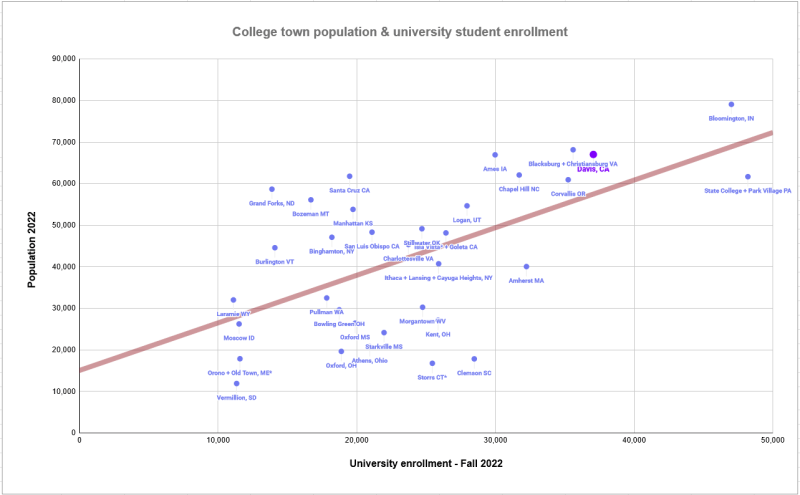
    Criteria for inclusion: stand-alone college towns with a population less than 90K and a public university larger than 10K enrollment. Dataset may not include every example of this, but diligent efforts have been made to be as complete as possible. The orange line shows the best-fit linear regression model. Any place above the line has more than its projected population based on enrollment. (Added 7:30 PM, June 23, 2023)

    By Rik Keller

    Tim Keller (no relation) stated in the article “Guest Commentary: How Big Does Davis Need to Be? College Towns Analysis Part 3 – Long-Term Planning” that “In previous articles we saw evidence that suggests that a population of 120,000 might be entirely appropriate for a university town such as Davis: It is the size of Ann Arbor, Michigan (home of the University of Michigan), Champagne-Urbana (home of the University of Illinois), and Lafayette Indiana (home of Purdue). These are all well-regarded and well-funded research universities of very similar size and character to UC Davis.”

    For reference, the 2022 population of Davis was 67,048, and Tim’s number is a huge 179% increase above that.

    The so-called “evidence” that he based this on was a very incomplete, cherry-picked, and in some cases factually-inaccurate, list of 17 universities and host towns to compare to Davis.

    He stated “The trend that emerges immediately is that the population of a “university town” such as ours tends to be about 3x the size of its student body.”

    I have access to a more complete database of 40 public research universities with enrollment of at least 10,000 students (and up to 50,000), located in distinct host towns with populations less than 100,000. Tim ignored the vast majority of these. It turns out that the median population-to-student enrollment ratio of these 40 college towns is almost identical to that of Davis (Davis is slightly higher), which completely undermines his argument that Davis needs massive population growth to support current university enrollment.

    If Tim hadn’t approached the exercise with an endpoint in mind—his preconceived notion that Davis need to be much larger than it is—he could have done a more credible analysis. His limited cherry-picked data had some basic facts wrong. The 2022 population of Corvallis was actually 60,956 (not 95,184), and the population-to-enrollment ratio is actually 1.73. And he drastically understated the enrollment for the University of Indiana at 35,253, when Fall 2022 enrollment was actually 47,005. The population-to-enrollment ratio for Bloomington is actually 1.68. With Davis at around 1.9, these two cases, as well as the median of 1.82 for the larger dataset, indicates that Davis has more population per enrollment than the norm.

    I won’t get into a critique right now of Tim’s notion that a simplistic and crude comparison of population size to university enrollment should provide prescriptive guidance. But suffice it to say for now that a more through examination of the facts using a more complete dataset of college towns, points to the opposite conclusion that he had.

    Should we be surprised that one of the people behind the “Sustainable Growth Yolo” organization is advocating for massive amounts of growth based on faulty analysis and assumptions? I’m not sure why they aren’t more honest and just delete the “sustainable” part.

    Rik Keller is a university instructor in communication studies and social work. He has two decades of professional experience in demographic analysis and housing policy & analysis in Texas, Oregon, and California after obtaining his master’s degree in city planning. He is also a 15-year Davis resident.

  • Letter: City Council moves toward an exclusionary Davis

    What a sad Council night for Davis this past Tuesday.

    Both projects put forward by the city Tuesday night are by design planning for an exclusionary Davis.

    Both projects short us on affordable housing for the very low income and low income. They both set aside the lowest number of units ever affordable to VLI and LI units of any proposed annexation.

    When David Taormino asked me to do the affordable housing for Bretton Woods I said I would if he doubled the land required for affordable housing.

    David provided land for 150 VLI and LI apartments instead of the required 68 apartments.

    Standing at the Bretton Woods Booth at the Farmers Market every Wednesday and Saturday proved my point. His willingness to do more VLI and LI units that he needed to was the critical element in winning community approval in a Measure J election.

    I and Delta Senior Housing Communities (DSHC) are no longer doing the affordable housing at Bretton Woods but that one generous act had great impact and won community support.

    With 378 acres to build why is Village Farms skimping on an extra four acres for housing VLI and LI people.

    All that is needed is 1% (3.78 acres) more of the 378 acres.

    Due to their skimping on both projects I am opposed to them both.

    I don’t want the Davis that is being sold to us. It is a Davis with fewer doors for the poor.

    That Davis will be richer and whiter and shun the poor working people.

    Join me in demanding more from each project to build a more welcoming and inclusionary Davis.

    David J. Thompson