Davisite Banner. Left side the bicycle obelisk at 3rd and University. Right side the trellis at the entrance to the Arboretum.

Category: Housing

  • Uncivil Discourse at the CivEnergy Forum

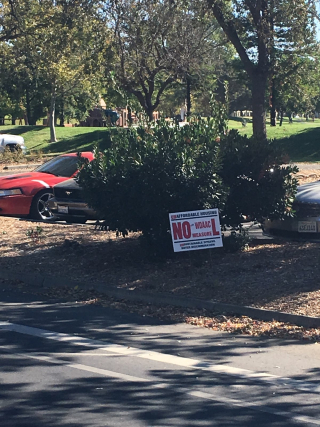
    Yes-On-LThe Yes on L side did not behave well at Sunday’s CivEnergy forum. 

    This inappropriate behavior certainly wasn’t CivEnergy’s fault.  They had picked an excellent moderator in the form of attorney and former City Council candidate Linda Deos, who asked fair and neutral fact-finding-oriented questions about the West Davis Active Adult Community (WDAAC) project.  And along the same lines, CivEnergy’s Bob Fung crafted from audience comment cards two more neutrally worded questions.  Actually, all were framed in terms of discussions rather than questions, a touch that I rather liked.  Deos further warned forum participants to keep their answers focused on the project and not make them personal.  Alas, that was not to be.

    (more…)

  • WDAAC Does Not Meet Real Housing Needs for Davis

    by Alan Pryor and Pam Nieberg

    Forward – Davis already has by far the oldest average population in the region and this project will compound that population imbalance. Despite the abundance of young University students, according to 2016 US Census Bureau estimates the percentage of people in Davis under the age of 18 is 16.1% compared to 25.5% in West Sacramento and 26% in Woodland. Looking at younger children, the disparity is even greater with 3.8% of the Davis population under the age of 5 compared to 8.1% in West Sacramento and 6.7% in Woodland.

    Clearly, because of the age-restrictions imposed on buyers, this project will do little to directly increase the housing stock for young families. And because of this dearth of kids in town, our schools are so starved for young students that we need to import over 650 students per day just to keep school doors from shuttering and moth-balling our existing neighborhood schools. And we pay dearly for schooling those imported students with the highest school-related parcel taxes in the region. We clearly need more young families with children in town to fill our schools and maintain our vibrancy in Davis yet few families can afford to come to Davis because of sky-rocketing home purchase and rental prices.

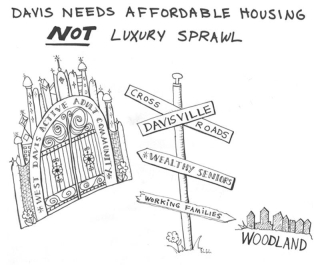
    What Davis really needs is smaller-scale, more dense, and  affordable housing designed for both seniors AND families of modest means. The last thing we need is a sprawling, senior-only Sun City-lite developments like you see in sunbelt states. A development with smaller homes laid out in a curvilinear fashion with different designs (instead of rows and rows of near-identical box-like houses) would attract far more seniors AND the families preferred if the project were designed with a close-knit neighborhood setting in mind.

    (more…)

  • Cumulative impacts of all the developments in Davis

    PublichousingBy Dan Cornford

    I do not have time to comment extensively right now on Roberta's piece. But I do want to say that I agree 110% with what she says. I am just sick and tired of all the pro-growthers accusing anyone who does not oppose their rampant pro-growth propaganda as being some old white, rich NIMBY, as someone who could not afford to buy his first house until I was 53, despite being a full professor at a CSU, and only then could I buy when I inherited a modest amount of money after my father died.

    Roberta is right that no candidate for council had the courage to squarely take on the pro-growthers. I have been saying and writing for two years that the Council, its commissions, and of course the pro-growthers, never stop to consider what the CUMULATIVE IMPACTS of all these developments will be in tandem with the unmandated growth of UCD over the next 5-10 years. What will be the environmental impact on a relatively small city of this growth in all respects (to say nothing of the fiscal impacts and burdens)? The fast expansion of UCD, notwithstanding their LRDP, and their recent MOU with the city, is no cause for comfort. (I mean, to take one example, if UCD does not meet its already inadequate building timetable, they will face a massive fine of $500 per unit. That's really going to force them to meet their timetable isn't it?)

    (more…)

  • Growth – The Elephant in the Room

    PublichousingNo one in Davis talks about growth.  We talk around growth, sure – the need for specific projects, or the need to preserve farmland.  But we never talk about growth

    Consider our most recent City Council election.  Did one of the candidates present themselves as pro-growth or slow-growth?  Not that I can recall.  “Smart-growth,” maybe – an infinitely flexible euphemism if I ever heard one.

    I suspect that no one wants to talk about growth because not a moment passes before the conversation-distracting “pro-developer” and “NIMBY” labels (and similar labels) are slung.  But we desperately need to talk about growth.  We’re growing now and we are facing questions about future growth in the immediate future (Measure L and the West Davis Active Adult Community) and beyond.

    (more…)

  • Is this really your view on Measure L, Davis Enterprise?

    Davis enterpriseIs this really your view on Measure L, Davis Enterprise?  Because I'm having trouble believing the words in front of my eyes. 

    Did you really write, "If WDAAC gets built and all the white Davis seniors move into it, then it will give more opportunity for minorities from out of town to move into the single-family houses the seniors vacate"?

    In other words, it would be OK if WDAAC were composed completely of white Davis seniors?  And the reason it would be OK is that nonwhite individuals would have the "opportunity" to move into the vacated houses formerly occupied by white individuals – even if the nonwhite individuals didn't have the opportunity to move into WDAAC itself?  Just the bare possibility that "minorities" could move into Davis would be enough to justify an exclusionary program?

    (more…)

  • What Are “Internal Housing Needs” in Davis?

    “That directive and those words means something!” — David Taormino on Measure R, 9/19/2018[1]


    Header-1

    By Rik Keller

    Measure R (the “Citizens’ Right to Vote on Future Use of Open Space and Agricultural Lands Ordinance”) was passed by the voters and adopted by the City of Davis in 2010. Davis Municipal Code Section 41.01.010(a)(1) states that the purpose of the Ordinance is [my emphasis] “…to establish a mechanism for direct citizen participation in land use decisions affecting city policies for compact urban form, agricultural land preservation and an adequate housing supply to meet internal city needs…”

    This article will examine what the phrase “adequate housing supply to meet internal city needs” means. First, while the word “need” is used several times, “internal needs” is not further mentioned in the adopted ordinance or in the ballot language that went to the voters (ballot language is purposely streamlined). Is this sui generis language that just appeared out of nowhere? Can it mean that any type of housing is sufficient to meet some sort of undefined “internal need” in Davis and should be allowed to convert agricultural lands? Measure R does state that “continued conversion of agricultural lands to meet urban needs is neither inevitable nor necessary,” so the Ordinance must have some criteria in mind to achieve this goal of not unnecessarily converting ag land, right?

    As will be demonstrated in the following, the phrase “internal housing need” as used in City of Davis policy framework, documents, and studies actually refers primarily to low and moderate income workforce housing, and indeed that category is the only one specifically mentioned and for which specific policies have been crafted to meet the need.

    (more…)

  • Will There be No Place in Davis for Low Income Seniors

    By Bill Powell and David Thompson

    “Each day I get five calls from low income seniors looking to find housing in Davis” says Susan at Shasta Point Retirement Community. “And each day at least one senior arrives at Shasta Point anxious to get housing and hoping by turning up they may have a better chance than just calling.” They don’t.

    Every day there are five to 10 emails or phone calls from low-income seniors to the two staff members at Eleanor Roosevelt Circle. At ERC about three seniors per day walk through the door hoping to get a place. They can’t.

    In 2018, there is a waiting list of 441 seniors for the four largest Davis affordable senior communities; Davisville (70), Shasta Point (67), Eleanor Roosevelt Circle (59) and Walnut Terrace (30). In 2017 there were a total of 14 turnovers. Only 14 of the 441 waiting in line got in. At that rate it would be 31 years before the last of those seniors get housed. The actual wait for an extremely low-income senior can be from three to five years.

    (more…)

  • Planned West Davis Adult Community, if Approved, Would Perpetuate Racial Imbalance in the City of Davis

    Complaintimage(Press release) The proposed restrictive West Davis Active Adult Community on the City of Davis’ November 6 ballot which advertises its purpose as a planned community “Taking Care of Our Own,” is being challenged in federal court because it will perpetuate racial imbalance and discriminate against minorities by restricting sales to residents of Davis

    In a federal complaint filed Monday, September 24, by Sacramento civil rights attorney Mark E. Merin, plaintiff Samuel Ignacio, a Filipino/Hispanic senior on behalf and all other minorities outside of Davis, seeks to stop the project because it excludes those living outside of Davis from buying most of the 410 planned for-sale units.

    Davis, a city whose senior population is disproportionately “white” as a result of historic racially restrictive covenants, red-lining practices, and previous University of California hiring practices, approved the project with 90% of its units restricted to “purchasers with a preexisting connection to the City of Davis.” The result of this “local resident” restriction, as alleged in the civil rights complaint, is the continuation of a racially imbalanced community and the exclusion of minority would-be purchasers in violation of the Federal Fair Housing Act.

    (more…)

  • How White Is Davis Anyway? A Comparative Demographic Analysis

    Part Two in a series, this article examines historic racial/ethnic demographics in Davis compared to surrounding areas and California as a whole in order to determine what sort of effect historic patterns of discrimination may have had.

    "The Past Isn't Dead. It Isn't Even Past"

    By Rik Keller

    The first installment of this series, “Why Is So Davis So White? A Brief History of Discrimination”, provided an overview of mortgage loan redlining, restrictive covenants, and other discriminatory housing practices in the U.S., with examples from Davis showing the extent of overt discrimination in housing practices that led to excluding non-white populations from specific areas.

    The article concluded with a brief summary that described how In Davis—as in many areas of the U.S.—redlining, restrictive covenants, and other discriminatory practices effectively locked out minorities from being able to participate in one of the greatest mass opportunities for wealth accumulation in U.S. history: the post-WWII housing boom. And even as overtly discriminatory practices started to be curtailed, post-WWII municipal zoning practices in the 1950s— especially in fast-growing suburban areas—emphasized large-lot single-family homes as a way to exclude more affordable housing types and to continue patterns of racial/ethnic/income segregation. One common misconception when discussing housing is that discrimination in the U.S. ended some time in the 1960s. Davis is an example of how the wealth disparities that were accentuated by these policies and practices persist today with residential patterns and housing opportunities distributed along particular racial/ethnic lines, along with ongoing discrimination.

    (more…)

  • The Spirit of the Davis Based Buyer Program for the West Davis Active Adult Community (WDAAC)

    By Jason Taormino

    The spirit of the Davis Based Buyer program for the West Davis Active adult community is a focus on our community's needs. Nearly six hundred Davis families have joined our interest list for the for sale homes and there are more than four hundred additional individuals on waiting lists for affordable senior apartments. During our lengthy community outreach including more than seventeen city commission and council meetings we were asked for some methodology to ensure that we focused on this home grown demand rather than advertising in the Bay Area.

    On dozens of occasions while dropping off or picking up my kids at Cesar Chavez elementary school I was approached by parents who were eager to move their aging parent(s) to Davis. From my perspective there are two clear segments of demand that our proposed neighborhood can serve from a market rate perspective – seniors in Davis who want to downsize and those who want their aging parents to come to Davis. Additionally, the affordable apartments and a memory care facility serve important needs. Without the senior restriction on 80% of the homes it is highly unlikely that seniors in Davis or bringing a parent to Davis would occur as a significant percentage of the total housing.

    (more…)