The City Council is hearing proposals to consolidate commissions on Tuesday night. These changes have serious implications. Here are the proposals:


The City Council is hearing proposals to consolidate commissions on Tuesday night. These changes have serious implications. Here are the proposals:
Council Member & Former Caltrans Employee’s Remarks on I-80
Submitted by Alan Hirsch
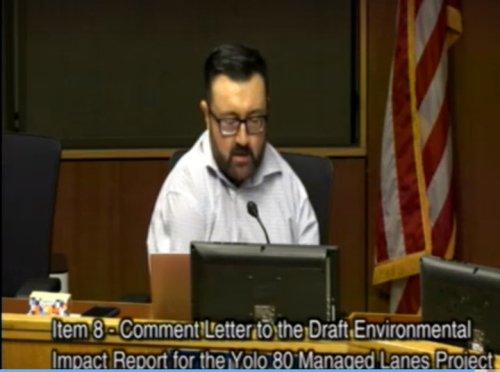
Below is a transcription of Councilperson Will Arnold remarks on the I-80 widening for the video of the 1/9/24 Davis Council meeting. Arnold was the Manager of Media Relations at Caltrans HQ until August 2023. His testimony adds to that of the Hi level whistle blower Jeanie Ward-Waller She accused Caltrans of violations CEQA in moving ahead freeway widenings and I-80 project in specific. YoloTD Board has never asked their staff or Caltrans a single question about that in any open board meeting.
(Link to city website with video see time stamp 3:51:29)
“Thank you, Mayor Chapman.
There is an important note I want to read:
‘Highway investments over the years have contributed to a dependence on automobiles and supported development patterns that have made walking, cycling and transit use inefficient, challenging and sometime dangerous in many parts of the state. Highway investment have also contributed to the displacement and division of some neighborhoods and imposed noise and safety hazard on many others.
Further research over the past several decades had demonstrated that highway capacity expansion has not resulted in long term congestion relief and in some cases has worsen congestion, particularly in urbanized regions. (ed note: all emphasis his) Projects in urban area that add travel lanes result in changes in travel behavior due to a short-term reduction in travel time and improvement in reliability. This phenomenon known as “Induced travel” explains why adding capacity has rarely succeed in reducing congestion over the long term or supported alternatives to driving and more transportation efficient land uses.
Finally, highway expansions are costly. Expansion of the existing highway system means less available funding for other transportation needs and priorities as well as continued increase to long term maintenance costs for the existing system. As a result, we cannot continue the same pattern of highway expansion investment in California and expect different results. 3:52:52
Rethinking our approach to highway expansion programs will be a critical part of insuring we are working toward equitably meeting our climate change goals. 3:53:01 ‘
This is part of the state Climate Action Plan for Transportation Infrastructure, known as CAPTI. This is a document passed in 2021 by the state transportation agency signed by Davis Hi Alumnus David Kim, former (CA) Secretary of Transportation
They Know. THEY KNOW (Arnold emphasis), They know what we are saying it true.
This isn’t a secrete in Sacramento, this it isn’t a secrete in any of the 12 Caltrans districts, even District 12 in Orange county. They know.
And yet, we reach these inflection points where it’s time to put our money where our mouth is as a state in how we invest our limited transportation dollars, and we each these inflection points and the same thing keep happening when we invest in what we know, which is more freeways, or lanes expecting a different result.
Which we know is the definition of Insanity.” ends 3:54:18
(From press release) Citing “the potential to induce sprawling growth”, the “potential adverse impacts on prime farm land”, “lack of proper public process”, devastating environmental and social outcomes including climate change, air pollution, and loss of biodiversity, the Sierra Club announces its opposition to Measure M in Woodland CA on the March 5, 2024 Special Municipal Election Ballot. Measure M is a vote to allow the construction of the Lower Cache Creek Flood Risk Management Project or, as it is referred to locally, the “Floodwall”.
In 2004, a majority of Woodland voters passed Measure “S”, which added a section to the Woodland Municipal Code that provides that the City shall not fund or take any action that supports the Lower Cache Creek flood barrier or a “substantially similar structure”.
A "No" vote on Measure "M" will keep that prohibiting language in the Woodland Municipal Code in its current form as originally enacted by Measure “S”, and will not allow City Council authorization for the construction and funding of the Lower Cache Creek Flood Risk Management Project.
The Lower Cache Creek Flood Risk Management Project consists of a 5.6 mile massive earthen structure from 6 ft to about 16 ft above grade, depending on its location, and the existing topography of the land. It will run east-west just north of the northern urban limits of the City of Woodland connecting to an existing levee on the Cache Creek Settling Basin.
The endorsement of the opposition to this ballot measure follows an extensive evaluation process by the local Sierra Club Yolano Group Management Committee, the Sierra Club Mother Lode Chapter Political and Executive Committees, and the Sierra Club California Local Measure Review Committee.

(From press release) Wildhorse neighborhood residents and Tree Davis have been developing a concept to transform under-used portions of Robert Arneson Park (the park adjacent to the intersection of Moore Boulevard and Bonnard Street in Northeast Davis) into Climate-Ready Landscapes. Climate-Ready Landscapes are spaces that are visually vibrant, drought tolerant, and support local nature. At Robert Arneson Park, this will be in the form of pollinator gardens and mini-forests. The Robert Arneson Park concept is related to work that Tree Davis has been working on at the Memorial Grove in West Davis on Shasta Drive.
Tree Davis is seeking feedback about the concept from park users and other stakeholders to gain insights about what changes will work best. There will be two in-person feedback sessions at the park. Before proceeding with this project, it is important that the Wildhorse community and other park users are comfortable with the changes that are proposed for the park. Tree Davis staff will be tabling, answering questions, and accepting feedback on Thursday, January 25th from 2:30pm to 5:30pm and Saturday, January 27th from 8:00am to 12:00pm near the central rotary off of Moore Drive.
Those that would like to share their thoughts but are not able to come to the in-person sessions can share feedback through an online survey, which can be found at: https://forms.gle/AfjBDcvJV3wERngA9 To see the project plans and learn more, visit our website at: https://www.treedavis.org/robert-arneson-park/
Tree Davis is a 31-year-old local non-profit that was established by local leaders to ensure the health of the city’s urban forest. Over the years the organization’s focus has grown – today the mission is to improve the health and resilience of local communities by enhancing and expanding Climate-Ready Trees and Landscapes through direct action, community engagement, and advocacy.
By Alan Hirsch
This year's Davis city-sponsored King celebration is on Peace Activism. It will take place on Monday at 10 am at the Veterans Memorial Center.
This 53-second viral YouTube video of Stokely Carmichael/Kwame Ture discussing peace and justice provides the context in which King was working.
I believe local cities, especially progressive Davis can best honor King by learning from him about how change happens- what it feels like when you are in the middle of the story. We can learn by analogy what it looks like when a local community is grappling with deep structural change—and how local civic leaders respond when they recognize the need for a change in the traditional way of doing things.
King’s goal in 1960’s was to reform the structural evil of Jim Crow, deeply ingrained in the culture of Southern cities.
Today, we are in the middle of a story of how to deal with the climate crisis - a society dependent on burning fossil fuels creating a crisis for long-term survival.
For Dr. King the obstacle to change was not Washington but local government. The Supreme Court had just equipped local governments with tools through rulings like Brown vs. Board of Education. The Eisenhower and Kennedy Administrations were sympathetic, yet in the 1960s South, it was local businesses & governments that resisted. They sought to first maintain peace, of the status quo, fearing that change would be disruptive, leading to divisiveness and disorder.
Similarly, in addressing climate change, the State of California has established strong goals and policies. It has provided local governments with tools under the environmental impact process to reduce our dependence on fossil fuels.
Local leaders are aware of what is at stake for climate.. During a discussion of the I-80 freeway widening January 9th Davis Councilmember Will Arnold shared what he learned when he was a Caltrans employee. He read from Caltrans HQ policy states freeway widening does not fix congestion for long and also undermines the state climate change plan…. local caltrans district need to stop advancing these projects. Arnold summed it up dramatically:
"We know this," widening freeways is "insanity."
Will Arnold labels I-80 insanity but other won’t join him
By Alan Hirsch
At the January 9th council meeting, Councilman Will Arnold read Caltrans policy guidance to local districts offices. It states flatly freeway widenings don’t work and are contrary to state climate change plan. He then said it was “the definition of… insanity” to try widening one more time. Arnold is a former high level Caltrans employee.
But in the city council did NOT support Arnold and the transit option and oppose widening due to abstentions by Gloria Partida (“I’m not sure” i.e.-we may need toll revenue) and Donn Neville (“I need more information”) .
Find the petition at: https://www.change.org/BetterYoloTransit
Why this petition matters
On Tuesday, let’s hope council is more curious than YoloTD on DEIR
By Alan Hirsch

At the YoloTD board meeting on December 11 the YoloTD staff the presented the I-80 project. After 6 public comment, and 16 ½ minute discussion they unanimous decided to accept the DEIR, it VMT mitigation plan, and the staff recommend alternate 4. HOT3+
These are the slide staff presented.
https://yolotd.org/wp-content/uploads/2023/12/2023-12-11_YoloTD-BoardSlides.pdf
No one at the meeting unpacked the ongoing financial obligation of mitigation that YoloTD took on as part of the DEIR
….. in turn for getting the $86 million in free starter money for the project
The VMT/GHG mitigation plan is on slides 15-19—which lists all the 7 mitigation measures.
Its bit confusing so let me unpack – before the Tuesday council meeting.
The following letter was submitted this morning by Dr. Stephen Wheeler and the Sierra Club Yolano Group as formal comments for the Yolo 80 Draft Environmental Impact Report (DEIR), addressed to Dr. Masum Patwary, Environmental Scientist C at the California Department of Transportation. A copy was also sent to the Davis City Council. The letter concludes by stating that the Yolo 80 DEIR should be revised and recirculated.
Dear Dr. Patwary:
This letter provides detailed comments on the Yolo 80 Draft Environmental Impact Report (DEIR) on behalf of the Yolano Group of the Motherlode Chapter of the Sierra Club.
I have prepared these comments as an unpaid Technical Advisor to the Yolano Group. In my professional life I am a Professor of Urban Planning and Design in the Department of Human Ecology at the University of California, Davis, and Chair of the UC Davis Community Development Graduate Group. I have studied urban and regional planning topics for more than 35 years, including interactions between transportation systems and regional land use patterns, and was formerly chair of the City of Berkeley Transportation Commission and cofounder of the Bay Area’s regional transportation-land use-housing advocacy organization Transform. I am the author of urban planning textbooks used in universities worldwide, including The Sustainable Urban Development Reader (Fourth Edition, 2023), Planning for Sustainability (Third Edition to be published in late 2024), and Reimagining Sustainable Cities (2021). My awards in this field include the Dale Prize for Excellence in Urban and Regional Planning.
Let me say first that it’s very unfortunate that the Yolo 80 project has proceeded this far without better alternatives being considered. As has been widely known for decades, widening freeways does not fix congestion problems; it just defers them for a few years while increasing overall motor vehicle use, greenhouse gas (GHG) emissions, local air pollution, suburban sprawl, and related problems. The climate crisis gives particular urgency to the need to stop increasing road capacity and vehicle use. Although California is making progress in many sectors towards reducing its GHG emissions, transportation is one area in which it is not. Transportation is also the single largest source of the state’s GHG emissions, accounting for 38 percent of the total.
In order to meet California’s GHG reduction goals, the state has adopted policies that discourage road expansion and its concomitant VMT increases. SB 743, passed in 2013, required agencies to use VMT as a metric for analyzing transportation impacts of new projects after July 1, 2020 instead of Level of Service (LOS). Put another way, this bill made reducing overall motor vehicle use the goal of state policy rather than short-term reductions in road congestion. The California State Transportation Agency (CalSTA)’s Climate Action Plan for Transportation Infrastructure (CAPTI), adopted in 2021, establishes policy that “projects should generally aim to reduce vehicle miles traveled” and counsels agencies that “when addressing congestion, consider alternatives to highway capacity expansion such as providing multimodal options in the corridor, employing pricing strategies, and using technology to optimize operations.” However, Caltrans appears to be disregarding the state’s new policy framework with multiple projects including Yolo 80.
A certain amount of congestion isn’t bad in that it puts realistic constraints on the public’s behavior. However, if congestion is deemed to be a problem beyond that point, the academic and professional literature shows that pricing, better land use planning, and other demand management solutions (e.g. working with large employers to promote vanpools and transit use) are the best strategies. But Caltrans never considered those alternatives in the Yolo 80 case. It clearly wanted to widen the freeway from the start, and indeed appears to have illegally begun widening I-80 east of the Mace intersection and west of the I-50 split in early Fall 2023 well before the current environmental review was completed. This action shows a high level of disregard for CEQA/NEPA processes, and we ask Caltrans to suspend construction activities on Yolo 80 until environmental review is completed and the environmental document certified.
The Yolo 80 DEIR has a great many deficiencies which require revising and recirculating the document. These include the following:
The following comments were submitted to the City of Davis by the Sierra Club Yolano Group on December 8. Transmitted via email to <SMetzker@cityofdavis.org>
Biological Resources
1. The Biological Resources should be studied in detail as outlined in the 5 December 2023 letter from Madrone Ecological Consulting, “Subject: Summary of Biological Resources Surveys Planned for the Village Farms Project, Yolo County, California.” but with the following suggestions:
Traffic
By Alan Hirsch, YoloTD
As you read this, the lengthy draft Environment Impact Report (EIR) for the widening of I-80 has been released for public review (see I-80 Widening draft EIR now available). It was first promised in early 2021.
Readers should be warned not to take its results as truth, but rather as a forecast that has not been peer reviewed. The goal of public review of an EIR is to correct the deficiencies before the final document is completed and a decision to approve the project is made. If done accurately, the conclusions should inform government decision makers if the $330 million project‘s benefits outweigh the impacts.
These background facts and past Davis Enterprise reporting might be useful as you read the draft EIR:
 Davisite