Davisite Banner. Left side the bicycle obelisk at 3rd and University. Right side the trellis at the entrance to the Arboretum.

Category: Environment

  • Tree Davis Position on Sutter Davis Hospital Tree Removal

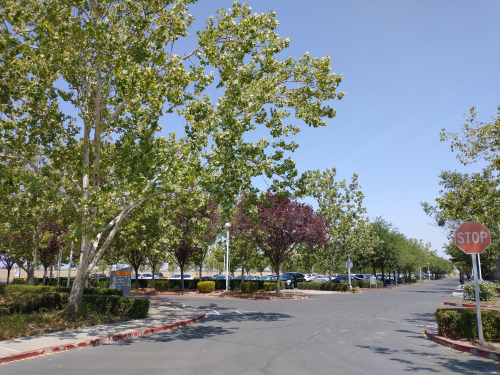
    Sutter Parking Lot Shade Trees 1

    Sutter Parking Lot Shade Trees

    A recent article in the Davis Vanguard ("City Will Have to Weigh between Trees and Solar Panels at Sutter as Complaints Reign about Public Process," July 21, 2021) described a variety of issues concerning the Planning Commission’s recent approval to remove 205 trees in association with improvements to the Sutter Davis Hospital campus. Tree Davis appreciates the efforts made by David Greenwald and Alan Hirsch to bring this proposal into the public spotlight. The Tree Davis Board has these thoughts to share.

    1) Our tree canopy is under increasing threat from decline due to old age, development, and climate change stressors like drought, wind, and pests. Tree Davis supports increasing measures to protect and preserve healthy trees and to grow our community canopy with climate-ready species. 

    2) We recognize that in certain circumstances, retaining healthy trees may not be possible. Full mitigation of lost canopy, through planting either on-or off-site should be accomplished, as per our Tree Ordinance.

    3) We support retaining mature tree canopy in parking lots when possible because trees can provide environmental and social benefits that PV arrays cannot, such as heat island mitigation, carbon storage, air pollutant uptake, beauty, stress reduction, and wildlife habitat.

    4) Tree Davis believes that the Tree Commission’s charter should be updated to include consultation on individual project proposals because of the expertise they can provide. For example, the proposal to transplant 43 mature trees to another location at Sutter Hospital may sound reasonable, but, the benefits may not offset the costs in the long term. The failed effort in Woodland to transplant historic olive trees along Gibson Rd. is an example.

    Greg McPherson
    President, Tree Davis Board of Directors

  • Sustainability, Adaptation, and Regenerative Farming: Understanding Responses to Global Warming

    This article was first published at https://islandviewmedia.net/blog/ and is reprinted here with permission of the author.  Davisites may find it of interest given the re-surfacing of the DISC project, which would pave over farmland and replace it with an automobile-oriented industrial project.  Regenerative farming envisions a way that the land could be used to combat rather than contribute to climate change and could potentially be deployed in various places in the Davis area.

    By Robert Chianese

    We strive to ensure our future by living, growing, and building sustainably. I’ve written about “Sustainability” since  the 1970’s, starting with my prize-winning essay on forming a local Sustainability Council which I did here in Ventura County. I became a true believer in its promise to reduce our impacts on the planet through its very tough tri-fold requirements: use renewable energy, no toxics, cause no loss of biodiversity.

    I later saw its promise fade as it became lost first in the fraudulent use of the term to “green-wash” all sorts of products and processes–lying about their sustainability. The FTC issued “Green Guides” in 2012 to push back on unsubstantiated claims about so-called green products, but corporations ballyhoo the term even more now. We hear boasts about the eco-friendly products of Clean Coal Energy, ExxonMobil, Monsanto, Dow Chemical, Malaysian Palm Oil and the Fur Council of Canada. Short-term ugly profit is more like it.

    Even more disturbing are current reports about our failures to shift off our carbon-hungry diet. Through our human-caused, “anthropogenic” actions, we cloak the globe in a heat shroud, intensifying droughts, wildfires, floods and sea level rise. Nothing sustainable here.

    Teenage phenom Greta Thunberg spent almost a year investigating how well we are meeting our environmental challenges. The documentary, “I Am Greta,” follows her through various countries and climates in search of sustainability successes, but she’s mainly discouraged and defeated. She even confronts the dean of environmental programs, David Attenborough about his gorgeous nature films in the time of climate systems collapse. He half-concedes he needs to change his pitch. His new series “A Life on the Planet” tries to atone for glossing over our very un-gorgeous damage to the earth.

    Ecologists have come up with new concepts we need in order to save the planet. Some say we need to adapt to the new climate realities, which implies accepting the damage we have done and adjusting to it. But neither adaptation nor adjustment get defined clearly.

    (more…)

  • City of Davis and the (Near) Future of Rail Travel

    L21spanish

    Virtual Public Workshop! Thursday, July 15 from 530 to 7pm


    I wrote the Bicycling, Transportation and Street Safety Commission (BTSSC) earlier today:

    To the BTSSC,

    I strongly suggest that the BTSSC set up an ad-hoc sub-committee about Link21 so that it can stay engaged long-term, receive and process community input and then at the appropriate time make recommendations to the City Council.

    The City of Davis is a small tomato in a huge pot of soup in this matter, but the railway proportionately bisects the City of Davis more than other town along its current route between Oakland and Davis. Davis grew around the rail and I-80 corridor in a way that – especially in the last 60 years – did not facilitate multi-modal travel based on the railway. A typical regional or suburban station like Davis in much of Europe would have multiple bus lanes that terminate at the station and hundreds of secure bicycle parking space for all kinds of bikes, suburb connections for walking and cycling for all directions, and a lively place for activity in front of the station, instead of a parking lot. The City has made some progress in this area of late, but, for example, there are still many who want a new parking structure at the station, and voters thankfully – but only narrowly – disapproved a new development project far from the station with no good cycling connections to it, lots of parking and imagined good access to I-80.

    I had tried to form a sub-committee nearly three years ago about the I-80 Managed Lanes Project, but it was terminated shortly after Commission approval because the second member moved to Sacramento. While I appreciate the healthy skepticism the BTSSC had about the Managed Lanes Project at the last meeting, I believe it prudent to get ahead of the game as much as possible for this even larger project that relates to both the Managed Lanes Project as well to our Downtown and General Plans, as significantly improved rail service would facilitate the creation of a lot more carfree or carlite households in town. As you seem to recognize, the worst outcome of the Managed Lanes project will do nothing but worsen traffic in town and literally throw a rotten tomato at our forming Climate Policy. The worst Managed Lane implementation will not support railway travel until perhaps many years from now, and indirectly, when thousands of Davis residents, frustrated with increased congestion and pollution, surround Caltrans District 3 HQ and bombard it with stinky, rotten tomatoes genetically-modified to annoy "deaf" state officials and narcissistic automobilists.

    TomatoesAs a robust railway powered by renewable energy is a key tool in fighting Climate Change, I would also suggest you consider making the sub-committee a joint one with NRC, and Social Services too in order to help ensure that the system is accessible for all households.

    The person who seems to be the current project manager for this part of the Megaregion, Jim Allison from Capitol Corridor, is very approachable and helpful. The Link21 sub-committee would be wise to also connect with other – especially smaller – communities along the corridor in order to create common, expected and seamless last-mile connections to their stations, and dense and proximate housing that makes good public transportation possible. All the pieces are necessary, but the puzzle has to be solved by everyone. I think that I prefer the tomato to the puzzle metaphor.

    Thanks,

    Todd Edelman"

  • Vague lanes solving regional pains?

    Davis80

    Not the Caltrans project! This is the author's concept for a bypass to and from the Bypass.

    On July 1st Davis Vanguard covered the announcement of Federal funding of 86 million dollars for the Yolo-80 Managed Lanes project.

    I appreciate most the comments of Alan Miller, Alan Pryor and Richard McCann. I hope I can add something below.

    The MTC area gets a lot of income from its bridges, and uses it for public transportation. Consider that Davis and SACOG-area drivers pay into this when driving south to San Jose, west to Oakland and San Francisco, and so on, but people from those areas make no similar contribution our region – really, the east side of the Northern California Megaregion – when traveling to Davis or Sac or of course towards Lake Tahoe.

    Caltrans dropped the long-promised new bike-ped bridge across the Bypass, replaced by some improvements on the west side of the Bypass. Combined with new infrastructure such as separated lanes and a lot of shade trees in West Sac,  the  whole corridor could be optimized for faster e-bikes and provide a good alternative for many, especially in east and the east part of South Davis. But… nope! Or so it seems.

    The graphics in the Caltrans presentation on the Yolo 80 Corridor planned for the BTSSC meeting this Thursday show only buses in the managed lanes, which is not what’s really planned for the managed lanes. Nasty! The managed lanes are mostly in added lanes, and if these lanes are available for private vehicles off-peak, for a premium, or free for a carpool then induced demand happens – see also Alan Pryor's comment in the Vanguard article – and we eventually lose.

    It’s also not clear how this project interfaces with the 80-Richards project.

    It’s not clear how much congestion there will be during the long construction period.

    It’s not clear if any general re-paving will decrease noise (new technology makes this possible).

    It’s probably unlikely that Caltrans will support a discount on Capitol Corridor during the construction period.

    But yeah, rail. What’s up with the future Capitol Corridor improvements? How does this project related to our impending new General Plan? My favorite idea is to build a highway bypass south of town and then put the railway below grade so that it also no long splits the City in two (in retrospect, it would probably have been better to not build anything south of the 80-rail corridor). Anyway, all the new space roughly in the center of Davis could be the location of a lot of new dense, mixed-use development which could facilitate low-vehicle ownership or at least use, as it would eventually be convenient to UCD and Downtown by bike, to both Sacramento and especially the Railyards, and to points to the west by rail. It would also be much quieter in parts of the City with this sort of ring-road solution. In general terms it would complement my concept for building above 113 roughly between Russell and Covell. I've also proposed a noise-mitigation and solar-generation project for the I-80 corridor through Davis.

    Related to this whole thing and that next to last point, over three years ago when I was on the BTSSC I initiated a sub-committee on 80 and related. It never went anywhere and was dissolved as the other Commissioner who joined it moved to Sacramento and no one else on the Commission wanted to pursue this… route. Sigh. Please demand that BTSSC members ask some hard questions this Thursday!


  • California’s Huge Budget Surplus Provides Once in Lifetime Opportunity to Bury Fire-Causing Power Lines

    Four power line fires map Sonoma Independent June 3 2022

    By Nancy Price

    Despite predictions of an even worse year for wildfires and power shutdowns than 2020, not one dollar of California’s immense $76 billion budget surplus is being allocated to actually prevent wildfires which is to bury overhead power lines.

    Since 2017, four of the six most destructive fires have been sparked by overhead power lines. Burying just a tiny fraction of these lines that pose the highest risk of fires is by far the most important preventive measure to protect us from catastrophic fires and the terrible cost we pay with our lives, health, economy and environment. 

    Preventing fires mean we can protect our forests that are much need carbon sinks so we can realize our state’s ambitious greenhouse gas reduction target to achieve carbon neutrality by 2045.

    Burying overhead wires would also eliminate the expanding number of massive power shutdowns that liability-averse utility companies order because of the fire risks. These shutdowns impacted 2.5 million Californians last year, especially the elderly and infirm, whose lives sometimes depend upon medical machinery requiring steady electricity.

    (more…)

  • 15 mph DESIGN SPEED in Davis!

    SD15
     
    My strong feeling is that all local streets – including Downtown – should have a 15 mph design speed. This is already a number most are familiar with, as it's used alongside e.g. speed tables on school routes and even the sharp turn from 2nd St to L St.

    The design speed is a speed that most people feel comfortable moving at in motor vehicles. People on bikes can also feel a design speed, but they are nearly infinitely more inherently safe than motor vehicles to others in the public ROW. 15 is also a bit faster than most cycling speeds.Traveling by bike on most greenbelt paths in Davis at 15 mph feels too fast – the paths are under-built – and perhaps the biggest design flaw in post 1970's Davis, sadly and ironically complemented by the clinically-insane wideness of many streets in West Davis, Mace Ranch and South Davis… but also much older streets in Old North, etc.

     
    Does it seem slow? Perhaps. However, consider that for most journeys by motor vehicle a relatively short distance is on local streets. So any journey lengthening will be minimal.
     
    Or can it even be shorter? Yes! 15 mph speed design is best complemented by elimination of existing mandatory stops; to be replaced by yields. It's these often unnecessary stops that lengthen journey time the most. Getting rid of them also decreases pollution (gas, particles and noise) and makes people less likely to feel the need to speed to the next stop sign.
     
    So it can be both safer and faster!

    (more…)

  • Big problems at BTSSC meeting tonight!

    2nd StRailway modification project along 2nd St. leads to subverted process and disrespected City policy.

    The item "CCJPA 2nd Street Improvements 30% Design" is on the Consent Calendar for the Bicycling, Transportation and Street Safety Commission (BTSSC) today.

    The Capitol Corridor Joint Powers Authority (CCJPA), which runs the eponymous rail service with partner Amtrak, is planning to make modifications to the railway parallel with 2nd St, roughly between L St and the Pole Line. A significant part of the project will also raise, repave and re-stripe 2nd St – there's long been a problem with railway ballast making its way to the street – and include installation of an ADA-compliant sidewalk on the north side of the street, where no sidewalk currently exists up to the west end of Toad Hollow.

    So far, so good? Unfortunately not. The item involving a significant infrastructure modification is only on the Consent Calendar and the changes to the street itself – aside from the new sidewalk, which is clearly a good thing – are not following the 2016 Street Standards, and the whole length of 2nd St is not compliant with the 2013 General Plan Transportation Element.

    (more…)

  • “Should Trees Have Standing?”

    IMG_7711The legacy of Christopher D. Stone.

    By Nancy Price

    It is fitting to honor Christopher Stone just when the Vanguard is hosting a webinar on the topic of Climate Change, SocioEconomic Disparities in Tree Cover and Sustainability on Sunday morning (May 23).

    For those who have never read Stone’s seminal article, he is remembered by so many as the father of environmental law for his inspired, path-breaking article, “Should Trees Have Standing? Toward Legal Rights for Natural Objects.”

    In this 1972 article in the Southern California Law Review where he taught at the USC Gould School of Law for 50 years, Stone wrote: “I am quite seriously proposing,…that we give legal rights to forests, oceans, rivers and other so-called ‘natural objects’ in the environment – indeed to the natural environment as a whole.” He went on to propose that these rights would be asserted by a recognized guardian, much as the law allows for guardians for children, incapacitated adults and others who have rights but require someone to speak on their behalf. As Stone pointed out, “the world of the lawyer is peopled with inanimate right-holders – such as trusts, corporations, joint ventures, municipalities…and nation states.” Stone was insisting that rather than treating nature as property under the law, that nature in all its life forms has the right to exist, persist, maintain and regenerate its vital cycles.

    (more…)

  • The Yolo Way meets the American Rescue Plan

    Our recovery from the pandemic must also be a response to the climate emergency
    By Adelita Serena
    You may have seen an internet meme that began as a March 2020 Graeme MacKay editorial cartoon. In one version, a “COVID” tsunami threatens a coastal city; behind it comes a larger “Recession” tsunami; behind it a “Climate Change” tsunami; and finally behind it a “Biodiversity Collapse” tsunami.

    Despite Yolo County’s inland location, we need to take seriously the message of this cartoon — that our recovery from the pandemic must also be a response to the climate emergency. It must also address deeply entrenched economic and social inequities causing these crises to strike some communities and demographics much harder than others.

    One immediate way to do this is to use our American Rescue Plan funding to develop narratives, programs, and projects that do all three: repair damage from COVID-19, fight climate change, and follow the leadership of frontline and long-disadvantaged communities for whom these efforts have the highest stakes. We can call our approach to these problems “The Yolo Way,” by which we signal our local recognition of what Martin Luther King called “an inescapable network of mutuality” and our commitment to making that network more healthy, just, fair and sustainable.

    (more…)

  • Senator Portantino Champions Ratepayer Equity Legislation

    SB 612 creates fair system for managing legacy energy resources and reducing costs for all ratepayers

    (From press release) State Senator Anthony Portantino (D-La Cañada-Flintridge) has introduced SB 612 which requires that California electric ratepayers have fair and equal access to benefits associated with investor-owned utility (IOU) legacy energy resources and that the resources are actively managed to maximize their value. The bill, sponsored by the California Community Choice Association (CalCCA), will have its first hearing on April 26 before the Senate Energy, Utilities and Communications Committee.  The bill would benefit community choice aggregators such as Valley Clean Energy, which serves electricity customers in Woodland, Davis, Winters and the unincorporated areas of Yolo County.

    Legacy energy resources are a major concern because they account for billions of dollars in above-market costs in IOU energy portfolios, and the utilities rely on California ratepayers to pay the costs. They include capital-intensive utility-owned generation facilities and expensive long-term renewable energy contracts with third parties.

    Under SB 612, legacy energy resources would be handled in more prudent ways that reflect new market realities and that reasonable steps are taken to minimize above-market costs that accrue to ratepayers.

    (more…)