Davisite Banner. Left side the bicycle obelisk at 3rd and University. Right side the trellis at the entrance to the Arboretum.

Category: Environment

  • The Yolo Way meets the American Rescue Plan

    Our recovery from the pandemic must also be a response to the climate emergency
    By Adelita Serena
    You may have seen an internet meme that began as a March 2020 Graeme MacKay editorial cartoon. In one version, a “COVID” tsunami threatens a coastal city; behind it comes a larger “Recession” tsunami; behind it a “Climate Change” tsunami; and finally behind it a “Biodiversity Collapse” tsunami.

    Despite Yolo County’s inland location, we need to take seriously the message of this cartoon — that our recovery from the pandemic must also be a response to the climate emergency. It must also address deeply entrenched economic and social inequities causing these crises to strike some communities and demographics much harder than others.

    One immediate way to do this is to use our American Rescue Plan funding to develop narratives, programs, and projects that do all three: repair damage from COVID-19, fight climate change, and follow the leadership of frontline and long-disadvantaged communities for whom these efforts have the highest stakes. We can call our approach to these problems “The Yolo Way,” by which we signal our local recognition of what Martin Luther King called “an inescapable network of mutuality” and our commitment to making that network more healthy, just, fair and sustainable.

    (more…)

  • Senator Portantino Champions Ratepayer Equity Legislation

    SB 612 creates fair system for managing legacy energy resources and reducing costs for all ratepayers

    (From press release) State Senator Anthony Portantino (D-La Cañada-Flintridge) has introduced SB 612 which requires that California electric ratepayers have fair and equal access to benefits associated with investor-owned utility (IOU) legacy energy resources and that the resources are actively managed to maximize their value. The bill, sponsored by the California Community Choice Association (CalCCA), will have its first hearing on April 26 before the Senate Energy, Utilities and Communications Committee.  The bill would benefit community choice aggregators such as Valley Clean Energy, which serves electricity customers in Woodland, Davis, Winters and the unincorporated areas of Yolo County.

    Legacy energy resources are a major concern because they account for billions of dollars in above-market costs in IOU energy portfolios, and the utilities rely on California ratepayers to pay the costs. They include capital-intensive utility-owned generation facilities and expensive long-term renewable energy contracts with third parties.

    Under SB 612, legacy energy resources would be handled in more prudent ways that reflect new market realities and that reasonable steps are taken to minimize above-market costs that accrue to ratepayers.

    (more…)

  • More concerns about Putah Creek restoration proposal

    April 5, 2021

    Davis Open Space and Habitat Commission

    Re: Proposal for habitat restoration/public access project along the South Fork of Putah Creek east of the City’s South Fork Preserve

    Dear Commissioners:

    I recommend that you approach the proposal with great caution and offer these questions and comments. There is no objection to weed control, riparian planting, and modification of water diversion methods. But the largest part of this proposal is to modify channel form, and that is of great concern. It’s been tried before on Putah Creek in Winters at great cost and great loss to fish and wildlife and riparian forest resources.

    The stream channel filling and alteration part of this proposal is premised on these erroneous ideas about the existing stream condition:

    (more…)

  • Please do not allow the Solano County Water Agency to destroy the Davis Putah Creek Preserve

    Note: the following was emailed to the Davis City Council and to members of the Open Space and Habitat Commission early this afternoon.

    Commissioners – Firstly, I apologize for this late communication so close to your Open Space and Habitat Commission meeting this evening. I just became aware yesterday of tonight's agenda item on the proposed study to modify Putah Creek through the Davis Putah Creek Preserve.

    I represent Friends of Putah Creek which is a non-profit corporation formed in response to the disastrous waterway modifications that were made in the Winters Putah Creek Parkway by the Solano County Water Agency. These changes were made during the last decade under the same guise of remediation and restoration of the Creek to a natural "form and function" as is now represented by their employee tonight. The current study proposes to eventually implement many of the same misguided, non-scientific based "improvements" in the Davis Putah Creek Preserve which proved so harmful in Winters.

    In response to the obvious outcome shortcomings of that project, Friends of Putah Creek undertook an extensive and quantitative evaluation of the project in terms of the subsequent habitat degradation and decline in plant and animal population in the Parkway. In this study we found substantial failure of the project to meet the promised improvements – even after spending over $7 million dollars on the 1.25 mile project itself and then millions more in subsequent efforts to remediate the damage caused by the project. Even today we are still seeing extensive tree die-back and loss of animal life that has yet to return. This is the worst example of environmental pork Yolo County has ever seen.

    (more…)

  • Valley Clean Energy Makes Major Solar+Storage Power Deal

    PV solar project

    A subsidiary of NextEra Energy Resources will construct Resurgence Solar, the new photovoltaic (PV) solar project, on the existing site. It will look similar to the project shown in this photo. Courtesy photo

    (From press release) With its recent approval of a new power purchase agreement, the Valley Clean Energy (VCE) board of directors took another significant step toward the agency’s goal of providing cost-effective renewable energy — and resilience — to its customers. VCE is the local electric generation provider for Davis, Woodland, Winters and unincorporated Yolo County.

    The VCE board approved the 20-year agreement to purchase the output from the Resurgence Solar I project currently under development in San Bernardino County by a subsidiary of NextEra Energy Resources, LLC. The total capacity of the solar photovoltaic project is 90 megawatts (MW) of power and 75 MW of battery energy storage. This project supplies enough energy to power two-thirds of the households served by VCE, and the storage delivers power to the electricity grid when it’s needed the most, in the early evening.

    “We are very pleased to work with Valley Clean Energy to help meet their renewable energy goals and bring clean, affordable, home-grown solar energy to their customers,” said Matt Handel, senior vice president of development for NextEra Energy Resources.

    (more…)

  • Debrief on Debris in the Bike Lane?

    IMG_20210203_073619

    South-bound Pole Line just south of East Covell. Convenient to pick-up, not so convenient for people who want to use the lane
    IMG_20210203_062949

    An hour earlier – most bikes are not equipped with headlights and the person on a bike might not see it.

    UPDATE: The piles I've described in this post which were on or near the East Covell corridor have been removed. There are some others in the bike lane on Loyola between the entrance to Korematsu Elementary and Alhambra, and still nothing either here or in general to communicate to people driving motor vehicles that people on bikes may deviate from the bike lanes….

    *****

    Last week's storm was the worst in ten years by many accounts, with serious damage to trees and property, a significant loss of perishable food and other problems caused by lack of power.

    Obviously city staff, private contractors and others had their work cut out for them and certainly we applaud their efforts, though many cheered PG&E field staff and they pooped on their bosses (and shareholders).

    From what I saw, arterial streets in Davis were cleared for the most part by January 28th, the day after the storms mostly ended. When out then to photograph the weird non-standard lane design on Lake at Russell I passed the dangerousafety radar speed sign on East Covell Blvd. that I blogged about last week.

    I noticed that street sweepers had made at least two passes on the traffic lanes of East Covell, because there was a consistent line of debris that started a  foot or two into the bike lane from the number two lane. I noticed the same, um, edging on other arteries.

    (more…)

  • Better main shot cropped_REDCity is blocking bike lanes?

    The City of Davis' only response to recent crashes in the vicinity of Pole Line Road and East Covell Blvd has thus far been Enforcement1. Actively, the Davis Police Department has been monitoring some locations in the area.  Passively, the City has placed a radar speed sign on WB East Covell between Manzanita and Baywood Streets, right about here.

    Why is the radar speed sign in the bike lane? The City places similar signs – and they and private contractors place various construction signs – off to the side on streets when there's space to do so, so they clearly understand the advantage of doing so. But when there's no space, they place the signs on the side of the street, and on most collectors and arterial streets in Davis this means it's in a bike lane.

    "Putting a radar feedback sign on Covell to invite drivers to slow down: good. Putting a sign in bike lane: not good," says Nicolas Fauchier-Magnan, the President of Bike Davis, who usually goes by Nico.

    "Obstructing the bike lane, on a street where drivers routinely go 50 mph or more is simply irresponsible. 

    "Come on, City of Davis," continues Nico. "You should know better, and you can do better. Please fix this terrible blunder before someone gets hurt. There is plenty of space on the grass, outside of the bike lane, to safely place this sign."

    (more…)

  • Nuclear weapons are illegal

    By Sarah Pattison

    On Jan. 22, the Treaty on the Prohibition of Nuclear Weapons enters into force and becomes part of the canon of international law, after it was ratified by the required 50 states. According to Article 1 of the Treaty, states party to the Treaty are prohibited under any circumstances from any of the following activities:

    1. Develop, test, produce, manufacture, otherwise acquire, possess or stockpile nuclear weapons or other nuclear explosive devices;
    2. Transfer to any recipient whatsoever nuclear weapons or other nuclear explosive devices or control over such weapons or explosive devices directly or indirectly;
    3. Receive the transfer of or control over nuclear weapons or other nuclear explosive devices directly or indirectly;
    4. Use or threaten to use nuclear weapons or other nuclear explosive devices;
    5. Assist, encourage or induce, in any way, anyone to engage in any activity prohibited to a State Party under this Treaty;
    6. Seek or receive any assistance, in any way, from anyone to engage in any activity prohibited to a State Party under this Treaty;
    7. Allow any stationing, installation or deployment of any nuclear weapons or other nuclear explosive devices in its territory or at any place under its jurisdiction or control.

    Because the United States has neither signed nor ratified the treaty, it does not have the force of law in this country. But the treaty was approved by 122 nations in 2017, and has since been signed by 86 nations and ratified by 51. It is a clear reflection of the frustration and impatience of non-nuclear nations with nuclear weapons states that have failed to fulfill the promise they made “in good faith” in the Nonproliferation Treaty in 1970 to negotiate the cessation of the arms race and complete disarmament “at an early date.” While our country and other nuclear weapons states may attempt to sidestep the legal force of the Treaty, we cannot avoid the compelling moral power it carries.

    (more…)

  • A revolution of values

    Move money to human, environmental needs

    By Nancy Price

    On Jan. 18, we celebrated Martin Luther King Jr.’s Jan. 15 birthday. With the long weekend, you could listen to more celebratory radio, T.V. and webinar programs.

    Usually, King’s 1963 “I Have a Dream” speech at the Lincoln Memorial is the highlight, often with community readings that this year may have been outdoor for safely.

    Now, in the midst of convergent social, economic and environmental crises, programs often talked about King’s most revolutionary “Beyond Vietnam: A Time to Break Silence” speech, given on April 4, 1967, at Riverside Church in New York, when he moved from civil rights to a critique of capitalism and an economic system that left tens of millions struggling in poverty.

    He spoke of the “triplets of evil” — racism, materialism and militarism — and called for a “revolution of values” a shift from a “thing-oriented” society to a “person-oriented” society.” He called for a “worldwide fellowship that lifts neighborly concerns beyond one’s tribe, race, class and nation.” He emphasized that “a nation that continues year after year to spend more money on military defense than on programs of social uplift is approaching spiritual death.”

    (more…)

  • The Failure of Measure B Suggests a New Vision Is Needed

    West from Rd 30B - Sac skylineBy Roberta Millstein, Pam Gunnell, Nancy Price, Alan Pryor, and Colin Walsh

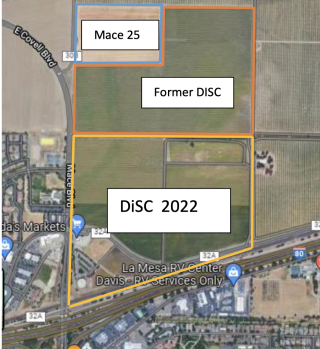
    Measure B – the measure that proposed a 200-acre business park and housing development outside of the Mace Curve – failed at the polls.  The defeat comes with official Yolo County returns showing that 16,458 people, or 52% of voters, said “no” to the project.  In Mace Ranch and Wildhorse, 60% of voters opposed the project.

    This is a remarkable result considering that the No on B campaign was outspent by over 14 to 1.  As of October 28, Yes on B had spent $258,919 between when B was put on the ballot in July and the election in November, while No on B had spent $18,149.  The No on B campaign, composed solely of volunteer Davis citizens, created its own literature, designed its own sign and other graphics, was active on social media, and, to the extent possible during COVID, pounded the pavement distributing flyers to let Davisites know about the negative impacts that this project would bring.  It was a true grassroots effort.  There were no paid designers, no paid consultants, no multiple glossy mailers, and no push-polls to gather information on what messages would sell.  Opponents also could not table at the Farmers Market due to COVID restrictions, normally the bread and butter of a campaign lacking deep pocket donors to finance getting its message out.

    By comparison, Yes on B hired a PR Firm and other consultants more than a year in advance of the vote to help contrive and package its message and run the campaign.

    The fact that Measure B was nonetheless defeated in the face of long odds and unusual circumstances shows that DISC was a bad project for Davis from the outset.  It was too big, chewing up prime farmland and habitat.   The promise of on-site housing for DISC employees could not be guaranteed, making the development car-and commuter- oriented with extensive parking areas. Poor public transportation options exacerbated this problem. The DISC development would have massively increased Davis greenhouse gas emissions and made it impossible for Davis to meet its carbon neutrality goals. We are in a climate emergency, as Yolo County and other counties have recognized; Davis needs to shoulder its share of responsibility for climate impacts, including but not limited to wildfire impacts and extreme weather events locally and globally.

    (more…)