Davisite Banner. Left side the bicycle obelisk at 3rd and University. Right side the trellis at the entrance to the Arboretum.

Category: Environment

  • Nuclear weapons are illegal

    By Sarah Pattison

    On Jan. 22, the Treaty on the Prohibition of Nuclear Weapons enters into force and becomes part of the canon of international law, after it was ratified by the required 50 states. According to Article 1 of the Treaty, states party to the Treaty are prohibited under any circumstances from any of the following activities:

    1. Develop, test, produce, manufacture, otherwise acquire, possess or stockpile nuclear weapons or other nuclear explosive devices;
    2. Transfer to any recipient whatsoever nuclear weapons or other nuclear explosive devices or control over such weapons or explosive devices directly or indirectly;
    3. Receive the transfer of or control over nuclear weapons or other nuclear explosive devices directly or indirectly;
    4. Use or threaten to use nuclear weapons or other nuclear explosive devices;
    5. Assist, encourage or induce, in any way, anyone to engage in any activity prohibited to a State Party under this Treaty;
    6. Seek or receive any assistance, in any way, from anyone to engage in any activity prohibited to a State Party under this Treaty;
    7. Allow any stationing, installation or deployment of any nuclear weapons or other nuclear explosive devices in its territory or at any place under its jurisdiction or control.

    Because the United States has neither signed nor ratified the treaty, it does not have the force of law in this country. But the treaty was approved by 122 nations in 2017, and has since been signed by 86 nations and ratified by 51. It is a clear reflection of the frustration and impatience of non-nuclear nations with nuclear weapons states that have failed to fulfill the promise they made “in good faith” in the Nonproliferation Treaty in 1970 to negotiate the cessation of the arms race and complete disarmament “at an early date.” While our country and other nuclear weapons states may attempt to sidestep the legal force of the Treaty, we cannot avoid the compelling moral power it carries.

    (more…)

  • A revolution of values

    Move money to human, environmental needs

    By Nancy Price

    On Jan. 18, we celebrated Martin Luther King Jr.’s Jan. 15 birthday. With the long weekend, you could listen to more celebratory radio, T.V. and webinar programs.

    Usually, King’s 1963 “I Have a Dream” speech at the Lincoln Memorial is the highlight, often with community readings that this year may have been outdoor for safely.

    Now, in the midst of convergent social, economic and environmental crises, programs often talked about King’s most revolutionary “Beyond Vietnam: A Time to Break Silence” speech, given on April 4, 1967, at Riverside Church in New York, when he moved from civil rights to a critique of capitalism and an economic system that left tens of millions struggling in poverty.

    He spoke of the “triplets of evil” — racism, materialism and militarism — and called for a “revolution of values” a shift from a “thing-oriented” society to a “person-oriented” society.” He called for a “worldwide fellowship that lifts neighborly concerns beyond one’s tribe, race, class and nation.” He emphasized that “a nation that continues year after year to spend more money on military defense than on programs of social uplift is approaching spiritual death.”

    (more…)

  • The Failure of Measure B Suggests a New Vision Is Needed

    West from Rd 30B - Sac skylineBy Roberta Millstein, Pam Gunnell, Nancy Price, Alan Pryor, and Colin Walsh

    Measure B – the measure that proposed a 200-acre business park and housing development outside of the Mace Curve – failed at the polls.  The defeat comes with official Yolo County returns showing that 16,458 people, or 52% of voters, said “no” to the project.  In Mace Ranch and Wildhorse, 60% of voters opposed the project.

    This is a remarkable result considering that the No on B campaign was outspent by over 14 to 1.  As of October 28, Yes on B had spent $258,919 between when B was put on the ballot in July and the election in November, while No on B had spent $18,149.  The No on B campaign, composed solely of volunteer Davis citizens, created its own literature, designed its own sign and other graphics, was active on social media, and, to the extent possible during COVID, pounded the pavement distributing flyers to let Davisites know about the negative impacts that this project would bring.  It was a true grassroots effort.  There were no paid designers, no paid consultants, no multiple glossy mailers, and no push-polls to gather information on what messages would sell.  Opponents also could not table at the Farmers Market due to COVID restrictions, normally the bread and butter of a campaign lacking deep pocket donors to finance getting its message out.

    By comparison, Yes on B hired a PR Firm and other consultants more than a year in advance of the vote to help contrive and package its message and run the campaign.

    The fact that Measure B was nonetheless defeated in the face of long odds and unusual circumstances shows that DISC was a bad project for Davis from the outset.  It was too big, chewing up prime farmland and habitat.   The promise of on-site housing for DISC employees could not be guaranteed, making the development car-and commuter- oriented with extensive parking areas. Poor public transportation options exacerbated this problem. The DISC development would have massively increased Davis greenhouse gas emissions and made it impossible for Davis to meet its carbon neutrality goals. We are in a climate emergency, as Yolo County and other counties have recognized; Davis needs to shoulder its share of responsibility for climate impacts, including but not limited to wildfire impacts and extreme weather events locally and globally.

    (more…)

  • Valley Clean Energy Completes Repayment to Smud

    VCE(From press release) Valley Clean Energy (VCE), Yolo County’s local public electric generation service provider, continues to make significant fiscal strides just 2½ years after its founding.

    In October, VCE made its final installment payment to the Sacramento Municipal Utility District (SMUD), reimbursing the utility for its assistance with operating services during VCE’s launch in 2018. The $1.5 million in deferred charges and interest were paid off on schedule, which demonstrates VCE’s financial discipline while continuing to offer clean electricity at competitive rates.

    (more…)

  • 5 Very Good Reasons to Vote No on Measure B – No on DISC

    Vote-no-on-measure-b-news

    (From press release) If you're still undecided about Measure B authorizing the 200-acre DISC Industrial Park on prime farmland and burrowing owl habitat with 2.6 Million sq ft of commercial buildings, following are five very good reasons to vote NO on this massive, sprawling, ill-conceived project that will forever change Davis for the worse.

    1. Nightmarish Traffic Gridlock

    • The Environmental Impact Report estimated that more than 24,000 in-and-out daily car trips will occur for the DISC project when completed – more than doubling current traffic levels. It will turn Mace Blvd. into a parking lot causing hours of gridlock every day.

    • The City and Developer have no plans at all on how they will mitigate this massive influx of new traffic. Instead, a Traffic Demand Management Plan will be prepared by the Developer in the future.

    • But "Figuring it all out later" is NOT a plan!

    2. Unprecedented Increases in Greenhouse Gas Emissions

    • Our world is burning up and melting around us. This year we have seen the largest fires ever in the Pacific Northwest, Colorado, Siberia, the Amazon, and Australia along with record-breaking ice-melts in Greenland and Antarctica.

    • Yet according to the project's Environmental Impact Report, "…net emissions in the year 2035 would equal 37,724.31 metric tons of CO2 equivalent per year, the project would NOT meet the City’s target of net carbon neutrality by the year 2040." Instead it will increase the City's carbon footprint by over 8% from this one project.

    • Our leaders passed an Emergency Climate Resolution just last year…what are they now thinking?

    3. DISC will Cannibalize our Downtown

    Thirty different small downtown Davis merchants recently signed a petition opposing the project's 100,000 sq ft of additional retail space (about the size of Davis Target) and the 160,000 sq ft of additional hotel space (more than twice the size of the new Marriott just across the street) because it would present severe economic hardship on the small downtown merchants already reeling from COVID.

    • The DISC Environmental Impact Report (EIR) also projected than an additional 313,000 sq ft of commercial space in Davis could become newly vacant due to competition from the DISC project leaving blight in its wake.

    • Our Downtown should not be Sacrificed for Developer Profits!

    4. DISC will NOT have Affordable Housing

    • The DISC Developer falsely claims the amount of affordable housing at the project is "record-breaking" for Davis. That is simply NOT true for either the market-rate OR the subsidized affordable housing.

    • The estimated rent for a market-rate 2- bedroom apartment will be $2,500+ per month and the estimated price for a 2,200 sq ft home will be over $800,000+ and will require a $200,000+ annual salary to buy.

    • There will be 128 subsidized housing units on-site which is 14.7% of the 850 total housing units. But the West Davis Active Adult Community will have 150 subsidized senior apartments on site which is 31.6% of the 475 total units.

    • DISC will neither be "Affordable" or "Record-Breaking"!

    5. DISC is using Voodoo Economics to Project a Profit for the City

    • Property Tax revenues are based on hopelessly optimistic and unrealistic valuations that are 48% higher compared to the same analysis done by the same financial consultant for the same business park just 5 years ago and 68% higher than current regional averages.

    • The City's Finance and Budget Commission voted on a slim 4-3 margin only that the project "is likely to produce a net positive financial benefit to the City"…Not exactly a ringing endorsement.

    • And one Commissioner even called the consultant's assumptions a "fairy tale".

    • Clearly, a thumb has been put on the scale to make the project seem economically far rosier than reality. _________________________________________________________

    The more we hear about DISC, the more it is clear that Davis will get all of the traffic and pollution and the Developers will get all of the profits. It's time to just say "NO"!

    __________________________________________________________

    Sierra Club Endorses No on Measure B – No on DISC

  • A Different Vision for the DISC 200 Acres

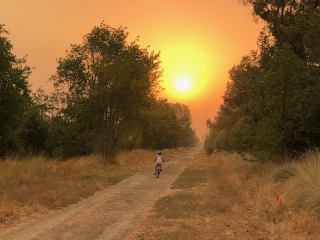
    Image1-2

    Photo credit: Nick Buxton

    By Juliette Beck

    A little over twelve years ago when I was pregnant with my first child and deciding whether to move to Davis to join my sister in raising our families here, I looked at the air quality data and considered the impacts on newborn lungs.

    I ultimately made the decision to move here and fight like hell for my children to grow up on a livable planet, in a healthy community. Given the climate emergency that has choked our skies with smoke for weeks on end, I'm not sure I'd make that same decision today.

    We are at a critical turning point in human history. For decades, scientists, activists and frontline communities have been telling us we must change course. This summer, it has become undeniable that all of us here in California are now on the frontlines of a rapidly destabilizing climate.

    With Measure B (thanks to Measure J/R now on the ballot as Measure D), we as citizens of Davis have the opportunity to vote on how our community will respond to the climate emergency – an emergency caused in large part based on how we as a society develop land and open space.

    Located just east of the Mace Blvd curve and north of the Ikeda Market, this swath of farmland borders Davis as a gateway to our city. It could be a showcase for climate positive, regenerative farming that sustains our local food needs. But if Measure B passes, it will instead be a sprawling development comprised mainly of $800,000+ luxury homes and a massive industrial business park.

    (more…)

  • Pros and Cons for Measure B (DISC)

    Davis-LWVBy the League of Women Voters Davis Area

    The Question:  Should residents approve annexing agricultural land to develop the Davis Innovation and Sustainability Campus (DISC)?  Annexation of county land for city-related uses has required citizen approval since voters passed the Citizens Right to Vote on Future Use of Open Space and Agricultural Landsordinance in 2000 (as Measure J) and renewed it in 2010 (as Measure R). 

    The Situation:  Davis has studied options for an innovation park with the goals of leveraging UC Davis' international reputation for academic and research advancements in agriculture, biotech, green-tech, and food science research.  As the options were studied, four options initially appeared to be available but these have since been reduced to one (see Appendix for a more detailed history).  The project site is agricultural land that has been productively farmed for many decades.  Moving forward with the project will put an end to farming on the site.

    (more…)

  • 2020 Sierra Club Yolano Group Questionnaire and Responses from Davis City Council Candidates

    Part 5  – Toxics Reduction

    by Alan Pryor

    Introduction – Every 2 years the Sierra Club Yolano Group prepares questionnaires for candidates in local races we deem to be seriously contested and/or where there are clear differences between the candidates on matters of interest to the public and/or our local Sierra Club members. We use questionnaires with written responses to allow the candidates to directly express their views and opinions in their own words. We report these in a series of articles on a range of environmentally-related topics.

    This is Part 5 of the series in which we report candidates' responses to a series of questions regarding toxics reduction in the City. The candidates responses are in alphabetical order based on their first name.

    ___________________________________________________

    1st Question re: Pesticide Use Reduction

    Preamble: Davis recently banned the use of pollinator-killing neonicotinoid class of pesticides and phases out the use of the herbicide glyphosate (the active ingredient in Monsanto’s Round-up product) next year. However, the City Council declined to require that only certified organic pesticides be used in the City’s Parks and Open Spaces as recommended by the Natural Resources Commission and endorsed by the Sierra Club Yolano Group.  

    Question: Do you support restricting pesticide use on City properties to only those certified as “organic” and why or why not?

    (more…)

  • 2020 Sierra Club Yolano Group Questionnaire and Responses from Davis City Council Candidates

    Part 4  – Transportation Management

    by Alan Pryor

    Introduction – Every 2 years the Sierra Club Yolano Group prepares questionnaires for candidates in local races we deem to be seriously contested and/or where there are clear differences between the candidates on matters of interest to the public and/or our local Sierra Club members. We use questionnaires with written responses to allow the candidates to directly express their views and opinions in their own words. We report these in a series of articles on a range of environmentally-related topics.

    This is Part 4 of the series in which we report candidates' responses to a series of questions regarding transportation management in the City. The candidates responses are in alphabetical order based on their first name.

    ___________________________________________________

    1st Question re: Bicycle Use

    Preamable: Davis prides itself on being a bicycle-oriented city with miles of bike lanes and paths throughout the community to facilitate bike use as an alternative form of transportation. Yet, the bicycle mode-share in Davis has dropped in recent years.  

    Question: What would you propose to make the bicycle a more viable and safe transportation mode in Davis?

    (more…)

  • 2020 Sierra Club Yolano Group Questionnaire and Responses from Davis City Council Candidates

    Part 2  – Land Use and Housing

    by Alan Pryor

    Introduction – Every 2 years the Sierra Club Yolano Group prepares questionnaires for candidates in local races we deem to be seriously contested and/or where there are clear differences between the candidates on matters of interest to the public and/or our local Sierra Club members. We use questionnaires with written responses to allow the candidates to directly express their views and opinions in their own words. We report these in a series of articles on a range of environmentally-related topics. This is Part 2 of the series in which we report candidates' responses to a series of questions regarding land use and housing in the City. All of the candidates supported Measure D so this question is not included for brevity. The candidates responses are in alphabetical order based on their first name.

    ___________________________________________________

    1st Question re: Measure B – Davis Innovation and Sustainability Campus Mixed Use Business Park

    Question: Do you support the development of the Davis Innovation and Sustainability Campus mixed use business park in Davis as proposed on the November ballot as Measure B and why or why not?

    (more…)