Davisite Banner. Left side the bicycle obelisk at 3rd and University. Right side the trellis at the entrance to the Arboretum.

Category: Environment

  • Architect says: Solar need not mean Tree Removal

    Solar & Trees, Perfect Together

    Solar and TREES - Page_1The following letter was sent to the City Council as well as to the Davisite.

    These past few weeks have made it clear to almost everyone that we have a problem on earth. The climate is different, and we are all heating up. Trees help reduce the “island heat effect” in and around cities. When trees are in a parking area the temperature of the parking area is 10 to 20 degrees cooler. They help shade us, our cars and more importantly the pavement so that it does not reflect the heat.

    Can solar panels and trees co-exist on the same site? Well, the short answer is yes. Of course, if your house in always in shade and you planned to put the solar panels on your roof you will not get enough power from the solar panels to pay for themselves in a lifetime. However, the standard philosophy that solar panels and trees cannot be placed near each other is nonsense.

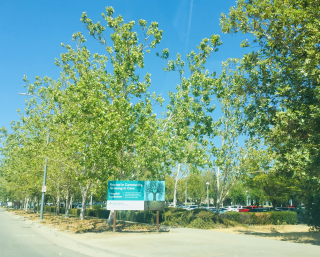
    Here in Davis we have before us a prime example. Sutter Hospital Phase 2 Project’s consultant proposes removing all the trees in the parking lot so that solar panels can be placed above the parked cars. City Council will be voting on an Appeal by Sutter Hospital from the approved City plan to permit the trees to be removed and NOT relocated as the City had required them to do so in its approval.

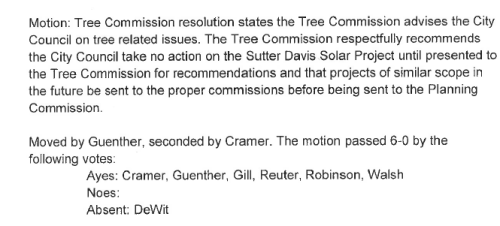
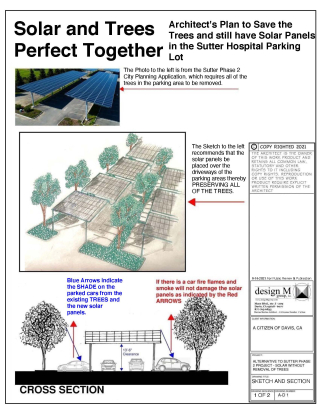
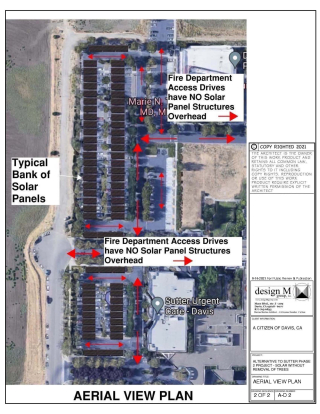
    Solar and TREES - Page_2However, there is a solution that will save the trees AND provide even more solar panels. The solar panels can span over the driveways in the parking lot thereby allowing the trees to remain on the island median between the parked cars. The trees would be far enough away from the solar panels so as not to shade them. The shade from the trees will still shade some of the cars, and the solar panels will shade some of the cars as well. The accompanying drawing shows where the solar panels can be located, a sketch comparing our recommendation to the Sutter Hospital consultant’s approved plan and a sectional drawing showing the shading of the trees and solar panels on the cars. This recommended plan also protects the solar panels from possible future car fires in the parking spaces.

    Hopeful,

    Marcus Marino, AIA, NCARB

  • Statement from the Sierra Club concerning tree cutting at Sutter

    Sutter-Davis-treesThe following letter was emailed to the City Council, the Natural Resources Commission, and the Tree Commission this morning

    Dear Council members and Commissioners –

    The Sierra Club Yolano Group is aware of the current controversy surrounding the placement of solar photovoltaic panels in parking lots at Sutter Hospital. To be clear, the Yolano Group supports both solar electrical generation and trees and realizes that sometimes these interests will conflict and compete with each other with respect to land use.

    For instance, we actively supported Yolo County's rapid expansion of ground-based solar PV systems but adamantly opposed their placement at Grasslands Park south of Davis on Mace Boulevard where it displaced a vernal pool and rare and endemic plants. We supported the deployment of wind turbines in southeastern Sutter County but opposed their placement in the Pacific Flyway near Clarksburg where their spinning blades could kill migrating and nesting birds. In each case there were acceptable alternative nearby locations where the alternative energy systems could be placed without adverse environmental impacts.

    It appears that such an analysis of alternative placement sites for the PV panels at Sutter Hospital has not been performed and we support such a process to help ensure that the maximum environmental benefits of PV deployment are obtained. We understand that two city commissions are currently looking at this exact same question, the Tree Commission and the Natural Resources Commission, and that such a review will be completed and recommendations issued within just a few months.

    The Davis community has numerous alternative energy and tree experts who can provide valuable input into these investigations for a measured deliberation which expertise should be fully utilized. We therefore request the Davis City Council defer final approval of the Sutter Hospital PV project until this Commission review, along with community input, is finalized and their final recommendations are issued.

    Respectfully submitted,

    Alan Pryor, Chair

    Sierra Club Yolano Group

  • Ill-advised Sutter Should Join Community in Exploring Alternative Locations for Solar Panels

    Alternate solar locationsBy Alan Hirsch

    The Davis Enterprise and Vanguard have now run five articles on Sutter Hospital’s Tree-to-Solar-Panel proposal to cut its most mature trees and install solar panels in the main parking lots. As noted by these articles, Sutter's proposal has quietly advanced below the radar for the most part.  Phase I was official approved by city staff administratively in 2019 without any public notice, and Phase II was approved without review of Davis Tree Commission or input from Tree Davis. In fact, city staff seem so cavalier about the process it issued a cutting permit for Phase II four month before the solar panels were approved.

    Environmentalists do not object to the cutting of any trees per se. We simply request a public hearing and discussion to gather input and ideas from our community, which includes not just arborists but solar panel designers and patients, doctors, and nurses who might view the tradeoffs of trees vs solar panel differently than the engineers who proposed the solar design.

    And as the accompanying diagram shows, there are choices. Use of the thirty acres Sutter owns north of the hospital has never been discussed. 

    What is confusing is over 90% of proposed tree cutting is unrelated to the expansion of the hospital building; they are related only to replacing tree with solar panels in the parking lot. “Sutter Phase I” from 2019 artificially conjoined two projects: the hospital building expansion (in largely treeless area) and a parking tree-to-solar project. 

    Then the new “Phase II” had no hospital constructions, only trees-to-solar.  Phase II is what is under appeal. 

    Yet the media and commentary miss this complexity.   The writing about Sutter’s tree to PV proposal, including several letters to the editor and a Channel 13 TV news report, have jumped to the simplistic conclusion this is a binary either/or proposition: trees or solar.  Some letters in the Enterprise have labeled those who want trees even considered “false environmentalists.”  Other misinformed individuals have jumped to the conclusion that the quest to save a few trees will halt the entire physical hospital expansion plans.

    Nothing could be further from the truth.

    Now is the time for the City Council to pause the tree cutting a few weeks to allow a Tree Commission meeting, at a minimum, to discuss the alternatives.  City staff could even put the item on the Tree Commission agenda for August 19th before the Council hearing.  Tree Commission Chair Colin Walsh has expressed a willingness to juggle their busy schedule to speed things along.  This would allow Sutter to move forward in a responsible and sustainable manner.

    We believe Sutter medical staff and leadership have been badly advised by its contract engineers, architects, and city staff.  We hope the medical facility and other leaders to join the Davis community in making a request to the City Council to inquire if we can have both solar panels and trees.

  • Call on City Manager to immediately BAN leaf blowing! RIGHT NOW!

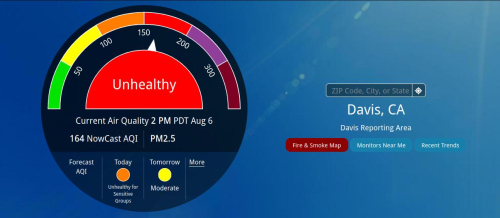
    AirNow080620212pm, Davis – The air is now nearly twice as bad as what requires a ban on leaf blowing. The City updates its notification as needed at 730am. This morning the air was good…

    Yesterday weather forecasters predicted that the smoke from various fires to the northeast would circle counter-clockwise at high elevations and then slowly descend on the north Bay Area and our area.

    YSAQMDwarning08062021

    Yolo-Solano AQMD issued an alert in mid-morning.
    DavisAir8620211015am

    This morning the smoke was easy to see, but the AQI was still good here as the smoke had not reached lower elevations. It started to do so in the early morning in Lake County, then soon in Napa and west Yolo.


    DavisAir8620211125am

    Late this morning…
    AirnowBryant0806202111am

    Quite curiously the Airnow distribution of data from the same monitors showed a lower AQI by half two hours ago, and at about 2pm nearly the same, getting close to 200 AQI.on Purple Air…
    CleanestAirinDavis

    The consistently cleanest part of the area right now – at lower left, just south of West Village, earlier today. This is the location of the City's only official AQI monitoring station. This is what the City uses to determine a leafblowing ban.
    Archerleafblowing2

    It's been well over 100 AQI for at least two hours, and is the source of the image at the top. So why isn't the City issuing a ban? Click on image to read the City's explanation…

    The Council and Staff would be singing us this fine song if we were making this up…. this threat to our health. But surely they realize that is extremely dangerous, a matter of equity, and of health as serious – at least temporarily – as COVID.

    It's been nearly a year since the City issued conditions for a temporary ban on leaf blowing. I've asked and have never seen any data on how many warnings or fines were issued. The Natural Resources Commission's poll on leaf blowing only ended at the end of July, and they might not see what the staff has processed until late September, and might not make recommendations until late October, while we're already in the season of falling leaves… and four months into the wildfire fallout season :-(. (Oh, by the way… today is the 76th anniversary of the beginning of the first nuclear war.)

    Leafblowersokay

  • Smoky Days Ahead!?! Leafblowers, Buses and Climate Shelters.

    7.27-28_windsI just sent the following to the City Council, relevant Commissions (BTSSC, NRC and SSC), County Supervisors and Yolo Solano Air Quality Management District…

    Per Weather.com the winds will shift to the north (and variants) at least part of this Tuesday and Wednesday. The prevailing south winds (from the south) have until now seem to have helped spare Davis and the immediate region (esp. to the west) from wildfire fallout from the huge fires east of Chico.

    As the wind may not just shift until late Monday or early Tuesday, I hope that Staff will be prepared to put the leaf blower ban into effect. (Note that most of the combined air region has had Spare the Air days for most or all of last week, if only for ozone)

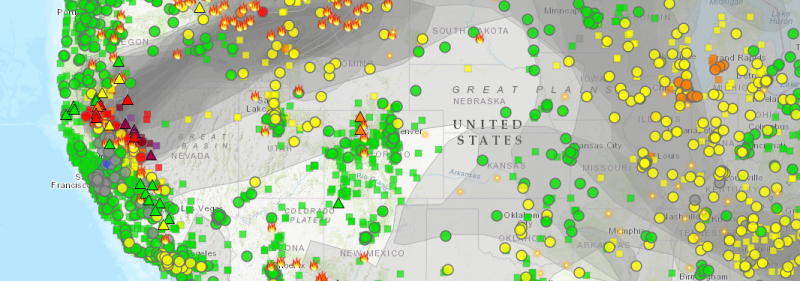
    Davisinbottomleftcorner

    Davis is in the lower left corner – https://fire.airnow.gov

    Spare the Air means that Unitrans is free. Possible smoke and almost certain heat (esp on Wednesday through Friday) will in my understanding open our "Climate Shelters" at Vets and the Mary Stephens Library. As 14th Street is served by Unitrans buses (1 to 3 lines depending on the time of year and day of the week) it seems like a good and free way for many to get to the Climate Shelters, yes? It seems likely that Climate Shelters disproportionately serve lower income people who have less access to not only modern HVAC but also personal motor vehicles.

    Unfortunately the free Unitrans service is in tiny print at best on the Share the Air notices (email or website), and as far as I recall has never been mentioned in the City's notices about the Shelters. All of these programs are happening, but the communication is not joined up, and few know about them

    SparetheAir-Unitrans

    Beyond this, I don't understand why Yolobus doesn't have free service during Spare the Air days. Do I understand this correctly? Can people in Davis get to Climate Shelters (or anywhere else urgent) during a smoke and/or wildfire fallout event by free public transport, but not anyone else in Yolo County?

    Thanks for taking immediate action when necessary…. or preemptively!

  • Tree Davis Position on Sutter Davis Hospital Tree Removal

    Sutter Parking Lot Shade Trees 1

    Sutter Parking Lot Shade Trees

    A recent article in the Davis Vanguard ("City Will Have to Weigh between Trees and Solar Panels at Sutter as Complaints Reign about Public Process," July 21, 2021) described a variety of issues concerning the Planning Commission’s recent approval to remove 205 trees in association with improvements to the Sutter Davis Hospital campus. Tree Davis appreciates the efforts made by David Greenwald and Alan Hirsch to bring this proposal into the public spotlight. The Tree Davis Board has these thoughts to share.

    1) Our tree canopy is under increasing threat from decline due to old age, development, and climate change stressors like drought, wind, and pests. Tree Davis supports increasing measures to protect and preserve healthy trees and to grow our community canopy with climate-ready species. 

    2) We recognize that in certain circumstances, retaining healthy trees may not be possible. Full mitigation of lost canopy, through planting either on-or off-site should be accomplished, as per our Tree Ordinance.

    3) We support retaining mature tree canopy in parking lots when possible because trees can provide environmental and social benefits that PV arrays cannot, such as heat island mitigation, carbon storage, air pollutant uptake, beauty, stress reduction, and wildlife habitat.

    4) Tree Davis believes that the Tree Commission’s charter should be updated to include consultation on individual project proposals because of the expertise they can provide. For example, the proposal to transplant 43 mature trees to another location at Sutter Hospital may sound reasonable, but, the benefits may not offset the costs in the long term. The failed effort in Woodland to transplant historic olive trees along Gibson Rd. is an example.

    Greg McPherson
    President, Tree Davis Board of Directors

  • Sustainability, Adaptation, and Regenerative Farming: Understanding Responses to Global Warming

    This article was first published at https://islandviewmedia.net/blog/ and is reprinted here with permission of the author.  Davisites may find it of interest given the re-surfacing of the DISC project, which would pave over farmland and replace it with an automobile-oriented industrial project.  Regenerative farming envisions a way that the land could be used to combat rather than contribute to climate change and could potentially be deployed in various places in the Davis area.

    By Robert Chianese

    We strive to ensure our future by living, growing, and building sustainably. I’ve written about “Sustainability” since  the 1970’s, starting with my prize-winning essay on forming a local Sustainability Council which I did here in Ventura County. I became a true believer in its promise to reduce our impacts on the planet through its very tough tri-fold requirements: use renewable energy, no toxics, cause no loss of biodiversity.

    I later saw its promise fade as it became lost first in the fraudulent use of the term to “green-wash” all sorts of products and processes–lying about their sustainability. The FTC issued “Green Guides” in 2012 to push back on unsubstantiated claims about so-called green products, but corporations ballyhoo the term even more now. We hear boasts about the eco-friendly products of Clean Coal Energy, ExxonMobil, Monsanto, Dow Chemical, Malaysian Palm Oil and the Fur Council of Canada. Short-term ugly profit is more like it.

    Even more disturbing are current reports about our failures to shift off our carbon-hungry diet. Through our human-caused, “anthropogenic” actions, we cloak the globe in a heat shroud, intensifying droughts, wildfires, floods and sea level rise. Nothing sustainable here.

    Teenage phenom Greta Thunberg spent almost a year investigating how well we are meeting our environmental challenges. The documentary, “I Am Greta,” follows her through various countries and climates in search of sustainability successes, but she’s mainly discouraged and defeated. She even confronts the dean of environmental programs, David Attenborough about his gorgeous nature films in the time of climate systems collapse. He half-concedes he needs to change his pitch. His new series “A Life on the Planet” tries to atone for glossing over our very un-gorgeous damage to the earth.

    Ecologists have come up with new concepts we need in order to save the planet. Some say we need to adapt to the new climate realities, which implies accepting the damage we have done and adjusting to it. But neither adaptation nor adjustment get defined clearly.

    (more…)

  • City of Davis and the (Near) Future of Rail Travel

    L21spanish

    Virtual Public Workshop! Thursday, July 15 from 530 to 7pm


    I wrote the Bicycling, Transportation and Street Safety Commission (BTSSC) earlier today:

    To the BTSSC,

    I strongly suggest that the BTSSC set up an ad-hoc sub-committee about Link21 so that it can stay engaged long-term, receive and process community input and then at the appropriate time make recommendations to the City Council.

    The City of Davis is a small tomato in a huge pot of soup in this matter, but the railway proportionately bisects the City of Davis more than other town along its current route between Oakland and Davis. Davis grew around the rail and I-80 corridor in a way that – especially in the last 60 years – did not facilitate multi-modal travel based on the railway. A typical regional or suburban station like Davis in much of Europe would have multiple bus lanes that terminate at the station and hundreds of secure bicycle parking space for all kinds of bikes, suburb connections for walking and cycling for all directions, and a lively place for activity in front of the station, instead of a parking lot. The City has made some progress in this area of late, but, for example, there are still many who want a new parking structure at the station, and voters thankfully – but only narrowly – disapproved a new development project far from the station with no good cycling connections to it, lots of parking and imagined good access to I-80.

    I had tried to form a sub-committee nearly three years ago about the I-80 Managed Lanes Project, but it was terminated shortly after Commission approval because the second member moved to Sacramento. While I appreciate the healthy skepticism the BTSSC had about the Managed Lanes Project at the last meeting, I believe it prudent to get ahead of the game as much as possible for this even larger project that relates to both the Managed Lanes Project as well to our Downtown and General Plans, as significantly improved rail service would facilitate the creation of a lot more carfree or carlite households in town. As you seem to recognize, the worst outcome of the Managed Lanes project will do nothing but worsen traffic in town and literally throw a rotten tomato at our forming Climate Policy. The worst Managed Lane implementation will not support railway travel until perhaps many years from now, and indirectly, when thousands of Davis residents, frustrated with increased congestion and pollution, surround Caltrans District 3 HQ and bombard it with stinky, rotten tomatoes genetically-modified to annoy "deaf" state officials and narcissistic automobilists.

    TomatoesAs a robust railway powered by renewable energy is a key tool in fighting Climate Change, I would also suggest you consider making the sub-committee a joint one with NRC, and Social Services too in order to help ensure that the system is accessible for all households.

    The person who seems to be the current project manager for this part of the Megaregion, Jim Allison from Capitol Corridor, is very approachable and helpful. The Link21 sub-committee would be wise to also connect with other – especially smaller – communities along the corridor in order to create common, expected and seamless last-mile connections to their stations, and dense and proximate housing that makes good public transportation possible. All the pieces are necessary, but the puzzle has to be solved by everyone. I think that I prefer the tomato to the puzzle metaphor.

    Thanks,

    Todd Edelman"

  • Vague lanes solving regional pains?

    Davis80

    Not the Caltrans project! This is the author's concept for a bypass to and from the Bypass.

    On July 1st Davis Vanguard covered the announcement of Federal funding of 86 million dollars for the Yolo-80 Managed Lanes project.

    I appreciate most the comments of Alan Miller, Alan Pryor and Richard McCann. I hope I can add something below.

    The MTC area gets a lot of income from its bridges, and uses it for public transportation. Consider that Davis and SACOG-area drivers pay into this when driving south to San Jose, west to Oakland and San Francisco, and so on, but people from those areas make no similar contribution our region – really, the east side of the Northern California Megaregion – when traveling to Davis or Sac or of course towards Lake Tahoe.

    Caltrans dropped the long-promised new bike-ped bridge across the Bypass, replaced by some improvements on the west side of the Bypass. Combined with new infrastructure such as separated lanes and a lot of shade trees in West Sac,  the  whole corridor could be optimized for faster e-bikes and provide a good alternative for many, especially in east and the east part of South Davis. But… nope! Or so it seems.

    The graphics in the Caltrans presentation on the Yolo 80 Corridor planned for the BTSSC meeting this Thursday show only buses in the managed lanes, which is not what’s really planned for the managed lanes. Nasty! The managed lanes are mostly in added lanes, and if these lanes are available for private vehicles off-peak, for a premium, or free for a carpool then induced demand happens – see also Alan Pryor's comment in the Vanguard article – and we eventually lose.

    It’s also not clear how this project interfaces with the 80-Richards project.

    It’s not clear how much congestion there will be during the long construction period.

    It’s not clear if any general re-paving will decrease noise (new technology makes this possible).

    It’s probably unlikely that Caltrans will support a discount on Capitol Corridor during the construction period.

    But yeah, rail. What’s up with the future Capitol Corridor improvements? How does this project related to our impending new General Plan? My favorite idea is to build a highway bypass south of town and then put the railway below grade so that it also no long splits the City in two (in retrospect, it would probably have been better to not build anything south of the 80-rail corridor). Anyway, all the new space roughly in the center of Davis could be the location of a lot of new dense, mixed-use development which could facilitate low-vehicle ownership or at least use, as it would eventually be convenient to UCD and Downtown by bike, to both Sacramento and especially the Railyards, and to points to the west by rail. It would also be much quieter in parts of the City with this sort of ring-road solution. In general terms it would complement my concept for building above 113 roughly between Russell and Covell. I've also proposed a noise-mitigation and solar-generation project for the I-80 corridor through Davis.

    Related to this whole thing and that next to last point, over three years ago when I was on the BTSSC I initiated a sub-committee on 80 and related. It never went anywhere and was dissolved as the other Commissioner who joined it moved to Sacramento and no one else on the Commission wanted to pursue this… route. Sigh. Please demand that BTSSC members ask some hard questions this Thursday!


  • California’s Huge Budget Surplus Provides Once in Lifetime Opportunity to Bury Fire-Causing Power Lines

    Four power line fires map Sonoma Independent June 3 2022

    By Nancy Price

    Despite predictions of an even worse year for wildfires and power shutdowns than 2020, not one dollar of California’s immense $76 billion budget surplus is being allocated to actually prevent wildfires which is to bury overhead power lines.

    Since 2017, four of the six most destructive fires have been sparked by overhead power lines. Burying just a tiny fraction of these lines that pose the highest risk of fires is by far the most important preventive measure to protect us from catastrophic fires and the terrible cost we pay with our lives, health, economy and environment. 

    Preventing fires mean we can protect our forests that are much need carbon sinks so we can realize our state’s ambitious greenhouse gas reduction target to achieve carbon neutrality by 2045.

    Burying overhead wires would also eliminate the expanding number of massive power shutdowns that liability-averse utility companies order because of the fire risks. These shutdowns impacted 2.5 million Californians last year, especially the elderly and infirm, whose lives sometimes depend upon medical machinery requiring steady electricity.

    (more…)