Davisite Banner. Left side the bicycle obelisk at 3rd and University. Right side the trellis at the entrance to the Arboretum.

Category: Current Affairs

  • Letter in praise of Anne Ternus-Bellamy

    Thank youAs we "two steps forward, one step back" our way out of the pandemic, a number of people have been rightly praised for their contributions to the community. Today I write to thank Anne Ternus-Bellamy for her outstanding coverage of the pandemic. 

    She has kept us up to date on all of the latest statistics; explained complicated facts about testing, vaccines, and best pandemic practices; and put that information into local, state, and national contexts.  She has explained a massive amount of information to us in a clear and accessible way. 

    Having such a wealth of information available has meant that we could make informed decisions, decisions that may have even saved lives.  It hasn't always been good news, but there is nonetheless a comfort to knowing what is going on. 

    I should add that she has found the time to fit in local political coverage as well, coverage that presents different perspectives on controversial issues in a fair and accurate way. 

    The Davis Enterprise is lucky to have her and so are we.

    Roberta Millstein

  • Credit Where Credit is Due

    People PowerBy Larry Guenther

    At Tuesday's meeting, (10/19/2021) City Council acted on recommendations made by a Council subcommittee, one of two subcommittees to look at the issue of "Reimagining Public Safety." Most of the discussion and credit for these changes was focused on the work the City Council subcommittee did. While the Council Subcommittee did do real work on producing these recommendations, there was a mere mention of the work done by a Joint Subcommittee of the Human Relations, Police Accountability, and Social Services Commission. Councilmembers and staff made almost no mention at all of the contribution from the rest of the Community.

    The Joint Subcommittee did an enormous amount of work and research to make Nine Recommendations to City Council for changes that would create a more effective and just Public Safety system. Members of the Joint Subcommittee included: Cecilia Escamilla-Greenwald, Dillan Horton, Judith MacBrine, Don Sherman, Susan Perez, Bapu Vaitla, Matthew Wise, Sheila Allen, Emma O’Rourke-Powell, and Judith Plank.

    Additionally, many community members put in countless hours of work, research, and thought that laid the ground work for the Nine Recommendations and, in fact, created the roadmap for the path the City is taking. Yolo People Power and the Yolo Democratic Socialists of America were two community groups that took the lead on this issue. Julea Shaw, Jordan Varney, Morgan Poindexter, and Francesca Wright of Yolo People Power stand out. These women were instrumental in analyzing Police Data, researching non-traditional and successful Public Safety programs in other municipalities, and educating and organizing community members. 

    If you see any of the people mentioned in this letter, please thank them. Their work has been instrumental in moving Davis Public Safety to a more effective and just system.

    Innovation and change comes from the Community.

  • Particle Wars in Davis –  What you can’t see can kill you, Part II…

    Screenshot from 2021-08-19 17-42-32

    The militarization of gardening?

    A conversation about the proposed – and not – restrictions on toxic micro-particle hyper-distribution -  a.k.a. “leafblowing” – by three of your favorite local activists!

    (COVID is Part I)

    This evening the City of Davis Natural Resources Commission (NRC) will hold the first of two hearings on possibilities for leaf blowing restrictions. Here’s the memorandum – a supplement to Council’s approval of temporary leaf blowing restrictions from last October. It includes Commission and Staff proposals and results of the surveys on leaf blowing taken which were taken in June.

    In summary, they are proposing a gas LB ban, time restrictions and user restrictions. Staff and Commission (sub-committee) proposals are broadly similar. 

    What’s very important, however, is that there is a strong likelihood that there will be a complete ban at the state level on gas-powered equipment such as lawn mowers, edgers and so on… including leaf blowers and vacuums, or combined units. This means that any equipment-related ban in Davis that only affects gas blowers will be nothing unique in just a couple of years. 

    The meeting is at 6:30pm
     

    AirNow08062021

    Leaf blowing prohibited on this day?…

    AIR QUALITY and wildfire fallout:

    Todd Edelman: There is no explanation of why the air quality-based restriction due to wildfire fallout  is based only on official AQI according to current City policy. For example, the very popular and relatively inexpensive Purple Air system could be used.  And Purple Air isn’t only used at private residences: The UC Davis environmental engineering dept has one on its roof for experiments. Lake County Air Quality Management District (AQMD) uses them for official monitoring outside of wildfire situations. The New Jersey Transit Authority seems to also use them for official purposes. Sutter Davis Hospital has them on their roof and inside. The elementary school at Beale Air Force Base has one, as does the Yolo Solano AQMD office in south Davis – they say they use it to recognize “trends”.

    But perhaps the most important use of Purple Air is to determine local impacts of leaf blowing…
    Previewonleafblowerstoryno2

    Nope… no new restrictions if the air's bad AFTER 7:30am…

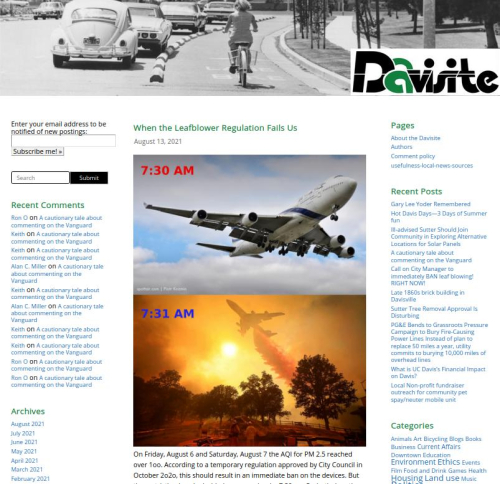
    Darell Dickey: I have trouble with the concept that we can only ruin our air quality when the air is otherwise pretty good. We’re going to avoid dirtying the air when it is already bad? And then there’s my favorite part: Blowing will always create a local situation of AQI over 100, which should result in an immediate ban on blowing. 

    I’m thinking that a good, logical way to present this is that if we’ve all agreed that 100 AQI is “bad enough” for us to ban activities that make it worse, then we should never be allowing the use of devices that make the AQI 100+. And this circles back to local air quality vs. relying entirely on one spot of data that’s outside of town to determine what we’re breathing in our neighborhoods at any given moment. 

    If AQI 100+ is bad anywhere, then stop creating AQI 100+!

    TE: There is nothing about how they determine how much ash is on the ground, though this is a condition of the lift of any AQI-based restriction according to current City policy. I have voiced this concern many times.

    There were several times when the official AQI went over 100 during the day but not before 9AM; this was not mentioned in the memorandum, though I brought it up repeatedly in August in emails to the NRC.

    LEAF-BLOWING, WILDFIRE SMOKE AND COVID-19

    The proclamation from October 2020 that resulted in temporary leaf-blower restrictions mentions “COVID-19” 10 times, yet the current memorandum only mentions it once, and not directly in relation to smoke effects on those with who have COVID. Further, the October 2020 mentions no specific research at that time on wildfire smoke and COVID, but there’s new research not mentioned in the memorandum. 

    AIR QUALITY, general:

    TE: As far as I can tell leaf vacuums distribute lots of dust, and as they pick up inorganic matter as mentioned in the memorandum, I don't see how they will be allowed. But still, do people think that these things work as HEPA interior vacuums?

    DD: True. But “lots of dust” from a vacuum situation is still way better than any blowing. It all needs to be in perspective as we’ll never arrive at “perfect.” Same way that electric cars aren’t perfect, but are better than gas cars, etc.

    TE: Well, I think at least all the most dangerous and invisible stuff comes out the back…

    DD: “Most dangerous” is not easy to defend. If the crap being stirred up produces a violent health reaction (allergies, asthma, etc), then the acute “most dangerous” thing is probably coming out the front. At least for those people who are severely affected.

    The only way to call any of this “better” is if less crap is being put into the air…. As compared to doing it another way. And IMO, a vacuum is better than a blower. And leaving stuff where it is, is better than all of it.  The timing of the device usage is also important. I vacuum up deep leaves to mulch them and put them where they’ll help the yard vs. choke the plants. And I do it when the leaves are not dusty. It is a relatively benign activity.
    Tahoe08222021

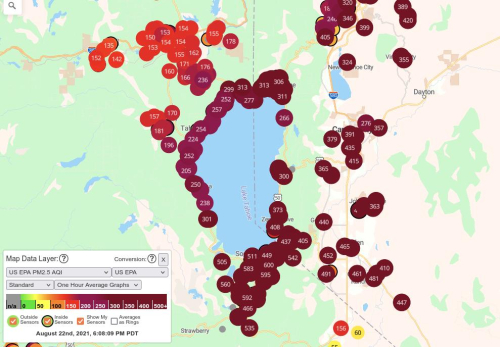
    Purple Tahoe


    LABOR:

    TE: There's no suggestions related to the labor issue except for what may eventually be affected by a ban on gas-powered blowers. What are their wages, by the way? This is a basic question for labor related actions or studies.

    DD: I hate the question where they ask the company how much it will financially destroy them. Of course the answers are all opinion, but it is presented and answered as fact. 

    TE: Yes they should give figures or something. Is there possible funding from AQMD to transition out of all leaf blowing?

    DD: Also, a significant percentage of landscaping businesses do not use any blowers. 

    TE: Why is this? How is this influenced by opinions of consumers and of workers or their managers/companies?

    DD: From what I can tell, the biggest concern from the citizenry is that they may have to pay more to the poor, under-paid folks. You know… the folks that they’re really concerned about harming with…. low wages.

    Asking the yard-care business owners how bad it will be if blower use is restricted is like asking El Macero drivers how bad it will be if Mace loses one of its travel lanes. It is a total guess. It is based on everything else not changing. And they simply have no idea what the result would be. Might be higher health and better hourly wages for everybody. But of course most claim that it will just be devastating to their business. I didn’t hear one response about how it would be better for the workers who might get paid more for doing healthier work.

    TE: I’ve repeatedly brought up this part of the issue, not only with the NRC, but also the Social Services Commission — it needs to agree to provide feedback. Though leaf-blowing is not a job based on sustainable practices, there are many related jobs which are, and they require a higher skill-set. Tree trimming, building on-site composting facilities, triage of soil situations? No one should lose their jobs. 


    LABOR AND PHASE-IN:

    TE; There seems to be no scientific reasons for only phasing out gas blowers in City properties except for protecting some companies. Nothing about increasing wages, etc. The proposed start date Jan 1 (2023) is after most of the "leaf season", and over two years since the temporary regulations came into effect. This seems to be about giving enough time to buy new equipment, but this seems like a tiny expense compared to labor.
     

    Screenshot from 2021-07-24 05-43-02

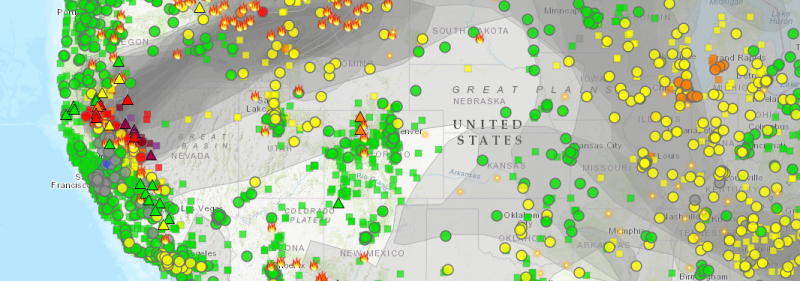
    Purple Nation

    VIBRATION (Sound):

    Roberta Millstein: You two are rightly focused on the air quality. But for a broader audience, you might also mention that these things are f*cking loud. Really f*cking loud. And that is for some a big part of why they are hated.

    TE: I know that traffic noise is very bad for human health. One thing that’s worse about leaf blowing noise is that it can be unpredictable, especially if one’s neighbor is doing it — but then also who memorizes the leaf blowing schedules of their neighbors or their yard sterilization services?

    While most electric leaf blowers are quieter than gas-powered ones, it’s not guaranteed. And if an electric leaf blower is less powerful than a gas one, people may use it for longer.


    OTHER:

    DD: And the main reason that some give for the “need” of leaf blowers? No other practical way of clearing large paved parking lots. 

    TE: Exactly, what are uses of LB's in terms of square footage or acres, etc?


    CULTURE: 

    TE: Yard work is good exercise if the air is clean. It connects one to their yards – even in a rental property – that other exercise outside cannot.

    Leaf blowers and vacuums didn't exist in significant numbers until what, the 1980's? What did people do before that? Die, in their yards, under piles of leaves?


    EFFECT ON TREE AND SOIL HEALTH:

    TE: In the Memorandum there's nothing from the Commission or Staff in the recommendations about the benefits of leaving leaves where they fall, even though it’s already recommended on sources linked from the City's Tree pages and others.

    The Tree Commission will hopefully offer feedback.


    EXAMPLES / Best Practice in Other Places:

    TE: There is mention of the other jurisdictions which have done partial to full bans, but not by name. They clearly have this list. There is no indication how many suffer significant wildfire fallout, though as many are in California certainly some have, and there's an assumption about why most didn't respond. Two have complete bans… who are they?


    EFFECT ON OTHER USERS OF ROW (street, greenbelt, or another public space):

    TE: There's nothing about how use of blowers contributes to the always non-permitted piles of yard waste in bike lanes. At the October meeting of BTSSC we need to pressure them into agreeing to providing an opinion on this, especially as a related item on yard waste in bike lanes has been sitting in the long-range calendar for many months as TBD. This issue has been going on for many years.

    Proposed ban during the week is only til 8AM, even though many are commuting to school or work by then, by pedal or foot. So then they will be exposed full-on as they traverse the City.

  • Call on City Manager to immediately BAN leaf blowing! RIGHT NOW!

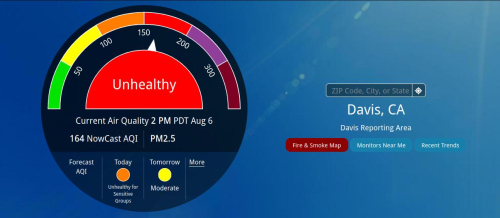
    AirNow080620212pm, Davis – The air is now nearly twice as bad as what requires a ban on leaf blowing. The City updates its notification as needed at 730am. This morning the air was good…

    Yesterday weather forecasters predicted that the smoke from various fires to the northeast would circle counter-clockwise at high elevations and then slowly descend on the north Bay Area and our area.

    YSAQMDwarning08062021

    Yolo-Solano AQMD issued an alert in mid-morning.
    DavisAir8620211015am

    This morning the smoke was easy to see, but the AQI was still good here as the smoke had not reached lower elevations. It started to do so in the early morning in Lake County, then soon in Napa and west Yolo.


    DavisAir8620211125am

    Late this morning…
    AirnowBryant0806202111am

    Quite curiously the Airnow distribution of data from the same monitors showed a lower AQI by half two hours ago, and at about 2pm nearly the same, getting close to 200 AQI.on Purple Air…
    CleanestAirinDavis

    The consistently cleanest part of the area right now – at lower left, just south of West Village, earlier today. This is the location of the City's only official AQI monitoring station. This is what the City uses to determine a leafblowing ban.
    Archerleafblowing2

    It's been well over 100 AQI for at least two hours, and is the source of the image at the top. So why isn't the City issuing a ban? Click on image to read the City's explanation…

    The Council and Staff would be singing us this fine song if we were making this up…. this threat to our health. But surely they realize that is extremely dangerous, a matter of equity, and of health as serious – at least temporarily – as COVID.

    It's been nearly a year since the City issued conditions for a temporary ban on leaf blowing. I've asked and have never seen any data on how many warnings or fines were issued. The Natural Resources Commission's poll on leaf blowing only ended at the end of July, and they might not see what the staff has processed until late September, and might not make recommendations until late October, while we're already in the season of falling leaves… and four months into the wildfire fallout season :-(. (Oh, by the way… today is the 76th anniversary of the beginning of the first nuclear war.)

    Leafblowersokay

  • Smoky Days Ahead!?! Leafblowers, Buses and Climate Shelters.

    7.27-28_windsI just sent the following to the City Council, relevant Commissions (BTSSC, NRC and SSC), County Supervisors and Yolo Solano Air Quality Management District…

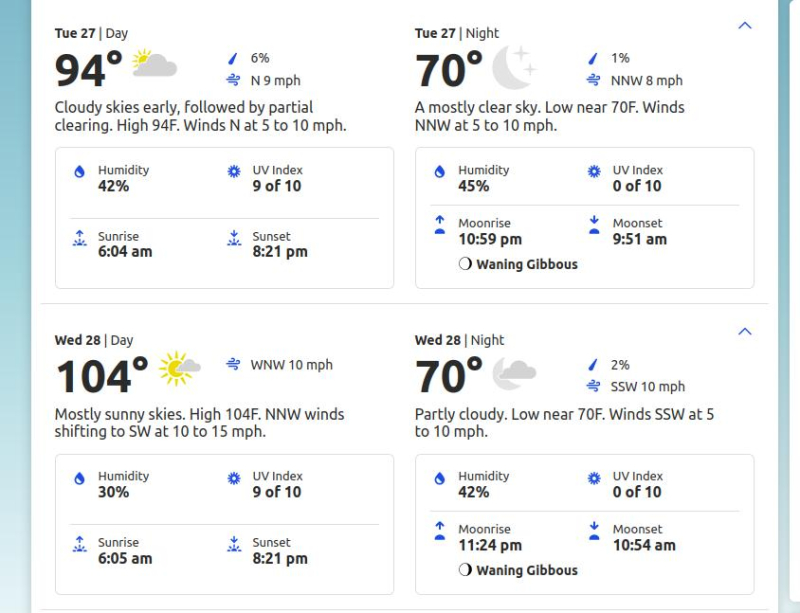
    Per Weather.com the winds will shift to the north (and variants) at least part of this Tuesday and Wednesday. The prevailing south winds (from the south) have until now seem to have helped spare Davis and the immediate region (esp. to the west) from wildfire fallout from the huge fires east of Chico.

    As the wind may not just shift until late Monday or early Tuesday, I hope that Staff will be prepared to put the leaf blower ban into effect. (Note that most of the combined air region has had Spare the Air days for most or all of last week, if only for ozone)

    Davisinbottomleftcorner

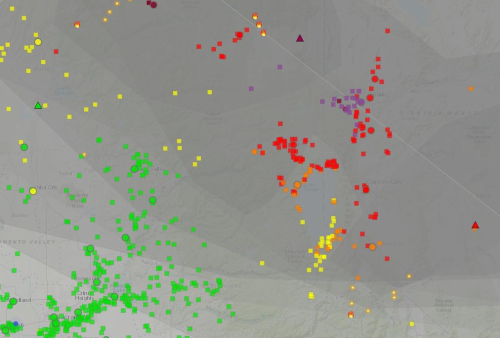
    Davis is in the lower left corner – https://fire.airnow.gov

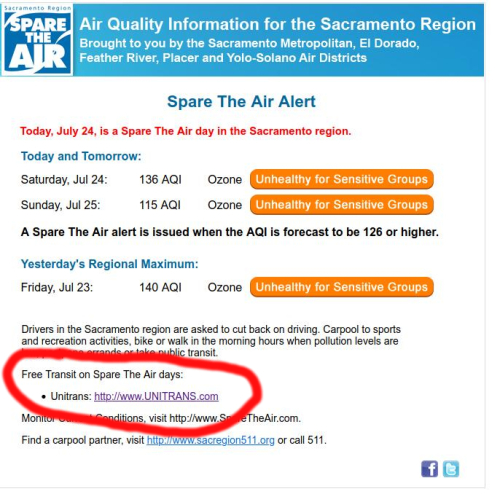
    Spare the Air means that Unitrans is free. Possible smoke and almost certain heat (esp on Wednesday through Friday) will in my understanding open our "Climate Shelters" at Vets and the Mary Stephens Library. As 14th Street is served by Unitrans buses (1 to 3 lines depending on the time of year and day of the week) it seems like a good and free way for many to get to the Climate Shelters, yes? It seems likely that Climate Shelters disproportionately serve lower income people who have less access to not only modern HVAC but also personal motor vehicles.

    Unfortunately the free Unitrans service is in tiny print at best on the Share the Air notices (email or website), and as far as I recall has never been mentioned in the City's notices about the Shelters. All of these programs are happening, but the communication is not joined up, and few know about them

    SparetheAir-Unitrans

    Beyond this, I don't understand why Yolobus doesn't have free service during Spare the Air days. Do I understand this correctly? Can people in Davis get to Climate Shelters (or anywhere else urgent) during a smoke and/or wildfire fallout event by free public transport, but not anyone else in Yolo County?

    Thanks for taking immediate action when necessary…. or preemptively!

  • City of Davis and the (Near) Future of Rail Travel

    L21spanish

    Virtual Public Workshop! Thursday, July 15 from 530 to 7pm


    I wrote the Bicycling, Transportation and Street Safety Commission (BTSSC) earlier today:

    To the BTSSC,

    I strongly suggest that the BTSSC set up an ad-hoc sub-committee about Link21 so that it can stay engaged long-term, receive and process community input and then at the appropriate time make recommendations to the City Council.

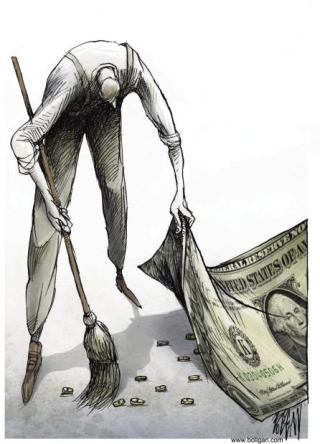
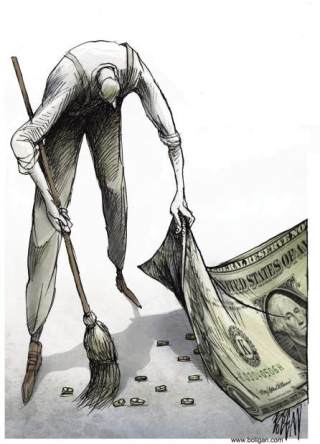
    The City of Davis is a small tomato in a huge pot of soup in this matter, but the railway proportionately bisects the City of Davis more than other town along its current route between Oakland and Davis. Davis grew around the rail and I-80 corridor in a way that – especially in the last 60 years – did not facilitate multi-modal travel based on the railway. A typical regional or suburban station like Davis in much of Europe would have multiple bus lanes that terminate at the station and hundreds of secure bicycle parking space for all kinds of bikes, suburb connections for walking and cycling for all directions, and a lively place for activity in front of the station, instead of a parking lot. The City has made some progress in this area of late, but, for example, there are still many who want a new parking structure at the station, and voters thankfully – but only narrowly – disapproved a new development project far from the station with no good cycling connections to it, lots of parking and imagined good access to I-80.

    I had tried to form a sub-committee nearly three years ago about the I-80 Managed Lanes Project, but it was terminated shortly after Commission approval because the second member moved to Sacramento. While I appreciate the healthy skepticism the BTSSC had about the Managed Lanes Project at the last meeting, I believe it prudent to get ahead of the game as much as possible for this even larger project that relates to both the Managed Lanes Project as well to our Downtown and General Plans, as significantly improved rail service would facilitate the creation of a lot more carfree or carlite households in town. As you seem to recognize, the worst outcome of the Managed Lanes project will do nothing but worsen traffic in town and literally throw a rotten tomato at our forming Climate Policy. The worst Managed Lane implementation will not support railway travel until perhaps many years from now, and indirectly, when thousands of Davis residents, frustrated with increased congestion and pollution, surround Caltrans District 3 HQ and bombard it with stinky, rotten tomatoes genetically-modified to annoy "deaf" state officials and narcissistic automobilists.

    TomatoesAs a robust railway powered by renewable energy is a key tool in fighting Climate Change, I would also suggest you consider making the sub-committee a joint one with NRC, and Social Services too in order to help ensure that the system is accessible for all households.

    The person who seems to be the current project manager for this part of the Megaregion, Jim Allison from Capitol Corridor, is very approachable and helpful. The Link21 sub-committee would be wise to also connect with other – especially smaller – communities along the corridor in order to create common, expected and seamless last-mile connections to their stations, and dense and proximate housing that makes good public transportation possible. All the pieces are necessary, but the puzzle has to be solved by everyone. I think that I prefer the tomato to the puzzle metaphor.

    Thanks,

    Todd Edelman"

  • What the HEC is Going On? Part III

    image from davisite.typepad.comConflicts of Interest in the City of Davis Housing Element Committee

     by Alan Pryor and Rik Keller

     Note: The preceding Part II in this series covering Brown Act violations is here:

     “Housing Element Committee members are expected to remove themselves from all discussions and votes on matters in which they have any direct personal financial interest.


    In gauging such extra-legal conflicts of interest and/or duty, each member shall exercise careful judgment and introspection in giving priority to the interests of fairness and objectivity; if there is any reasonable doubt that the member has a conflict, the member shall refrain from participation in the committee’s deliberations and vote(s).” – City of Davis Housing Element Committee Ground Rules (p. 4)

    (more…)

  • What the HEC is Going On? – Part II

    Under rugThe City’s Denial of Brown Act Violations by the Housing Element Committee and Certain of Its Members is Not Credible nor Factually-Based

     by Alan Pryor and Rik Keller

     Note: A subsequent Part III of this series will cover conflicts of interest of HEC members in detail

     Introduction

    Last week the authors wrote a carefully-researched and well-documented article on the City of Davis’s Housing Element Committee (HEC) alleging several serious violations of the California state Brown Act open meeting laws prohibiting direct communications between members of jurisdictional bodies. As stated in that article, the composition of the Council-appointed HEC, which is supposed to represent a “diversity of interests” in the community, was instead primarily composed of development and real estate interests and their local supporters.

    In our article, we also disclosed that several weeks ago, there were a last-minute series of policy recommendations very favorable to the real estate and development interests in the City that were suddenly introduced to the Committee by these same real estate and development interests. These recommendations, in direct violation of the Brown Act, were sent directly from one member of the HEC to the entire HEC.

    The HEC then further violated the Brown Act in considering and voting to adopt the same recommendations without publicly noticing that these recommendations were being considered by the HEC. In essence, these recommendations were introduced secretly to the HEC and then voted upon without full public disclosure and scrutiny of the recommendations. Furthermore, the development and real estate interests on the Committee failed to adequately disclose conflicts of interest in terms of their investments and holdings in the City that would be impacted by these very same favorable recommendations approved by the HEC (see more on this point in the coming Part 3 of this series of articles).

    (more…)

  • 15 mph DESIGN SPEED in Davis!

    SD15
     
    My strong feeling is that all local streets – including Downtown – should have a 15 mph design speed. This is already a number most are familiar with, as it's used alongside e.g. speed tables on school routes and even the sharp turn from 2nd St to L St.

    The design speed is a speed that most people feel comfortable moving at in motor vehicles. People on bikes can also feel a design speed, but they are nearly infinitely more inherently safe than motor vehicles to others in the public ROW. 15 is also a bit faster than most cycling speeds.Traveling by bike on most greenbelt paths in Davis at 15 mph feels too fast – the paths are under-built – and perhaps the biggest design flaw in post 1970's Davis, sadly and ironically complemented by the clinically-insane wideness of many streets in West Davis, Mace Ranch and South Davis… but also much older streets in Old North, etc.

     
    Does it seem slow? Perhaps. However, consider that for most journeys by motor vehicle a relatively short distance is on local streets. So any journey lengthening will be minimal.
     
    Or can it even be shorter? Yes! 15 mph speed design is best complemented by elimination of existing mandatory stops; to be replaced by yields. It's these often unnecessary stops that lengthen journey time the most. Getting rid of them also decreases pollution (gas, particles and noise) and makes people less likely to feel the need to speed to the next stop sign.
     
    So it can be both safer and faster!

    (more…)

  • This sounds fishy!

    Sound-spikesBy Robert Canning

    At next week’s city council meeting, council will be asked to change the city’s sound ordnance. With little discussion or notice, city staff have added an item to the agenda that could have big implications for city planning and residential neighborhoods in Davis.

    In a nutshell, the amendment would, as one person has put it, allow someone to stand in front of your house and blow an air horn for a minute or two every hour without violating the sound ordinance. This would be allowed because city staff have decided it is better to measure sound by averaging it over an hour, rather than use a simple measure like the maximum allowed sound, how the current ordinance works. A quick check on the web shows that two other college towns – Chico and San Luis Obispo – have existing sound ordinances that use the “maximum” sound standard. Others have found that most cities use the maximum allowed sound rather than an average.

    And this makes sense. Using maximum allowable sounds – particularly during quiet periods like nighttime – eliminates repetitive loud noises like, to use an extreme example, pile drivers and other such concussive noises as the Chico ordinance notes. San Luis Obispo has sound levels for daytime hours that are meant to limit loud noises such as leaf blowers and the like.

    (more…)