

“That directive and those words means something!” — David Taormino on Measure R, 9/19/2018[1]
By Rik Keller
Measure R (the “Citizens’ Right to Vote on Future Use of Open Space and Agricultural Lands Ordinance”) was passed by the voters and adopted by the City of Davis in 2010. Davis Municipal Code Section 41.01.010(a)(1) states that the purpose of the Ordinance is [my emphasis] “…to establish a mechanism for direct citizen participation in land use decisions affecting city policies for compact urban form, agricultural land preservation and an adequate housing supply to meet internal city needs…”
This article will examine what the phrase “adequate housing supply to meet internal city needs” means. First, while the word “need” is used several times, “internal needs” is not further mentioned in the adopted ordinance or in the ballot language that went to the voters (ballot language is purposely streamlined). Is this sui generis language that just appeared out of nowhere? Can it mean that any type of housing is sufficient to meet some sort of undefined “internal need” in Davis and should be allowed to convert agricultural lands? Measure R does state that “continued conversion of agricultural lands to meet urban needs is neither inevitable nor necessary,” so the Ordinance must have some criteria in mind to achieve this goal of not unnecessarily converting ag land, right?
As will be demonstrated in the following, the phrase “internal housing need” as used in City of Davis policy framework, documents, and studies actually refers primarily to low and moderate income workforce housing, and indeed that category is the only one specifically mentioned and for which specific policies have been crafted to meet the need.
However, despite the clear definition of the phrase “internal housing need” when we look at the City’s General Plan for which Measure R is designed to “further” and “implement,” there are some who have either forgotten this recent history or are hoping that we forget this recent history as they seek citizen approval to convert agricultural lands on the periphery of the city. These proposals should be evaluated carefully to determine whether they are truly addressing the policy language and intent in Measure R, the General Plan, and supporting documents.
Keeping with Measure R directives, project proposals that seek voter approval to develop protected agricultural land should be evaluated based on whether the proposed conversion of agricultural land to other uses is necessary and whether it meets the directive of addressing the city’s internal housing need—the housing need for the city’s workforce, particularly underserved low- and moderate-income households.
Legislative Intent
Legal precedent provides for an analysis of legislative intent to be used to establish an interpretation “where legislation is ambiguous, or does not appear to directly or adequately address a particular issue, or when there appears to have been a legislative drafting error.” [wikipedia]
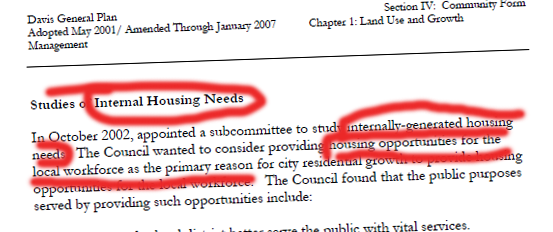
Measure R states that it [my emphasis]: “implements the general plan and is consistent with the city’s adopted general plan and furthers and implements the policies of the general plan. The city finds that this ordinance will provide for a balance between the preservation of agricultural lands and open space and the housing needs of the city.” Looking into the General Plan it becomes apparent that the phrase “internal housing need” had a specific meaning in City of Davis policy and legislative history starting around 2002 and leading up through the General Plan Update in 2007 and to the adoption of Measure R in 2010 as an update to the 2000 Measure J language. There is a whole section entitled “Studies of Internal Housing Needs” on p. 47 of the City of Davis 2007 General Plan Update, Chapter 1. Land Use and Growth Management [http://documents.cityofdavis.org/Media/Default/Documents/PDF/CDD/Planning/Plans-Documents/GP/004-01-Land-Use-and-growth-Managment.pdf].
In the very first sentence of this section, we find that in 2002 the City Council “appointed a subcommittee to study internally-generated housing needs. The Council wanted to consider providing housing opportunities for the local workforce as the primary reason for city residential growth…” This is key: the first mention of the phrase “internal housing needs” in the General Plan refers to the housing needs of the local workforce.
Further on in this section we find out that an “Internal Housing Needs Analysis” was prepared for City Council review in 2003 that “analyzed the City’s share of housing needs based on local employment growth [listed first], UCD growth, and “natural” growth through 2015.”
On the heels of that study, in 2004, the City Council reviewed another study that addressed the key component of the primary internal housing need—workforce housing—in a “Middle Income Housing – Needs, Impacts, and Options” analysis: “This study analyzed the need for middle income housing, the public benefits and potential impacts of a middle income housing inclusionary requirement, and the public benefits and potential adverse impacts on protected classes from establishing a preference for local workers to purchase or rent local housing.” The study and other analysis found that while a middle income inclusionary housing would reduce profit margins for developers, they would still “not need to subsidize the middle income costs through the construction and pricing of the market rate units in the project unless the project had unusually high development costs and few housing units to absorb these costs.”
In 2005, “the City Council adopted an updated resolution directing staff to implement an annual City growth guideline of 1% based primarily on internal housing needs. The Council also adopted a resolution regarding key issues of a middle income housing requirement and a local employee preference system that would be utilized in the sale and re-sale of inclusionary housing units.”
This is also key: the established growth rate guidelines in 2005 were related directly to internal housing needs, which are defined as primarily as workforce housing needs. Measure R in 2010 is directly related to these growth rate directives and they are mentioned specifically in the Ordinance. And workforce housing was so central to the Council’s conception of the city’s internal housing needs, that they also adopted the Middle Income Ordinance in 2005 as one of the primary ways to address increasing the workforce housing supply for households who had incomes above the City’s low-income affordable housing thresholds. Davis Municipal Code Article 18.06 Middle Income Housing contains the provisions of the ordinance [http://qcode.us/codes/davis/?view=desktop&topic=18-18_06-18_06_010]
I have provided selections from the Middle Income Ordinance and emphasis below. The key things to note are that the Ordinance is focused on housing for the local workforce “in particular” and that the ordinance would not impact elderly households because they had more concentration in higher income categories.
1) The City of Davis is interested in providing housing that is affordable to its local workforce as well as other underserved households. A study of middle income housing needs, impacts, and options completed for the City of Davis found that the Davis housing market is not providing adequate ownership housing opportunities for middle income households. Middle income households cannot afford to purchase even the least expensive market rate housing being developed and cannot qualify for affordable housing units provided for low and moderate income households.
(2) The City of Davis is using its vested powers to provide for the housing needs for all economic segments of the community and the local workforce in particular.”
(B) There is a slightly higher concentration of elderly households in the one hundred thousand dollars and above income categories than in the sixty thousand to ninety-nine thousand dollars income range which closely resembles the “middle” income range…The higher income elderly households, however, would generally be able to find decent housing compared to lower income households.
(9) The City of Davis is attempting to provide middle income housing to support the community’s growth in employment by providing employee housing, retain a balance of jobs and housing, provide mobility, and preserve air quality. The City of Davis is attempting to avoid urban sprawl and excessive commuting.
(10) The City of Davis is attempting to balance housing programs with agricultural land preservation programs which purchase conservation easements, including mitigation requirements for the conversation of agricultural land by urban development.
Note also that (10) above echoes almost the exact language used later in Measure R to “provide for a balance between the preservation of agricultural lands and open space and the housing needs of the city.” Clearly, Measure R was drafted with direct reference to existing City policies, programs, and studies including this Ordinance, the growth control provisions, and the 2007 General Plan Update.
Forgotten History?
The story doesn’t end there though. There are some who have either forgotten this recent history or are hoping that we forget this recent history as they seek citizen approval to convert agricultural lands on the periphery of the city.
For example, the developers for the proposed West Davis Active Adult Community (WDAAC) project, which is put forth as Measure L on the ballot in Davis in the November election, have tried to use Measure R language to justify the necessity of converting agricultural land on the northwest periphery of the city. The following is a “legal opinion” released by the developers in January 2018 that did not discuss any legislative intent behind the phase ”internal housing need” but merely made some specious propositions that were either ignorant of or were attempting to erase the actual meaning of the phrase “internal city needs”:
January 2018 . “The phrase “an adequate housing supply to meet internal city needs” is not further defined in Measure R and was not defined in Measure J, the voter-approved predecessor measure passed in 2000. We believe the voters’ decision to not include a definition of this phrase is recognition that the “internal city needs” is a concept that may change over time.”
The developers have used this justification for the project that completely ignores the policy context of Measure R that is rooted in the General Plan in numerous presentations to City Council, in their marketing materials, and in media articles. For example:
- David Taormino (9/19/2018; Davis Vanguard): "However, the legal and policy foundation for the Davis Based Buyers’ Program is the mandate in Measure R which states in part: Purpose Clause (1) “The Purpose of this article… and an adequate housing supply to meet internal City needs…”"
- David Taormino (9/19/2018): "If Vanguard readers think my program is not appropriate and following the mandate in Measure R, then they should postulate what they think the writers of Measure R meant when they put the words “adequate housing supply to meet internal City needs into the Measure”? That directive and those words means something!"
There is, of course, a massive irony in the project developers saying “That directive and those words means something!” about Measure R while at the same time trying to twist those words and give a false definition to them in order to try to justify their project.
There is a second irony in that these same project developers who were trying to use a broad and nebulous definition of “internal housing need” applied to Measure R that apparently means whatever they want it to mean for a particular project, were also involved in efforts to kill one of the main policies in Davis that actually addressed the primary internal housing need in Davis: the Middle Income Ordinance. David Taormino spoke in opposition to the passage of the Middle Income Ordinance as recorded in Davis City Council Minutes from 3/8/2005. The Davis Chamber of Commerce worked on the behalf of a coalition of developers and other business interests and brags about killing the Middle Income Ordinance provisions in 2009: “Ultimately, we were successful in helping to get the Middle Income Ordinance suspended indefinitely.” [http://www.davischamber.com/uploads/2/4/6/9/24698775/board_positions_1999_to_present_updated_feb2016.pdf
And there is a final irony that the suspended Middle Income Ordinance which addressed the City’s primary identified internally-generated housing need—workforce housing—also included studies that found that senior households already had higher representation in upper income categories; but these project developers who were involved in efforts to oppose the ordinance are invoking the phase “internal housing need” to support their project that calls for primarily luxury senior housing.
Moving Forward
The history of the language in Measure R (2010) regarding the policy goal of an “adequate housing supply to meet internal City needs,” stretches back to 2002 and includes numerous studies from that time up to the 2007 City of Davis General Plan Update regarding “the primary reason for city residential growth to provide housing opportunities for the local workforce.”
However, policy support for programs that have been put into place to address this internally-generated need have been weakened by development interests: the City’s Middle Income housing program that was intended to partially address the internal housing need for the moderate-income workforce was suspended in 2009, and the provisions for low-income housing in the City’s Affordable Housing Ordinance were dramatically weakened on an interim basis this year.
There has been a flood of development proposals this year seeking to gain approval before the City’s affordable housing requirements are possibly strengthened again by the end of 2018. These proposals should be evaluated with additional scrutiny to determine whether they are truly addressing the City’s official policy directives and intent in Measure R, the General Plan, and other supporting documents that make up the land use policy framework.
Keeping with Measure R directives, project proposals that seek voter approval to develop protected agricultural land should be evaluated based on whether the proposed conversion of agricultural land to other uses is necessary and whether it meets the directive of addressing the city’s internal housing need—the housing need for the city’s workforce, particularly underserved low- and moderate-income households.
In terms of the WDAAC project in the ballot in November, Measure R does not support a justification for this project as meeting “internal housing need” for workforce housing. It is a project that consists primarily of senior-only, market-rate, upper-income, suburban-sprawl style housing. Approving this project would mean giving up both farmland and the possibility of a better project in that area that addresses the most underserved housing needs of Davis. Compared to when “internal housing needs’ were starting to be discussed in Davis more than 15 years ago and the phrase made its way into City policy, workforce housing, particularly for diverse range of low- and moderate-income households is even more of a pressing need now.
Rik Keller is a university instructor in communication studies and social work. He has 17+ years of professional experience in housing policy & analysis in Texas, Oregon, and California after obtaining his master’s degree in city planning. He is also a 10+ year Davis resident and a current renter.
[1] http://www.davisvanguard.org/2018/09/guest-commentary-response-davis-based-buyers-program/

 Davisite
Leave a comment