

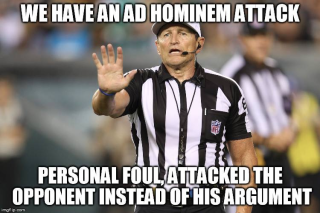
With discussions over the June elections heating up, it is perhaps not surprising that discussions about what does and does not constitute civil discourse are also heating up in Davis.
Luckily for us, these rules have long been established, so we need only take this opportunity to remind ourselves of what they are. The devil is in the details, but the basic idea is this: do not commit the ad hominem fallacy. That is, do not attack the person. Criticizing their arguments or actions, however, is legitimate.
But what constitutes an attack on the person? There are several forms.
1. Attack on a person's character. This one is the easiest to spot, and yet it is all too often violated. Calling someone stupid, corrupt, or dishonest are just some examples.
2. Attack on a person's affiliations or circumstances. This is harder to spot. However, if someone is using someone's affiliations or circumstances as a way to discredit what someone else is saying, then they are attacking the person rather than the argument. For example, if someone's views are being dismissed because they are old, or young, or a student, or a homeowner, or a Republican, or a Democrat, then that is an attack on the person.
3. Attack on a person for being motivated by the desire to gain something (or avoid losing something). This is perhaps the hardest of the three, possibly because there are times when, for example, it does make sense to "follow the money" and see if someone has a vested interest in what they are arguing for. Still, however, this is an attack on the person, and so it should be used very judiciously – that is, only when one has good evidence.
But what's wrong with an attack on the person? Several things:
1. It is irrelevant to the truth of what someone is saying. It is an attempt to discredit the speaker without addressing what the speaker is actually saying. But if the truth is what we seek, then we should focus on what someone is saying, not on the person who is saying it.
2. It is unproductive. It is an attempt at distraction, and (unfortunately) it often succeeds. People then get caught up in addressing the attack rather than addressing the issue at hand.
3. It is hurtful and unpleasant.
The truth is that attacks on the person are the last resort of someone who lacks a good argument, so they attack the person instead. Do we all slip occasionally? Yes, we do, including myself. Thus the need for this reminder.
What kind of disagreement is OK, then? Well, we need not march in lockstep agreeing with each other all the time. Indeed, there's reason to think that could be the worst thing we can do – it's good that we challenge each other to see things in a new way and challenge each other to defend our positions.
So, we can disagree with each other over facts, or over what is right and what is wrong. We can provide reasons for our views and show when others have not given good reasons for their views. We can also disagree over whether a particular action was good or bad, helpful or harmful.
Just do it civilly.

 Davisite
Leave a reply to Colin Cancel reply