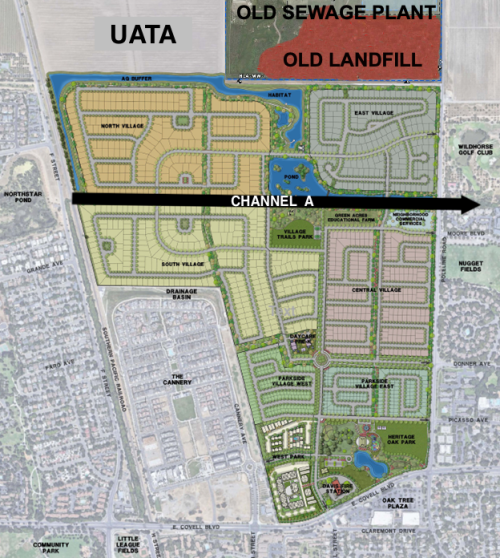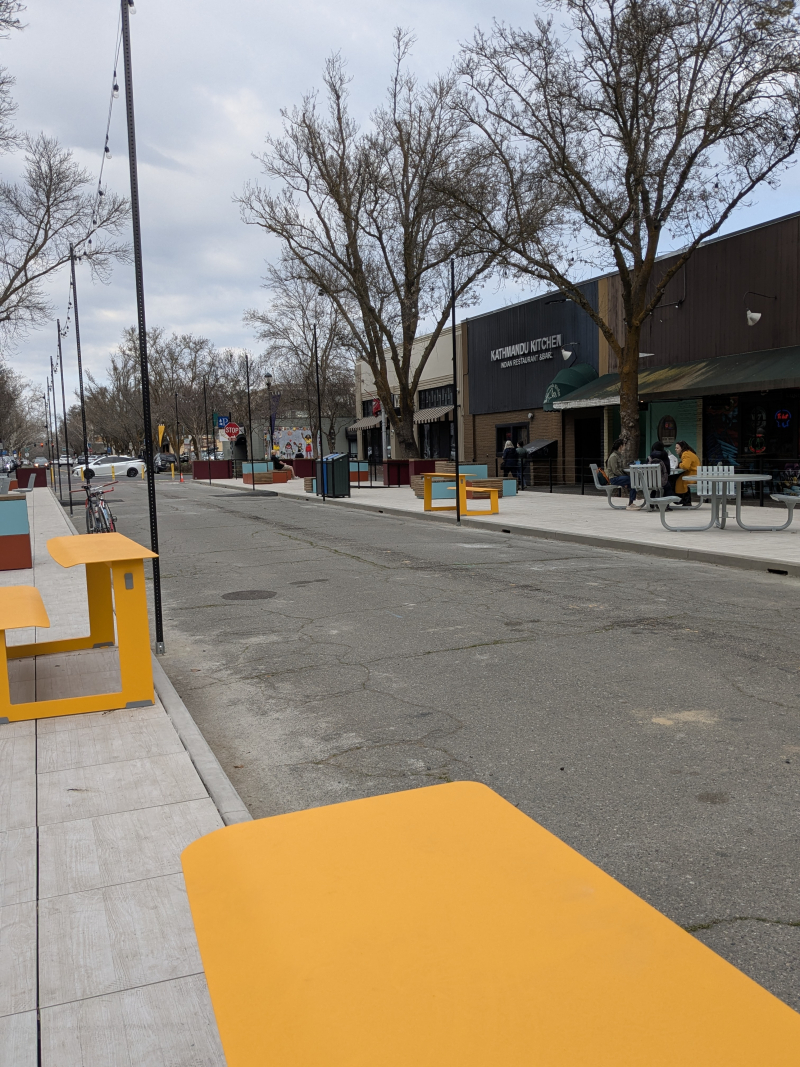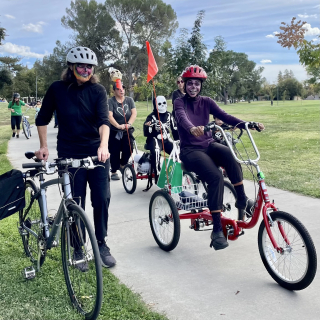
Davisite Banner. Left side the bicycle obelisk at 3rd and University. Right side the trellis at the entrance to the Arboretum.

Category: Uncategorized

  • Planning Commission and majority of public commentors strongly criticize Village Farms project and DEIR Part II Public Comments of concerns and issues regarding the Village Farm project and its DEIR

    IMG_7733

    By Eileen M. Samitz

    The Village Farms Draft Environmental Report (DEIR) was released roughly a month ago and the deadline for public comment is coming up soon on Tuesday Feb. 25th at 5pm. It is important to submit your comments and any concerns now to City Staff member Dara Dungworth at ddungworth@cityofdavis.orgThe City weblink to the DEIR is at https://www.cityofdavis.org/city-hall/community-development/development-projects/village-farms-davis where you then click on the CEQA section.

    The Planning Commission held a meeting to hear comments from the commissioners and the public on the Village Farms DEIR on February 12that Community Chambers. The outcome of the meeting was that the planning commissioners expressed many concerns and about the inadequacies of the Draft EIR.  Likewise, the majority of the more than 50 public commentors pointed out inadequacies of the DEIR and rejected the project for many reasons that have been raised before. (See weblinksbelow.) A majority of the commissioners and some public commentors also asked for an analysis of a “reduced footprint” alternative of a downsized project to be added to the DEIR, similar to one included in the Covell Village DEIR by the same consulting group.

    Many of the Village Farms issues and problems have been raise in an earlier Op-ed:

    https://newdavisite.wordpress.com/2025/02/09/title-village-farms-deir-is-inadequate-project-would-bring-massive-impacts-and-costs/

    YesterdayPart I of this article covered a number of the Planning Commissioners comments:

    https://newdavisite.wordpress.com/2025/02/18/planning-commission-and-majority-of-public-commentors-strongly-criticize-village-farms-project-and-d/


    The following is a summary of the numerous Village Farms issues, followed by some of the comments from Davis residents with concerns about the project and its Draft DEIR voiced at the Planning Commission meeting.

    Many Village Farms concerns and issues 

    – Village Farms is the largest project ever proposed in Davis for 1,800 housing units on almost 500 acres, but it has the same problems, and more, as its predecessor Covell Village that was voted down 60:40 by a Measure J vote in 2005.

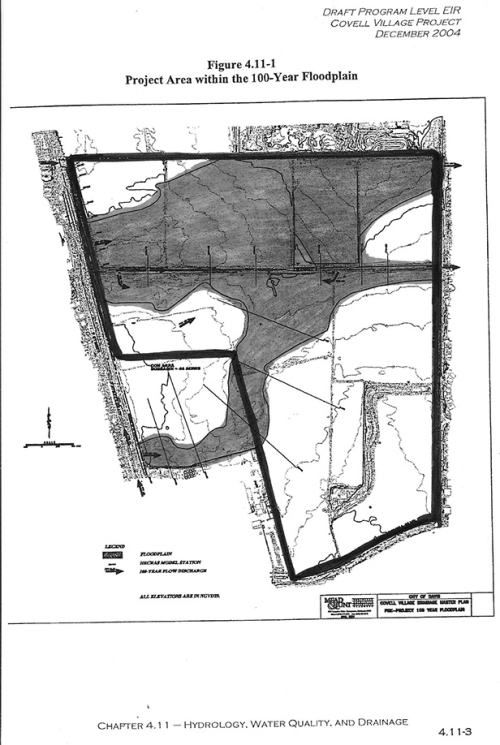
    the 200-acre flood plain and the fundamental planning principle thathousing should not be built on an enormous flood plain like this due to flooding risks, particularly a massive amount of housing and the added issue of climate change. This is a FEMA Zone A, a Special Flood Hazard Area (SFHA).
    IMG_7734

    -the toxics and chemical contaminants including PFAS carcinogenic “forever chemicals and high levels of manganese also exceeding MCL’s,coming from the adjacent unlined Old City landfill and Sewage Treatment Plant into the groundwater.

    -soil toxics including toxaphene and lead in high levels in the area where the large Heritage Oak Park is to be located.

    lack of safe access issues for bicyclists and pedestrians including the possibility that there would not be any grade-separated crossing. TheDEIR states that is uncertainty about the “feasibility” of the Pole Line undercrossingVillage Farms has no access to the west because of the railroad tracks, no access from the north due to the Old City Landfill and Sewage Treatment Plant, and no ability for an underpass or overpass (south) at Covell Blvd. due to existing infrastructure. Now, in additionthere is uncertainty of the feasibility of a Pole Line Rd. under-crossing to the east (likely also due to existing infrastructure.) 

    -traffic impacts are already enormous at Covell Blvd. and Pole Line Rd.and adding 1,800 housing units there would only exasperate the situation with gridlock. In turn the gridlock would impose health and safety impacts from idling car exhaust and particulate matter deteriorating air quality, and increase greenhouse gases. 

    -Vehicle Miles Traveled (VMT) is not realistic metric to use for Davis. It makes the false assumption that higher density housing will result in more use of public transportation by the residents. This is a fallacy, particularly when Davis has an inadequate and inconvenient public transit system that is designed primarily to serve UC Davis needs, not the community’s needs. The City has no plans to significantly expand its transit system, andfurthermore you cannot expect or force people to use public transit to try to reduce car use.

    -952 trees being cut down and the destruction of habitat for endangered speciesand also that trees help control flooding since they draw on a large volume of water.

    -inadequate protection of the vernal pools which have the endangeredspecies of Vernal Pool Tadpole Shrimp and the very rare native plant species of Astragalus tener var. tener and Extriplex joaquinana.

    -tearing up and re-routing Channel A destroying trees and habitat which also increases flooding potential, particularly to existing nearby neighborhoods such as Wildhorse. Will this increase flooding risk force north Davis residents to need to get flood insurance?

    -risks of the carcinogenic PFAS “forever chemicals” contaminated groundwater mixing with the Channel A runoff water. This can occursince groundwater levelperiodically rise from less groundwater being drawn down due to surface water use, and climate change is causing more frequent heavy rain events. The project plans to reroute the channel creating new deep sections, potentially allowing the contaminated groundwater to mix with the channel runoff water. In turnthis contaminated channel runoff would flow east through Wildhorse exposing those residents, and ultimately to the wetlands. It would be catastrophic if the wetlands were contaminated and other connecting waterways.

    -traffic, road damage, and air pollution impacts from the need to move ONE MILLION CUBIC YARDS of UATA soil with high levels of arsenic to try to fill the massive 200-acre flood plain. This would take 100,000 dump trucks moving soil down Pole Line Rd., which was just re-paved. Imagine adding 100,000 dump truck trips to the already heavily impacted Pole Line Rd. traffic? Air quality would likely be impacted as well due to the soil dust from so many trucks moving his massive amount of high arsenic level soil.

    -the 118-acre UATA (Urban Ag Transition Area) dig pit would result creating a huge crater-like 10’ deep hole that could have runoff from the adjacent unlined Landfill and Sewage Treatment Plant collect in it and soak into the ground further contaminating the groundwater. 

    – unaffordable housing due to the majority of the Village Farms homesbeing at least $700,000 -$800,000 with a significant number of the homes costing over $1 million.

    -liability to the City due to the risk of flooding and potential health impacts from the toxics and other chemical contaminants exposure to the public.

    -enormous infrastructure costs including an un-needed new fire station that would cost Davis residents many millions to build, staff, equip, and operate long-term. Since 90% of the Fire Department calls are medical and only 10% are fire related, we don’t need a new fire station. Instead, an emergency medical service is what makes far more sense and for a fraction of the cost. An emergency medical service would have such a small foot could be located almost anywhere in East Davis. 

    the serious inadequacy of the Village Farms DEIR due to the absence of so much information and details neededincluding the lack of sufficient alternatives with lesser impacts than the primary project proposal as CEQA requires. An analysis of a reduced footprint alternative developing only below the channel was needed as welldownsizing the number of units significantly and preserving the vernal pools. CEQA states that The Guidelines require that the number of alternatives be limited to those that would avoid or substantially lessen any of the significant effects of the project (Section 15126(d)(5).”


    Public commentors with major concerns and criticism of the Village Farms project and its DEIR

    Nicholas Pinter, a Professor of Applied Geosciences and Wildhorse resident called in his  comments regarding the potential flooding issues due to Village Farms and downstream to Wildhorse. “ I have concerns about the design and impacts of the Village Farms project.  My primary concern at this time is the effects of the project on downstream hydrology.  Having reviewed the draft environmental impact report (DEIR), I fear that this analysis, its hydraulic modeling, and other elements of the DEIR may significantly underestimate downstream hydrologic impacts.  Potentially including significant additional flow volumes and higher water levels in the Wildhorse neighborhood and elsewhere.  I recommend independent hydraulic modeling of the impacts of the Village Farms project.  

    The DEIR notes that mitigation efforts will be designed and implemented in the future, but no details are provided nor any specific timeline for the design or implementation of these mitigation measures.  This is not acceptable.  I recommend that the city of Davis and its residents insist on detailed engineering designs that prove full mitigation of downstream hydrologic impacts; mitigation to the standard recommended by the Association of State and Federal Flood Plain Managers (ASFPM) and others which requires “zero adverse impacts.”

    Last, and more broadly, the proposed Village Farms development involves large-scale relocation and reengineering of the current stream channel and flood plain system.  This raises many additional questions and concerns.  I leave you with a quote from ASFPM.  “Future developments should avoid high hazard and ecological sensitive areas.  State and local government should guide development away from these areas by applying land use management techniques.  This is the most effective way to minimize cumulative losses.”  

    Jim Flannigan explained how there was a glaring deficiency in the DEIR of a reduced footprint alternative analysis for the project to be located entirely below Channel A.  This is to avoid building on the 200-acre flood plain and distance the housing far from the unlined Old City Landfill and Sewage Treatment Plant.  He pointed out that the Yolo County Dept. of Community Service also recommended the DEIR analyzing this reduced footprint, as did he and other citizens during the only City Council meeting addressing the Village Farms DEIR alternatives in Dec. 2023. 

    Susan Rainer, an architect specializing in green planning, commented on the massive loss of trees and that tearing out 952 trees was ecocide. Also, that trees actually help prevent flooding by absorbing water, so removing them would contribute to flooding. She emphasized potential City liability due to toxics exposure the residents.  She also stated her support for the DEIR analyzing a reduced footprint alternative.

    Retired Cal Trans traffic engineer and former Planning Commissioner Dapo Okupe said that the idea of adding 1,800 at Covell Blvd. and Pole Line Rd. could not possibly work since we do not have the infrastructure to support the massive traffic resulting. He made clear that vehicle miles traveled (VMT) does not reflect the real impacts of traffic. (Note: This is particularly true for Davis having such a minimal public transit system focused primarily on UCD needs, so car usage will not be significantly reduced as VMT assumes.)

    David McGlocklin also raised his concerns about the loss of the 952 trees and the habitat impacts. He also spoke to the many impacts and costs that the project would bring and potential City liability. He supported the analysis of a reduced footprint alternative also.

    Liz Reay stated that the project has already been voted down by the Davis voters and it has come back after 20 years to haunt us.  She also said that the developer has had 20 years to figure this out but the many problems of the project have still not been resolved. She pointed out potential liability to the City regarding the toxics issues from the adjacent unlined Old City Landfill and Sewage Treatment Plant.  Also, the possibility of home owners needing to get flood insurance due to flooding potential.

    Chris Carter brought up how the project with all its impacts made no sense and as a bicyclist that more car traffic at Covell Blvd. and Pole Line Rd. would make those roads even more dangerous. He did not want to get killed trying to travel on his bike there. 

    Wildhorse resident Margie Longo, gave a detailed explanation of existing drainage conditions at Wildhorse and how the DEIR did not address the flooding potential that the Village Farms project would cause the Wildhorse neighborhood. She also supported the analysis of a smaller footprint alternative that was needed for the DEIR.

    Cannery resident Andrew McElrone explained the many concerns that the Cannery neighbors had regarding the ability of the City to plan and oversee this project. The Cannery has had many problems with failed construction workmanship.  There is much concern about the massive traffic impact that would funnel Village Farms traffic west through the Cannery’s already impacted Cannery traffic circle. 

    Former Planning Commissioner Nancy Price explained the health impacts of carcinogenic PFAS “forever chemicals” leaking from the unlined Old City Landfill and Sewage Treatment Plant that needs to have a minimumof a 1,000 ft. buffer zone to distance the housing from the landfill.

    Dr. Glen Holstein, a biodiversity specialist, commented on the inaccuracies of the DEIR on the habitat issues, and the fact that the mitigations were not sufficient to protect some of the rarest plants and invertebrate species in the world. He stated the need for better protection of these rare vernal pools on the Village Farms site and that he could not support the project. 

    Sharon Montooth emphasized the lack of safe access issues for bicyclists and pedestrians at the busy intersection of Covell Blvd. and Pole Line Rd. particularly for children. She had great concern about the loss of so many trees and impacts on the wildlife, particularly endangered species like the Swainson’s Hawk. She also raised concern about the toxics from the unlined Old City Landfill and Sewage Treatment Plant.

    Vijay Kumar, a professional civil engineer for 35 years, explained a stunning analogy that the estimated ONE MILLION CUBIC YARDS of soil that the project DEIR says it would need to move. This would be the equivalent of filling the Super Bowl Stadium with soil 600 feet high. He had never encountered a residential project professionally that had to move that much soil. (It is notable that this UATA “dig pit” soil  has high levels of arsenic above MCL’s to try to fill in the enormous 200-acre flood plain. This would likely cause air quality impacts as well from the soil dust.) He added that there is no reason to allow annexation of the UATA “dig pit” site.

    Dave Bakay expressed that the project traffic impact predictions were unrealistic and how vehicle miles traveled (VMT) was not logical as a metric. It makes no sense to claim having 2,700 units is better for VMT than 1,800 to reduce impacts. He raised the lack of access to the project from the west and the north, and their related safety issues for kids especially. He supported analysis of a reduced footprint alternative.

    John Keller emphasized the importance of CEQA and that climate change needs to be taken into account with our City planning. 

    Calli Garritson, a Cannery resident, called in her many concerns about the toxics, potential flooding, lack of safe access , the DJUSD’s overly-optimistic assumptions that Village Farms would bring a significant number of school children. She was especially concerned about the street that Village Farms plans to put through to the Cannery traffic circle which would pave through the Cannery urban farm, and cause major traffic and safety issues.   

    La Buena Vida resident  Roberta Stuart also called in her concerns that the traffic impacts from Village Farms would exacerbate an already excessively impacted roads (Pole Line Rd. and Covell Blvd.).  

    Judy Feldman of Covell Farms called in comments enumerating the many Village Farms impacts including concern about the toxics, flooding potential, access issues, the habitat impacts and that none of these impacts were being adequately addressed by the DEIR.

    I attended, and also commented on many of the summarized issues (above) particularly the toxics, floodplain and flooding issues, traffic, and infrastructure issues and costs and the need for the DEIR to analyze a downsized version of the “Reduced Acreage Environmentally Superior Alternative” from the Covell Village Draft EIR of building only below the channel, with the modifications of preserving the vernal pools and downsizing the number of housing units significantly to a more reasonable number.

    Summary 

    The comments from the Planning Commission and the majority of the public commentors were clear, that the Village Farms project proposal has a plethora of problems which are not addressed adequately by the DEIR. The DEIR was rushed to accommodate the developer’s desire to get his project to a Measure J/R/D  vote quickly. Village Farms has all the same problems and more, than its predecessor Covell Village which is why the project was rejected by Davis residents.

    The fact is, the Village Farms site is seriously handicapped site with a massive 200-acre flood plain and flooding risks, significant toxics issues including PFAS carcinogenic “forever chemicals” leaking from the adjacent unlined Old City Landfill and Sewage Treatment Plant, habitat destruction, enormous infrastructure costs, lack of safe access for bicyclists and pedestrians due to existing infrastructure impeding the ability to add undercrossings or overcrossings, massive traffic that would exacerbate the already heavily impacted Covell Blvd. and Pole Line Rd. roads by adding 1,800 units and in turn the gridlock of idling cars exhaust would impose health and safety impacts, and the majority of the project having unaffordable housing for the incomes of average local workers and families. 

    For residents with concerns regarding the Village Farms project, please submit your DEIR comment before Tuesday, Feb. 25th at 5pm. For more information regarding the many Village Farms project issuesplease contact Citizens for Responsible Planning at citizens@dcn.org

    — Eileen Samitz is a former Davis Planning Commissioner and served on the city of Davis 2001 General Plan Update land-use committee and the subsequent Housing Element Update Committee.

  • Planning Commission and majority of public commentors strongly criticize Village Farms project and DEIR Part I

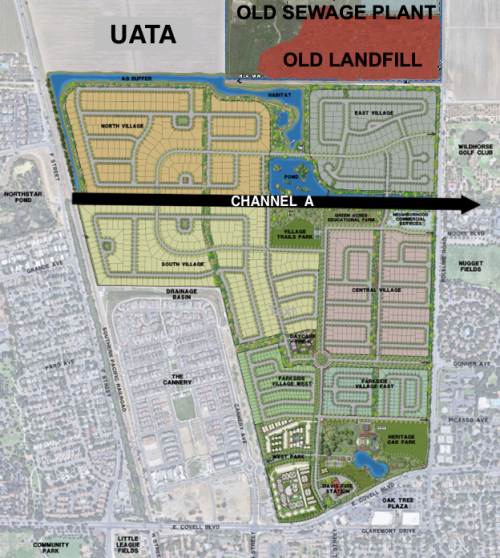
    Original Village Farms proposal with Old Landfill  UATA and Channel A defined
    By Eileen M. Samitz

    The Village Farms Draft Environmental Report (DEIR) was released roughly a month ago and is required by the California Environmental Quality Act (CEQA) law to circulate to allow public comments to be received in writing and verbally at public meetings. Last Wednesday, Feb. 12th the City of Davis Planning Commission meeting agenized comments and discussion from the planning commissioners, and allowed the public to voice their comments.

    The outcome of the meeting was that the planning commissioners expressed significant concerns and had much criticism of the Draft EIR as well as raised other issues regarding the project.  Likewise, the majority of the more than 50 public commentors, both in person and by recorded voicemail, disapproved of the project for many reasons that have been pointed out before (see previous article link below.) However, a majority of the commissioners and some public commentors wanted to see an analysis of a “reduced footprint” alternative, similar to one included in the Covell Village DEIR by the same consulting group.

    (more…)

  • Village Farms DEIR is inadequate, project would bring massive impacts and costs

    Original Village Farms proposal with Old Landfill  UATA and Channel A defined

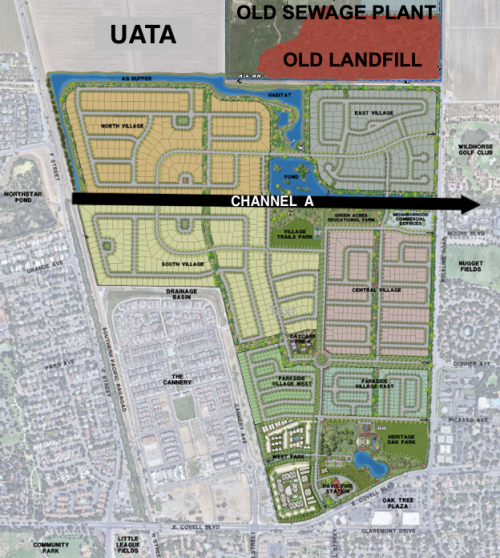
    Original Village Farms proposal but showing locations of the Old City Landfill and Sewage Treatment Plant, Channel A, and the UATA site.


    By Eileen M. Samitz

    The Draft Environmental Impact Report (DEIR) has been released for comments on Village Farms, on a parcel outside city limits, is the largest project ever proposed for Davis with 1,800 units on almost 500 acres. The DEIR was rushed and is inadequate since it’s missing  important details and makes unwarranted assumptions and conclusions.

    The project has a multitude of problems primarily because it is a seriously handicapped land parcel. The site’s serious issues include a 200-acre flood plain, being located adjacent to the unlined Old City Landfill and Sewage Treatment Plant with a long history of leakage into the ground water of toxics and other chemical contaminants (now including PFAS “forever chemicals”), enormous traffic issues already at Covell Blvd. and Pole Line Rd., access issues because it cannot be accessed from F St. due to the railroad tracks and there’s questionable feasibility of a Pole Line undercrossing, massive impacts on habitat, and enormous costs of the infrastructure and services needed.

    (more…)

  • “Sitting-friendly” G St.

    PXL_20250125_214747637_exported_1737893470120Sitting-friendly does not mean the same thing as "Joy Priority, Expressed with Convivial Design".

    Join me on G Street…

    I'm not discussing here the fight to make it happen, the politicians who voted against it, the free car parking entitlement, and the process to get us to this point…

    I visited early on Saturday afternoon, January 25th, 2 days before the ribbon cutting..

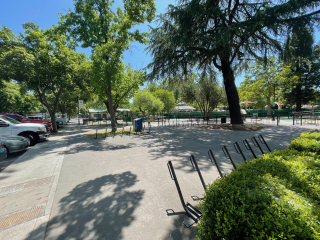
    Please see photos with captions.  

    It's incomplete and it's not clear why they are doing an opening event at this time. But I will say that the only clear positive thing about it is that it's much quieter than the rest of Downtown at that time of day. At the time I compared it to the corner of 2nd St and E St, where one could barely hear the sound of a violin over all the engine noise. Nearly all of Downtown is like that, vibration pollution squashing any notion of genius loci.

    Unfortunately, a significant proportion or perhaps the majority of people will drive to get here.  The title of what I'm writing at you now refers to "bicycle-friendly", our City's delusional compliment about itself: It's designed for cars, but bikes are accepted in some places. 


    Comments:

    The varied types of seating seem to be well used, though demand is very low right now. 

    There's only two intentional ADA compliant seating spaces, in the typical 3/4 configuration, but it's not clear if people will be able to move to a free table if a space is needed and there's no space for a couple using wheelchairs, which may also be a oversight of ADA, but it reflects an ugly assumption. 

    The bicycle parking is reduced compared to the prior configuration and it's nearly all full now, which is a problem since there's hardly anybody here… Most of the bike parking is at the south end. There's nothing specifically for larger bikes such as cargo bikes or bikes with trailers.

    As I understand it, restaurants here will be able to rent spaces on the platforms and displace existing furniture and spots to sit in… If I have this correct, it means a lot less general public seating. This will create conflicts if the exclusive seating is empty and the public seating is full.

    The total number of proper seats at tables is well less than the number of Commissioners which were eliminated in the recent Purge led by the mayor. 

    Tables, for example, in Central Park allow groups of perhaps eight people to sit together. The tables here only allow four.

    The wood and cube formed feeding block things encourage climbing, which means that they'll be filthy very quickly and not very conducive to seating for many. Certainly, kids should not be discouraged from climbing, but there's not any climbing specific equipment here.

    There's no food available at windows on the sidewalks. There's a coffee shop and a tea place, but it's not clear if they or the restaurants etc. will platform-ize.

    There's a provision for sun shades only on the tables and it's not clear who will put these up and take them down everyday, or if they will be locked in place overnight during the summer… The other seating has no shading at all 

    It's not clear to me how the unshaded seating will perform when it's in the sun for hours during the summer. The platform material will likely create an issue.

    The existing street surface is incredibly ugly and actually forms a centerpiece for the whole thing. One of the videos at the link is 180° shot of the street street. From the perspective one of those yellow two-person one-sided tables. It's all ugly, asphalt and parked cars.

    The white colored pavers or whatever on the platforms show dirt really easily and will look like crap immediately. 

    Bright headlights from cars coming north from 2nd Street and turning left or right from southbound G Street at 3rd Street will all pierce the eyeballs of everyone sitting at both ends or actually most of the street. I had actually made a specific point about this to city staff months ago but got no reaction.

    There's an absurdly insufficient number of trash and recycling receptacles. 

    The vertical poles holding up the string lights are dark and may have insufficient contrast from the street etc. Especially at night. This might be an ADA oversight. Some high curbs were eliminated, which is positive.

    What's happening with the two empty store fronts?

    Thanks for reading!

  • DDBA busy address growing crime and safety concerns

    By Dan Urazandi
    I wrote this letter for other downtown businesses. When asked to reproduce it publicly I refused, as it involves an internal  DavisDowntownBusinessAssociation issue and as only DDBA members can vote on it for matters both practical and tasteful I held it back. But since the DDBA establishment went on the Davis Enterprise to claim that there is no crime problem and they have taken care of it even as they claim it's not their business to deal with it, I think the side that is actually against crime should also be publicly aired, dirty laundry though it may be:
     
         All of us know crime is increasing downtown and most of us have been hurt by it. Over the last 5 years my son and I have been victims of assault with a deadly weapon, aggravated assault, and three burglaries let alone the felony vandalism and many other lesser but costly crimes, all because we operate a downtown business in a town that has given up on law enforcement. By comparison in 27 previous years of business, we suffered 2 felonies, both minor.
         The problem is obvious and yet our city council and police force want to pretend it does not exist. So too, apparently, does the DavisDowntownBusinessAssociation. These so called representatives who are all paid by us must be made to do their job. Pressure must be brought.
         When I witnessed my neighbor being pummeled into the ground by a 250 pound homeless man through the window that was broken just days before in a burglary, I went on TV to call out how the city and police were ignoring all complaints about crime in the alley beside my store. The day after that aired the deputy chief of DPD was in my shop. But this method of publicly shaming the city into action can only be used sparingly. If we bang the drum constantly about how dangerous downtown has become, we will scare away our customers.
         So Heather Caswell of The Wardrobe has been working within the system and behind the scenes to address the crime emergency. She wants DDBA to take action, which could be a way of influencing the city to withdraw its pro-crime agenda. DDBA is notoriously close to city hall, so much so that the current DDBA head is the former mayor and until the position rotated a week ago the mayor was the former head of DDBA.
        Also like city hall, DDBA is a closed system even as it claims to represent us all and lives off our taxes. Both feign democracy but control the system so incumbents run unopposed and status quo is maintained. In order to vote all us involuntary DDBA members have to physically show up or send a representative to the meeting Thursday Jan 23 at 5:30 at Natsoulas Gallery. Making votes secret and difficult is how a dozen people run a 500+ member organization. Most of us have no time for DDBA and their games but if we turn out this Thursday we can elect Heather Caswell and Ezra Beeman to the DDBA board. They have promised and proven themselves to be committed to downtown safety and will be replacing members of a board that has refused to take any position on crime. This will be a move in the right direction to fight back against the political mismanagement that is endangering us all.


  • Businesses & People Before Criminals — Time for a Clean Sweep of the Downtown Davis Business Association Board

    by Alan C. Miller

    Note:  Read Jonathan Greenberg’s article, below this article, before reading this!   Both my and JG’s articlse are in response to the Davis Enterprise article by Kevin Wan at:  https://www.davisenterprise.com/forum/commentary-ddba-addressing-downtown-safety/article_b2cc9648-d81e-11ef-9fb7-17ed56e5d85f.html

    If you know a downtown business owner, encourage them to go to the DDBA meeting at Natsulous Gallery this evening at 5pm to vote Heather Caswell, Ezra Beeman, Shelly Ramos and Kellie Palmerto the Board.  It’s time to clear the board and start with a fresh slate that isn’t blinded by embracing an outdated belief in a failed ideology.  

    Gloriously, Tuesday’s piece in the Davis Enterprise by Kevin Wan (KW) says that accusations have been leveled against the DDBA that it doesn’t address public safety, then goes on at length to claim that DDBA does address public safety (in the ways that are OK to KW).  KW continues that the purvue of DDBA is “marketing, promotion, and economic development” and adds, Law enforcement and security is not within our purview.

    So according to KW, the DDBA deals with “public safety” all the time, but “public safety” isn’t within DDBA’s purvueIn other words, KW doesn’t agree with the proposed safety plan, so he makes claims that DDBA doesn’t have the prevue of public safety then explains how they deal with public safety every month.  Why not just say you don’t agree with the proposed program instead of opening the article with a glaring contradiction?

    KW claims DDBA has, “devoted time every month to tackling the challenges of crime and homelessness facing our downtown community”.  If that’s true, why have the tactics you have used so far rendered the current state of things downtown and in adjacent neighborhoods with the effects from the so-called “homeless” the worst they has even been in many years?

    If you question my statement, let me tell you I can see downtown out my living-room window.  I live adjacent to the railroad tracks by the Amtrak station.  I have so-called “homeless” encampments both 200’ to the east of me and 200’ to the west of me, and the associated piles of garbage that are always associated with these encampments. Myneighbor and I have repeatedly cleaned up this garbage ourselvesmore times than I care to imagine.  We’ve also spent countless hours and thousands of dollars in deterrence measures.  

    Since DDBA has been working so hard, as you claim, and clearly utterly failing, why attack people who are willing to try something new, taking the matter into their own hands to do it themselves when the City and the current DDBA board cannot, or will not?   

    KW goes on to claim that the proposed program could pose liability to DDBA regarding privacy, trust, discrimination, etc.  Yet the program has been presented to Yolo Countt DA Jeff Reisig, and he has given support to the idea as beneficial in deterring crime.  Ask yourself, who might know more about the legal consequences of a crime-deterrence program:  the Yolo County district attorney, or the owner of a restaurant?

    KW seems very concerned about what harm may come to DDBA from this crime-deterrence program.   But do you know what reallyhurts the DDBA and downtown businesses?  Crime!  

    All we are SAY-ing, is give S.E.N. a chance!  #sing-it!#  

    All we are SAY-ing, is give S.E.N. a chance!

    S.E.N. is the Safety Empowerment Network.  The idea is to use security cameras to identify repeat offenders, and a database so downtown businesses can identify these repeat criminals efficiently and report their findings to law enforcement.  It’s similar to talking to each other, but must faster and far more efficient.

    KW continues, “we can address safety concerns without compromising our values” and sites the need for “balancing accountability with compassion”.  Who’s values?  Compassion for who?  No one is questioning the societal compassion of sheltering a mom who lost her job and couldn’t pay the rent.  But I hold nocompassion for those who trash our downtown and its adjoining neighborhoods and commit crimes even to the point of threatening and even punching people.  

    The implication at the end of the article seems to be that Heather and Ezra and others who support S.E.N. will be implementing something illegal, destructive to DDBA, and somehow lack compassion.  These implied accusations are ridiculous and borderline offensive.  Heather and Ezra are good people – they are very good people.  I’ve known Heather for decades.  She owns and runs one of the longest-running independent businesses in downtown Davis.  I’ve known Ezra as good neighbor for near a decade.  He owns a consulting business based in downtown and lives in the adjacent neighborhood.  He is concerned not only for the safety of downtown, but for the safety of his daughters, and the safety of others in nearby neighborhoods.  

    What is KW expressing concern about? . . . “our” (his) “values” for “compassion” towards . . . who exactly? . . . criminals who threaten people downtown ?

    This so-called “compassion” that KW brings up needs to be examined more closely.  This is what the professor and author Gad Saad has termed "suicidal empathy"the excessive, self-destructive form of compassion where individuals or societies prioritize the well-being of others to their own detriment. “Suicidal empathy” occurs when empathy is taken to an extreme, leading to decisions or behaviors that harm oneself or one's group in the name of helping others.  Saad argues that while empathy is an essential human trait, it becomes dangerous when it blinds people to the negative consequences of their actionsOverly empathetic policies or attitudes may enable harmful behavior, sacrificing rational self-preservation or fairness in favor of misguided moral virtue.

    The advocates of the Safety Empowerment Network will of course address issues of liability, privacy, trust and discrimination in order to make the program successful and fair, within the framework of the program.  It is highly disingenuous to use fear mongering tactics to imply that the program will itself cause any of these things.  The purpose of the program is the safety of Davis businesses and Davis residents.  And as Jonathan Greenberg rightly points out, the biggest threat to those who are living outdoors who are NOT criminals is those living outdoors that ARE criminals.

    I am personally interested in the S.E.N. Program to help deter issueswith the effects of the so-called “homeless” in the downtown-adjacent neighborhoods and other neighborhoods near parks, drainage ditches, bicycle paths and railroad tracks.    It is my hope that if the database and camera system is successful for use by downtown businesses, this could be used as a tool in protecting our neighborhoods as well – from these same and other criminals found amidst the so-called “homeless” population.

    A neighbor of minemyself and a nearby business have used CPTED (Crime Prevention Through Environmental Design) concepts to make the area around our homes less conducive to crime and criminals.  This is needed because of the over-abundance of so-called “homeless” that congregate nearby.  We have spent countless hours and thousands of dollars doing this, with, I believe, a degree of success.  No, we shouldn’t have to spend our time and our money doing this.  However, we have learned through experience that the City isn’t going to do this for us.

    Similarly, downtown businesses and the DDBA must fend for themselves, because the City isn’t going to do it for them.  Downtown businesses must take matters into their own hands, as we did, and the Safety Empowerment Network is an important tool to help empower downtown businesses against crime.  Apparently, Kevin Wan and other members of the current board aren’t interested in even trying this program to see if it works.  Therefore, it is time to vote Heather Caswell, Ezra Beeman, Shelly Ramos and Kellie Palmer to the DDBA Board.

    Alan C. Miller is nearly 40-year resident of Old East Davis, a friend to a few good people, and a source of great annoyance to many others.

  • The Sixth Annual Zombie Bike Parade Festival: A Weekend of Halloween Thrills and Community Impact

    =?UTF-8?b?Tm9yY2FsIFRyeWtlcnMgb24gQmlrZXMuanBn?=(From press release) The sixth annual Zombie Bike Parade Festival, held from Friday, October 25th through Sunday, October 27th, was a spectacular success, bringing together thousands of participants for a weekend of Halloween-themed festivities, community engagement, and charitable giving. Orchestrated and hosted by the Davis Odd Fellows with huge contributions from The Bike Campaign, Davis Bike Club, and Hallmark Properties, the event raised significant funds for local non-profits while showcasing the vibrant spirit of Davis.

    Festival Highlights:

    The festival kicked off with a variety of events, including the Mirror Image Dance Company’s Trunk-or-Treat on Saturday afternoon and the sold-out Zombie Ball on Saturday evening. At the Zombie Ball, the Davis Odd Fellows Lodge was transformed into a popular destination for Halloween enthusiasts, and costumed partygoers danced to music by DJ Duc Jones, enjoyed themed drinks, and participated in a thrilling costume showcase. 

    The main event on Sunday saw over 1,000 bicyclists join the traditional Zombie Bike Parade, riding from Community Park to Mace Ranch Park and back. Nearly 2,000 participants gathered throughout the day for festival activities, which culminated in the awe-inspiring zombie skydiving grand finale at Community Park.

    (more…)

  • Follow the Money – Part II

    No on Q Banner Artwork 2

    The Davis Employee Unions are Filling the Yes on Measure Q Campaign Coffers

    by the No on Measure Q Campaign Committee -  – FPPC No. 1470874

    Last week, we reported on the $22,482.20 that Davis firefighters and their union paid to or spent on behalf of 4 sitting Davis City Council member campaigns in the 2020 (Josh Chapman and Will Arnold) and 2022 (Gloria Partida and Bapu Vaitla) election cycles (see Follow the Money – Part I at https://newdavisite.wordpress.com/2024/10/04/follow-the-money/).

    These direct contributions preceded huge, retroactive salary increases given to the Davis firefighters pushing their compensation well in excess of what neighboring, similar-sized cities are paying their firefighters.

    As Davis Enterprise columnist Rich Rifken once wrote: "No segment of the Davis' labor force is gorging at the trough more voraciously than the Fire Department…"

    Well, not to be outdone, other Davis city employee unions are joining the firefighters' union in rapidly filling the coffers of the Yes on Measure Q campaign committee. Following are their campaign contributions to the Yes on Measure Q campaign committee reported thus far:

    (more…)

  • Letter: Linda Deos for City Council

    I endorse Linda Deos for election to City Council based on the experience I have had serving with her on the City of Davis Planning Commission for the past two years.  During that time the commission has engaged in long and difficult deliberations that resulted in approval of important development projects and policies, often after significant modifications by the commission.  Linda has been a fully engaged and vital participant in reaching those decisions.

    Evaluating this type of complex subject matter requires familiarity with the principles of land use, planning, zoning, housing and the applicability of continually evolving State law.  These are precisely the same topics about which a councilmember must be intimately knowledgable, meaning Linda will be ready to "hit the ground running" on her first day in office.

    In working with Linda, I have found her to be consistently well informed, articulate, and prepared to ask penetrating questions of project applicants and City staff.  Linda is also sensitive to community values and concerns- – a vitally important trait for serving on City Council. 

    Based on my experience working with Linda on issues similar to those that lie ahead, I strongly urge voters to elect Linda to City Council. Although I am chair of the Planning Commission, the opinions expressed in this letter are strictly my own.

    Greg Rowe