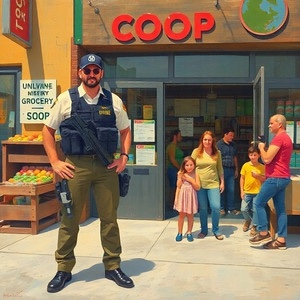
Your host: Alan C. "Al" Miller
Pictured: an extreme version of himself

By Elaine Roberts Musser
I was appalled with City Council’s response to the apprehension many expressed at the City Council meeting on June 4 about the proposed midterm city budget and 1% sales tax increase. Concerned citizens were gaslighted, accused of seeking revenge for the commission mergers and engaging in hyperbole. (Gaslighting in this context is manipulating citizens into questioning their own perception of reality to avoid accountability for questionable behavior.)
The fact of the matter is we only pointed out things the Finance & Budget Commission would’ve zeroed in on, were it still in existence (but hasn’t been for almost a year). But as we know, the current City Council (minus Councilmember Neville) voted to eliminate this commission in favor of a more generic Fiscal Commission that has not yet met, now manned with new commissioners who are mostly commission inexperienced.
Here are the problems we highlighted:
In other words, the City Council wants us to approve a 1% sales tax increase, in essence a blank check with virtually no accountability, insisting we trust them to make responsible decisions. Their conduct has hardly inspired confidence!
When people fought decades ago to save land from development, forever, do you believe what they were really fighting for was to save the land from development 'forever, or until there was pressure to build housing, whichever comes first' ?
It's June, and the City of Davis is in mourning. People are visiting the Davis Cemetery to visit our fallen committees. To celebrate this misery, Alan C. Miller sang "Committee Rise, Committee Set" at the City Council meeting last night, sung to the tune of "Sunrise, Sunset" from Fiddler on the Roof. Mr. Miller was brought to tears by his own performance.
This can be viewed at this link: https://davis.granicus.com/player/clip/1703?view_id=6&redirect=true
At this time signature: 38:10
Here's the lyrics from Tuesday night's (June 4th) council meeting:
To be Discussed and Possibly Decided at Tuesday, June 4th Davis Council Meeting
By Scott Steward
Right when Davis is in full graduation mode – the City is to consider items that have everything to do with how free you are to express your views without being recorded and traced, with or without your knowledge. Is this servail increasing our safety or providing more tools that have to be maintained and that have to find an excuse to exist?
Military equipment in a civil city? Where Davis has been resistant, other communities are less so, and the armaments that our police department does not have, it can leave them wondering if they have to borrow the highest gauge shielding and firearms. Or is that true? Is keeping the peace more about relationships and not over-arming to defend against community breakdowns that erupt in bizarre and tragic ways? Ways that no shielding can defend. A teenager hidden in a house, a gun owner deciding he does not like a police officer, a gun owner whose roommate does not suspect he has lost it. Or a knife held by a young man whose mind and body go feral?
Disarming those whose weapons are for organized crime and premeditated harm, this is part of peacekeeping, and how that can happen safely for the police officers is to be heard and understood. What are the tradeoffs? What is necessary, and what is contributing to escalation?
Item 5 (7:15) – agenda is here: https://documents.cityofdavis.org/Media/Default/Documents/PDF/CityCouncil/CouncilMeetings/Agendas/2024/2024-06-04/City-Council-Agenda-06-04-24.pdf

(From press release) On May 29, the Sierra Club and the Environmental Council of Sacramento (ECOS) filed a lawsuit against Caltrans alleging legally inadequate environmental analysis of the I-80 freeway widening project through Yolo County.
The lawsuit’s goal is to stop Caltrans from widening 17 miles of the I-80 freeway from six to eight lanes between Davis and Sacramento through the Yolo Bypass Wildlife Area until Caltrans conducts a valid analysis of adverse environmental impacts threatened by the project and implements appropriate mitigation for these harmful effects.
Caltrans’ Environmental Impact Report (EIR) grossly underestimates increased vehicular travel, which would emit far larger quantities of greenhouse gases (GHG) and air pollutants than claimed. The EIR fails to consider viable alternatives, such as increased public transit or alternate tolling strategies. Therefore, the project neither adequately manages demand nor produces adequate revenue to fund needed transit alternatives. Also, Caltrans’ proposed mitigation is woefully inadequate to offset the resulting increased GHG and air pollutant emissions.
Caltrans violated the California Environmental Quality Act (CEQA) by failing to acknowledge that freeway widenings do not produce less congestion but, in fact, result in increased traffic — leading to worse congestion and pollution – due to “Induced Demand”.
CTC's $105M highway widening grant shows it has lost the plot when it comes to following Governor Newsom’s and the Legislature’s stated climate directives.
By Carter Rueben (NRDC) and Alan Hirsch
On May 16 the California Transportation Commission (CTC) approved $105 million from the State’s Trade Corridor Enhancement Program (TCEP) to widen a stretch of Interstate 80 from Davis to Sacramento. In the room and on the Zoom feed, dozens of Davis and Sacramento-area and statewide advocates called in to ask CTC to reject the funding and push Caltrans to provide real congestion relief and reduced environmental impacts.
NRDC identified TCEP in a 2023 report, "Closing the Climate Investment Gap," as the state program that most heavily invests in highway widening in contravention of our state’s climate goals.
A study commissioned by the California State Transportation Agency came to a similar conclusion.
By NRDC’s latest estimate, CTC has granted over $2 billion total to more than 50 highway expansion projects since the TCEP program was created in 2018, even though the program is able to fund projects that are wins for both goods movement and the environment, like truck and train electrification projects and rail grade separation projects.
We're at a pivotal time when the state’s climate laws require the state to dramatically scale up rail lines, bus routes, and active transportation corridors, while investing in electrification efforts that zero-out tailpipe pollution. Yet, the TCEP highway widening projects are doing just the opposite – collectively adding hundreds of millions of additional vehicle miles traveled (VMT) across the state per year. This is a trend we can and must reverse, as our friends at NextGen Policy detailed in their report, California at a Crossroads.
The Yolo 80 project is indicative of the systemic issues at Caltrans and CTC and retro-thinking by Yolo County and city elected officials that reject their own climate action plans drawn up by 5 local citizen climate to enable Caltrans.
What makes the Yolo 80 highway widening particularly striking?
What message will the CTC send Thursday?
By Alan Hirsch
Letter to California Transportation Commission CTC@catc.ca.gov
Chair Carl Guardino and Members,
CC CTC Equity Committee Chair William Walker
Re: Disagreeing Better on Transportation Projects
Mr. Guardino:
Senator Daniel Patrick Moynihan used to say:
“You are entitled to your own opinions. But you are not entitled to your own facts.”
The California Public Records Act (and the Brown Act) were designed so we work from the same facts—that there is sharing of information – so in dialog agencies don’t strategically withhold information to put electeds official as well as the public at an unfair disadvantage in reviewing projects.
Transparency is Inclusivity.
However, I want to bring to your attention a situation where Caltrans seems to be strategically withholding information from the public on a $1/2 billion project.
In June 2023 the CTC staff report recommended NOT to fund Yolo80 toll lanes out of TCEP funds, rating it medium priority. In that staff report CTC staff rated Yolo80 31st out of 48 projects. Caltrans rated Yolo80 last in priority (24th) out of 24 of their projects. (extract from June 2023 staff report attached)
This of course raises question why it is now rated a priority for advance funding. In the CTC discussion on 5/16. Would not you and other commissions like to know?
In fact 11 months ago, I tried to find out.
DEI (Diversity, Equity and Inclusion) is given lot of lip service in progressive circles in Yolo County. But it can turn performative – especial if those in power have already made up their mind on a solution and don’t want to be contradicted- i.e. surface and take in to account diverse opinions.
That is what has been at play for Yolo County on Yolo80 widening with local electeds having made up their mind 3 years ago to add toll lanes to a 17 mile stretch of I-80. After that they have worked to turn the legally required public process into a check the box exercise, excluding diverse view point from being considered– even when the diverse viewpoints are backed by top transportation experts from UC Davis.
We are now at the end-stage where Davis Mayor/Yolo Transportation District Chair Josh Chapman is overtly discouraging public participation: he said openly it don’t matter what members of Davis public think — hiding the fact the project is not yet fully funded and public input to the California Transportation Commission (CTC) can still make a difference.
This DEI hypocrisy in Yolo County will continue unless people call out the hypocrisy. The public can be heard at the CTC’s Equity Committee meeting Wednesday. It is especially focused on this behavior like this by in local transportation jurisdictions.
Emails are needed to the “CTC-EAC” (California Transportation Commission- Equity Advisory Committee) to note the performative nature of Yolo80 Environmental process (Caltrans District 3 and YoloTD) – and also to oppose funding the new toll lanes until the process is made truly diverse and inclusive in the search for a solution.
Write to CTC@catc.ca.gov Subject: Equity and: Funding widening Yolo80 with Toll Lanes.
Issues to note to the Equity Committee: (cut and paste into email?)
On Wednesday May 1, the 1971 page (plus 345-page appendix)- final EIR for yolo80 was released. The 139 comments take up nearly 71% of the pages. – 108 of the 139 were from individuals, not government agencies, cities or environment groups with paid staff. This highlights the fact this science-defying proposal from Caltrans has become “the most controversial freeway project in the state.”
———————–
NOTE: The last chance to comment on the funding will be at California Transportation Commission Meeting Thursday May 16, By Tuesday send any comments. (esp inadequately funded mitigation plan, induced demand negates any congestion relief, no environmental justice plan for tolls)
to CTC@CATC.CA.GOV
Subject: Widening I-80 with a Expensive Toll lane.
Pro-Tip: use 14 or 16 pt font for short email.
————————–
The EIR concluded that despite the widening the freeway will generate 158M more miles of driving (VMT) a year…equal to adding over 11,000 more cars to the road and should be built based on “Statement of Overriding concern” as it has benefit to reducing congestion- Even though everyone agree this is wrong as congestion will return within less than ten years. It is also strange given their VMT Mitigation plan only offsets 55 Mil VMT miles year of the additional driving and ignores the nearly 50Million of additional a truck.
Adding capacity via toll lanes only guarantee richest member of community- and groups of Tahoe travelers never faces congestion.
The EIR also ignores any analysis of increased danger from narrowing lanes and permanently removing shoulders. (see diagram)
The ability of the proposed mitigation plan to provide a carbon/VMT offset is taken to higher degrees of absurdity to somehow claim the project tolls will fund adequate mitigations- and have money left for a social equity/environmental Justice program into perpetuity.
Public not told about public hearing on toll levels.