
Not much going on in Davis these days . . . coming up short on starter topics . . . #sigh# . . . anyone?


Not much going on in Davis these days . . . coming up short on starter topics . . . #sigh# . . . anyone?
SUBJECT: "Commentary: A Wake Up Call" (Wednesday's Blavis Blansplard)
Only DG could get a robo-call about solar panels from a call center in India and think it was a a wake-up call. I was rummaging through the trash behind Vanguard Headquarters on Thursday evening at 8:17 p.m. and found the recipe for the article. As a public service I am posting it here:

This volume of Al's Corner is dedicated to the celebration of the Davis Vanguard's National Issues Open Discussion Page. Of course, this page isn't open to me, or several other banned people. Nor, in practice, is it a discussion. Let's do some stats and declare a winner:
While there has been a discussion on that 'other' blog, the reason I hang here is that many comments get deleted there without explanation, especially on this issue and especially comments even modestly politically right. However, this is a sensitive issue, and I am not going to allow outright insults directed at trans people/supporters/protestors nor at persons associated with Mom's for Liberty.
For example, for some reason that other blog allows MFL persons to be called Nazis, and that sort of useless comment isn't going to be allowed here. On the other hand, in the Yahoo comments on the Bee article, about 153 out of 155 comments were against the library actions, despite the article leaning towards supporting the protestors. AND . . . many if not most of those commenting there were denying the existence of trans people, insulting trans people, and/or calling trans people various derogatory terms implying mental illness just for being trans. I'm not putting up with any of that shit here either. I won't outright delete a comment unless it's completely empty of anything but outright hate towards either side, and I'll always explain why a comment or part of a comment was deleted.
My views on the library matter are simple: I'm a Jew who believes the Skokie decision was the greatest triumph for the core of what makes America great: Free speech, baby!
What are your views? I'd like this to focus on free speech vs. hate speech; the actions/authority of the library/library-manager, the actions of those putting on the meeting and those protesting the meeting, and various takes in the media.
(Note: I have a life, so your comments may not be posted for many hours. Deal with it.)
Got a thought on Davis politics, or a even a single politic? Got a thought on the request to give a donation to the Davis Vanguard so they can fund the replacement of their crappy old website? I have a thought — give instead to the Davis-Ite to replace the D-ite's even older, crappier website ! Underfunded old crappy blog structures: It's the Davis Way !

A huge explosion and fireball enveloped the Al's Corner tanker truck late Tuesday evening. The explosion was heard as far away as Esparto, Knights Landing, Allendale, Zamora, Broderick, Saxon, Batavia, and the Milk Farm.
Preliminary investigation by the combined UCD and City fire departments indicate that a flea had flown into the side of the tank, causing the explosion.
When asked how a flea could have caused such an explosion, fire chief Woody Burns said simply:
"It was a very annoying flea".
Contacted at his new residence on the east side of Pole Line Road just north of 8th Street, Al was asked about Al's Corner's iconic run in the Davis shitty-blog scene. Al responded simply:
"It's been real, and it's been fun. But it hasn't been real fun."
There's a part B. We hit 100 comments: such an ashwevement 😐
* If Nishi can't be built, there's nothing to trade as a mitigation
* Dedicated bike-ped crossing of the Yolo Bypass was quietly cancelled after years of promises.
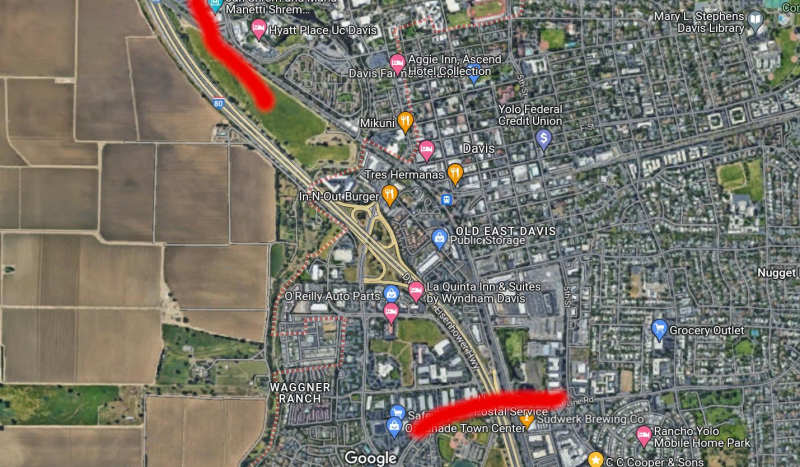
Tonight's City Council Agenda item on the 80 Yolo Managed Project was already covered critically and nearly exhaustively last weekend in the Davis Enterprise and yesterday here in the Davisite and in the Davis Vanguard.
A Bridge That Can't Be Built…
I arrived in town after Nishi 1.0 (retroactively supported a concept that would involve a complete redesign of the 80-Richards interchange inclusive of a parking structure and Park & Ride for regional buses which would have minimal impacts on Richards) and was against Nishi 2.0 because I don’t think that there should be housing (buildings with windows people open!) so close to the noisy and arguably otherwise-polluting interstate, but it’s not why I am suggesting that the proposed “multi-modal” mitigation is a fallacy. I agree with others that no VMT mitigations should happen with this project, and am trying to make clear that the plan of Caltrans and its erstwhile partners are also a mess from a technical point of view. (There's also the sheer ironic delight of trying to facilitate the construction of a project using these VMT credits – as it were – to make the Nishi space noisier and more polluted next to a widened interstate.)
The 80-railway corridor is a wall for people on bikes, but so is the railway on its own. See Pole Line over 80 at lower right in the illustration above. It’s incredibly long because it has to go very high over the railway tracks, more so than to get over 80 itself (to better understand this, picture the crossings over 113 which are much lower as they only need to accommodate trucks.) First of all, this – and all the over-crossings of 80 in town – are simply not comfortable and suitable for people on normal bicycles, especially carrying children, and especially if they can make the journey by private motor vehicle or e-bike. The over-crossings have around a 6 to 7% grade, nearly twice as high as the Dutch standard: So to make it comfortable for hundreds of people to go from Nishi to campus it would have to be nearly twice as long. Look again at the view of 80 at Pole Line: There’s no space for this unless it’s very circuitous and indirect and lands behind the Shrem Museum or just by the entrance to Solano Park from Old Davis Rd. (The red line in the top of the image is only as long as Pole Line, and it needs to be much longer.) And that’s just for cycling. Imagine walking this at least twice a day. Motor vehicles including buses can obviously do this, but that's no one's definition of "multi-modal".
I feel confident in saying that since a motor vehicle, bus, bicycle and walking connection is part of the agreement for Nishi, and as Union Pacific forbids an under-crossing, there’s no way to build Nishi unless it’s returned to the voters. There’s nothing to mitigate here as nothing can be built for mitigation.
***
A Cancelled Crossing…
For years a dedicated and new bicycle-pedestrian bridge across the ‘Bypass was promised in the project. In 2020 – when I was still on the Bicycling, Transportation and Street Safety Commission (BTSSC) – the notification that it was dropped some months earlier was only indirectly mentioned in a summary for a BTSSC meeting by the primary liaison for the City of Davis at the time, Brian Abbanat (former City of Davis Senior Planner; now he’s in a similar role for Yolo County and co-presenting Tuesday evening.) A couple of years later when this was mentioned to the other co-presenter, YCTD head Autumn Bernstein, she said it was not funded: I believe that the aggregate truth – to be precise as possible – is that Caltrans dropped it, never told any of the local interested groups about it (e.g. Bike Davis, Davis Bike Club) through their liaison Abbanat and that it wasn’t part of the initial, funded proposal to the Federal Government. Our City, County and State government representatives were silent about this betrayal in our so-called "USA cycling capitol".


In what could be the most important hero-story in Davis' history, Walter Shwe saved the Davisite from Alan Miller's hypocrisy as found on Al's Corner. Readers should congratulate Mr. Shwe for his Davis-saving efforts in the comment section below. In his own words, combining two WS comments, one of which was written at 4:45 a.m. on July 5th, Mr. Shwe says:
" I exposed the hypocracy of Mr. Miller. He regularly slammed the Davis Vanguard for censorship, yet he did the same thing with me everytime I tried to truthfully call someone out by name. Without the the names, my comments had little value. Worse still, he swore frequently, then attempted to laugh it off. Good riddance to Al's Corner. Al's Corner turned out not to be a free speech platform. Glad I don't have to read any more of Mr. Miller's whinny comments about the Davis Vanguard! 🤣 "
Mr. Shwe TRUTHFULLY called people out by name, but was prevented doing so by Alan Miller. He also called out Mr. Miller's "swearing". Most important, he pointed out that Al's Corner did not publish all his comments in whole, PROVING that Al's Corner was not a free speech platform. He also proved that Mr. Miller was a horse.