Davisite Banner. Left side the bicycle obelisk at 3rd and University. Right side the trellis at the entrance to the Arboretum.

Category: Politics

  • Letter: City Council moves toward an exclusionary Davis

    What a sad Council night for Davis this past Tuesday.

    Both projects put forward by the city Tuesday night are by design planning for an exclusionary Davis.

    Both projects short us on affordable housing for the very low income and low income. They both set aside the lowest number of units ever affordable to VLI and LI units of any proposed annexation.

    When David Taormino asked me to do the affordable housing for Bretton Woods I said I would if he doubled the land required for affordable housing.

    David provided land for 150 VLI and LI apartments instead of the required 68 apartments.

    Standing at the Bretton Woods Booth at the Farmers Market every Wednesday and Saturday proved my point. His willingness to do more VLI and LI units that he needed to was the critical element in winning community approval in a Measure J election.

    I and Delta Senior Housing Communities (DSHC) are no longer doing the affordable housing at Bretton Woods but that one generous act had great impact and won community support.

    With 378 acres to build why is Village Farms skimping on an extra four acres for housing VLI and LI people.

    All that is needed is 1% (3.78 acres) more of the 378 acres.

    Due to their skimping on both projects I am opposed to them both.

    I don’t want the Davis that is being sold to us. It is a Davis with fewer doors for the poor.

    That Davis will be richer and whiter and shun the poor working people.

    Join me in demanding more from each project to build a more welcoming and inclusionary Davis.

    David J. Thompson

  • Comparison of Village Farms Davis and Shriners Proposed Developments

    Comparison of Village Farms Davis and Shriners Proposed Developments

    by Alan Pryor

    I. Introduction – Recent online comments suggested a side-by-side comparison of the features of several currently proposed development projects subject to a Measure J vote would be useful to allow readers to do an “apples-to-apples” comparison of the salient features of the projects. As a result, I prepared such a spreadsheet showing what I considered to be the most important features of the Village Farms Davis and the Shriners development projects.

    The following general categories were considered in this analysis;

    1. Total Project Size and Buildable Acres
    2. Number of Market Rate and Affordable Housing Units and Density
    3. Area of Open Space, Roadways, and Proposed Mitigation
    4. Distances to Important Local Destinations and Public Transit Access
    5. Infill Potential vs. Sprawl
    6. Other Project Benefits to the Community

    Information for the analysis was derived from public sources and/or filings made by the project developers and follow-up inquiries when additional information was sought.

    ________________________________________________________________________________

    II. Results – The results of this effort is shown in the following spreadsheet:

    (more…)

  • Managing the mismanagement

    Should Mayor Will Arnold recuse himself tonight from an I-80 project discussion because he's Media Affairs Manager at Caltrans?

    ArnoldArnoldImage left: Councilmember Arnold's official Facebook Page & Caltrans / Image right: City of Davis

    Tonight's City Council Agenda item on the 80 Yolo Managed Project was already covered critically and nearly exhaustively last weekend in the Davis Enterprise and yesterday here in the Davisite and in the Davis Vanguard.

    It’s no secret that Mayor Will Arnold is the Media Relations Manager for Caltrans.  Should he recuse himself from the discussion for ethical reasons?  Should he be signing a letter to support a project he would then have to (continue to) work on at Caltrans? I don’t think he can recuse himself from the communications hierarchy there. Based on the linked articles above, consider how Caltrans communicates things about the project: The spin, the lack of backstory, obfuscations to the point of dishonesty… disrespect. (At a public presentation hosted by Cool Davis a couple of months ago, Autumn Bernstein of Yolo Transportation District – who is co-presenting this evening at City Council – said that her agency had convinced Caltrans to do the managed lanes variant with VMT mitigation. The linked articles tell me Caltrans had already decided to do this some time ago, and I would not be totally surprised if they try to re-include the new bike-ped crossing of the Yolo Bypass as a carrot.) 

    Arnold’s job description at LinkedIn is:  “Caltrans Headquarters Public Affairs, Office of the Director – Duties include managing media inquiries and press relations, designing and executing effective communications strategy, and writing/editing communication plans, press releases, talking points and social media content.”

  • A Tale of Two Crossings: Nothin’ from nothin’ leaves nothin’

    * If Nishi can't be built, there's nothing to trade as a mitigation
    * Dedicated bike-ped crossing of the Yolo Bypass was quietly cancelled after years of promises.
    NishiPLcomparison1


    Tonight's City Council Agenda item on the 80 Yolo Managed Project was already covered critically and nearly exhaustively last weekend in the Davis Enterprise and yesterday here in the Davisite and in the Davis Vanguard.


    A Bridge That Can't Be Built…

    I arrived in town after Nishi 1.0 (retroactively supported a concept that would involve a complete redesign of the 80-Richards interchange inclusive of a parking structure and Park & Ride for regional buses which would have minimal impacts on Richards) and was against Nishi 2.0 because I don’t think that there should be housing (buildings with windows people open!) so close to the noisy and arguably otherwise-polluting interstate, but it’s not why I am suggesting that the proposed “multi-modal” mitigation is a fallacy. I agree with others that no VMT mitigations should happen with this project, and am trying to make clear that the plan of Caltrans and its erstwhile partners are also a mess from a technical point of view. (There's also the sheer ironic delight of trying to facilitate the construction of a project using these VMT credits – as it were – to make the Nishi space noisier and more polluted next to a widened interstate.)

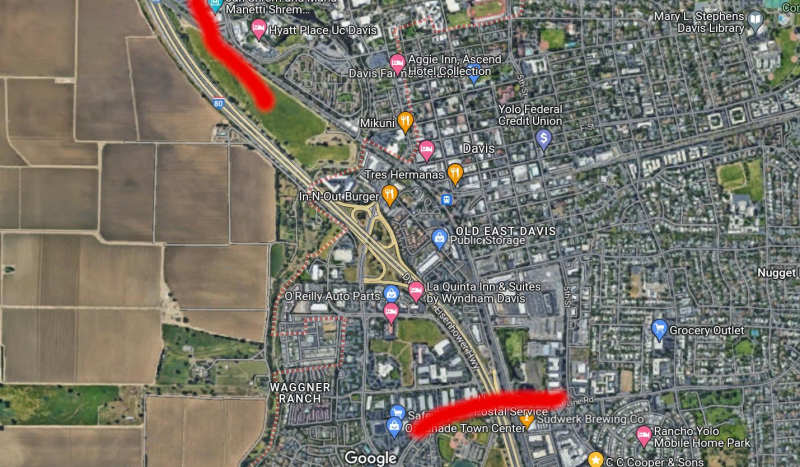
    The 80-railway corridor is a wall for people on bikes, but so is the railway on its own.  See Pole Line over 80 at lower right in the illustration above. It’s incredibly long because it has to go very high over the railway tracks, more so than to get over 80 itself (to better understand this, picture the crossings over 113 which are much lower as they only need to accommodate trucks.) First of all, this – and all the over-crossings of 80 in town – are simply not comfortable and suitable for people on normal bicycles, especially carrying children, and especially if they can make the journey by private motor vehicle or e-bike.   The over-crossings have around a 6 to 7% grade, nearly twice as high as the Dutch standard: So to make it comfortable for hundreds of people to go from Nishi to campus it would have to be nearly twice as long. Look again at the view of 80 at Pole Line: There’s no space for this unless it’s very circuitous and indirect and lands behind the Shrem Museum or just by the entrance to Solano Park from Old Davis Rd. (The red line in the top of the image is only as long as Pole Line, and it needs to be much longer.) And that’s just for cycling. Imagine walking this at least twice a day. Motor vehicles including buses can obviously do this, but that's no one's definition of "multi-modal".

    I feel confident in saying that since a motor vehicle, bus, bicycle and walking connection is part of the agreement for Nishi, and as Union Pacific forbids an under-crossing, there’s no way to build Nishi unless it’s returned to the voters. There’s nothing to mitigate here as nothing can be built for mitigation.

    ***

    A Cancelled Crossing…

    For years a dedicated and new bicycle-pedestrian bridge across the ‘Bypass was promised in the project. In 2020 – when I was still on the Bicycling, Transportation and Street Safety Commission (BTSSC) – the notification that it was dropped some months earlier was only indirectly mentioned in a summary for a BTSSC meeting by the primary liaison for the City of Davis at the time, Brian Abbanat (former City of Davis Senior Planner; now he’s in a similar role for Yolo County and co-presenting Tuesday evening.) A couple of years later when this was mentioned to the other co-presenter, YCTD head Autumn Bernstein, she said it was not funded: I believe that the aggregate truth – to be precise as possible – is that Caltrans dropped it, never told any of the local interested groups about it (e.g. Bike Davis, Davis Bike Club) through their liaison Abbanat and that it wasn’t part of the initial, funded proposal to the Federal Government. Our City, County and State government representatives were silent about this betrayal in our so-called "USA cycling capitol".

  • Development Planning Priorities for Davis

    Note: As part of item 8 on Tuesday's City Council agenda, the City will consider an evaluation rubric as a possible tool for consideration of review of peripheral proposals. The following is an alternative rubric proposal.

    Proposed by Judy Corbett, Alan Hirsch, Roberta Millstein, Alan Pryor, Bob Schneider, David J. Thompson, Colin Walsh, Stephen Wheeler, James Zanetto, and Sierra Club Yolano Group

    1. Develop infill opportunities first

    • City to hire consultant or add staff to actively pursue and encourage implementation of the Downtown Plan and other infill opportunities.
    • Council action to initiate redevelopment of city-owned parcels on Fifth Street and communicate with potential nonprofit partners.
    • Council to approach school district regarding redevelopment of 5th Street properties.
    • Upzone parcels along arterial corridors and in shopping centers to a minimum height for mixed-use development so as to use land efficiently in central locations.
    • 100% affordable housing overlay zoning like the Cambridge model to create new affordable housing redevelopment opportunities in already developed areas. By focusing zoning changes only for affordable housing it gives affordable housing developers the opportunity to initiate redevelopment projects without competing against more lucrative for profit market rate developments for development sites.
    • Reduce parking requirements for these sites, including considering car-free housing on certain sites, along with low parking maximums, to encourage redevelopment & affordability; a package of policies to reduce motor vehicle use such as on-site car-shares, market pricing, good bike parking, transit improvements, etc.

    2. Initiate and complete General Plan or Specific Plans updates.  This will provide a comprehensive look at the future and ensure consideration of cumulative impacts including traffic, water, wastewater and other infrastructure. A General Plan is preferred but an option might be a Specific Plan for the Northeast and /or Northwest areas. Any new planning process should be kept short and efficient so as to avoid the lengthy and expensive experiences of many past plans.

    3. Peripheral development standards

    (more…)

  • Make transit & walkable communities a priority, not just a mitigation for freeway widening

    I-80TO Mayor Will Arnold and Members
    Davis City Council

    From: Judy Corbett, Professor Steven Wheeler, Alan Pryor, Professor Mark Huising, Professor Roberta Millstein, Jim Zanetto, Colin Walsh, Alan Hirsch, Robert Thayer

    Our group supports walkable, bikeable, compact infill development near transit, shopping, community amenities, and jobs. Building a wider freeway to increase the auto capacity is contrary to our over-arching goal of reducing greenhouse gas (GHG) emissions.

    It is well established science that wider freeways do not fix congestion but do increase driving and greenhouse gas emissions (GHG), as noted in the well researched Davis Enterprise article of June 3th. The travel forecast model developed by the UC Davis Institute for Transportation Studies (and accepted by Caltrans and the Yolo County Transit District) estimates that the I-80 freeway widening will generate enough car travel (178 million miles a year !) to  equal the GHG emissions that would be generated by adding a new auto centric city the size of Winters.

    Will Davis Decide to Ignore Climate Emergency?

    On Tuesday June 6 Caltrans will ask the Davis City Council to make use of our GHG-reducing projects to justify the additional GHG that would be caused by the I-80 widening.

    (more…)

  • No deal on cuts except military. Tax the corporations and the wealthy.

    Neither happened in the debt ceiling deal that is now through the Senate.

    Screenshot-2023-05-23-at-2.By Scott Steward

    Representatives take a sober oath of office to serve the people and what we get are plutocrats. Replutocrats and Deplutocrats, choose their Parties of Grievance or Complicity, controlled by plutocrats in succession to be the Pelosis and the McConnells of their time – McCarthy and Jeffries.

    There is no good scenario where irresponsible military spending, grossly fattened tax benefits (for the already ultra-wealthy) and withholding aid to the hungry is the plan.

    The 20 year wars in Iraq and Afghanistan cost us $21 trillion. Whatever we've been doing in the middle east, now Ukraine, and around the world has cost us trillions. When crying for a balanced budget, why aren't we ending sixty years of US led forever war policy?

    Corporate profits have increased 14 times since 1980 to $2.8 trillion a quarter. In the same years, most wages have just kept up. Tax law has increased owner, executive, and trust babies purchasing power a 100 times. They can afford the cost cost of health care, housing and education.  For these essentials, the rest of us have less purchasing power than we did 60 years ago. That is what our budget policy should fix.

    (more…)

  • Letter: Hibbert’s 224 Apartment Proposal Will Have NO Parking and NO Poor

    This Loophole Must Be Removed

    Hibbert’s SB 330 development avoids the Builder’s Remedy which at least requires 20% of the units for Low Income (LI) so on the face of it for 224 units projected there should be 44 units for low income households.

    So by adding a measly 8,000 sq. ft. retail to a four story project, Hibbert’s avoids providing 33 low income units. Under SB 330 only 11 low income units are proposed which is 5%. None of units will serve very low income (VLI) households which is the city’ biggest gap in meeting the RHNA numbers of 580 VLI.

    The project is exclusionary by design.

    For the Hibbert’s site proposal under SB330 there will be no parking requirements. Think of the impact on G street neighbors and the Co-op in particular. Where will 250-300 vehicles park in the neighborhood?

    David J Thompson

  • Housing SB423 and SB4 California Senate

    By David J. Thompson

    Passage of SB 423 will make “Builders Remedy” permanent for cities not having an approved housing element. Bill neglects building housing for very low income households.

    Two bills relating to housing and requirements affordable housing have been sent to the Senate Floor. Because Davis has not had its housing element approved by the State of California, our city is now open to “Builders Remedy”. SB 423 makes permanent that any housing can be built as long as it has 20% of the units for low income households. Under SB 423 most city oversight is removed.

    My critique of these two bills (SB423 and SB4 Weiner) is that they do nothing (as far as I can tell) to provide housing for the most in need group of very low income households (VLI) in our city. They do however; push for units for low income households (LI) and that might be as much as the housing advocates could lobby for in these two bills.

    If these low income units are the only ones built then a city will continue to not meet its VLI targets. Does that mean therefore most housing elements will be found out of compliance? And therefore, the builders remedy will be the only law of the land? I have a call into the Senate to pose this question. (This paragraph added today)

    (more…)

  • City Council is Jeopardizing their Proposed Tax Measure on the November 2024 Ballot by Withholding a Vote on New Peripheral Residential Development

    By Alan Pryor

    The Davis City Council recently decided at their April 4, 2023 meeting that they would explore all options for putting a new general tax measure on the November 2024 ballot while declining to place a peripheral housing project on the same ballot. The Council’s stated reasons are that they did not believe Staff had the “bandwidth” to process both ballot measures simultaneously and that they feared the controversy of placing a peripheral ballot measure on the same ballot as their preferred general tax measure ballot may harm the tax measure’s chances of success.

    And at last Tuesday night's Council meeting they agreed to relegate all future peripheral Measure J/R/D housing ballot measure to special elections over at least the next few years. I believe this decision was shortsighted and made without a complete understanding of what motivates Davis voters to approve or disapprove of tax measures in Davis.

    Aside from the obvious charge that the City is favoring adding new revenue to their coffers over providing needed housing in the community (after standing on their soap boxes and proclaiming the dire need for housing over and over again in the past), this decision displays a misunderstanding of the realities of Davis electoral politics and this lack of awareness may presage the failure of both the expected November 2024 general tax measure AND any new peripheral housing ballot measure on later special election ballots.

    Let me explain.

    (more…)