Davisite Banner. Left side the bicycle obelisk at 3rd and University. Right side the trellis at the entrance to the Arboretum.

Category: Politics

  • Setting the Record Straight – Part 1

    Myths vs. Facts about Village Farms Davis

    by Alan Pryor

    I. INTRODUCTION

    Opponents of Village Farms Davis have made numerous misleading and/or outright false claims about the Project and its supposed adverse environmental impacts on Davis and its residents. Their allegations are made without almost no quantitative supporting data from independent, verifiable 3rd-party sources to support their claims. Unfortunately, these naysayers instead rely on speculation and innuendo to attempt to disparage and denigrate the proposed Project.

    This article is the first in a series that will present detailed information that factually refutes each of these untrue “myths” and false allegations made by project opponents . This first article summarizes the false claims and provides a brief summary response followed by a more in-depth discussion refuting some of the allegations that require additional information to refute them. Subsequent articles in the coming weeks will further address some of these false claims in much greater detail.

    (more…)
  • Proposed changes to noise ordinance need to be sent back to the drawing board

    [The following email was sent to CityCouncilMembers@cityofdavis.org]

    Dear City Councilmembers,

    I am writing concerning Item 4B for tonight’s City Council meeting — specifically the changes to Davis’s noise ordinance. The changes would eliminate the concrete, objective measurement of too much noise — a decibel level — and replace it with the subjective determination of which sounds are “ordinary and reasonable.”  Left unclear is who is to make this determination, when such people would be available, and on what basis they would decide.

    As I understand it, the objective standard of a decibel level is being removed not just from public playgrounds, parks, and schools, but also from the regulations concerning sounds from animals, power tools, and vehicle repairs.  Thus, these proposed changes will affect every citizen in Davis.

    And let’s be clear.  This is a quality of life issue, yes, but it is more than that. Loud sounds have demonstrated physical and psychological harms on people and animals.  This is a public health issue.  Speaking personally, I find loud noises extremely debilitating. I can’t think properly, much less get any work done.

    Also, these changes will have people keeping their windows closed and using their A/Cs, unnecessarily wasting energy — and then still not really preventing exposure to the worst sounds.

    Yet despite the potential for serious harm, these considerable changes are poised to be passed without a staff presentation, without input from commissions, and without discussion of concerns raised by Davis’s citizens.

    I urge you to send this proposal back to the drawing board.

    Thank you.

    Sincerely,

    Roberta Millstein
    Davis citizen

  • Another 2026 Progressive Coalition Winner

    By Scott Steward

    North Carolina District 4 candidates, Nida Allam holding a slim lead (on the left) and Valerie Fourshee incumbent (on the right)

    We have seen it in New Jersey and Texas, and now we will see it in North Carolina. The next bellwether primary election takes place on March 3rd; the damage of being a progressive except for Palestine (and progressive except for single-payer and except for rubber-stamping appropriations bills) may end the career of incumbent Valerie Foushee in North Carolina’s 4th Congressional District. Fourshee was a latecomer to the 2022 election, using AIPAC and Cryptocurrency donations of $2 million, knocking out the local favorite by 4,000 votes. 

    Nida Allam, former Vice Chair of the North Carolina Democratic Party and current Durham County Commissioner, returns with more experience and a small donation campaign budget that exceeds Fourshee’s this time around.  She promises “to build a brighter future for the Research Triangle, where our democracy works for all of us, and everyone has access to a living wage, affordable healthcare, a great public education, and a livable planet.”

    Unlike Allam, who rejects corporate PAC money, Foushee has historically accepted donations from pharmaceutical and health product interests and from defense contractors such as Lockheed Martin and Northrop Grumman. In 2024 and 2025, she has cast votes that align more with an establishment-centrist position than with that of a fighter. 

    Foushee supports expanding the Affordable Care Act (ACA), she has not championed Medicare for All. Foushee voted for the Israel Security Supplemental Appropriations Act, which provided over $26 billion in aid (all of which has been distributed), using the excuse that the Act included $1 billion in aid for Gaza (of which only a fraction has been distributed*). 

    The race between Allam and Fourshee brings into focus the important transition from incremental hand-wringing Democratic leadership and the energy of the next generation.  Should Allam win, it will further momentum for the coalition of 6 organizations dedicated to departing from big-money politics, a coalition willing to tax bloated excess in our society so that we can afford healthcare, education, and housing.

    (more…)
  • Trump administration drops its attack on the University of California

    By Roberta Millstein

    This is a quick followup to two earlier articles.

    In “Trump’s Attacks on the University of California (and higher education more generally)” I explained how the administration’s “Demand” letter sought a $1.2 Billion “settlement” from UCLA for allegations of civil rights violations related to antisemitism and affirmative action. 

    Then, in “Coalition of faculty unions prevails against Trump’s attacks on the UC,” I explained that the U.S. District Court in the Northern District of California granted the Plaintiffs in AAUP v. Trump, including the Davis Faculty Association, a preliminary injunction — that by temporary court order, the federal government is prohibited from holding federal funds hostage in an effort to coerce the University of California into imposing policies that would violate our First Amendment rights.

    That temporary court order is now permanent in the wake of the Department of Justice dropping its appeal of the federal court order.

    As Brian Lynch explains, the order:

    …doesn’t just unwind what the government already did to UCLA — it sets the rules for what the government can’t do going forward to any part of the UC system.

    He continues:

    The modified order, filed February 13, 2026, does two remarkable things. First, it forces the government to follow the law before it cuts university funding. Second — and this is the real teeth — it means that if the government freezes or restricts UC funding without completing every required procedural step, the university can go straight to court and seek enforcement of the injunction. The government would be in violation of a federal court order, and the remedy is immediate. Universities don’t have to start from scratch with a new lawsuit; the injunction is already in place.

    Note the word “universities” — not just UCLA, not just the UC, but universities. Thus, Lynch points out “this injunction is a roadmap for every university currently facing the same playbook.”

    This strikes a major blow against Trump’s attempts to illegally control the free speech and operation of universities in the U.S. Are you listening, University of California? Thanks to your faculty, students, and staff who risked speaking out, you don’t have to capitulate to Trump’s demands anymore. I — and many others — urge you to stop.

    This is a BFD. And it shows that fighting back can work.

  • Municipal Code “Clean-Up” Will Eliminate Noise Decibel Limits for All Parks, All School Grounds, Barking Dogs, Power Tools and More

    By Joe and Janet Krovoza

    On Tuesday, February 3, 2026, the city council approved eliminating all noise decibel limits for every city park, all school grounds, barking dogs, non-commercial power tool use and vehicle repair in neighborhoods. The council did this under the guise of a Consent Calendar “clean-up” item buried among changes to nine different ordinance chapters. The subheading was “Remove outdated and unenforceable provisions–noise limitation.”

    Consent Calendar items are reserved for items deemed “routine and non-controversial” that “require no discussion.” This is not where one would expect a major overhaul of the Davis municipal code’s noise ordinance. During public comment at the February 3 meeting, we alerted the council to the magnitude of what staff had placed on the Consent Calendar and asked the council to pull the item for discussion. They did not. Agenda Item 4D passed unanimously with no public input on the noise section (other than ours), and no staff presentation.

    Ordinance amendments require two “readings.” The first reading is to receive input, the second reading is for the staff to present revisions if legitimate issues arise during the first reading. Staff have placed the second reading on the Consent Calendar for the upcoming February 17th meeting as item 4B. The meeting starts at 6:30 pm. No staff presentation is planned, no public input is invited – though comment must be accepted, as always, at the start of the meeting under General Public Comment.

    The changes have not been reviewed by any city commission. They should go to the Planning Commission, at a minimum. It’s unclear who the staff are that did the work on this. No experts or analysis is cited in the vague 168 word explanation for this radical new approach to city noise management. The short explanation of changes makes references to ambient noise making accurate readings difficult, ambient noise creating prosecution issues for the Yolo Superior Court, and the need for consistent application. These make no sense in the context of what’s being approved.

    The city’s stated reasoning for these alterations is that because the city “has grown larger and traffic has increased locally and on highways” it is now “more difficult to take accurate noise readings.” Really? Says who? We are very familiar with the various noise studies and exchanges with the city’s consulting sound engineers since 2019, and are deeply aware of the literature. Not once have we heard a consultant posit that ambient noise levels were making it difficult to take accurate measurements. This is a complete canard, invented by unidentified staff to deflect argument and justify the gutting of huge swaths of the ordinance.

    The subheading also indicates the amendment addresses “unenforceable provisions.” There’s nothing unenforceable when something exceeds a limit. Try telling a traffic officer this the next time you are pulled over for speeding. If anything, abandoning decibel limits for subjective police officer or city determinations makes enforcement more, not less, challenging. What’s easier and more defensible than enforcing an explicit limit? 

    (more…)
  • Yolo County Nonprofits Host Civic Engagement Pizza and Movie Night on Feb 17

    (From press release) Yolo County residents can join “Pizza and a Movie Night” on Feb. 17 from 5-8 p.m. at Woodland Community College to learn more about civic engagement. The free event is sponsored by AAUW of Davis, Indivisible Yolo and the Yolo County Leage of Women Voters, and includes pizza and a 90-minute documentary from 2024 called “The Deciders.”  The event also will include small-group discussions where attendees will learn more about their role in governing policy, the importance of voter registration and timely ballot return, and opportunities for advocacy in 2026 elections. Discussion leaders will answer voter registration and election participation questions.

    Seating is limited with priority registration offered to students at Yolo County high schools and Woodland Community College. For more information and to register: http://bit.ly/49sOy8L.

    “We all share the same goal of taking the important message of active civic engagement in democracy directly into our community,” said Michelle Famula, president, Yolo County League of Women Voters. “Together we support a democracy in which every eligible voter has the desire, right, knowledge and confidence to exercise their voting rights.”

    The event will center around the film, which showcases how active voices in a working-class community impacted government policy and improved lives. Organizers say they especially hope to engage youth newly registered to vote, busy working households, college students and recently arrived county residents to help ensure higher voter turnout in the fall.

    (more…)
  • Suggested changes to Ordinances for the Village Farms Project

    [The following was sent to the Davisite for posting]

    February 2, 2026
    To: Mayor Donna Neville and Council Members
    Fr: David J. Thompson, Affordable Housing Advocate
    Re: My Suggested Changes to Exhibit E Affordable Housing PIP Report

    Could you please address these questions and concerns before tonight’s final City Council vote on the second reading regarding Village Farms?

     Due to a number of issues I have located I have made the following suggestions by section number on the “Affordable Housing” agreement:

     1)    Section 2. General Clarification, All 360 units are to be “deed restricted permanently affordable”. However, in Section 5. Which provides specific detail, the term ‘deed restricted permanently affordable’ is missing and should be included in Section 5.

     2)    Section 4.1. Do not understand why requirement of 18+ acres has been reduced to 16 acres?

     3)    Section 4.1. I have previously stated to the Council that the closer to transportation and shopping center the sites wins extra points in the funding competitions. Not knowing where these parcels will be should have been set by now to ensure the sites gets highest extra points for location. Why will the siting be unknown when the citywide vote occurs?

     4)    Section 5. ’80 ownership units for moderate income households…’.  I have previously provided you with an analysis why this is not likely possible with a Limited Equity Housing Cooperative. The only other option is to do a condo which I think is equally difficult for much the same reasons. How does the city plan to get the ownership units built?

     5)    Section 5. I would suggest you allow for these 80 units to be also done as rentals which are a more feasible, of value and a likely option. They could be delivered much earlier. The likelihood of acquiring funding for moderate income ownership housing is a long shot at best.

     6)    So the City may well be left with NO affordable housing and land use dedication which will not be developed in the near future, or perhaps ever.

     7)    Section 6.C. Given the trend in financing low-income housing $2 million may not be enough at $20,000 per unit to complete the subsidy funding of the initial 100 units. What are the additional dollars per unit Mercy Housing is asking for per unit at Bretton Woods?

     8)    Section 7.2. For me and perhaps for others, the section below definitely confuses me.

    (more…)
  • What happens when you build primarily high-end housing?

    By Roberta Millstein

    Two recent articles about Vacaville, our neighbor to the south, caught my eye. Both have to do with what has happened to Vacaville in the wake of building more high-end (i.e., expensive) housing.

    The first article was in the SF Chronicle, “This Bay Area exurb is full of McMansions — and may be the ‘next frontier’ of the housing crisis.” Here is an excerpt:

    Unlike Vallejo, which has yet to fully recover from its 2008 bankruptcy filing, Vacaville has signs of a suburb on the rise: a burgeoning biotech presence, a median household income in the low six figures, several new higher-end subdivisions. But the more people flock to this bedroom community for cheaper housing, the more its rental prices veer toward San Francisco levels. Over the past half-decade, Vacaville’s share of cost-burdened renters has swelled more than any other Bay Area community. 

    “If you’re a renter in Vacaville, there’s so many different market forces working against you,” said Robert Eyler, an economics professor at Sonoma State University. “Until you’re actively looking for a rental there, it’s hard to understand just how bad it is.”

    Some priced-out renters have been surprised to learn that Vacaville has no problem greenlighting construction. It’s the type of projects that’s the issue. 

    According to Vacaville’s official housing reports, it completed around 2,900 residential units between 2015 and the end of 2021, more than double what it had targeted. That was enough to put Vacaville among the top 10 Bay Area cities in overall housing production. 

    But the bulk of the building has been for large single-family homes. Along Vacaville’s southern edge, construction crews are working on a 2,400-acre development called Lagoon Valley, which will include more than 1,000 houses spanning 14 distinct neighborhoods, retail and office space, a golf course and a community event center. 

    Meanwhile, Vacaville has long ranked toward the bottom of Bay Area communities in producing multifamily homes. Housing projects such as townhomes, duplexes and triplexes, often called the “missing middle,” make up less than a 10th of the city’s housing stock. 

    Then an article in The Reporter, “Vacaville Council rejects DIF recommendations,” caught my eye. In the context of rejecting recommendations from a 2025 Developmental Impact Fees Nexus Study, Lisa Vorderbrueggen of the BIA Bay Area stated, “Vacaville has added housing yet student enrollment is declining, a clear sign that middle-income families are being priced out.”

    I leave the relevance for the upcoming discussions about Village Farms as an exercise for the reader.

  • Rebuttal to Village Farms Flood Control Claims

    By Rena Nayyar

    This is a response to a recent article by one of the Village Farms partners regarding the project’s proposed flood control. The article makes the claim that Village Farms will be “better protected from flooding than most of Davis.” That claim is just marketing. The Village Farms EIR does not support this claim. Links to city documents are at https://www.cityofdavis.org/city-hall/community-development/development-projects/village-farms-davis

    The article didn’t cite any sources showing a track record for their “sound, proven engineering design principles” that would be employed to reduce flood risk.  The “hundreds of pages of engineering analysis related to the impact of extreme storm events to the project…demonstrate that Village Farms Davis will be better protected against flooding” is exaggerated as these involve modeling based on assumptions and not actual plans for how this will be implemented. In fact, the flood and stormwater strategy is still being assembled piecemeal, after the circulation of the Draft EIR.  It is meaningless for them to praise the merits of a plan in flux. Village Farms is not a simple “raise the pads” project. It relies on a complex coordinated stormwater and grading strategy across a huge site in a flat floodplain basin with known downstream flooding problems. In that kind of environment, there are lots of failure scenarios. This problem requires completed project level planning that has not yet been done. 

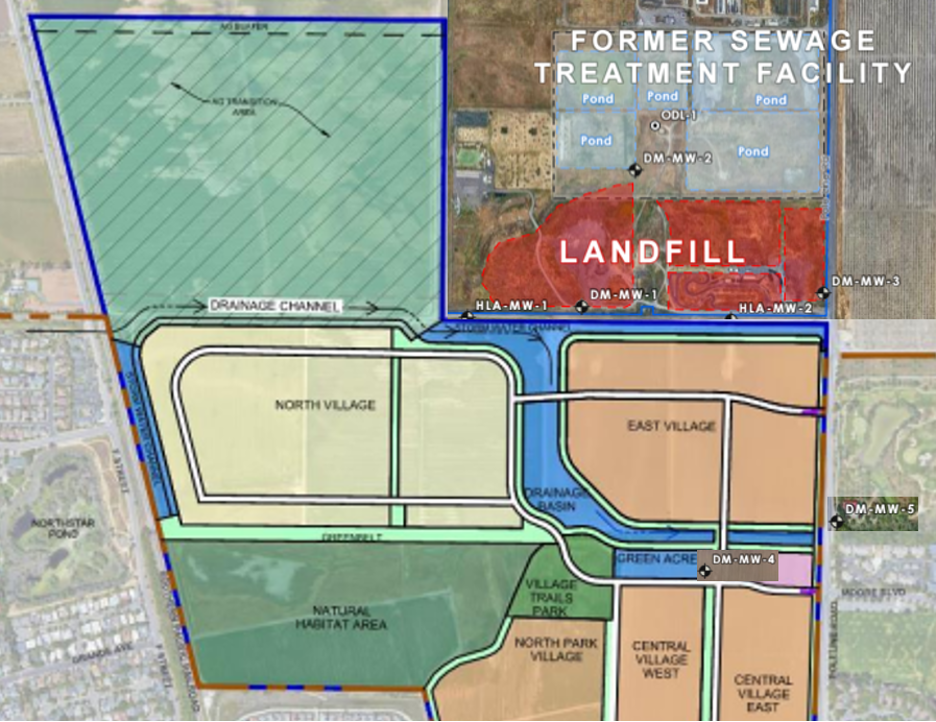
    In the Final EIR response to comments on page 2-10,  liners are being proposed for Channel A to try to prevent the contaminated groundwater including PFAS “forever chemicals”  from mixing with the Channel A runoff water. When the City starts talking about Channel A “liners” and isolation measures to prevent stormwater from interacting with groundwater– those are major changes. This is a sign that the system is being engineered around problems that were not resolved when the public reviewed the Draft EIR. 

    Since the flood plan is so incomplete and not yet approved, the project’s flood story may require future changes, for example in maps (Final EIR page 3-12).  On page 4-83 the Final EIR says that because the drainage patterns of the area will change, “a design-level drainage report shall be submitted to the City …for review and approval” when the first tentative subdivision map is submitted.  Similarly, the response to Comment 217-54, page 2-996 says
    “the preparation of a final Stormwater Control Plan, …cannot be prepared at this time ” and “the appropriate time for a Stormwater Control Plan will be when a tentative subdivision map has been prepared”. 

    (more…)
  • No Certification of the Village Farms EIR  

    By Eileen M. Samitz

    The City Council will soon be making a decision with serious consequences of whether to certify the Village Farms EIR. It is critical that they deny certification. This EIR is seriously inadequate and flawed, and certifying it would expose the City to liability while surrendering the City’s leverage to correct course on this disastrous project.

    Background

    A similar version of Village Farms, Covell Village, was rejected by Davis voters 60:40 in 2005 for many of the same reasons this project and its EIR must be rejected now. The developer, John Whitcombe (Tandem Properties partner) bought the 386-acre parcel in bankruptcy due to the many obstacles making it impractical to develop (originally costing $11 million) for a mere $3.2 million. The site has long been handicapped by an enormous floodplain, unmitigable traffic, access issues, extraordinary infrastructure costs, and toxics from the adjacent unlined Old City Landfill and Sewage Treatment Plant.

    Aberrant, Chaotic, Rushed Process

    The Village Farms “process” has been aberrant. The developer demanded that the City push his project ahead of other projects being processed. The City caved and has been accommodating him ever since, to the detriment of the community. The apparent objective has been to rush this “legacy” project onto the ballot, but the EIR and key documents still contain a plethora of “to be determined,” and “if feasible” language.

    Public meetings were rushed through the holidays, when many residents were unavailable to comment. In backwards order, the City Council held a workshop the day before the Planning Commission was asked to recommend certification of a Final EIR that did not yet exist. Never in Davis’s history has the Planning Commission been asked to recommend certification of an EIR before it was complete, yet staff pressured for that recommendation anyway. That’s not transparency, it’s corner‑cutting. The City has prioritized a June 2026 ballot timeline over the community’s right to a fair, thorough CEQA process.

    Village Farms: Serious Impacts, Costs, and EIR Inadequacies

    Massive traffic

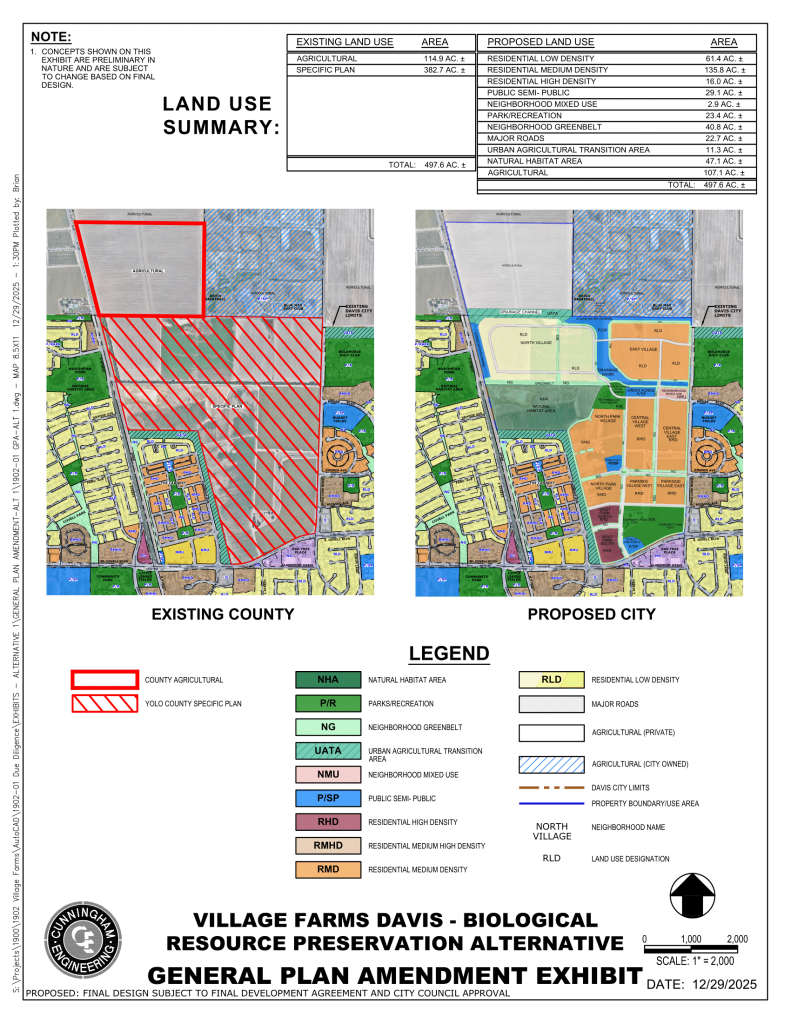
    Village Farms would add at least 15,415 car trips PER DAY, from 1,800 housing units on the 498‑acre site, the largest residential project ever proposed in Davis. This is likely an underestimation because it assumes substantial public transit use. Covell Boulevard and Pole Line Road, already heavily impacted, would be gridlock, degrading streets to Level of Service “F”. Cut-through traffic would impact many neighborhoods of cars trying to avoid this congestion.

    (more…)