Davisite Banner. Left side the bicycle obelisk at 3rd and University. Right side the trellis at the entrance to the Arboretum.

Category: Money

  • Village Farms Contaminant Risks

    [This Op-ed article was originally published in the Davis Enterprise on March 22nd in response to February 18th Davisite and Davis Vanguard articles in which Alan Pryor asserted that valid concerns related to contaminants associated with the proposed Village Farms Davis project, are “myths”.  This is a slightly modified version of that article.]
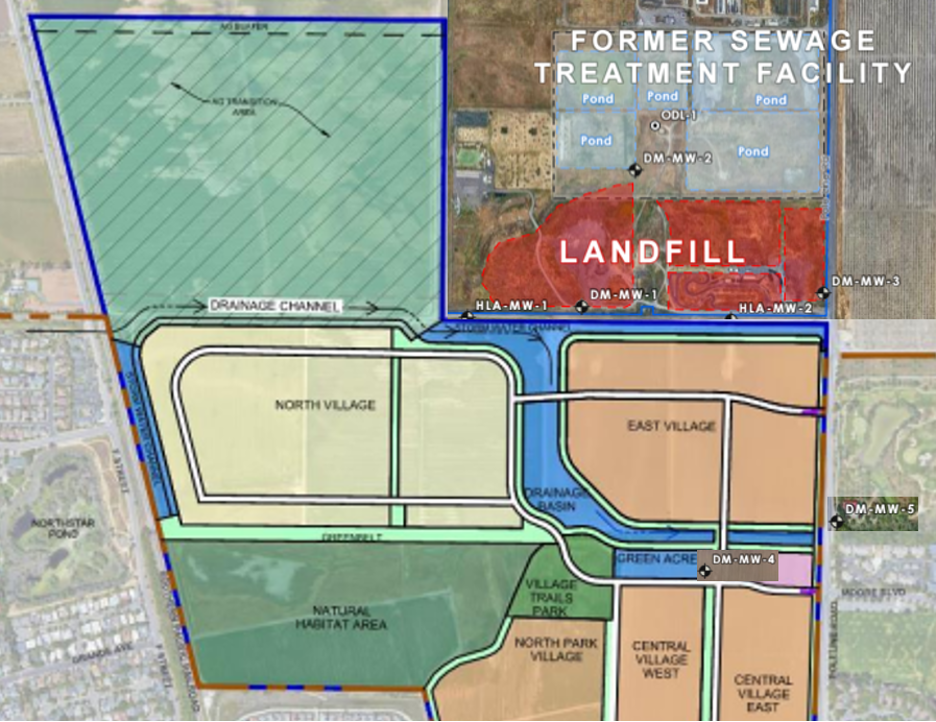
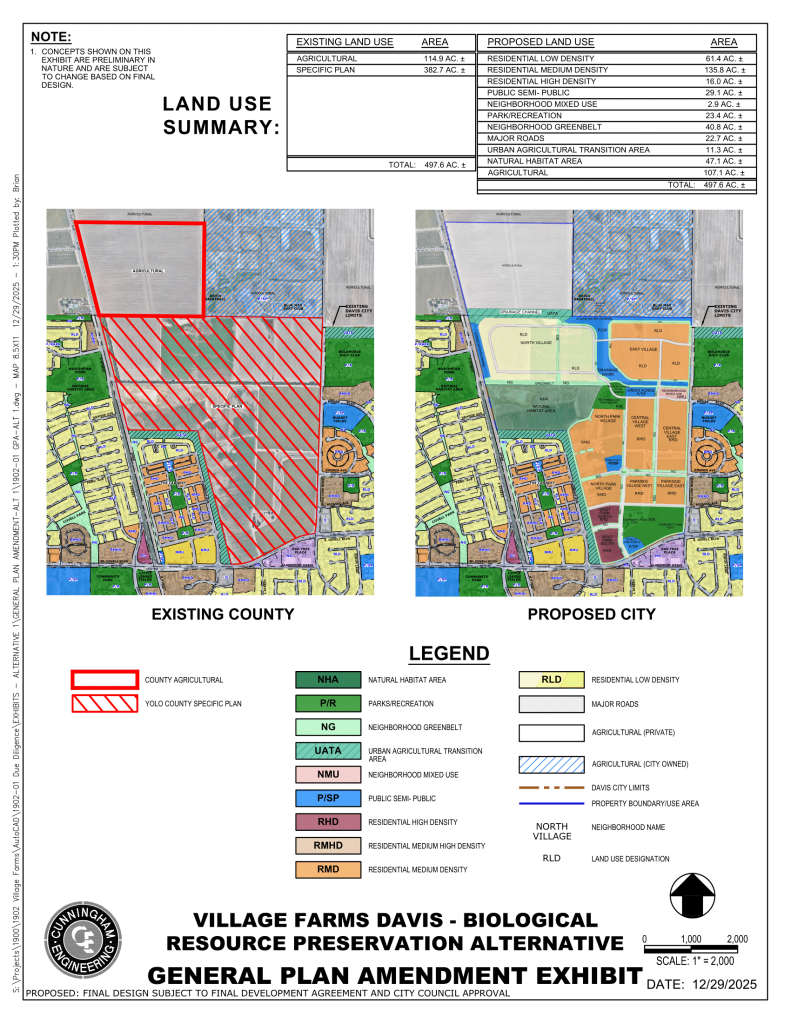
    This map from the Draft Environmental Impact Report, which was not included in the Davis Enterprise Op-ed article, shows Village Farms proposed drainage and housing adjacent the Old Davis Landfill/Burn Dump and Sewage Treatment Plant and monitoring well locations. The liner discussed in the Davis Enterprise op-ed article and the Partial Draft Response to EIR Comments does not appear in the Development Agreement or Baseline Project Features. 

    By Steven Deverel, Marjorie Longo, and Robert Okamoto

    There was a recent attempt to dismiss contaminant risks related to the proposed Village Farms project in north Davis. We herein summarize data and potential risks related to contamination from the adjacent Old Davis Landfill, Burn Area, and Wastewater Treatment Plant.

    First, it was posited that contamination from the landfill has dissipated, per and poly fluoralkaline substances (PFAS) are not a health issue and that Village Farms Davis will not be built on the landfill.

    Response

    (more…)
  • Who will really pay for the Affordable housing at Village Farms?

    By Matt Williams

    I learned something very interesting in the last few days that gave me an incredible sense of “Here we go again!” Specifically, where is the $6 million Affordable Housing contribution coming from?

    Alan Pryor has said on the Vanguard that the $6 million is coming from the developer, but is it? Or is it actually going to be coming from the taxpayers?

    The history of the Cannery tells us that there is a very good chance that the taxpayers will end up footing the bill for the $6 million. But because Village Farms is so sketchily defined/described, there is no way to know.

    Cannery was much better and more completely described/defined, but one year after the documents had all been signed, they came back to the City saying they “needed” $12 million more cash. City Council negotiated the $12 million down to $8 million … and then imposed a 30-year Mello-Roos Tax on the Cannery residents, with the taxpayer total payments of which amounting to more than $21 million taken out of those taxpayers’ pockets.

    There is nothing in the Baseline Features or the Development Agreement for Village Farms that tells Davis voters whether there will be a Mello-Roos levy (often called a CFD), and/or how large the Mello-Roos levy will be.

    To add insult to injury at The Cannery, the City Council never asked the developer what value the City would be getting back in exchange for the $12 million being asked for, or the $8 million eventually given. Unfortunately, the City got zero dollars of value in that Cannery situation.

    We have no way of knowing what might happen in the case over Village Farms. This is just one more way this project is not ready for prime time, and the only logical vote on Measure V is “No.”

  • Celebration of Abraham Raises Over $2300 for Joshua House Hospice

    (From press release) On February 1, 2026, the more than 130 members of the interfaith community of Yolo County were welcomed by Khalid Saeed to the beautiful new Woodland Mosque & Islamic Center for the annual Celebration of Abraham. This year’s theme was Returning to Abraham: Reflections in Courage. Abraham is a major character is all three Abrahamic traditions: Jewish, Christian and Islamic.

    The theme also reflected the site of the first Celebration of Abraham 2003 was at Holy Rosary Church in Woodland. Father John Boll (retired), who hosted the first Celebration in 2003, was this year’s first speaker and he presented the biblical story of Abraham beginning God’s call for him to leave his birthplace in Ur “into a land that I will show you.” (Genesis 12:1, HBFV)—the promised land. Rabbi Leah Julian, Director of Education and Youth at Congregation Bet Haverim then spoke. She said the ancient Rabbis saw Abraham as a man of great faith and courage and she cited stories of Abraham’s stand against prevailing idol worship, his courage to do the unpopular thing (smashing idols) and on some occasions, Abraham even stood up to the ultimate authority for what he believed was right. The Rabbi ended her speech with a heartfelt appeal for community unity through caring with courage. The third speaker was Imam Riaz Ahmed Quadri who leads the Woodland Mosque congregation. He noted that Prophet Ibrahim, as he is known in the Islamic faith, was one of 124,000 prophets that have been sent to mankind. In Islam, Ibrahim is called God’s friend and he was known for turning away from falsehood which took great courage at the time. He is a true example to follow where he turned to faith over fear.   After their prepared remarks, the Micheal Hirsh moderated the speakers responding to questions from the audience.

    (more…)
  • Davis Deprives Younger Adults of Longterm Housing: Population Demographics

    by Hiram Jackson

    Introduction

    Davis has followed a policy of restrictive growth since 2000 when Measure J passed, which allowed city voters to approve of new projects on the margins of the city.  Since then, Breton Woods, designed for older (55+ years) residents, and the Nishi project, designed for UC Davis students, both passed in 2018. 

    Apart from that, every other proposed project, which notably would have been available for younger adults less than age 54, has been rejected.  This quarter century drought on peripheral developments for younger adults has consequences in our current demographic makeup.

    City of Davis census data show a local declining young adult population

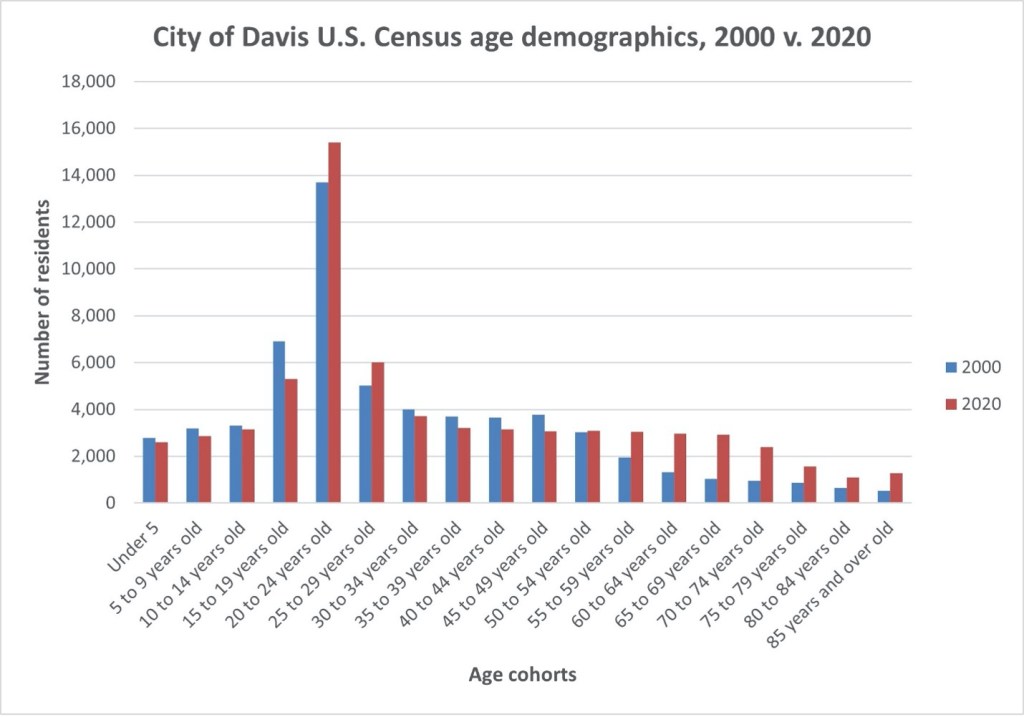
    From 2000 to 2020 U.S. Census data show that Davis grew from about 60,000 to 66,000, an annualized growth rate of about 0.5%.  Within that time the population of 20- to 29-year-olds, which includes mostly UC Davis students, grew by about 2500.  The population of Davis adults aged 50 and older grew by 8,000, reflecting good health and the desirability of our community.  Meanwhile, the number of young adults aged 30 to 49 has shrunk by 2,000 during the same period (See Census chart). 

    Figure 1 – City of Davis Population – 2000 v. 2020 U.S. Census

    This last age cohort, specifically, includes parents who are likely to enroll students in the local public schools.   Based on the 2020 U.S. census, the 30 to 49 age cohort is proportionally larger, statewide and nationally, than either the Baby Boomer or older Gen X population, demonstrating that the Davis decrease is anomalous in not accommodating this age cohort.

    (more…)
  • The ballot arguments in favor of Village Farms are extremely misleading about affordable-by-design housing

    Arguably, they are downright deceptive

    By Roberta Millstein

    In a previous article, I explained how it is only the Baseline Features of a project that are guaranteed to be built.  I further explained that the Affordable Housing that Village Farms claims to provide is not part of the Baseline Features, i.e., the features that we will vote on as part of Measure V — it seems to be, but then by referring to the Development Agreement where it says only that the City “may elect to request Developer to construct the units” (emphasis added), it becomes clear that there is no guarantee of Affordable Housing at all. (Please refer back to that article for details).

    In this article, I will explain that the “commitments” to affordable-by-design housing that proponents tout in their ballot arguments and elsewhere are similarly ephemeral.  Voters should be aware that the project may not include much affordable-by-design housing at all.

    First, let’s clarify.  In California, capital ‘A’ Affordable Housing has a specific legal definition, with classifications based on income as a percentage of Area Median Income (AMI).  In order to qualify to occupy an Affordable Housing unit, one has to fall into the requisite income class.

    But “lower case ‘a’”, affordable-by-design (also called “missing middle”) housing has no such income restrictions.  Anyone can purchase it, regardless of income.  However, as the name suggests, the point is that certain types of housing are likely to be less expensive, and thus more affordable: duplexes, triplexes, cottage courts, and multiplexes are examples.  They are still “market rate” — they will cost whatever the market will bear — but the hope is that they will be affordable to those who do not qualify for Affordable Housing but who do not earn enough money to purchase larger, single-family homes.

    So, what do the Village Farms proponents promise? 

    (more…)
  • Let’s Talk Honestly About Village Farms Home Prices

    By Leslie Blevins

    There has been a lot of certainty lately about what homes at Village Farms will cost. Too much certainty compared to what the facts actually show.

    Project opponents continue repeating that every home in the development will “start at $740,000,” as if that number is locked in, guaranteed, and unavoidable. It isn’t.

    The $740,000 hypothetical figure being cited comes from a fiscal modeling assumption for a hypothetical average 1,740 sq ft home used in an economic analysis — not from a builder price sheet. The modeling assumption itself states that medium-density homes are projected at an AVERAGE sales price of $740,000 not starting sales price.

    But that number was used to estimate tax revenue. It was NOT a declaration of a minimum sales price. There is a big difference between a modeling input and a market reality.

    The truth is, we do not know what homes will cost in five to ten years when these units are actually built. Construction costs fluctuate. Interest rates change. The economy shifts. Lending standards evolve. Labor markets tighten and loosen. Anyone claiming certainty about 2029 home prices is speculating.

    (more…)
  • What are the guaranteed parts of the Village Farms project?

    Looking at Affordable Housing in particular

    By Roberta Millstein

    With the for and against ballot arguments for Village Farms and their rebuttals posted to the County’s website (as Measure V), and the campaigns starting to ramp up, I thought it was important to highlight what are technically known as the projects Baseline Features. These are available as part of the “Full Text of Measure V” on the County’s website, and I encourage Davisites to take a close look at them, but I wanted to point out a couple of things first.

    Most important to note is what it means to be a Baseline Feature. As the text of the Measure itself clarifies:

    Beyond the Baseline Project Features there are other additional requirements for the Project, including but not limited to, the mitigation measures set forth in the Village Farms EIR, and the Development Agreement that, while important to the Project, are not Baseline Project Features and may be modified with the approval of the City after the appropriate public process (emphasis added).

    Another way of saying this is to point out that only the Baseline Features are guaranteed parts of the project. Anything else can be changed with a vote of the City Council — and here one should keep in mind that membership of that future City Council could be somewhat or even substantially different from today’s City Council. Thus, anything that is not a Baseline Feature is not a guaranteed part of the project.

    And even then, it’s important to read the Baseline Features carefully, as some of us learned when Bretton Woods was able to jettison its promised memory care facility. Let me give an example that is tied to one touted feature of the project that is of great interest to many voters: Affordable Housing.

    The rebuttal to the argument against Measure V states that the project will have “360 units serving very low to moderate income households.” But is this true?

    (more…)
  • It’s Time for New Leadership for our CA-4 House Seat

    By Scott Steward

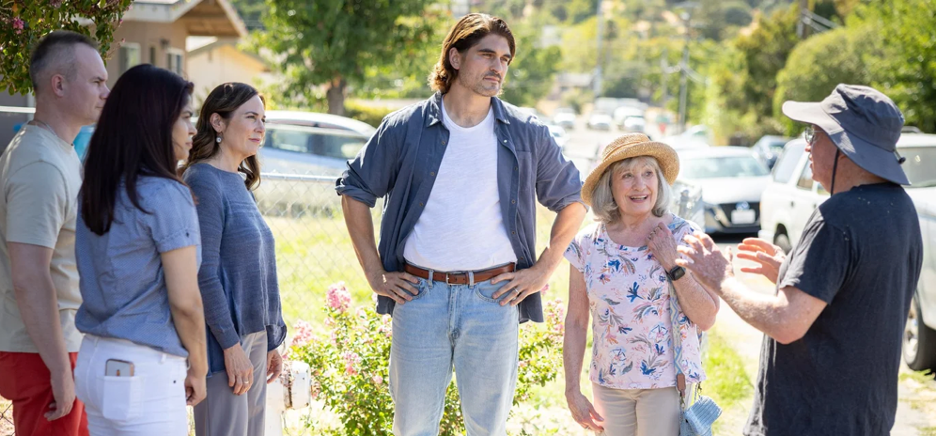
    Eric Jones at one of his Meet and Greets held throughout the District

    At this critical time, as we confront the destruction of our democratic institutions and equal representation under the law, we have a choice to make while we can still vote.  

    There is no need to worry that a Democratic primary challenge will eliminate all Democrats from our safely blue district race. In this year’s District CA-4 Congressional primary election on June 2nd (early voting starts on Monday, May 4th), we can vote for one of the two leading Democratic candidates: Mike Thompson or Eric Jones.  

    Mike Thompson, the 28-year incumbent, has shown that no amount of phone calls and letters will change his commitment to a system that “trusts the process.” Thompson’s politics will not allow him to raise taxes on gross excess (oil, drug, gambling, tech, and the weapons industries). He has and will continue to rationalize excessive profits and justify incarceration at home and $6 trillion (since 2001) in support of endless war

    (more…)
  • Make It Happen for Yolo County Receives $20,000 from Beneto Foundation as Nonprofit Continues to Expand

    Funds will help build capacity to address furniture poverty for local youth

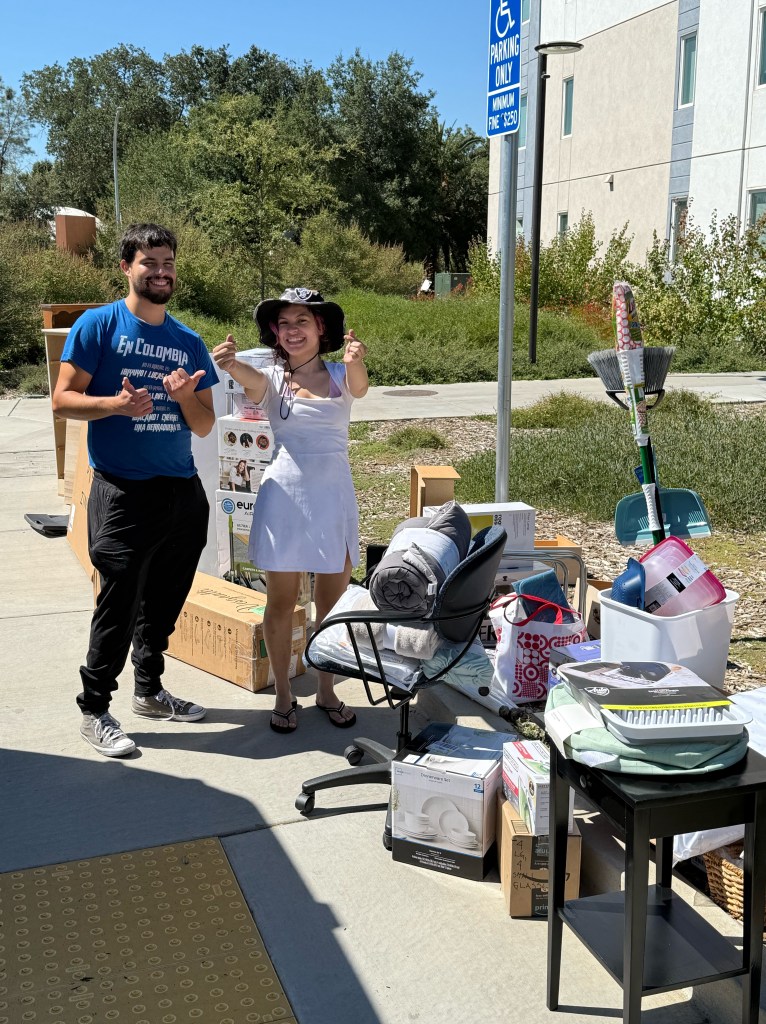
    Two local youth unload the furniture and household goods they received from Make It Happen for Yolo County in fall 2025.The nonprofit recently received a grant from Beneto Foundation.

    (From press release)The Beneto Foundation has granted $20,000 to local nonprofit Make It Happen for Yolo County to help sustain and expand the organization that addresses furniture poverty among Yolo County’s underserved teens and young adults as they transition into independent living. The nonprofit provides furniture, household goods and resources to furnish their first homes.

    “As our nonprofit continues to grow, we are grateful to our new funder, the Beneto Foundation, for investing in our work and the resilient youth we serve,” said Cathi Schmidt, executive director, Make It Happen for Yolo County. “Beneto is passionate about helping youth in our community, and we know this partnership will help us continue to reach more local teens and young adults who are moving out on their own without the resources to furnish their new homes.”

    (more…)
  • Setting the Record Straight – Part 1

    Myths vs. Facts about Village Farms Davis

    by Alan Pryor

    I. INTRODUCTION

    Opponents of Village Farms Davis have made numerous misleading and/or outright false claims about the Project and its supposed adverse environmental impacts on Davis and its residents. Their allegations are made without almost no quantitative supporting data from independent, verifiable 3rd-party sources to support their claims. Unfortunately, these naysayers instead rely on speculation and innuendo to attempt to disparage and denigrate the proposed Project.

    This article is the first in a series that will present detailed information that factually refutes each of these untrue “myths” and false allegations made by project opponents . This first article summarizes the false claims and provides a brief summary response followed by a more in-depth discussion refuting some of the allegations that require additional information to refute them. Subsequent articles in the coming weeks will further address some of these false claims in much greater detail.

    (more…)