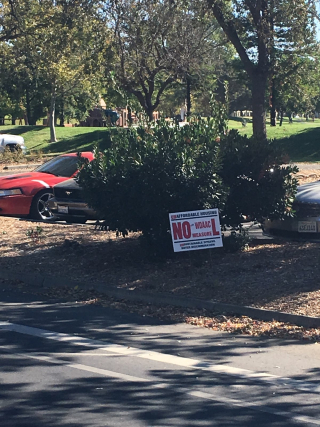
 Dave Taormino asked the Davisite to post the photo at the left with the comment:
"No comment."


Dave Taormino asked the Davisite to post the photo at the left with the comment:
"No comment."
 The sign to the left greeted me this morning as I went to vote at my polling place at the VMC. It is, in my opinion, an example of improper electioneering.
Electioneering is not permitted within 100 feet of a polling place. Electioneering is defined by the California Election Code Section 319.5 as “the visible display or audible dissemination of information that advocates for or against any candidate or measure on the ballot within 100 feet of a polling place, an elections official’s office, or a satellite location.”
Although someone cut the "Yes" part of the sign out, it's clear that this sign is advocating for the WDAAC project and is thus prohibited.
You have to wonder about the real merits of a project when its proponents will stoop this low to promote it.
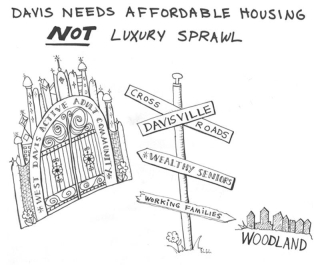 By Rik Keller
The Yes on Measure L/West Davis Active Adult Community (WDAAC) campaign has been saying that opponents of the project are "against seniors" and has been making unsubstantiated claims that the No On WDAAC campaign arguments are "lies" [see: https://newdavisite.wordpress.com/2018/10/14/uncivil-discourse-at-the-civenergy-forum/]. In the added context of the Yes on L campaign spending about $250,000 in this election cycle compared to about $7,500 for the opposition (as of reports filed 10/20/2018), this kind of messaging from deep-pocketed special interest groups who stand to make millions from cynical voter manipulation is offensive.
The following is a sampling of some Davis citizen comments against the Measure L/WDAAC project from social media posts that demonstrate that Davis residents are seeing through the blizzard of marketing money and the false charges of the project proponents. To my knowledge, none of these are from anyone working/volunteering on the No On WDAAC campaign, nor were they solicited by the campaign. It is notable that a significant number of the comments were posted on the Yes On L campaign's own Facebook page posts/advertisements.
By David Thompson
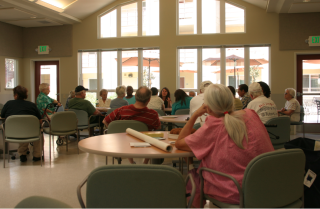
With your YES vote for Measure L, these low income seniors will get to stay and live in Davis. Otherwise, there are few places for them to go.
Davis Low Income Seniors are People by the Numbers
How many low income seniors will get a home in Davis?
“This energy flowing through my senior years comes directly from the Davis Community through the Eleanor Roosevelt Circle, thank you. Davis is a uniquely qualified community to establish new models of senior housing. Please vote yes on Proposition L to house more seniors.”
Diane C. Evans, Davis

Yesterday, Jason Taormino posted the photo at the left from their setup in downtown for the Halloween walk, showing one of their volunteers dressed as Pocahontas. Most people have heard of “blackface”, especially since Megyn Kelly recently had her NBC show cancelled over defending blackface as being “ok so long as you were dressing, like, as a character.” So why does the Yes on L campaign think that it’s ok to dress in redface as Pocahontas?
People have been rightly and roundly criticized for dressing in redface before. A student at Oklahoma university was pilloried for dressing in redface, with the recognition that a costume like that is “deeply disrespectful to the Native American community.” Stephanie Fryberg, a Professor of Psychology and American Indian Studies at the University of Washington, as quoted in an article from Indian Country Today, asks, “Why are issues for Native people taken as less serious in the domain of bias and stereotyping and prejudice than for African Americans, why is there this difference?”
Another “Untruth” by the Yes on Measure L Campaign
By Alan Pryor and Pam Nieberg
INTRODUCTION
The Yes on Measure L campaign has been falsely characterizing the soils on which the WDAAC project is to be built as “unproductive” or “low quality alkaline soils solely used for winter animal feed crops”. Their most recent mailer contained the following graphic:
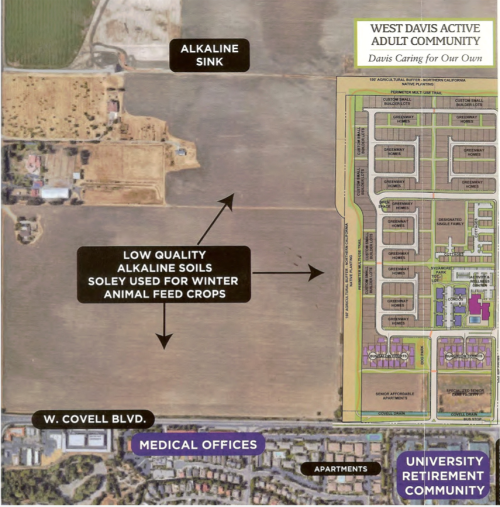
These claims are demonstrably untrue. In fact, the soil is suitable for a variety of human crops as characterized by the Yolo Co Agricultural Conservation and Mitigation Program. In summary, according to the EIR certified by the City Council, the lower approximately 50% (36.2 acres) of the site is Brentwood clay loam. Approximately a third of the soils (26.75 acres ) on the site directly above the Brentwood soils are Marvin silty clay. Above that are Willows clay (11.44 acres), and only a tiny piece (0.56 acres) in the upper north west piece of the site is Pescadero silty clay/saline-alkaline.
 Let’s Meet the City’s Real Internal Housing Needs, Including for Low-Income Seniors
By Nancy and Don Price
In October 2002, the City Council appointed a subcommittee to study housing needs in Davis. In particular, the Council wanted to consider providing housing opportunities for the local workforce as the primary reason for city residential growth.
In this context, the phrase “internal housing need” was incorporated in City policy framework, documents, and studies to refer primarily to low and moderate income workforce housing. Indeed, work force housing is the only category of housing specifically mentioned as “internal needs” in the City’s General Plan and for which specific policies have been crafted to meet the need.
For instance, Measure J (voter approved in 2000) and Measure R (voter approved in 2010) as an update of Measure J was intended to “further” and “implement” meeting this “internal housing need” based on local employment growth, UCD growth, and “natural” growth. Indeed, meeting this “internal housing need” is the only justification provided in Measures J/R for converting agricultural lands on the periphery of the city.
Unfortunately, the Yes on Measure L campaign has erroneously misappropriated the term, “internal housing needs,” to otherwise claim the WDAAC project, providing low-income subsidized senior housing and much larger and expensive homes for senior purchase, meets these needs and thus should be approved by voters. This is a false claim and is not supported anywhere in City documents.
By the No on Measure L Campaign
Introduction
A letter received from the Fair Housing Council of Orange County, posted yesterday on the Davisite, advises the City of Davis of the wrongful naming of the West Davis Active Adult Community senior housing project:
“the term ‘active adult community’ is very much misguided and needs to be changed…rather than moving forward with a name that readily implies that the community is not welcoming of individuals who have a right to choose to live within in its borders.”(excerpted from letter)
Eric Gelber, a Davis resident with 26 years experience as an attorney with disability rights advocacy experience – including fair housing advocacy – made the following statement in response to this letter:
“The Fair Housing Amendments Act of 1988 (FHAA) added disability and families with children as protected classes under the federal Fair Housing Act. A concession to seniors was also enacted to allow for senior housing developments, which could continue to utilize age restrictions if specified conditions were met. One of the conditions is that 20 percent of the housing in such developments must not be age-restricted, and must be available to younger households, including families with children.
Some of the earliest cases under the FHAA focused on advertising for developments, which marketed themselves as communities for “active adults.” Such advertising was determined to be a not so subtle way of discriminating against people with disabilities who were not traditionally “active.” Similarly, advertising a senior housing development as an “adult” community, gives the impression that families with children are not welcome in even the 20 percent of homes that are not age-restricted.(emphasis added)
The Davisite was forwarded the following letter from the Orange County Fair Housing Council (OCFHC), a private 501(c)(3) non-profit located in Santa Ana, California. The OCFHC raises concerns about the project's use of the term ‘active adult.' With respect to the term 'adult,' the letter states that "fair housing and related civil rights laws…do not recognize or sanction adult-only or otherwise age restricted housing within California that falls outside of the specific definition of what constitutes senior housing" and "may give the impression that families with children are not welcome to live in that community." They also raise the concern that the use of the term 'active' "may tend imply that, even for the properly age restricted portion of the project, people with disabilities may not be welcome." The letter appears in its entirety below.

By Rik Keller
“What has kept Davis so white?”
—City of Davis Mayor Pro Tempore Gloria Partida 10/3/2018
This is Part III in a series of articles about the history and ongoing patterns of housing discrimination in Davis.
Introduction
In Part 1: “Why Is Davis So White? A Brief History of Housing Discrimination” and Part 2 “How White Is Davis Anyway? A Comparative Demographic Analysis” of this series, other types of housing discrimination practices were mentioned that have continued even after explicit racial discrimination practices ended; for example, subprime lending that and “exclusionary zoning” that result in development patterns that focus on low-density single family houses and exclude more affordable housing types.
The point is, to borrow a quotation, “The past isn’t dead. It isn’t even past”.
An article about the 50th anniversary of the passage of the Fair Housing Act this year stated: “As Richard Rothstein explains in his groundbreaking book The Color of Law, our past segregationist policies have deep roots. Explicit discrimination may be outlawed, but indirect segregation via disinvestment and exclusionary land use policies remain common themes in our country today.” [https://www.housingvirginia.org/news/microblog-50-celebrating-the-fair-housing-act/]The history and dynamics of these issues in Sacramento have been studied by Dr. Jesus Hernandez from the Sociology Department at UC Davis. His “research focuses on understanding the connection between economic market activity in the region and the patterns of racial segregation that we have.” [https://www.capradio.org/news/the-view-from-here/2017/08/15/s10-e2-transcript-segregated-sacramento/]
 Davisite