The following was originally posted as a comment in response to the Davisite article Comments to the Open Space & Habitat Commission concerning DiSC 2022 and has been reposted here as an article with permission of the author.
By Ron O


The following was originally posted as a comment in response to the Davisite article Comments to the Open Space & Habitat Commission concerning DiSC 2022 and has been reposted here as an article with permission of the author.
By Ron O

The following was emailed to members of the Open Space and Habitat Commission (OSHC) on Sunday. The OSHC is scheduled to discuss the revised MRIC/ARC/DISC project, now dubbed DiSC 2022, at its Monday Oct 4 meeting. If you wish to comment on the project yourself, see instructions on the agenda for the meeting, located here.
Dear members of the Open Space and Habitat Commission,
I am writing to you as a former commissioner (10+ years) and Chair of the OSHC, having completed my term last December. I was involved in analyzing what is now being called the DiSC 2022 project in all of iterations, so I hope you find my comments helpful in your discussions.
To begin, I am pleased to see in the minutes from your last meeting the following: "[Ms. Reynolds] said the Commission also had the option of agendizing the Addendum to the project's Environmental Impact Report ("EIR") later this year if the Commission wanted to provide comments on the Addendum to the EIR. That meeting would have to happen before December when the project is scheduled to go before the Planning Commission, she said." I strongly urge you to do this. The OSHC has a history of productively discussing and giving comments on EIRs, as it did with earlier versions of DISC as well as Nishi and other projects, with the comments thoughtfully crafted from the Commission carrying more weight than comments from individual members. For example, you might wish to ensure that the biological surveys have been properly updated and that greater awareness of approaches to climate change are being taken into account, such as the lost opportunity for regenerative agriculture on the property if the project is built.
Another important piece of background: in the last iteration of the project, the developer kept insisting that Mace 25 was not part of project, even though it clearly was. This led to mistrust in the community. Because of that mistrust, people are now concerned that this smaller project without Mace 25 is just a foot in the door for the already rejected larger project to come later. I urge you to recommend that the developer state, as a sign of good faith, that this is not their intention — designating the ~100 acres to the north of the project as ag mitigation would be the clearest way to do that.
The rest of my remarks will focus on the Staff Report and related attachments, located online here.
Staff's and Council's Current Scheme to Limit Analysis and Input from the Commissions include Artificial, Arbitrary Deadlines Imposed on Citizen Advisory Commissions.
By Alan Pryor
Introduction
Readers will remember one of the primary complaints surrounding DISC 1.0 on the November 2020 ballot as Measure B was that the Commissions were intentionally and systematically excluded from fully participating in the review of the project through scheduling manipulations imposed by City Staff with Council approval. It appears that history is repeating itself which is the subject of this series of articles. Part 1 of the series (see https://newdavisite.wordpress.com/2021/09/15/deja-vu-council-and-staff-collude-to-limit-review-of-the-disc-2022-project-by-the-citys-advisory-com/) discussed the history of City Staff and Council ignoring input by both the Advisory Commissions and the public in many other important City matters.
This Part 2 in the series discusses the recent Council decision that greatly limits Citizen Advisory Commission input and recommendations for Baseline Features for the newly proposed DISC 2022 project now heading for the June 2022 ballot in Davis. The article is a detailed examination of the means by which the City Council and Staff are intending to again limit analysis and input from the Commissions by hamstringing the Commissions' ability to hold multiple meetings to review the DISC 2022 project.

Staff and City Council favor developer interests over citizen input
By Roberta Millstein
This past Tuesday (Sept 7), the City Council formally set in motion the process to evaluate the twice-reborn industrial park/hotel complex on prime farmland outside the Mace curve, now dubbed DISC 2022. Readers will recall that this project was handily defeated at the polls less than a year ago. Now it is back again with half the acreage, fewer amenities, and a smaller proportion devoted to revenue-generating commercial uses.
Also back again is staff acquiescing to the developer's extremely short requested timeline.
There have been some improvements in process this time around. The project was made a regular agenda item, allowing for greater citizen awareness and discussion, though apparently a number of people were still caught by surprise. And all of the relevant commissions are scheduled to be consulted from the outset, something that citizens had to fight for the last time.
However, staff's Tuesday proposal was that each commission can only evaluate the project once. Why? The developer wants this on the ballot by June 2022 and staff wants to comply with that, stating there is not enough time for commissions to have more than one meeting concerning the proposal. Why do they want to go along with the developer? Well, you will have to ask them, but it is certainly not a timeline that favors citizen input, remembering that commissions are intended to be a conduit for citizens to give feedback to the City.
This article was first published at https://islandviewmedia.net/blog/ and is reprinted here with permission of the author. Davisites may find it of interest given the re-surfacing of the DISC project, which would pave over farmland and replace it with an automobile-oriented industrial project. Regenerative farming envisions a way that the land could be used to combat rather than contribute to climate change and could potentially be deployed in various places in the Davis area.
By Robert Chianese
We strive to ensure our future by living, growing, and building sustainably. I’ve written about “Sustainability” since the 1970’s, starting with my prize-winning essay on forming a local Sustainability Council which I did here in Ventura County. I became a true believer in its promise to reduce our impacts on the planet through its very tough tri-fold requirements: use renewable energy, no toxics, cause no loss of biodiversity.
I later saw its promise fade as it became lost first in the fraudulent use of the term to “green-wash” all sorts of products and processes–lying about their sustainability. The FTC issued “Green Guides” in 2012 to push back on unsubstantiated claims about so-called green products, but corporations ballyhoo the term even more now. We hear boasts about the eco-friendly products of Clean Coal Energy, ExxonMobil, Monsanto, Dow Chemical, Malaysian Palm Oil and the Fur Council of Canada. Short-term ugly profit is more like it.
Even more disturbing are current reports about our failures to shift off our carbon-hungry diet. Through our human-caused, “anthropogenic” actions, we cloak the globe in a heat shroud, intensifying droughts, wildfires, floods and sea level rise. Nothing sustainable here.
Teenage phenom Greta Thunberg spent almost a year investigating how well we are meeting our environmental challenges. The documentary, “I Am Greta,” follows her through various countries and climates in search of sustainability successes, but she’s mainly discouraged and defeated. She even confronts the dean of environmental programs, David Attenborough about his gorgeous nature films in the time of climate systems collapse. He half-concedes he needs to change his pitch. His new series “A Life on the Planet” tries to atone for glossing over our very un-gorgeous damage to the earth.
Ecologists have come up with new concepts we need in order to save the planet. Some say we need to adapt to the new climate realities, which implies accepting the damage we have done and adjusting to it. But neither adaptation nor adjustment get defined clearly.

Virtual Public Workshop! Thursday, July 15 from 530 to 7pm
I wrote the Bicycling, Transportation and Street Safety Commission (BTSSC) earlier today:
To the BTSSC,
I strongly suggest that the BTSSC set up an ad-hoc sub-committee about Link21 so that it can stay engaged long-term, receive and process community input and then at the appropriate time make recommendations to the City Council.
The City of Davis is a small tomato in a huge pot of soup in this matter, but the railway proportionately bisects the City of Davis more than other town along its current route between Oakland and Davis. Davis grew around the rail and I-80 corridor in a way that – especially in the last 60 years – did not facilitate multi-modal travel based on the railway. A typical regional or suburban station like Davis in much of Europe would have multiple bus lanes that terminate at the station and hundreds of secure bicycle parking space for all kinds of bikes, suburb connections for walking and cycling for all directions, and a lively place for activity in front of the station, instead of a parking lot. The City has made some progress in this area of late, but, for example, there are still many who want a new parking structure at the station, and voters thankfully – but only narrowly – disapproved a new development project far from the station with no good cycling connections to it, lots of parking and imagined good access to I-80.
I had tried to form a sub-committee nearly three years ago about the I-80 Managed Lanes Project, but it was terminated shortly after Commission approval because the second member moved to Sacramento. While I appreciate the healthy skepticism the BTSSC had about the Managed Lanes Project at the last meeting, I believe it prudent to get ahead of the game as much as possible for this even larger project that relates to both the Managed Lanes Project as well to our Downtown and General Plans, as significantly improved rail service would facilitate the creation of a lot more carfree or carlite households in town. As you seem to recognize, the worst outcome of the Managed Lanes project will do nothing but worsen traffic in town and literally throw a rotten tomato at our forming Climate Policy. The worst Managed Lane implementation will not support railway travel until perhaps many years from now, and indirectly, when thousands of Davis residents, frustrated with increased congestion and pollution, surround Caltrans District 3 HQ and bombard it with stinky, rotten tomatoes genetically-modified to annoy "deaf" state officials and narcissistic automobilists.
 As a robust railway powered by renewable energy is a key tool in fighting Climate Change, I would also suggest you consider making the sub-committee a joint one with NRC, and Social Services too in order to help ensure that the system is accessible for all households.
The person who seems to be the current project manager for this part of the Megaregion, Jim Allison from Capitol Corridor, is very approachable and helpful. The Link21 sub-committee would be wise to also connect with other – especially smaller – communities along the corridor in order to create common, expected and seamless last-mile connections to their stations, and dense and proximate housing that makes good public transportation possible. All the pieces are necessary, but the puzzle has to be solved by everyone. I think that I prefer the tomato to the puzzle metaphor.
Thanks,
Todd Edelman"
On July 1st Davis Vanguard covered the announcement of Federal funding of 86 million dollars for the Yolo-80 Managed Lanes project.
I appreciate most the comments of Alan Miller, Alan Pryor and Richard McCann. I hope I can add something below.
The MTC area gets a lot of income from its bridges, and uses it for public transportation. Consider that Davis and SACOG-area drivers pay into this when driving south to San Jose, west to Oakland and San Francisco, and so on, but people from those areas make no similar contribution our region – really, the east side of the Northern California Megaregion – when traveling to Davis or Sac or of course towards Lake Tahoe.
Caltrans dropped the long-promised new bike-ped bridge across the Bypass, replaced by some improvements on the west side of the Bypass. Combined with new infrastructure such as separated lanes and a lot of shade trees in West Sac, the whole corridor could be optimized for faster e-bikes and provide a good alternative for many, especially in east and the east part of South Davis. But… nope! Or so it seems.
The graphics in the Caltrans presentation on the Yolo 80 Corridor planned for the BTSSC meeting this Thursday show only buses in the managed lanes, which is not what’s really planned for the managed lanes. Nasty! The managed lanes are mostly in added lanes, and if these lanes are available for private vehicles off-peak, for a premium, or free for a carpool then induced demand happens – see also Alan Pryor's comment in the Vanguard article – and we eventually lose.
It’s also not clear how this project interfaces with the 80-Richards project.
It’s not clear how much congestion there will be during the long construction period.
It’s not clear if any general re-paving will decrease noise (new technology makes this possible).
It’s probably unlikely that Caltrans will support a discount on Capitol Corridor during the construction period.
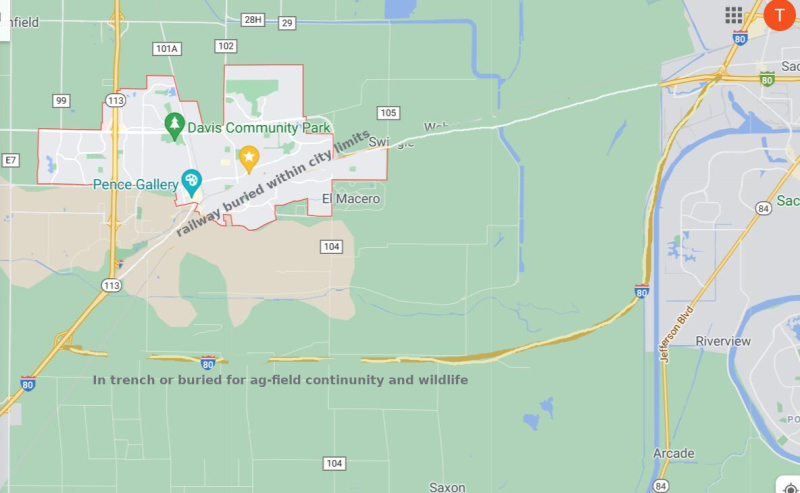
But yeah, rail. What’s up with the future Capitol Corridor improvements? How does this project related to our impending new General Plan? My favorite idea is to build a highway bypass south of town and then put the railway below grade so that it also no long splits the City in two (in retrospect, it would probably have been better to not build anything south of the 80-rail corridor). Anyway, all the new space roughly in the center of Davis could be the location of a lot of new dense, mixed-use development which could facilitate low-vehicle ownership or at least use, as it would eventually be convenient to UCD and Downtown by bike, to both Sacramento and especially the Railyards, and to points to the west by rail. It would also be much quieter in parts of the City with this sort of ring-road solution. In general terms it would complement my concept for building above 113 roughly between Russell and Covell. I've also proposed a noise-mitigation and solar-generation project for the I-80 corridor through Davis.
Related to this whole thing and that next to last point, over three years ago when I was on the BTSSC I initiated a sub-committee on 80 and related. It never went anywhere and was dissolved as the other Commissioner who joined it moved to Sacramento and no one else on the Commission wanted to pursue this… route. Sigh. Please demand that BTSSC members ask some hard questions this Thursday!

By Rik Keller
You might be a YIMBY[1] if:
[1] YIMBY stands for “Yes In My Back Yard.” However, since YIMBYs often advocate for building in other areas outside of where they live, YIYBY (“Yes In Your Back Yard”) might be more accurate, albeit not as easy to say. “BANANAS” (Build ANything ANywhere AlwayS) is another suggested acronym. Self-identified YIMBYs have been making their presence known in Davis.
[2] NIMBY stands for “Not in My Back Yard.” No one actually calls themselves this; it’s an insult that YIYBYs (see previous footnote) like to sling against anyone who tries to argue for good projects and good planning.
By Dan Cornford
On May 20, the Housing Element Committee voted in favor of 10 recommendations, one of which was the elimination of R1 (aka Single Family Housing, or SFH) zoning. Neither the Planning Commission nor the City Council weighed in on this recommendation as a body in their recent meetings concerning the Draft Housing Element, although some members of both bodies expressed interest in pursuing at least some weakening of R1 zoning. On the state level, SB 9 and SB 10 would eliminate R1 zoning.
Is this a good idea? Will it lead to affordable housing? Would it be good for the environment?
In short: No, no, and no.
Here are five reasons why eliminating R1 zoning is a bad idea:
 Conflicts of Interest in the City of Davis Housing Element Committee
by Alan Pryor and Rik Keller
Note: The preceding Part II in this series covering Brown Act violations is here:
“Housing Element Committee members are expected to remove themselves from all discussions and votes on matters in which they have any direct personal financial interest.
In gauging such extra-legal conflicts of interest and/or duty, each member shall exercise careful judgment and introspection in giving priority to the interests of fairness and objectivity; if there is any reasonable doubt that the member has a conflict, the member shall refrain from participation in the committee’s deliberations and vote(s).” – City of Davis Housing Element Committee Ground Rules (p. 4)


In regard to the Open Space and Habitat Commission meeting last [Monday] night, here are some highlights:
The recommendation (from the article linked above) to request that the northern (approximately) 100 acres be established as agricultural mitigation was not discussed or considered by the commission. Two commenters reiterated this request. (The 100 acres was part of prior proposals.)
The commissioners proceeded to review and edit the recommendations made when the proposal included the northern portion of the site. The developer representative claimed that many of them no longer applied, since the northern site is not part of the current iteration. As a result, the commissioners edited and deleted large sections of the prior recommendations, on-the-spot.
As the meeting approached 9:00 p.m., the chair suggested that a second meeting be held, given the amount of work left to be done. However, several commission members were not able to attend an additional meeting prior to the October 18th deadline set by the council. The chairperson stated that the council put the commission in a "bad place", and stated that she was "very unhappy" about it. The chair stated that they had received the packet for review on the previous Friday afternoon (for this Monday meeting).