Davisite Banner. Left side the bicycle obelisk at 3rd and University. Right side the trellis at the entrance to the Arboretum.

Category: Land use

  • DISC is back… and so is bad process

    8E95805A-8A18-4D60-AE6F-0C4FDE0CA708
    Staff and City Council favor developer interests over citizen input

    By Roberta Millstein

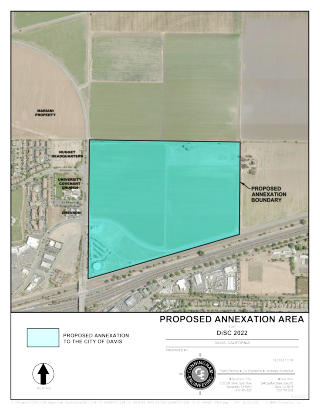
    This past Tuesday (Sept 7), the City Council formally set in motion the process to evaluate the twice-reborn industrial park/hotel complex on prime farmland outside the Mace curve, now dubbed DISC 2022. Readers will recall that this project was handily defeated at the polls less than a year ago. Now it is back again with half the acreage, fewer amenities, and a smaller proportion devoted to revenue-generating commercial uses. 

    Also back again is staff acquiescing to the developer's extremely short requested timeline. 

    There have been some improvements in process this time around. The project was made a regular agenda item, allowing for greater citizen awareness and discussion, though apparently a number of people were still caught by surprise. And all of the relevant commissions are scheduled to be consulted from the outset, something that citizens had to fight for the last time. 

    However, staff's Tuesday proposal was that each commission can only evaluate the project once. Why? The developer wants this on the ballot by June 2022 and staff wants to comply with that, stating there is not enough time for commissions to have more than one meeting concerning the proposal. Why do they want to go along with the developer?  Well, you will have to ask them, but it is certainly not a timeline that favors citizen input, remembering that commissions are intended to be a conduit for citizens to give feedback to the City.

    (more…)

  • Sustainability, Adaptation, and Regenerative Farming: Understanding Responses to Global Warming

    This article was first published at https://islandviewmedia.net/blog/ and is reprinted here with permission of the author.  Davisites may find it of interest given the re-surfacing of the DISC project, which would pave over farmland and replace it with an automobile-oriented industrial project.  Regenerative farming envisions a way that the land could be used to combat rather than contribute to climate change and could potentially be deployed in various places in the Davis area.

    By Robert Chianese

    We strive to ensure our future by living, growing, and building sustainably. I’ve written about “Sustainability” since  the 1970’s, starting with my prize-winning essay on forming a local Sustainability Council which I did here in Ventura County. I became a true believer in its promise to reduce our impacts on the planet through its very tough tri-fold requirements: use renewable energy, no toxics, cause no loss of biodiversity.

    I later saw its promise fade as it became lost first in the fraudulent use of the term to “green-wash” all sorts of products and processes–lying about their sustainability. The FTC issued “Green Guides” in 2012 to push back on unsubstantiated claims about so-called green products, but corporations ballyhoo the term even more now. We hear boasts about the eco-friendly products of Clean Coal Energy, ExxonMobil, Monsanto, Dow Chemical, Malaysian Palm Oil and the Fur Council of Canada. Short-term ugly profit is more like it.

    Even more disturbing are current reports about our failures to shift off our carbon-hungry diet. Through our human-caused, “anthropogenic” actions, we cloak the globe in a heat shroud, intensifying droughts, wildfires, floods and sea level rise. Nothing sustainable here.

    Teenage phenom Greta Thunberg spent almost a year investigating how well we are meeting our environmental challenges. The documentary, “I Am Greta,” follows her through various countries and climates in search of sustainability successes, but she’s mainly discouraged and defeated. She even confronts the dean of environmental programs, David Attenborough about his gorgeous nature films in the time of climate systems collapse. He half-concedes he needs to change his pitch. His new series “A Life on the Planet” tries to atone for glossing over our very un-gorgeous damage to the earth.

    Ecologists have come up with new concepts we need in order to save the planet. Some say we need to adapt to the new climate realities, which implies accepting the damage we have done and adjusting to it. But neither adaptation nor adjustment get defined clearly.

    (more…)

  • City of Davis and the (Near) Future of Rail Travel

    L21spanish

    Virtual Public Workshop! Thursday, July 15 from 530 to 7pm


    I wrote the Bicycling, Transportation and Street Safety Commission (BTSSC) earlier today:

    To the BTSSC,

    I strongly suggest that the BTSSC set up an ad-hoc sub-committee about Link21 so that it can stay engaged long-term, receive and process community input and then at the appropriate time make recommendations to the City Council.

    The City of Davis is a small tomato in a huge pot of soup in this matter, but the railway proportionately bisects the City of Davis more than other town along its current route between Oakland and Davis. Davis grew around the rail and I-80 corridor in a way that – especially in the last 60 years – did not facilitate multi-modal travel based on the railway. A typical regional or suburban station like Davis in much of Europe would have multiple bus lanes that terminate at the station and hundreds of secure bicycle parking space for all kinds of bikes, suburb connections for walking and cycling for all directions, and a lively place for activity in front of the station, instead of a parking lot. The City has made some progress in this area of late, but, for example, there are still many who want a new parking structure at the station, and voters thankfully – but only narrowly – disapproved a new development project far from the station with no good cycling connections to it, lots of parking and imagined good access to I-80.

    I had tried to form a sub-committee nearly three years ago about the I-80 Managed Lanes Project, but it was terminated shortly after Commission approval because the second member moved to Sacramento. While I appreciate the healthy skepticism the BTSSC had about the Managed Lanes Project at the last meeting, I believe it prudent to get ahead of the game as much as possible for this even larger project that relates to both the Managed Lanes Project as well to our Downtown and General Plans, as significantly improved rail service would facilitate the creation of a lot more carfree or carlite households in town. As you seem to recognize, the worst outcome of the Managed Lanes project will do nothing but worsen traffic in town and literally throw a rotten tomato at our forming Climate Policy. The worst Managed Lane implementation will not support railway travel until perhaps many years from now, and indirectly, when thousands of Davis residents, frustrated with increased congestion and pollution, surround Caltrans District 3 HQ and bombard it with stinky, rotten tomatoes genetically-modified to annoy "deaf" state officials and narcissistic automobilists.

    TomatoesAs a robust railway powered by renewable energy is a key tool in fighting Climate Change, I would also suggest you consider making the sub-committee a joint one with NRC, and Social Services too in order to help ensure that the system is accessible for all households.

    The person who seems to be the current project manager for this part of the Megaregion, Jim Allison from Capitol Corridor, is very approachable and helpful. The Link21 sub-committee would be wise to also connect with other – especially smaller – communities along the corridor in order to create common, expected and seamless last-mile connections to their stations, and dense and proximate housing that makes good public transportation possible. All the pieces are necessary, but the puzzle has to be solved by everyone. I think that I prefer the tomato to the puzzle metaphor.

    Thanks,

    Todd Edelman"

  • Vague lanes solving regional pains?

    Davis80

    Not the Caltrans project! This is the author's concept for a bypass to and from the Bypass.

    On July 1st Davis Vanguard covered the announcement of Federal funding of 86 million dollars for the Yolo-80 Managed Lanes project.

    I appreciate most the comments of Alan Miller, Alan Pryor and Richard McCann. I hope I can add something below.

    The MTC area gets a lot of income from its bridges, and uses it for public transportation. Consider that Davis and SACOG-area drivers pay into this when driving south to San Jose, west to Oakland and San Francisco, and so on, but people from those areas make no similar contribution our region – really, the east side of the Northern California Megaregion – when traveling to Davis or Sac or of course towards Lake Tahoe.

    Caltrans dropped the long-promised new bike-ped bridge across the Bypass, replaced by some improvements on the west side of the Bypass. Combined with new infrastructure such as separated lanes and a lot of shade trees in West Sac,  the  whole corridor could be optimized for faster e-bikes and provide a good alternative for many, especially in east and the east part of South Davis. But… nope! Or so it seems.

    The graphics in the Caltrans presentation on the Yolo 80 Corridor planned for the BTSSC meeting this Thursday show only buses in the managed lanes, which is not what’s really planned for the managed lanes. Nasty! The managed lanes are mostly in added lanes, and if these lanes are available for private vehicles off-peak, for a premium, or free for a carpool then induced demand happens – see also Alan Pryor's comment in the Vanguard article – and we eventually lose.

    It’s also not clear how this project interfaces with the 80-Richards project.

    It’s not clear how much congestion there will be during the long construction period.

    It’s not clear if any general re-paving will decrease noise (new technology makes this possible).

    It’s probably unlikely that Caltrans will support a discount on Capitol Corridor during the construction period.

    But yeah, rail. What’s up with the future Capitol Corridor improvements? How does this project related to our impending new General Plan? My favorite idea is to build a highway bypass south of town and then put the railway below grade so that it also no long splits the City in two (in retrospect, it would probably have been better to not build anything south of the 80-rail corridor). Anyway, all the new space roughly in the center of Davis could be the location of a lot of new dense, mixed-use development which could facilitate low-vehicle ownership or at least use, as it would eventually be convenient to UCD and Downtown by bike, to both Sacramento and especially the Railyards, and to points to the west by rail. It would also be much quieter in parts of the City with this sort of ring-road solution. In general terms it would complement my concept for building above 113 roughly between Russell and Covell. I've also proposed a noise-mitigation and solar-generation project for the I-80 corridor through Davis.

    Related to this whole thing and that next to last point, over three years ago when I was on the BTSSC I initiated a sub-committee on 80 and related. It never went anywhere and was dissolved as the other Commissioner who joined it moved to Sacramento and no one else on the Commission wanted to pursue this… route. Sigh. Please demand that BTSSC members ask some hard questions this Thursday!


  • You might be a YIMBY if…

    Affordablehousingmeme

    By Rik Keller

    You might be a YIMBY[1] if:

    1. You advocate for zoning deregulation and “filter down” affordable housing thinking those are very different from Reaganomics, deregulation, and trickle-down housing.
    2. You are a “faux-gressive” who laces your rhetoric with terms like “social justice” and “equity” and “sustainability” without thinking of the impropriety of appropriating and co-opting those terms; meanwhile, the effects of the policies you promote kick people of color out of their homes in lower-income areas  and promote unregulated sprawl  onto farmland or habitat.
    3. You pretend that people who point out the deep connections of your movement to development real estate interests and funding are “conspiracy theorists.”
    4. You need a foil to vilify, so you pretend there are organized NIMBY[2] groups that want nothing built anywhere ever, then ferociously battle this strawman.
    5. You claim we have “under-built” housing for decades and blame it on the NIMBY boogeyman without evidence.
    6. You think that because you took one economics class in college and learned one thing (the “law” of supply and demand, not really a law at all), you understand complex housing markets and that your simplistic prescriptions are “solutions”.
    7. You engage in naive magical thinking, conjuring up a world where if you build more housing, only the people you want to move in, move in—no rich out-of-town investors! —and developers will want to build so much housing that prices will drop, reducing their profit margins.
    8. You claim affordable housing activists who advocate for specific affordable housing programs are too naive to understand how free market capitalism and Econ 101 will benefit them.
    9. You avoid even mentioning actual programs that produce affordable housing such as inclusionary zoning programs and funding public housing.
    10. You believe that “build baby build” is the only answer and eschew all other solutions or even suggestions as to how to get affordable housing built.
    11. You don't care where you build. It could be next to a freeway, in a historic neighborhood, on prime farmland, or wherever—just build.
    12. Your movement belittles, insults, and vilifies anyone who points out the flaws in your reasoning as a way to distract from the real issues.
    13. You try to start class wars and generational wars, pitting the middle class (especially older) against people with lower incomes, in favor of high-income developers.


    [1] YIMBY stands for “Yes In My Back Yard.” However, since YIMBYs often advocate for building in other areas outside of where they live, YIYBY (“Yes In Your Back Yard”) might be more accurate, albeit not as easy to say. “BANANAS” (Build ANything ANywhere AlwayS) is another suggested acronym. Self-identified YIMBYs have been making their presence known in Davis.

    [2] NIMBY stands for “Not in My Back Yard.” No one actually calls themselves this; it’s an insult that YIYBYs (see previous footnote) like to sling against anyone who tries to argue for good projects and good planning.


  • Why eliminating single-family zoning is a terrible idea

    Screen Shot 2021-06-19 at 4.18.46 PM

    By Dan Cornford

    On May 20, the Housing Element Committee voted in favor of 10 recommendations, one of which was the elimination of R1 (aka Single Family Housing, or SFH) zoning. Neither the Planning Commission nor the City Council weighed in on this recommendation as a body in their recent meetings concerning the Draft Housing Element, although some members of both bodies expressed interest in pursuing at least some weakening of R1 zoning. On the state level, SB 9 and SB 10 would eliminate R1 zoning.

    Is this a good idea? Will it lead to affordable housing? Would it be good for the environment?

    In short: No, no, and no.

    Here are five reasons why eliminating R1 zoning is a bad idea:

    (more…)

  • What the HEC is Going On? Part III

    image from davisite.typepad.comConflicts of Interest in the City of Davis Housing Element Committee

     by Alan Pryor and Rik Keller

     Note: The preceding Part II in this series covering Brown Act violations is here:

     “Housing Element Committee members are expected to remove themselves from all discussions and votes on matters in which they have any direct personal financial interest.


    In gauging such extra-legal conflicts of interest and/or duty, each member shall exercise careful judgment and introspection in giving priority to the interests of fairness and objectivity; if there is any reasonable doubt that the member has a conflict, the member shall refrain from participation in the committee’s deliberations and vote(s).” – City of Davis Housing Element Committee Ground Rules (p. 4)

    (more…)

  • What the HEC is Going On? – Part II

    Under rugThe City’s Denial of Brown Act Violations by the Housing Element Committee and Certain of Its Members is Not Credible nor Factually-Based

     by Alan Pryor and Rik Keller

     Note: A subsequent Part III of this series will cover conflicts of interest of HEC members in detail

     Introduction

    Last week the authors wrote a carefully-researched and well-documented article on the City of Davis’s Housing Element Committee (HEC) alleging several serious violations of the California state Brown Act open meeting laws prohibiting direct communications between members of jurisdictional bodies. As stated in that article, the composition of the Council-appointed HEC, which is supposed to represent a “diversity of interests” in the community, was instead primarily composed of development and real estate interests and their local supporters.

    In our article, we also disclosed that several weeks ago, there were a last-minute series of policy recommendations very favorable to the real estate and development interests in the City that were suddenly introduced to the Committee by these same real estate and development interests. These recommendations, in direct violation of the Brown Act, were sent directly from one member of the HEC to the entire HEC.

    The HEC then further violated the Brown Act in considering and voting to adopt the same recommendations without publicly noticing that these recommendations were being considered by the HEC. In essence, these recommendations were introduced secretly to the HEC and then voted upon without full public disclosure and scrutiny of the recommendations. Furthermore, the development and real estate interests on the Committee failed to adequately disclose conflicts of interest in terms of their investments and holdings in the City that would be impacted by these very same favorable recommendations approved by the HEC (see more on this point in the coming Part 3 of this series of articles).

    (more…)

  • 15 mph DESIGN SPEED in Davis!

    SD15
     
    My strong feeling is that all local streets – including Downtown – should have a 15 mph design speed. This is already a number most are familiar with, as it's used alongside e.g. speed tables on school routes and even the sharp turn from 2nd St to L St.

    The design speed is a speed that most people feel comfortable moving at in motor vehicles. People on bikes can also feel a design speed, but they are nearly infinitely more inherently safe than motor vehicles to others in the public ROW. 15 is also a bit faster than most cycling speeds.Traveling by bike on most greenbelt paths in Davis at 15 mph feels too fast – the paths are under-built – and perhaps the biggest design flaw in post 1970's Davis, sadly and ironically complemented by the clinically-insane wideness of many streets in West Davis, Mace Ranch and South Davis… but also much older streets in Old North, etc.

     
    Does it seem slow? Perhaps. However, consider that for most journeys by motor vehicle a relatively short distance is on local streets. So any journey lengthening will be minimal.
     
    Or can it even be shorter? Yes! 15 mph speed design is best complemented by elimination of existing mandatory stops; to be replaced by yields. It's these often unnecessary stops that lengthen journey time the most. Getting rid of them also decreases pollution (gas, particles and noise) and makes people less likely to feel the need to speed to the next stop sign.
     
    So it can be both safer and faster!

    (more…)

  • Big problems at BTSSC meeting tonight!

    2nd StRailway modification project along 2nd St. leads to subverted process and disrespected City policy.

    The item "CCJPA 2nd Street Improvements 30% Design" is on the Consent Calendar for the Bicycling, Transportation and Street Safety Commission (BTSSC) today.

    The Capitol Corridor Joint Powers Authority (CCJPA), which runs the eponymous rail service with partner Amtrak, is planning to make modifications to the railway parallel with 2nd St, roughly between L St and the Pole Line. A significant part of the project will also raise, repave and re-stripe 2nd St – there's long been a problem with railway ballast making its way to the street – and include installation of an ADA-compliant sidewalk on the north side of the street, where no sidewalk currently exists up to the west end of Toad Hollow.

    So far, so good? Unfortunately not. The item involving a significant infrastructure modification is only on the Consent Calendar and the changes to the street itself – aside from the new sidewalk, which is clearly a good thing – are not following the 2016 Street Standards, and the whole length of 2nd St is not compliant with the 2013 General Plan Transportation Element.

    (more…)