


When people fought decades ago to save land from development, forever, do you believe what they were really fighting for was to save the land from development 'forever, or until there was pressure to build housing, whichever comes first' ?
Category: Land use
-
Final I-80 EIR released – an embarrassment of errors that sets up Caltrans for Legal challenge

By Alan HirschOn Wednesday May 1, the 1971 page (plus 345-page appendix)- final EIR for yolo80 was released. The 139 comments take up nearly 71% of the pages. – 108 of the 139 were from individuals, not government agencies, cities or environment groups with paid staff. This highlights the fact this science-defying proposal from Caltrans has become “the most controversial freeway project in the state.”
———————–
NOTE: The last chance to comment on the funding will be at California Transportation Commission Meeting Thursday May 16, By Tuesday send any comments. (esp inadequately funded mitigation plan, induced demand negates any congestion relief, no environmental justice plan for tolls)
to CTC@CATC.CA.GOV
Subject: Widening I-80 with a Expensive Toll lane.
Pro-Tip: use 14 or 16 pt font for short email.————————–
The EIR concluded that despite the widening the freeway will generate 158M more miles of driving (VMT) a year…equal to adding over 11,000 more cars to the road and should be built based on “Statement of Overriding concern” as it has benefit to reducing congestion- Even though everyone agree this is wrong as congestion will return within less than ten years. It is also strange given their VMT Mitigation plan only offsets 55 Mil VMT miles year of the additional driving and ignores the nearly 50Million of additional a truck.
Adding capacity via toll lanes only guarantee richest member of community- and groups of Tahoe travelers never faces congestion.
The EIR also ignores any analysis of increased danger from narrowing lanes and permanently removing shoulders. (see diagram)
The ability of the proposed mitigation plan to provide a carbon/VMT offset is taken to higher degrees of absurdity to somehow claim the project tolls will fund adequate mitigations- and have money left for a social equity/environmental Justice program into perpetuity.
Public not told about public hearing on toll levels.
-
My Apology to the Citizens, Voters and Seniors of Davis
By David J. Thompson
I feel that I must ask the citizens and voters of Davis for your forgiveness relating to what did not happen with the 150-unit senior housing project assigned to Delta Senior Housing Communities (DSHC) at the Bretton Woods project. My apology is because in 2021 DSHC without a word to the City of Davis or the public abandoned the four-year Bretton Woods project. So what was promised to the public by DSHC is not going to happen.
From 2016 through 2021 I worked tirelessly on behalf of Delta Senior Housing Communities, Inc. (DSHC) to win passage of Measure J (approval of what is now Bretton Woods). If Measure J passed then DSHC would be given five acres of land to build 150 units of low-income affordable senior housing. Although I asked the President of DSHC to help me win passage he never did and in three years he did not attend any of the many neighborhood meetings or the twice weekly booth at the Davis Farmers Market. I think the DSHC President may have attended one event but in that four-year campaign none of the other three DSCH officers/board members ever attended any event or even wrote a letter of support to the Davis Enterprise.
During that time I began to think that DSHC was hardly functioning as the board of a non-profit tax-exempt entity.
-
City Comissions Merger Proposals are Ill Conceived – Testify Tuesday!
The City Council is hearing proposals to consolidate commissions on Tuesday night. These changes have serious implications. Here are the proposals:
-
Sierra Club Endorses No on Measure M – No on the Floodwall in Woodland, CA
(From press release) Citing “the potential to induce sprawling growth”, the “potential adverse impacts on prime farm land”, “lack of proper public process”, devastating environmental and social outcomes including climate change, air pollution, and loss of biodiversity, the Sierra Club announces its opposition to Measure M in Woodland CA on the March 5, 2024 Special Municipal Election Ballot. Measure M is a vote to allow the construction of the Lower Cache Creek Flood Risk Management Project or, as it is referred to locally, the “Floodwall”.
In 2004, a majority of Woodland voters passed Measure “S”, which added a section to the Woodland Municipal Code that provides that the City shall not fund or take any action that supports the Lower Cache Creek flood barrier or a “substantially similar structure”.
A "No" vote on Measure "M" will keep that prohibiting language in the Woodland Municipal Code in its current form as originally enacted by Measure “S”, and will not allow City Council authorization for the construction and funding of the Lower Cache Creek Flood Risk Management Project.
The Lower Cache Creek Flood Risk Management Project consists of a 5.6 mile massive earthen structure from 6 ft to about 16 ft above grade, depending on its location, and the existing topography of the land. It will run east-west just north of the northern urban limits of the City of Woodland connecting to an existing levee on the Cache Creek Settling Basin.
The endorsement of the opposition to this ballot measure follows an extensive evaluation process by the local Sierra Club Yolano Group Management Committee, the Sierra Club Mother Lode Chapter Political and Executive Committees, and the Sierra Club California Local Measure Review Committee.
-
Tree Davis Seeking Feedback on Plans to Transform Sections of Robert Arneson Park into Climate-Ready Landscapes

(From press release) Wildhorse neighborhood residents and Tree Davis have been developing a concept to transform under-used portions of Robert Arneson Park (the park adjacent to the intersection of Moore Boulevard and Bonnard Street in Northeast Davis) into Climate-Ready Landscapes. Climate-Ready Landscapes are spaces that are visually vibrant, drought tolerant, and support local nature. At Robert Arneson Park, this will be in the form of pollinator gardens and mini-forests. The Robert Arneson Park concept is related to work that Tree Davis has been working on at the Memorial Grove in West Davis on Shasta Drive.
Tree Davis is seeking feedback about the concept from park users and other stakeholders to gain insights about what changes will work best. There will be two in-person feedback sessions at the park. Before proceeding with this project, it is important that the Wildhorse community and other park users are comfortable with the changes that are proposed for the park. Tree Davis staff will be tabling, answering questions, and accepting feedback on Thursday, January 25th from 2:30pm to 5:30pm and Saturday, January 27th from 8:00am to 12:00pm near the central rotary off of Moore Drive.
Those that would like to share their thoughts but are not able to come to the in-person sessions can share feedback through an online survey, which can be found at: https://forms.gle/AfjBDcvJV3wERngA9 To see the project plans and learn more, visit our website at: https://www.treedavis.org/robert-arneson-park/
Tree Davis is a 31-year-old local non-profit that was established by local leaders to ensure the health of the city’s urban forest. Over the years the organization’s focus has grown – today the mission is to improve the health and resilience of local communities by enhancing and expanding Climate-Ready Trees and Landscapes through direct action, community engagement, and advocacy.
-
Sierra Club Yolano Group comments on Village Farms scope of work
The following comments were submitted to the City of Davis by the Sierra Club Yolano Group on December 8. Transmitted via email to <SMetzker@cityofdavis.org>
Biological Resources
1. The Biological Resources should be studied in detail as outlined in the 5 December 2023 letter from Madrone Ecological Consulting, “Subject: Summary of Biological Resources Surveys Planned for the Village Farms Project, Yolo County, California.” but with the following suggestions:
- In the Aquatic Resources Delineation study, we recommend the timing of the determination of the extent of wetlands be expanded to include any times in which the area is water-inundated rather than at specifically identified times because inundation can occur during variable periods.
- We recommend the then current leasehold farmer not perform any cultural activities resulting in soil disturbances, including planting of cover crops, until the all wetland studies are completed.
- In the analysis for rare plants, we recommend all historical records be consulted.
- All surveys performed for determination of Biological Resources should be performed by specialists approved or certified to perform such studies under CEQA guidelines and performed in accordance with CDFW protocols.
- Environmental evaluation should also be performed considering the Yolo Regional Resource Conservation Investment Strategy/Land Conservation Plan (RCIS/LCP) in addition to the Yolo Habitat Conservation Plan & Natural Community Conservation Plan (HCP/NCCP).
Traffic
-
A Critique of Village Farms
In reference to the Village Farms Scoping Session
The City has asked citizens to comment on the Village Farms project. Here are mine…
by David J. Thompson
The project is based on obsolete planning principles which feature the single family home.
Preponderance of SF homes in this era is absurd for a town that thinks it’s green.
Global Warming is guaranteed and increased by this car-centric planning model.
Too few market-rate apartments for a community with such a low vacancy rate for the past 30 years. The lack of market rate apartments means tens of thousands of Students and working people will continue over paying on rent given the continued low vacancy rate.
There should be many more market rate apartments to bring down the excessive rental costs in Davis. Most of the 55.7% of Davis households (the 36,780 renters) are already overpaying rent (more than 30% of income spent on rent is HUD guideline).
Dos Pinos housing co-op has been the most successful home ownership program in Davis. 38 years later it is still providing substantial savings for its moderate income owners. It helps families time and time again rather than a one off bonanza and it’s gone forever. There are 122 households on the waiting list for DP (60 units) and the list has been closed since 2017 (2021 info from DP). There are between 6-10 turnovers per year. Why was another Dos Pinos co-op not included in Village Farms?
-
Response to Davis Enterprise Article on December 6, 2023: “City, County, UCD Gather for Annual Meeting.”
By Greg Rowe
A recent Davis Enterprise article described the annual meeting of the Davis City Council, Yolo County District 2 and 4 Supervisors and UC Davis administrators, held on December 5. UCD’s on-campus student housing construction program since 2018 was glowingly portrayed by the university representatives. The reality is that UCD had for years resisted building an adequate supply of on-campus housing to meet the needs of its continued enrollment growth, and literally had to be dragged kicking and screaming into agreeing to finally address the problem.
Evidently forgotten amid UCD’s self-congratulatory presentation were the herculean exertions between 2015 and 2018 by a small alliance of dedicated citizens who committed countless hours working toward the goal of convincing UCD to address its student housing needs in a meaningful way. Those efforts focused on educating the Davis City Council and the Yolo County Board of Supervisors about UCD’s long-standing failure to provide on-campus student housing on pace with escalating enrollment, and the resulting negative community impacts. The group wrote countless articles, letters and a comprehensive “white paper,” met with UCD planners and elected officials, spoke at meetings of the UC Board of Regents, and documented the superior student housing accomplishments at other UC campuses.
Early drafts of UCD’s Long Range Development Plan (LRDP) proposed to only marginally increase the percentage of students living in campus residence halls between 2018 and 2030. The university’s initial intent was to simply redevelop existing campus housing rather than aggressively increasing bed capacity with new construction.
It also appeared that UCD intended to dodge its housing responsibilities by continuing to “master lease” apartment complexes in Davis for exclusive occupancy by UCD students. This “band aid” approach meant fewer apartments were available to workforce families. It also allowed apartment owners to avoid paying property taxes because the lessee, UCD, is tax-exempt.
-
Did Caltrans Piece-Meal Plan for I-80 corridor violate CEQA, ignore Davis impacts?
Caltrans failure to do corridor wide EIR negated transit, wastes billions and did not call out cut thru impacts
by Alan Hirsch, Yolo Mobility
Transit works best as a network- you won’t get transit ridership if you just build just 1 or 5 miles of light rail, or upgrade just a few miles of Amtrak to 100mph service. You need to have interconnected regional system, especially with our dispersed land use patterns.
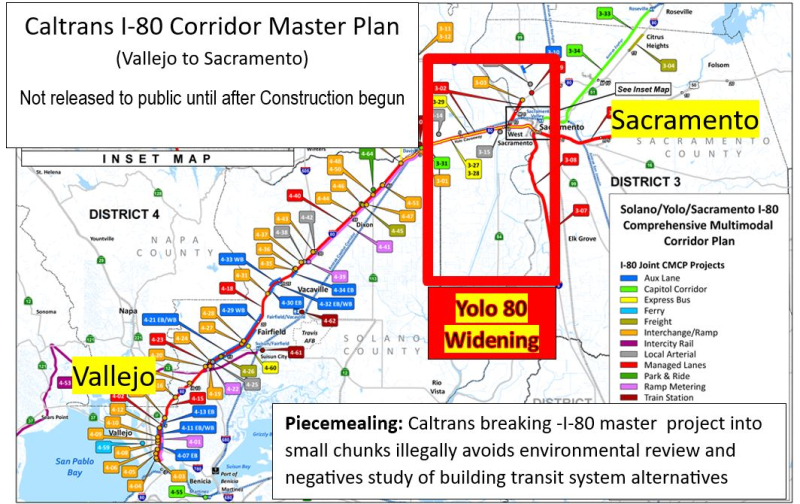
Below is a Caltrans map from the long-hidden corridor plan, the “I-80 CMCP” shows the many widenings has planned or started in the I-80 Corridor. These types of corridor plans, first required by SB1 (2017) reveal for the first time “piece-mealing” of freeway widening, I.E., breaking a corridor widening into many small separate projects. Each separate project is studied separately thru alternative analysis/EIR process so to assure transit alternative are small stand-and never pencil. And many of project are so small they don’t even require at EIR.
If fact, this is why piece-mealing is a violation of California Environmental Law. It has been cited by many others including a recent hi level whistleblower as how Caltrans systematically gets around environmental laws designed to address climate change.
The corridor plan for I-80 (I-80 CMCP) was not released to public on Caltrans website until May of 2023, over 9 months after the Yolo80 EIR alternative were selected. In fact, this corridor plan did compare transit vs highway alternatives. It concluded upgrading the Capitol Corridor Rail service to 100 MPH is 15x more cost effective to move people than the entire bundle of freeway widening shown on map (see Vanguard article).
With many of the widening construction already are underway, one can wonder how many billions (with a B) of dollars in taxpayer money are being poorly spend because of this setup by Caltrans to preordain a result ? What sort of set back does this represent on meeting the state climate plan that required us to reduce driving and well as shift to electric cars to reduce our GHG’s.
One can also note the Yolo causeway “bottle neck” and cut thru traffic in Davis did not just happen: it was created by Caltrans by widening freeway to the west and it impact on Davis section of I-80 s shown clearly in traffic studies.
As for collaboration with communities in the developing corridor plans, a public record request of Yolobus/Yolo TD found no records in its files it was involved in developing the plan, and Caltrans has never presented the final or preliminary report or involved YoloTD board or Davis City or its Commissions in its development in a substantive way. Yet Caltrans lists these entities, as well as citizens groups like Bike Davis as involved with its development. Caltrans neglect of considering community impact is shown by Caltrans failure to list “reduce cut thru traffic” as a goal/purpose/need for their proposed Causeway widening on its project website.
SAVE THE DATE: A Freeway Teach-In Nov 8th
Davis Futures Forum on the Future of the I-80 Corridor
Wed, Nov 8th 7:00-8:30 Davis Community Church Fellowship Hall, 412 C street
I-80 traffic congestion is frustrating even the most patient among us! The Caltrans proposed solution has been to increase the number of traffic lanes, however many Davis citizens have expressed strong opposition noting the need for transportation alternatives. Further, a high level Caltrans executive has accused her peers of violating environmental laws by underestimating the negative impacts of the proposal. And research at the UC Davis Institute of Transportation Studies shows that attempts to address congestion by adding lanes only works for a short time before the lanes are filled again by new drivers.
What is the solution? The public is invited to explore this question at a Davis Futures Forum talk and panel discussion. The keynote speaker is Professor Susan Handy, the renowned head of the National Center for Sustainable Development. Her presentation will be followed by a diverse response panel who will give us their thoughts about how best to move forward. The event will be held Wednesday, Nov 8th at 7pm in at the Davis Community Church. Please sign up in advance and you will receive advance material, a link to the real-time zoom and YouTube recording of the teach-in.

