Davisite Banner. Left side the bicycle obelisk at 3rd and University. Right side the trellis at the entrance to the Arboretum.

Category: Housing

  • The most recent Village Farms Affordable Housing Plan

    [The following letter to the Davis City Council was shared with the Davisite for posting]

    January 12th, 2025
    To. Mayor Neville and Council Members
    Fr. David J Thompson
    Re. The most recent Village Farms Affordable Housing Plan

    The latest iteration of the Affordable Housing Plan for Village Farms is still missing critical elements. Therefore, it should not be accepted by the City Council.

    * I Have placed the Regional Housing Needs Allocation (RHNA) numbers in a table at the end of this article. Clearly, Davis is most deficient in creating Very Low Income (VLI) and Low Income (LI) units

    As an interested observer, it has been difficult to keep up with the numerous changed affordable housing plans for VF brought forward at the very last minute.

    • I encourage the City Council to require the VLI and LI affordable housing plan to be specifically set in VF as close as possible to Covell Blvd. Please switch the MOD site to the most northerly of the three parcels. All the major competitive sources of funding for affordable housing are based upon a points system. Usually, each applicant scores 100 points and the winning applicants are those applicants which gain more in tie breakers. High points are for example given for categories with a quantified proximity to existing bus routes and to shopping centers with a supermarket. These points are critical specifically to the projects set aside for the categories of Very Low Income (VLI) and Low Income (LI). These projects will have a far better chance of being funded when set adjacent to Covell Blvd.
    • Another point to make is that the specific sites to be designated for VLI and LI should be large enough (min 4 acres) to be built in two phases. The second phase will score higher when added to an existing phase because of increased scale and reductions in management, administrative, legal, architectural fees and in building costs. A community building and offices built in phase one will not be needed for phase two. This also frees up land in phase two to be used for income earning additional housing units rather than the additional non-earning expenses of a community building. Otherwise, each smaller site will have to have a community building and separate staffing and duplicate costs for the expense categories listed above. Every saved penny per unit wins additional award points in the competitions.
    • If I am correct there will be no for sale single family units affordable to 80%-120% income category. This is a measureable weakness in the range of affordable housing products in the present application.
    (more…)
  • How City Council Upended the Village Farms EIR Alternatives Analysis

    By Greg Rowe

    The California Environmental Quality Act (CEQA) requires an Environmental Impact Report (EIR) to examine the potential impacts of a range of reasonable alternatives to the proposed project and evaluate the comparative merits of the alternatives. Under CEQA, the purpose of studying alternatives is to allow meaningful analysis and comparison of alternatives that could reduce significant environmental impacts as compared to the proposed project.

    The alternatives must be feasible, meet most or all of the project objectives, and avoid or substantially lessen one or more of the project’s significant impacts. Alternatives are generally evaluated in a qualitative manner rather than to the same degree of exactitude as the proposed project. A “no project” alternative is always included. The “no project” alternative for a project that would develop vacant land would in most cases be the “Environmentally Superior Alternative (ESA),” but not building the project would fail to achieve any of the project objectives.

    As a result, the alternative that best avoids or mitigates the most impacts is typically identified as the ESA, but the lead agency (the City of Davis in this case) is not obligated to substitute this alternative for the proposed project. In fact, because alternatives are generally analyzed qualitatively, a lead agency could not approve an alternative consistent with CEQA unless that alternative was also analyzed at the project-specific (i.e. detailed) level, such as the Biological Resources Preservation Alternative (BRPA) for the Village Farms project.

    Alternatives are selected after the project’s impact analysis has been completed and the project’s potential impacts to the environment are known.  This is a logical sequence because it is impossible to know if an alternative would produce fewer impacts if the potential project’s impacts are not yet  revealed, just as a doctor cannot consider alternative treatments for a patient before the ailment and its source are known.

    In my experience working with EIRs since 1984, once the impact analysis has been completed, there typically will be a meeting among the EIR consultant, the client (in this case, the City of Davis) and potentially the project proponent (in this case, the developer).  For a project such as Village Farms, the EIR consultant and city planning staff would use their professional experience and knowledge of the area and CEQA to devise a range of reasonable alternatives, with which the project proponent may or may not concur. In other words, the selection of alternatives is an objective process based on impartial judgment and professional experience. It should not influenced by political or financial considerations.

    A knowledgeable but now retired land use consultant once told me that in his long experience, impacts to biological resources, traffic, and air quality tend to be the primary factors that influence the identification of alternatives. Typical alternatives might include any or all of the following:

    • The same footprint or area but with fewer units (meaning lower density).
    • A smaller physical footprint but with the same number of units, which would typically avoid impacts on sensitive biological resources on the property.
    • A reduced project area footprint that includes the same number of housing units, but with a different mix of housing types.   
    • A lower number of housing units on a smaller footprint.   
    • Developing the project at an entirely different location, if acquiring such land for an alternative is feasible.
    (more…)
  • Davis Planning Commissioner Explains His “No” Votes on Village Farms

    [Note: a shorter version of this article appeared in today’s Davis Enterprise. This longer version gives additional details and background for Commissioner Rowe’s votes.]

    By Greg Rowe

    Introduction

    The planning commission’s marathon December 17 meeting concluded with two recommendations to city council for the proposed Village Farms development: certify the project’s Environmental Impact Report (EIR); and approve the project for a Measure D election.  It is expected that by January 20, Council will consider those recommendations and decide whether to place the project on the June ballot.  (January 20 is the last meeting date when Council can meet the County’s deadline for June ballot measures.) Voter approval would be followed by a general plan amendment, pre-zoning, and annexation of the site from Yolo County.   

    I voted against certifying the EIR because of what I am convinced are serious procedural irregularities, based on working with the California Environmental Quality Act (CEQA) since 1984. I likewise declined to support the project because I am convinced its location within a flood hazard zone would compromise the safety of Davis residents within Village Farms.   

    What is Village Farms?

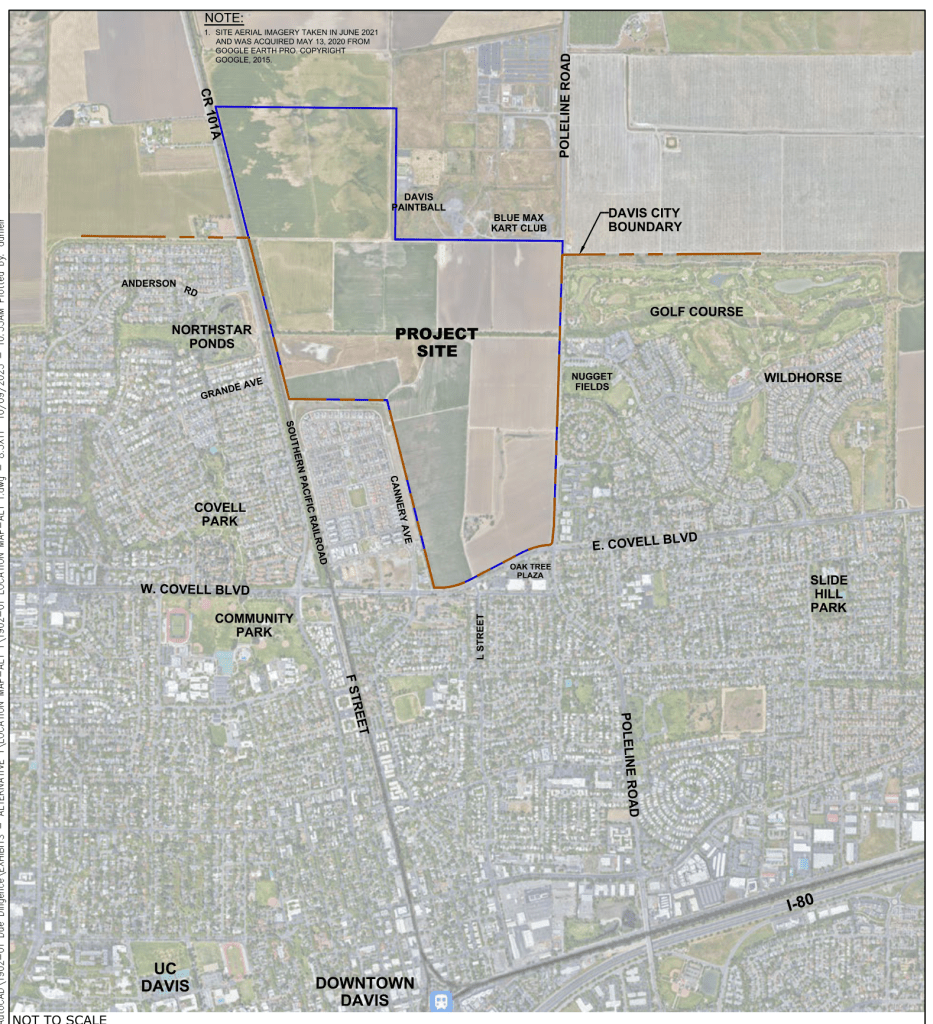
    The developer proposes to build 1800 market rate and affordable homes of various types, ranging from apartments to single-family detached homes. There would also be parks, open space, a protected 47-acre wetland habitat, a site for pre-K daycare, and a small land dedication to the City of Davis for public facilities. The property comprises 497 acres situated at the intersection of Pole Line Road and Covell Blvd, extending westward along Covell and north along Pole Line to the Blue Max Kart Club and Davis Paintball.  

    The proposed project would border The Cannery neighborhood, wrapping around that community on its north side and extending northward along the east side of F Street.  A major City of Davis drainage course (“Channel A”) flows west to east through a portion of the Village Farms site. The developer has stated that grading and infrastructure installation would take about two years, and buildout would occur in four phases lasting an additional 15 years. Pursuant to the draft Development Agreement (DA) between the developer and the City, the developer would install grade-separated bicycle and pedestrian crossings of Pole Line Road and F Street.     

    Climate Change and Floods

    The Central Valley has long experienced devastating floods, as described in historian Robert Kelley’s seminal 1998 book, Battling the Inland Sea.  The risk of flooding is now much greater because of a warming climate and a higher population that would be exposed to flooding caused by large and intense storms.

    (more…)
  • Comments needed requesting the “Reduced Footprint” alternative be included in the Village Farms DEIR by this Friday Jan. 2 at 5pm

    By Eileen M. Samitz

    The Partially Recirculated Village Draft EIR has included the five alternatives in Chapter 7,  “Alternatives Analysis” from the original DEIR. This opens that door to comment on adding the “reduced footprint” alternative proposed by Davis citizens requested at  the Dec, 12, 2023 City Council meeting. This alternative should have been included, which is similar to the “environmentally superior” reduced footprint alternative which was included in the previous Covell Village Draft EIR. Because this “Alternative Analysis” chapter is included in the Partially Recirculated DEIR, comments on the Alternatives Analysis are now “in-scope” until Jan 2nd at 5 pm. That means the city has to evaluate and respond to all significant points you make related to this topic. It’s your right under CEQA. Here’s a definition of what makes a point significant:

    “A “significant point” is a substantive comment that raises a material environmental issue or identifies a   specific deficiency in the EIR’s analysis, conclusions, or mitigation such that the agency must address it with a reasoned written response grounded in the record (not a mere acknowledgment).”

    Because the Village Farms process has been so aberrant and fast-tracked from the beginning, our public input has been compressed timewise. Because all of this was piled on during the holidays, including back-to-back public meetings, we now only have until this Friday Jan. 2, at 5pm to submit our comments to ask for this reduced footprint alternative.

    (more…)
  • Comments on the Village Farms recirculated draft EIR

    By Roberta Millstein

    In an earlier article, I mentioned that there was a recirculated (and partial) Draft Environmental Impact Report (DEIR) for the Village Farms proposal, necessitated by “new information” related to the City’s overall Wastewater Treatment Plant (WWTP) capacity.” I also noted that the City was taking public comment on the recirculated (partial) DEIR, with comments due by 5 PM, January 2. As that day is very soon upon us, I thought I would share my own comments here.

    Anyone thinking of submitting their own comments should note the following:

    “Pursuant to CEQA Guidelines Section 15088.5(f)(2), the City of Davis directs that public comments must be restricted to the newly circulated information contained in this document related to wastewater treatment capacity. The City is not obligated to respond to any new comments that are directed to the portions of the Draft EIR that were not revised and are not being recirculated in this document.”

    Comments must be directed to:

    Dara Dungworth, Principal Planner
    City of Davis Department of Community Development
    23 Russell Boulevard, Suite 2
    Davis, CA 95616
    ddungworth@cityofdavis.org

    My public comments (submitted earlier today) are as follows:

    (more…)
  • Please Do Not Certify the Village Farms Application nor the Project Individualized Plan (PIP)

    [The following message was shared with the Davisite for posting]

    December 16, 2025

    TO Mayor and City Council and Planning Commission

    FR David J Thompson

    RE Please Do Not Certify the Village Farms Application nor the Project Individualized Plan (PIP)

    With so many unanswered questions still on the table and even newer projections which are still not sufficiently clarified I do not feel that the Village Farms proposal and its PIP are factual enough to deserve certification or approval at this time.

    My points are;

    (more…)
  • “No” to a Fourth Fire Station

    By Elaine Roberts Musser

    The newly released city staff report for Village Homes still includes a fourth fire station. It also adds a public safety center for police and EMS for good measure. It is estimated the fourth fire station alone would cost the city $3.5 million per year. God only knows how many more millions of dollars the addition of police and EMS at that spot would set the city back!

    Where in the heck does city staff think the money for all this is going to come from? Last I looked there was no money tree in the back of City Hall. Nor do taxpayers have unlimited pockets. Many citizens are struggling just to make ends meet, as Mayor Vaitla has noted often enough, especially in light of what is going on at the federal and state level.

    Additionally, City staff is trying to claim the city’s General Plan requires a fourth fire station, which is a patently false assertion. The general plan called for an analysis of fire facility needs, not construction of a 4th fire station.

    The next fairy tale spun by city staff is that the Fire Department or the City Council itself already made the decision to build a 4th fire station. Where does staff get this tarradiddle from? First, the October 30, 2018 City Council minutes prove otherwise – the City Council just flat out didn’t make such a commitment. Second, the Fire Department has no authority to approve such an undertaking.

    If the City Council wants this development project to pass a measure J/R/D vote, then any mention of a public safety center and 4th fire station should be completely removed. Any lame attempt to supposedly set aside a parcel for “public safety”, to disguise the real intent to build a fourth fire station, will not fool anyone.

    For more complete information go to the following link: https://davisvanguard.org/2025/12/city-council-revisits-fire-station/

  • Give your feedback to the city on the Village Farms project proposal

    By Roberta Millstein

    Heads up for Davis City Council “workshop“ on Village Farms, Tues, Dec 16, approx 7:20 PM. This is an opportunity for you to let the city know your views on the project.

    Item 6: Staff recommends the City Council conduct a public workshop on the Village Farms Davis project (VF) applications, as follows:
    a. Receive Staff presentations on the proposed project;
    b. Receive Applicant presentations on the proposed project;
    c. Take public comment; and
    d. Consider the following project applications and documents and provide feedback:


    i. Pre-General Plan Amendment, including provisions for Baseline Project Features as required by Chapter 41 of the Davis Municipal Code; and
    ii. Pre-Zoning and Preliminary Planned Development; and
    iii. Development Agreement.

    Details here: https://documents.cityofdavis.org/Media/Default/Documents/PDF/CityCouncil/CouncilMeetings/Agendas/2025/2025-12-16/06-Village-Farms-Workshop.pdf

    IN PERSON PUBLIC COMMENTS:
    Speakers will be asked to line up at the podium and state their name for the record. Comments are limited to no more than 2 minutes per speaker.

    WRITTEN AND VOICEMAIL PUBLIC COMMENTS:

    1. Submit written public comments to CityCouncilMembers@cityofdavis.org. Emails are distributed to City Council and staff. To ensure the City Council has the opportunity to review information prior to the meeting, send emails by 3:00 p.m. on the meeting date.
       
    2. Submit comments by voicemail prior to the meeting: Call the city’s dedicated phone line 530-757-5693 to leave a voicemail message for public comment. Staff will play comments during the appropriate agenda item. Comments will be accepted from 12:00 noon until 4:00 p.m. on the day of the meeting. Voicemail public comments will not be accepted after 4:00 p.m. Speakers will be limited to no more than two minutes.
       
      Note: You must leave a separate voicemail for each item you wish to comment on. Please indicate your name and which item you are speaking about.
  • Why is a Portion of the Village Farms DEIR being Recirculated and has the Proper Process been Followed in Doing So?

    by Alan Pryor

    A portion of the Village Farms DEIR (contained in the Utilities and Services chapter) is being recirculated because the City, as the “lead agency” in the EIR process, has received a last-minute report from Brown and Caldwell dated November 7. This report indicates that the City’s existing Wastewater Treatment Plant (“WWTP”) is perilously close to exceeding its maximum flow capacity and needs to be upgraded to meet the City’s wastewater treatment permit issued by the Regional Water Quality Control Board. This information was not known by the City when they prepared and circulated the current Village Farms DEIR for comment.

    However, since the new information impacts the analysis of the Village Farms project’s impact on the City’s WWTP, the City determined that the portion of the Village Farms DEIR addressing Utilities and Services needs to be recirculated with the updated information for public comment prior to consideration of the revised FEIR for certification by the City.

    Unfortunately, the City has done a poor job explaining this need to the public when they recirculated the portion of the DEIR needing additional comment. Two questions immediately come to mind that should have been answered by the City in more detail and explained better when the DEIR was recirculated.

    1) What Information Came to Light that Necessitated the Recirculation of the Portion of the Village Farms Davis DEIR?, and

    2) Is this Process Proper and Legally Compliant with CEQA and State Regulations Regarding Public Noticing and Subsequent Consideration by the Planning Commission and the City Council?

    The following discussion addresses these questions.

    (more…)
  • Planning Commission declines to even discuss Village Farms evaluation process

    By Roberta Millstein

    At last night’s Planning Commission meeting, I was the only (!) oral commenter, via the call-in option. I raised a series of concerns about the process and timeline for evaluating the Village Farms proposal, which I will paste in below. Yet neither staff nor any member of the Planning Commission chose to acknowledge the existence of my concerns, much less respond to them. I will let the reader decide whether I am making a mountain out of a molehill (possibly) or whether the Planning Commission shirked its duty by not even discussing the concerns.

    As background, the sole point of the meeting was to decide whether to “continue” the Dec 2 meeting until Dec 17, to “to allow for the final negotiations of the project’s draft development agreement to be completed such that the Planning Commission can take action before the draft is forwarded to the City Council for consideration.”

    Here is the slightly longer version of my comments that I emailed to members of the Planning Commission prior to the meeting, differing primarily in the second paragraph which I had to cut for time in my oral comments.

    (more…)