

Since the news that three historically black churches in Landry County, LA were burned over the two-week period between March 26th and April 2, the Celebration of Abraham has wrestled with how to respond in a way that says to our black community, we will walk along side of you. Today we learned of a way to show that we care about our Christian brothers and sisters at these black churches. Specifically, our community can help repair the damage done to these important religious communities by donating to the GO FUND ME campaign at https://www.gofundme.com/f/church-fires-st-landry-parishmacedonia-ministry (or type “gofundme seventh district” in your search engine) organized by the Seventh District Baptist Association, a 149 year old non-profit religious organization.
Category: Ethics
-
Betting on a crash – confronting those speculating on our future
The dark side of capitalism is that disruption, change and scarcity all provide avenues of profit for those willing to speculate on its consequences.
 Paradise on fire
By Nick Buxton
It is hard to imagine reading the latest Intergovernmental Panel on Climate Change (IPCC) report and feeling energised and excited. After all, the report, published in October 2018, warned that we are on a path to catastrophic climate change, way beyond the maximum 1.5 degrees temperature increase goal made three years ago at the United Nations climate conference in Paris. It leaves me with a sinking feeling of dread. Yet, strange as it may seem, some who read the IPCC report may well have reacted with joy. Yes, at the chance to make money. The dark side of capitalism is that disruption, change and scarcity all provide avenues of profit for those willing to speculate on its consequences.
The seemingly shameless capacity of some people to seek profits in the most desperate of situations was brought starkly home recently when I read about a financial investor in Dallas who as Hurricane Harvey approached the US east coast realised that investing in short-term housing in Houston and South Florida would be profitable as people fled their homes and looked for anywhere to stay. “We saw occupancy go to 100 percent in a lot of those hotels,” says the Dallas investor. “We didn’t crush it. But we made 25 percent, 30 percent, pretty quick.”
-
Vanguard and City Council Ethical Challenges Persist
 Four (or Five?) Times the Impropriety, Plus Potential Brown Act Violations
By Roberta Millstein and Colin Walsh
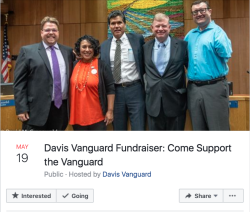
On Thursday, the Davisite published an article, “Mayor Brett Lee’s Fundraising for the Davis Vanguard Crosses a Line.” Since then, the Vanguard has changed the format of its fundraising event to include four of the five members of the Davis City Council. But this doesn’t make the event better. The new format makes it worse – at least four times worse. Plus, with four City Council members in attendance it will be nearly impossible to avoid Brown Act violations.
First, let’s consider the changes in format and advertising of the Vanguard fundraiser. The main change, of course, is from one councilmember attending the fundraiser (Brett Lee) to four councilmembers (Lee together with Gloria Partida, Lucas Frerichs, and Dan Carson) attending. But the Facebook event page was also changed from saying that Lee would “host” the fundraiser to saying that the fundraiser will “feature” the four councilmembers, with Will Arnold (who is pictured in the photo associated with the event; see above) “unable to attend” while “there in spirit.” It also states that “Each of the speakers will speak briefly and then take questions.”
-
Mayor Brett Lee’s Fundraising for the Davis Vanguard Crosses a Line
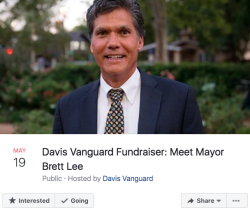 I like Mayor Brett Lee. I donated to his campaign. I endorsed him and put his lawn sign on my lawn. I voted for him. I haven’t always agreed with his votes on Council, but that’s normal. But now Mayor Lee plans on hosting a fundraiser for the Davis Vanguard next month. This is an ethical breach that is different from a disagreement about policy or process. Elected officials – especially those who may be running for re-election soon – should not be raising money for purported news outlets, as Mayor Lee is planning on doing for the Vanguard.
It doesn’t help that the Vanguard’s track record is none too clean. David Greenwald, founder of and primary writer on the Vanguard, has exhibited a lack of journalistic ethics. The Davis Vanguard is alleged to have participated in a political campaign in violation of its non-profit status; an IRS complaint was filed along with substantiating evidence. It has developed a reputation for hostile attacks against commenters, forcing repeated changes to its comment policy (most recently to disallow anonymous commenters, although it’s not clear that this change in policy has helped improve the climate for commenters). And it has failed to follow the Institute for Non-Profit News’s ethical guidelines by failing to be fully transparent about the funding of its news operations, particularly with respect to advertisements from local developers, calling into question its “editorial independence from all revenue sources to ensure news judgments are made in the interest of the communities they serve as journalists.”
Indeed, those very same ethical guidelines for non-profit newsrooms recommend avoiding “accepting donations from government entities, political parties, elected officials or candidates actively seeking public office.”
It’s surprising that Mayor Lee would want to associate himself with the Vanguard given all that improper behavior. But that’s not the main issue.
-
UC Workers Strike on April 10: How to Show Your Solidarity

By Connor GormanSolidarity forever! The UC still hasn't agreed to provide basic rights and dignity to many of its workers (much less what they truly deserve) while simultaneously intimidating, threatening, and retaliating against workers for their participation in labor activities. Because of this, AFSCME 3299 (which covers service and patient care workers) filed an Unfair Labor Practice (ULP) charge against the UC and will be striking next Wednesday (April 10) along with UPTE-CWA 9119 (which covers technical and professional employees).
There are a variety of ways that students, workers (who aren't part of AFSCME 3299 or UPTE-CWA 9119), and community members can support the strike and demand an end to the UC's blatant violation of workers' rights along with demanding that the UC provide all of its workers with a living wage while maintaining and expanding essential benefits and protections like good, affordable healthcare; a dignified retirement plan; and job security. The main way that anyone can show their support is by joining the picket line for any period of time that they're able to between 7am and 5pm on the corner of College Park and Russell Blvd., while prioritizing attendance at the 12pm rally if possible (or if you're in Sacramento there will be another picket line at the Medical Center). You can even study or grade at the picket line.
-
Local Sierra Club and Audubon Groups Raise Concerns about Burrowing Owls at Mace 25
 Buow picture taken by R. Millstein, 8/2017
Davisites may recall the large proposed business park, the Mace Ranch Innovation Center (MRIC), which would be sited on the farmland outside of the Mace curve to the east of Davis, subject to a Measure R vote. The project proposal was withdrawn in 2016, but the commission on which I serve, the Open Space and Habitat Commission, has been told informally that the project may be re-proposed again in some form. In its original form, the proposal included 25 acres of land purchased with funds from the City’s Open Space program, widely referred to as the “Mace 25.” (See my op-ed in the Davis Enterprise, “How 25 acres of open space got into the MRIC proposal” for the history of how that occurred).
In response to the widespread belief that the MRIC proposal will back in front of the City, two local environmental groups have raised concerns about the presence of burrowing owls on the Mace 25: the local chapters of the Sierra Club and the Audubon Society. Note that burrowing owls have been designated as a “species of special concern” in California, and their numbers have been declining precipitously in recent years.
-
Valley Clean Energy Board Meeting to Be Held on April 11
 (From Press Release) The Valley Clean Energy board of directors will meet at 5:30 p.m. Thursday, April 11, in the Community Chambers at Davis City Hall, 23 Russell Blvd. in Davis. The meeting is open to the public.
The board — which includes members of the Davis and Woodland city councils and the Yolo County Board of Supervisors — is expected to discuss strategies for increasing the amount of renewable power that VCE will offer, with a focus on local renewable resources.
VCE, the local electricity provider, launched last June and provides cleaner energy at competitive rates to 55,000 local customers. For more information, visit https://valleycleanenergy.org. To receive agendas by email, sign up at https://valleycleanenergy.org/get-in-touch/.
-
Update on Pesticide Use in the City of Davis
 Following is a copy of a letter sent by Alan Pryor, a Natural Resources Commission member, concerning pesticide use in Davis and the qualifications required for consideration for the IPM Specialist position for which the City is now seeking a replacement. The letter was sent to Stan Gryzco (Public Works Assistant Director), Richard Tsai (Environmental Resources Manager), and John McNearny (Wildlife Resource Specialist) as the top 3 City officials overseeing the as-yet-to-be-replaced Integrated Pest Management (IPM) Specialist.
Readers may recall that the previous beloved IPM Specialist, Martin Guerena left the position under unusual circumstances and was subsequently awarded the City's Environmental Recognition Award last year in the Individual Category for his decade of service to the City.
-
Cool Cuisine Burger Battle Brings Magnificent Medley of Flavors
 With just a little over a week left of the March Cool Cuisine vegan Burger Battle, I thought now would be a good time to share the burgers that I’ve tried so far. I hope to try at least one or two more before the end of the month. (Full disclosure: I’m not actually vegan, more like a flexitarian).
My partner and I have tried four of the entries, focusing not on the burgers-trying-to-be-like-meat, but rather on the more unusual offerings. Our burgers have come from the Davis Food Co-op, Yeti Restaurant, Redrum, and Zumapoke & Lush Ice (with the Upper Crust Bakery providing vegan buns for the Co-op and Zumapoke). All were creative, flavorful, and, most importantly, delicious. Of the four, the one from the Co-op is probably my favorite… but not by much. Each was outstanding in its own way.
-
Bob Dunning Doesn’t Understand that the City’s Declaration of a Climate Emergency Is No Laughing Matter
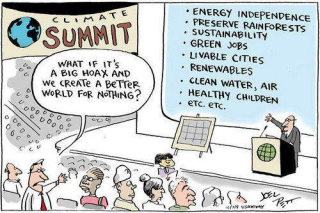 We are indeed in a climate emergency, and I am glad that the City Council has officially recognized it; big kudos also to the citizen activists who urged them to. I look forward to seeing the concrete actions that will be made in light of the recent Declaration.
Yet apparently not everyone feels this way. In a pair of recent columns (here and here), Bob Dunning made fun of the Declaration with a series of obviously ridiculous proposals that, he suggests (tongue firmly in cheek) the City could implement.
 Davisite