Davisite Banner. Left side the bicycle obelisk at 3rd and University. Right side the trellis at the entrance to the Arboretum.

Category: Ethics

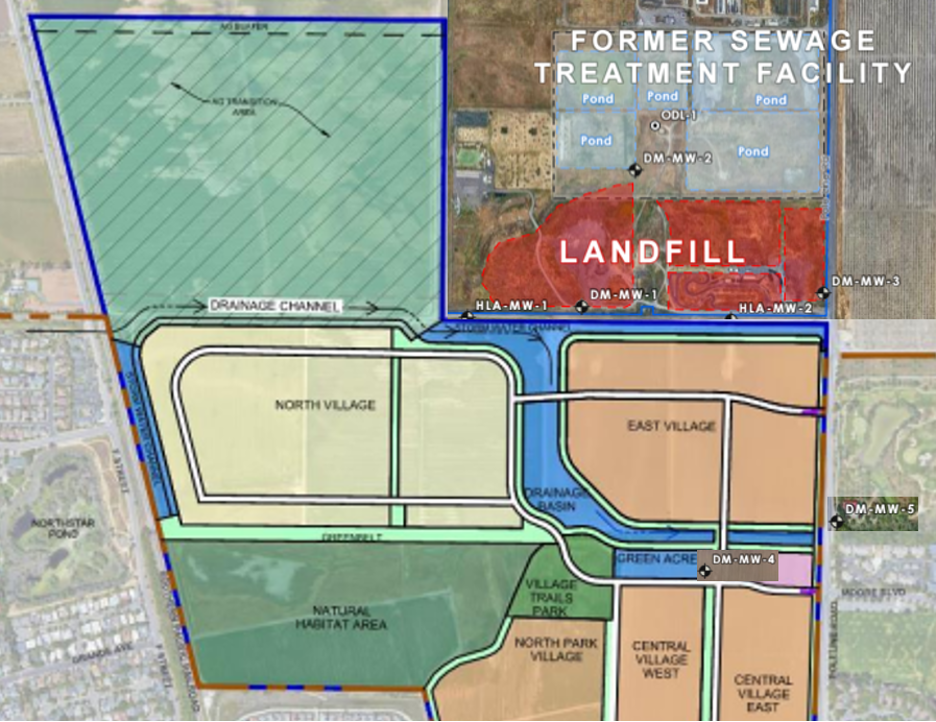
  • Give your feedback to the city on the Village Farms project proposal

    By Roberta Millstein

    Heads up for Davis City Council “workshop“ on Village Farms, Tues, Dec 16, approx 7:20 PM. This is an opportunity for you to let the city know your views on the project.

    Item 6: Staff recommends the City Council conduct a public workshop on the Village Farms Davis project (VF) applications, as follows:
    a. Receive Staff presentations on the proposed project;
    b. Receive Applicant presentations on the proposed project;
    c. Take public comment; and
    d. Consider the following project applications and documents and provide feedback:


    i. Pre-General Plan Amendment, including provisions for Baseline Project Features as required by Chapter 41 of the Davis Municipal Code; and
    ii. Pre-Zoning and Preliminary Planned Development; and
    iii. Development Agreement.

    Details here: https://documents.cityofdavis.org/Media/Default/Documents/PDF/CityCouncil/CouncilMeetings/Agendas/2025/2025-12-16/06-Village-Farms-Workshop.pdf

    IN PERSON PUBLIC COMMENTS:
    Speakers will be asked to line up at the podium and state their name for the record. Comments are limited to no more than 2 minutes per speaker.

    WRITTEN AND VOICEMAIL PUBLIC COMMENTS:

    1. Submit written public comments to CityCouncilMembers@cityofdavis.org. Emails are distributed to City Council and staff. To ensure the City Council has the opportunity to review information prior to the meeting, send emails by 3:00 p.m. on the meeting date.
       
    2. Submit comments by voicemail prior to the meeting: Call the city’s dedicated phone line 530-757-5693 to leave a voicemail message for public comment. Staff will play comments during the appropriate agenda item. Comments will be accepted from 12:00 noon until 4:00 p.m. on the day of the meeting. Voicemail public comments will not be accepted after 4:00 p.m. Speakers will be limited to no more than two minutes.
       
      Note: You must leave a separate voicemail for each item you wish to comment on. Please indicate your name and which item you are speaking about.
  • Why is a Portion of the Village Farms DEIR being Recirculated and has the Proper Process been Followed in Doing So?

    by Alan Pryor

    A portion of the Village Farms DEIR (contained in the Utilities and Services chapter) is being recirculated because the City, as the “lead agency” in the EIR process, has received a last-minute report from Brown and Caldwell dated November 7. This report indicates that the City’s existing Wastewater Treatment Plant (“WWTP”) is perilously close to exceeding its maximum flow capacity and needs to be upgraded to meet the City’s wastewater treatment permit issued by the Regional Water Quality Control Board. This information was not known by the City when they prepared and circulated the current Village Farms DEIR for comment.

    However, since the new information impacts the analysis of the Village Farms project’s impact on the City’s WWTP, the City determined that the portion of the Village Farms DEIR addressing Utilities and Services needs to be recirculated with the updated information for public comment prior to consideration of the revised FEIR for certification by the City.

    Unfortunately, the City has done a poor job explaining this need to the public when they recirculated the portion of the DEIR needing additional comment. Two questions immediately come to mind that should have been answered by the City in more detail and explained better when the DEIR was recirculated.

    1) What Information Came to Light that Necessitated the Recirculation of the Portion of the Village Farms Davis DEIR?, and

    2) Is this Process Proper and Legally Compliant with CEQA and State Regulations Regarding Public Noticing and Subsequent Consideration by the Planning Commission and the City Council?

    The following discussion addresses these questions.

    (more…)
  • Planning Commission declines to even discuss Village Farms evaluation process

    By Roberta Millstein

    At last night’s Planning Commission meeting, I was the only (!) oral commenter, via the call-in option. I raised a series of concerns about the process and timeline for evaluating the Village Farms proposal, which I will paste in below. Yet neither staff nor any member of the Planning Commission chose to acknowledge the existence of my concerns, much less respond to them. I will let the reader decide whether I am making a mountain out of a molehill (possibly) or whether the Planning Commission shirked its duty by not even discussing the concerns.

    As background, the sole point of the meeting was to decide whether to “continue” the Dec 2 meeting until Dec 17, to “to allow for the final negotiations of the project’s draft development agreement to be completed such that the Planning Commission can take action before the draft is forwarded to the City Council for consideration.”

    Here is the slightly longer version of my comments that I emailed to members of the Planning Commission prior to the meeting, differing primarily in the second paragraph which I had to cut for time in my oral comments.

    (more…)
  • Take action today for Cache Creek habitat

    By Catherine Portman

    Urge the Yolo County Board of Supervisors to postpone the Dec 9th vote on Cemex’s application to extend the Granite Capay Mining and Reclamation permit another 10 years. Send your comments to clerkoftheboard@yolocounty.org and Lucas.Frerichs@yolocounty.gov

    Almost 30 years ago, I participated in the Cache Creek “gravel wars”. We believed the aggregate industry could mine gravel and reclaim mined areas. The County adopted the Cache Creek Area Plan (CCAP) which included reclamation requirements prioritizing reclamation of farmland, then secondarily habitat.

    Well, after all these years the reclamation hasn’t worked out too good. Turns out it is very difficult to meet the “healthy soil” requirements of the Surface Mining Reclamation Ordinance. It takes a long time to accumulate enough soil to put back to recreate an ag field. And when the soil is stored so long it loses its mojo according to a soil assessment by consultants House & House.  The assessment identified one reclaimed ag field produced only wheat but before it was mined it produced sunflower, corn, tomatoes and peppers.

    Habitat reclamation is sad too. Deep pit mining was supposed to result in recreational lakes in a proposed Cache Creek Parkway. Turns out the stagnant water in the pits has high levels of methyl mercury that precludes recreational use—also not too good for fish and water fowl. The Cemex application adds two more, larger (204 acres) deep pits. Some of the pits are into the water table so ground water goes into the pits and evaporates from the surface further depleting ground water. Lakes were not the natural ecosystem of the Creek—riparian floodplain was.

    (more…)
  • Yet another update on Village Farms proposal — is this proper process?

    By Roberta Millstein

    A few days ago, I wrote about two updates from the City concerning the Village Farms proposal, one of which let citizens know that the Draft Environmental Impact Report (DEIR) would be recirculated in light of new information about impacts to the City’s wastewater treatment plant and the other which announced that the City was releasing a not-quite-final-Final-EIR — a draft Final EIR, if you will — to which information about impacts to the wastewater treatment plant would be added later. 

    I wondered then how that would impact the City’s timeline for evaluating the Village Farms proposal — when would the Planning Commission weigh in on it?  When would the City Council weigh in on it?  (There is some discussion of this in the comments on the earlier post).  The issue there is that the City has been aiming to have the project up for a Measure J/R/D vote in June 2026, but (it seemed to me) the delays from this new wastewater treatment plant would make that extremely difficult, if not impossible.

    Well, we have our answer now.  As I read the City’s new update (posted to the City’s website yesterday, November 25), it means that the City isn’t changing its timeline much, if at all.  In other words, the Planning Commission will weigh in on (recommend or not recommend) the project without having a completed Final EIR.  And then, the City will likewise weigh in on the project with the hot-off-the-presses Final EIR, using the (partial? conditional?) recommendation from the Planning Commission. 

    I’m neither a lawyer nor am an expert on land use policy.  But I have been following things pretty closely in Davis for the last decade or so.  And I have never heard of anything like this. 

    It seems highly irregular to me.  And it seems as though the City is shortchanging its analysis of the impacts to the wastewater treatment plant.  If the impacts legally triggered changes to the EIR, doesn’t that mean that they should be important enough for the Planning Commission to consider?

    Here is the new update, with information about when the above-mentioned meetings will occur:

    (more…)
  • Two updates on the Village Farms project

    By Roberta Millstein

    This is just to call people’s attention to two updates on the Village Farms project. We had been expecting to see a Final Environmental Impact Report (FEIR), responding to comments on the Draft EIR, when on November 17, the City announced:

    New information has recently come to the attention of the City of Davis Department of Public Works Utilities and Operations related to the City’s overall Wastewater Treatment Plant (WWTP) capacity. Preliminary results from an ongoing study – which is still underway – revealed that the wastewater treatment system is approaching capacity sooner than anticipated, in large part due to the City’s successful water conservation efforts. Simply put, reduced water flow causes a higher concentration of waste. Though the system is performing efficiently, changes to the composition of the wastewater and new assumptions about treatment necessitate modifications to the WWTP to ensure continued reliable service for years to come. Once the study is complete in early 2026, staff will facilitate a discussion with the City Council and community about next steps.

    Thus:

    … the City of Davis is recirculating the portions of the Village Farms DEIR that require revisions to reflect this new information. Until January 2, 2026, the public may submit comments on the recirculated portions. The City will prepare a revised “response to comments” document that includes comments on these revised sections of the DEIR, and intends to make the full Final EIR available to the public at least 10 days prior to City Council action to certify the EIR. Comments submitted during the initial circulation in early 2025, and the City’s responses to those comments, will be made available in draft form for public review prior to the Planning Commission consideration of the project.

    But then on November 21, the City made an additional announcement:

    A partial draft response to comments on the previously circulated Draft Environmental Impact Report (DEIR) is provided at the link below. This document is a draft to provide the public and decision makers with an early preview of the partial responses to comments on the previously circulated DEIR for the project. This document is being released to the public prior to the Final Environmental Impact Report (FEIR) for the project and is not required by CEQA regulations but is being provided for maximum public transparency. Minor revisions to this draft document may be required to fully respond to public comment received on the partially recirculated DEIR during its 45-day comment period (November 17, 2025 through January 2, 2026).

    “The link below” that is referred to in the quote is here: https://documents.cityofdavis.org/Media/CommunityDevelopment/Documents/PDF/CDD/Planning/Project-Applications/Village%20Farms%20Davis/VFD%20Partial%20Draft%20RTCs%20DEIR_Optx.pdf

    For those of us that have been waiting to see the FEIR and have been wondering what was going on (e.g., me), this gives us probably a close-to-final version of what the FEIR will be — as I understand these announcements. (It’s a Draft Final EIR responding to the Draft EIR — got it??)

    For more information on the Village Farms proposal, and for the text of the two announcements copy-pasted above, go here: https://www.cityofdavis.org/city-hall/community-development/development-projects/village-farms-davis

  • Coalition of faculty unions prevails against Trump’s attacks on the UC

    UC administration is still laying low and not joining the fight

    By Roberta Millstein

    This is just meant to be a quick follow up to my earlier article, “Trump’s Attacks on the University of California (and higher education more generally).” On Friday, the U.S. District Court in the Northern District of California granted the Plaintiffs in AAUP v. Trump, including the Davis Faculty Association, a preliminary injunction. By temporary court orderthe federal government is prohibited from holding federal funds hostage in an effort to coerce the University of California into imposing policies that would violate our First Amendment rights.

    The judge’s decision is a rebuke of the “Demand letter” I wrote about in the earlier article (and I believe its arguments would likewise apply to the “Compact” that has been presented to other U.S. universities).  Judge Rita Lin writes:

    Plaintiffs have submitted overwhelming evidence. Across 74 declarations and more than 700 pages of supporting documents, Plaintiffs show that the Administration and its executive agencies are engaged in a concerted campaign to purge “woke,” “left,” and “socialist” viewpoints from our country’s leading universities. Agency officials, as well as the President and Vice President, have repeatedly and publicly announced a playbook of initiating civil rights investigations of preeminent universities to justify cutting off federal funding, with the goal of bringing universities to their knees and forcing them to change their ideological tune. Universities are then presented with agreements to restore federal funding under which they must change what they teach, restrict student anonymity in protests, and endorse the Administration’s view of gender, among other things. Defendants submit nothing to refute this.

    In her article on the decision, Davis Enterprise journalist Monica Stark helpfully explains that the order will stay in place until all of the required procedures under Title VI and Title IX are followed — in other words, the procedures that the Trump administration should have followed instead of simply declaring guilt and trying to impose an outrageous $1.2B fine with illegal conditions.  (See Stark’s article or the judge’s order for the list of required procedures).  The Trump administration’s conditions included, the judge states, “conditions on continued federal funding that impermissibly burden their First Amendment rights” (p. 74).

    Judge Lin offered examples of conditions on the granting or continuance of federal funding that would violate the First Amendment rights of Plaintiffs’ members (meaning that the Trump administration is prohibited from doing the following):

    (more…)
  • Yolo County: It’s time to Fix or Nix the Cache Creek Parkway Plan

    Recent Google Earth photo of the 1,900 acre Cemex mining complex located one mile north of Madison and seven miles west of Woodland.

    By Juliette Beck

    In the early morning hours on July 4, 2025 as young campers were resting from their busy day at Camp Mystic, catastrophic floodwaters from Guadalupe Creek in the Texas Hill Country rose to a level that was deemed unimaginable. No parent would have ever knowingly put their children in harm’s way. They trusted their government — local planning departments – to do their jobs to protect public health and safety.

    This week, the Yolo County Planning Commission is considering a plan to extend deep pit gravel mining across more than 500 acres of the floodplain along Cache Creek. The county has hitched Cache Creek’s future to a long-term plan that involves the exchange of permits to mine aggregate deep into the aquifer in exchange for net gain “gifts” of land for a proposed 14-mile recreational parkway. However, this stretch of Cache Creek is a FEMA -designated floodway – designated to carry floodwaters to protect downstream communities, including the town of Woodland. Is it prudent to knowingly put birders, dog walkers, and recreational visitors in harm’s way?

    Yolo County staff are already in the hot seat — under investigation — for their lax code enforcement that led to the deadly July 2 fireworks explosion in Esparto. The staff report recommending approval of the permit application filed by CEMEX – an $18 billion global cement company – is full of assurances, Yet are these plans really climate proof?

    (more…)
  • Trump’s Attacks on the University of California (and higher education more generally)

    By Roberta Millstein

    With so many people in Davis affiliated in some way or another with UC Davis, I thought it might be helpful to try to highlight the two fronts on which the University of California is under attack by the federal government, because it is easy to get lost and confused in the details.  And before I get into some of those details, you may wish to sign up at Stand for UC (open to anyone) for more information and ways to get involved. 

    Also, I want to call attention to this helpful webpage from the UCSD Faculty Association, which contains a statement calling on the UC Regents and UC President James Milliken to publicly reject Trump’s demands and has links to many relevant resources.  I’m drawing heavily on their work in this article.

    The two points of attack are:  1) the “Demand” letter that the administration sent to UCLA back in August and 2) the “Compact” letter that the administration sent to 9 schools in early October, later broadening its “offer” to all U.S. colleges and universities.  I had originally hoped to discuss both in one article, but just explaining the first of these took a lot of words, so I will try to discuss the “Compact” in a future article.

    The “Demand” letter seeks a $1.2 Billion “settlement” from UCLA for allegations of civil rights violations related to antisemitism and affirmative action.  Now, whatever one thinks of the way UCLA has handled things such as the pro-Palestine protests of last year — and I have my concerns — that amount of money is more than the UC system can absorb without serious damage. Governor Newsom accurately called it “extortion” [1]; President Milliken said it would “devastate UC and inflict real, long-term harm on our students, our faculty and staff, our patients, and all Californians.” 

    Importantly, this Demand letter has only recently become public (as of October 24).  The UCLA Faculty Association and the Council of University of California Faculty Associations had to file a lawsuit against the UC administration (yes, you are reading that correctly), who had refused to release the details of the letter.  The UC released the information after a California superior court judge ordered it to do so and the state Supreme Court rejected its appeal (see Monica Stark’s article in the Davis Enterprise for details of the Superior Court’s ruling).

    In addition to the monetary demand, the letter makes demands on UCLA that go well beyond addressing the alleged problems.  According to the SF Chronicle, the demands would require UCLA to (and this is not a complete list):

    (more…)
  • Improving Davis’ Inclusiveness & safety

    “Don’t think of a hateful elephant.“

    By Alan Hirsch

    “Love is the only force powerful enough to turn an enemy into a friend” M.L. King Jr.

    Next week, the Davis Hate Free Together program will hold an all-day strategic summit to evaluate its progress and plan its future direction. This collaborative effort—originating from the City of Davis, UC Davis, and Yolo County—was initially created to address bigotry and prejudice toward individuals based on identity (e.g., being gay, Black, Hispanic, or Jewish).

    However, the program now needs to evolve beyond addressing individual prejudice and begin tackling the deeper and more complex challenge of intergroup conflict.

    UC Davis is currently under intense pressure from the Trump administration to dismantle its diversity programs and respond to what has been labeled an “epidemic of hate” focused on one group: Jews. This new directive highlights the limitations—and potential harms—of the Hate Free Together framing. Not only may it be ineffective, but it might also worsen group conflict.

    More fundamentally, the “Hate Free” framework contradicts well-established findings in cognitive science about how the human mind works. If I tell you, “Don’t think of an elephant,” you will, of course, think of an elephant. Similarly, if a government tells people, “Don’t hate those other people,” the instruction may backfire. Talking about the Holocaust has not ended antisemitism.

    The program also treats hate, prejudice, and bigotry as if they were medical conditions, rather than social or psychological phenomena. But tribalism is something all humans are susceptible to, especially under certain environmental and cultural pressures.

    The choice of this “don’t think about hate” framing was likely unintentional. The Hate Free Together branding emerged in 2022, created by a PR team just coming off the Healthy Davis Together COVID testing initiative. Indeed, the hatefreetogether.org website describes hate as a virus, setting a goal of “total eradication”—implying the program will functions like a vaccine.

    But when hate exists at the group level, this disease/victim metaphor sets the stage for a dangerous contest: Who will be politically defined as the viral “haters,” and who as the innocent “victims”? This dynamic incentivizes groups to highlight their own trauma and victimhood while blaming others—rather than accepting responsibility for working to a safe, welcoming, and pluralistic community. There is even an incentive to traumatize your own people: stoking fear is a well-known political tool.   This is not ‘victim’ blaming (again who is the victim?) but suggests the tactics “victims” choose count.

    (more…)