Davisite Banner. Left side the bicycle obelisk at 3rd and University. Right side the trellis at the entrance to the Arboretum.

Category: Environment

  • Stop PG&E from Robbing us Today, Climate Action Everywhere Tomorrow!

    Our only homeBy Scott Steward

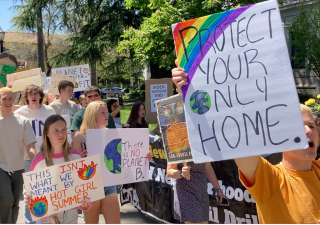
    The necessary actions to combat climate changes are too slow – obvious.  Here is some of what the youth had to say to us adults on April 19th.  Our local youth from Fresno, Davis, and Sacramento made their voices (short movie clip here) heard at the Capital this past Friday.

    California has made good progress, and Yolo County has made more progress. We hope Davis will be as focused and insistent on necessary changes as well.

    What can adults do today to help our children's tomorrow?  There are many, but one thing stands out in our State, and that is to reverse the 2022-2023 damage inflicted by the California Public Utility Commission (CPUC), shielded by Governor Newsom, to raise our rates and just about crush the last 25 years of residential renewable energy progress in California. 

    Your utility bills have gone up 30% to pay $5.7 Billion to PG&E to cover climate change costs that an energy judge has already ruled are twice the $2.7 Billion needed.  Please consider taking action and reading the op/ed written by Loretta Lynch, former Chair of the CPUC, who got us out of the Enron crisis 20 years ago. Paywall – so the article in full requires a temporary subscription to SF Chronicle – here is an excerpt.

    (more…)

  • Little Publicized Hearing on I-80 Tolls

    $10+ at rush hour  - but Tahoe Groups go free!

    By Alan Hirsch

    Cartoon- induce demand can't wait for road to be widenedPolicies that will  decide how hi the tolls will be on new I-80 lanes will be discussed at little publicized hearing Tuesday April 9th  5:30 at the  West Sacramento Public Library.  Zoom will be available. This may be the first – and maybe last- chance for most members to make oral public  comments as future toll agency meetings will be held during the day in DT Sacramento SACOG offices, where zoom-in comments are not allowed.

    Staff for this new agency members have also shared they believe, under the proposed policies, they expect tolls on I-80  for Davis commuter  may typically be $10 each way at congestion times– or even more when congestion is worst -even $40). But they are proposing 3-in-a- car will go toll free- a policy that seems to differentially favor Tahoe recreational travelers over commuters.

    The hearing by the California Transportation  Commission (CTC) will take input on  setting up a new agency and making policies for the proposed 17 miles of new toll lane that run from I-80 in Dixon to both I-80 and I-50 Sacramento River Bridges. The agency will decide how  tolls are set, who get  discounted tolls,  and how the toll revenue will be used. The Agency sponsors are SACOG and  Yolo Transportation District. YoloTD is  chaired  by Davis Mayor Josh Chapman who is also the Davis’s representative on SACOG.

    (more…)

  • Council’s Non-Scientific Reasoning on I-80

    Why Didn’t  YoloTD share the facts?

    By Alan Hirsch

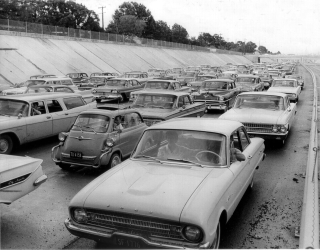
    Congestion photo old car_texas59_traffic_jam_1962My beloved Davis has failed to accept the science out of UC Davis on climate change.  I worry for our future if even Davis  can’t face the urgency of our situation.

    I urge everyone to watch the March 5th video of Davis City council and listen to their rationalization not to align city policy with UC Davis scientists on the freeway I-80 policy. The city council discussed sending a letter to state officials noting the city’s agreement with Caltrans’ own policy that freeway widening is contrary to the State’s climate action plan and won’t solve congestion. The city council rejected sending the letter, even though no one challenged its substance.

    I know a few readers here still might think freeway widening works to fix congestion–  for them  I wonder who they are listening  to if Caltrans policy itself accepts UC Davis research? 

    Begin watching council rationalize the “settled science” away beginning at 1:07:41 as Councilmember Donna Neville withdraws her letter and offers two unscientific  reasons: 1) there was no community consensus, and 2) the letter would not make any difference.

    Is consensus the way to measure scientific validity in Davis? Should we accept at face value Councilmember Gloria Partida’s argument that her survey of people she talked to on her walks takes precedence over findings from the UCD Institute of Transportation Studies?   Or Neville’s statement that until we have consensus, we “should not speak to the highest level of government.”  I note the council managed to take a position on the Israel Gaza war before a polarized audience.

    (more…)

  • Seeds of Justice Reading and Reflection Group

    3J7bKPV9bFOewGS1OhJwxh8d6Bi5UoOyHkumtqrZXLv8X6uzQhdCaV17cbsME2TUQkmjRGzHzGQ56blu8xWqaJVouH7tyinKQTWN0qdzUTYc5Mj6gCZvBm_HhGzenPKyPdNCeHwMocLAycbVLbrfjyc

    By Ooti Maxine, Maidu artist

    (From press release) The Seeds of Justice learning community started in 2021 as a project of the Episcopal Church of St. Martin to study the backgrounds for establishing land-based ministry in Yolo County; that is, an approach to ministry that considers the racialized history of the land including its uses, original inhabitants, labor and immigration, ecosystem health, and environmental threats, to be a key component of the church’s mission. We have in the past two years hosted lively conversations with Native Californian cultural practitioners, historians, and professors: Diana Almendariz, Melissa Moreno, Melinda Adams, Beth Rose Middleton Manning, John Liu, and Alan Taylor.

    This year, we are partnering with YoloSol, a cultural arts and ecology collective, and the Yolo Interfaith Alliance for Climate Justice to read the book Know We Are Here, edited by Terria Smith, a tribal member of the Torres Martinez Desert Cahuilla Indians.

    We will meet once a month on Tuesdays from 6:30-8pm at St. Martin's  to reflect on how these stories shape our understanding of the Native Californian past, shed light on our current climate crisis, and might suggest pathways to a restorative future for the web of life here in the Yolo bioregion.

    (more…)

  • Davis Chooses Popularism over Science

    YoloTD is going to CTC for I-80 money

    By Alan Hirsch

    Image001 1656

    YoloTD Chair/Mayor Chapman

    On Tuesday March 5, Davis Council let stand a 2021 policy to “strongly support” I-80  widening for cars—ignoring 34 letters and public comments asking for  reversal of  city policy adopted with no commission or other input.

    The city council, at least temporally, seems to have joined the science deniers on freeways with a majority of members  claiming we need “consensus” before simply accepting UC Davis research, affirming settled science, or even simply adopting policy that  just restated Caltrans and the state climate plan on sustainable transportation.

    This also means science supporting Davisites must turn their  attention to a more sympathetic body to stop I-80: the California Transportation Commission (CTC). This body once in the  past  blocked funding Yolo80, rating it 24 out of 24 in priority and might do it again next week. Emails  on CTC agenda item 19 are needed ideally  by Monday to ask them to block a $105 Mil grant  for more I-80 auto widening in Yolo County.  They, unlike YoloTD seem concern with induced demand’s climate impact, as  described in this article “Managed Lane Expansion Project  Not Approved by California Transportation Commission

    Who spoke in favor of the Widening in Davis?

    (more…)

  • 75% fossil fuel reduction by 2030

    As the group of students, staff, and faculty whose meeting with Chancellor May in December 2021 led to a plan to eliminate fossil fuel use by UC Davis (Fossil Free UCD), we are pleased to see the release of the Fossil-Fuel Free Pathway Plan (FFFPP), as reported in the Davis Enterprise.  We are grateful to Chancellor May for his continuing dialogue and leadership. 

    The FFFPP calls for eliminating 95% of fossil fuel use from university operations by 2040.  Equally important is the shorter-term goal contained in the plan: a 75% reduction of fossil fuel use by 2030. 

    This shorter-term goal is essential because deep and swift emission cuts from burning fossil fuels is the only appropriate response to the dramatic consequences of climate change we are already experiencing.  To meet this 75% reduction target, UCD will need to work together with other UCs and our state and federal legislators to secure funding.

    As a leading university, UCD educates our students for a successful future. Our teaching mission comes with a responsibility to ensure that we graduate our students in a world where they enjoy a stable climate. UCD is showing by example that we can greatly reduce the use of fossil fuels within years, not decades. This leadership will hopefully inspire other universities and government entities to swiftly enact plans to go fossil-fuel free as well.

    UCD affiliates who wish to join our ongoing efforts are encouraged to contact us via our website at https://fossilfreeucd.org/

    Cort Anastasio
    Patrick Cunningham
    Mark Huising
    Brianna Mcguire
    Helene Margolis
    Elizabeth Miller
    Roberta Millstein
    Emma Saffel
    Suzana Sawyer
    Stephen Wheeler
    Sandy Xie

    On behalf of Fossil-Free UCD

  • State Protections Sought for Vanishing California Burrowing Owls

    (From press release) Conservation groups petitioned the California Fish and Game Commission today to protect five imperiled populations of the western burrowing owl under the California Endangered Species Act.

    The petition seeks endangered status for burrowing owls in southwestern California, central-western California and the San Francisco Bay Area, and threatened status for burrowing owls in the Central Valley and southern desert range.

    “These fascinating ground-dwelling owls need relief from being bulldozed or evicted to make way for urban sprawl,” said Jeff Miller, a senior conservation advocate at the Center for Biological Diversity. “I’ve witnessed the disappearance of burrowing owls from much of California over the past two decades, and it pains me to watch their extinction trajectory. They need immediate protections if we want to keep these owls around to grace our grasslands and open spaces.”

    The only owl species that nests and roosts underground, the burrowing owl was formerly widespread in California and commonly nested in grasslands throughout low elevation areas of the state. Burrowing owls have suffered significant habitat loss due to urban development, conversion of grasslands to agricultural lands, and large-scale wind and solar energy infrastructure. They are also killed by rodenticides and collisions with wind turbines and cars.

    The owls rely on burrowing mammals such as ground squirrels to excavate underground burrows for nesting and roosting. Urban development removes suitable nesting and foraging habitat, while ground squirrels are routinely eradicated from ranching and agricultural lands.

    “When a formerly common species disappears from our landscape, what does it say about the health of our ecosystems? Abundant burrowing owls once brought so much joy to residents of our valley, but development has pushed them to the brink of extinction,” said Shani Kleinhaus with Santa Clara Valley Audubon Society.

    Protecting the burrowing owl under the California Endangered Species Act would require state and local agencies to manage threats. That would include ending the state policy of allowing owls to be evicted from lands slated for development and requiring adequate mitigation for habitat loss. Regional planning efforts, and in some cases direct intervention to boost owl abundance, are needed to prevent the imminent disappearance of burrowing owls from many areas of the state.

    “State protections are urgently needed since the environmental review process hasn’t meaningfully protected or conserved burrowing owls,” said Catherine Portman with the Burrowing Owl Preservation Society. “We’ve tried to get mitigation for owl habitat destroyed by scores of development projects in Yolo County, but owl colonies are routinely evicted without requiring habitat protections. For example, 103 acres of prime burrowing owl breeding habitat in Yolo County were developed in 2015 in exchange for only 19.5 acres at a mitigation bank that has never hosted nesting owls.”

    (more…)

  • Tonight at City Council: Weigh in on I-80 widening

    By Roberta Millstein

    Just a quick heads up to let folks know about an opportunity to weigh in on the proposed I-80 widening project.  The subcommittee of Councilmbers Arnold and Neville have drafted a letter for City Council consideration that recognizes the objections raised by many Davisites to the project and expresses concerns.  See proposed letter here: Download 04-Subcommittee-Recommendation-Transportation-Letter

    I think it is a fairly weak letter, and would urge something stronger, but I think it's also important to acknowledge that it is at least more of a stand than the City Council has been willing to give prior to this.  So a comment on the order of, "thanks, this is good, but we can do better" seems appropriate.

    As a reminder:

    • In person public comment: This is item #4 on the agenda, tentatively scheduled for 6:55 PM.
    • Submit written public comments to CityCouncilMembers@cityofdavis.org. Emails are distributed to City Council and staff. To ensure the City Council has the opportunity to review information prior to the meeting, send emails by 3:00 p.m. on the meeting date.
    • Submit comments by voicemail prior to the meeting: Call the city’s dedicated phone line (530) 757-5693 to leave a voicemail message for public comment. Staff will play comments during the appropriate agenda item. Comments will be accepted from 12:00 noon until 4:00 p.m. on the day of the meeting. Voicemail public comments will not be accepted after 4:00 p.m. Speakers will be limited to no more than two minutes.
  • I-80 A Threat to Housing Affordability?

    Blinder siloVideo: A Widening Goal is for More Bay Area ”Super Commuters”

    By Alan Hirsch 

    The Davis  General Plan is on Tuesday’s city council agenda- not just in the item so labeled, but reverse  of the city policy of “strongly supporting” the I-80 widening.

    I-80  is not just about climate, it also impacts having housing, affordable housing for local residents.

    While we in Davis can zone in more density like Cannery,  push Davis developers to increase their affordable set aside a few percent points, and even  vote a tax on ourselves to fund a housing trust, the benefits for current resident will easily be diluted by demand generated from over  ten thousand commuters a day  the 33% increase in freeway capacity enable.

     Prices are set by demand vs supply,  If  more people have access and want housing here the prices will go up- as will demand for subsidized affordable units.

    (more…)

  • Will Davis Council get serious about Climate & I-80?

    Cartoon fist grabing freewayReview of policy to “Strongly Support” the widening at Tuesday Meeting

    By Alan “Lorax” Hirsch

    On Tuesday March 5th  Davis  Council  Meeting, there will FINALLY be a full discussion of the I-80 policy for the City of Davis. it will likely be in cryptically worded agenda item called Legislative Policy.  

    This is follow-up to the January 9th Council meeting where the city council wrote a highly critical letter about the problems with the environmental analysis for the widening.  And the June 6th 2023 meeting Caltrans pressured the city council and said “agree to partner with us- tonight–  or you won’t get mitigation money.”

    Currently,  Davis City policy is expressed in letter written to federal government and California Transportation Commission to “strongly support” the I-80 freeway widening. This is based on two lines slipped into a 10 page city council’s lobbying policy agenda item three years ago (2/16/21).  The BTSSC (Davis city transportation Commission) has never been consulted on this policy, neither has the council ever before had a in depth discussion targeting support or opposition this $465Mil project. Contining this  policy put obtains the missing $200- $350 mill need to complete construction of the project- and funding it mitigation of its GHG above real transit improvements. 

    ACTIONS NEEDED:

    If residents  want to speak up on this project, they can do one of these actions:

    • Show up council chambers and make a 2-minute comment— (you can make comment in general comment period before 7 pm and still make an election night party)
    • Leave Voice msg noon at 4pm on Tuesday 5th. 530-757-5693
    • Email: Davis City Council citycouncilmembers@cityofdavis.org

    Talking Points:

    (more…)