Davisite Banner. Left side the bicycle obelisk at 3rd and University. Right side the trellis at the entrance to the Arboretum.

Category: Environment

  • Yocha Dehe Joins The Sierra Club, Yolo County Farm Bureau, And Residents, To Demand Sensible Cannabis Land Use Policy

    Tribe joins suit calling for changes to flawed Cannabis Land Use Ordinance

    (From press release) In an effort to hold Yolo County accountable for developing fair and sound cannabis land use policy, the Yocha Dehe Wintun Nation has partnered with the Sierra Club, Yolo County Farm Bureau, and local residents in a lawsuit to do precisely that.

    The lawsuit does not seek to stop cannabis cultivation and related businesses in Yolo County, or to prevent County residents from profiting from the cannabis industry.  Rather, it would simply require the County to comply with California environmental law by evaluating the full and real impacts of cannabis cultivation, and mitigate those impacts, before adopting an ordinance regulating it.  Adhering to this process is what the California Environmental Quality Act requires, and indeed, these same requirements apply to every other regulated land use.

    “The cannabis industry has a place in Yolo County, just as cannabis has a place in the medicine cabinets of many people in California,” noted the Tribal Council of the Yocha Dehe Wintun Nation. “But sensible cannabis permitting can’t happen until the County is clear-eyed about the problems overconcentration creates, especially in sensitive areas around schools, near cultural heritage sites, and in smaller communities like those in the Capay Valley.”

    (more…)

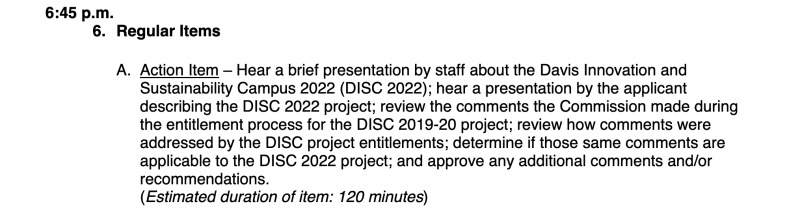
  • Report from the Open Space & Habitat meeting re: DiSC 2022

    Screen Shot 2021-10-03 at 8.45.43 PM
    The following was originally posted as a comment in response to the Davisite article Comments to the Open Space & Habitat Commission concerning DiSC 2022 and has been reposted here as an article with permission of the author.

    By Ron O

    In regard to the Open Space and Habitat Commission meeting last [Monday] night, here are some highlights:

    The recommendation (from the article linked above) to request that the northern (approximately) 100 acres be established as agricultural mitigation was not discussed or considered by the commission. Two commenters reiterated this request. (The 100 acres was part of prior proposals.)

    The commissioners proceeded to review and edit the recommendations made when the proposal included the northern portion of the site. The developer representative claimed that many of them no longer applied, since the northern site is not part of the current iteration. As a result, the commissioners edited and deleted large sections of the prior recommendations, on-the-spot.

    As the meeting approached 9:00 p.m., the chair suggested that a second meeting be held, given the amount of work left to be done. However, several commission members were not able to attend an additional meeting prior to the October 18th deadline set by the council. The chairperson stated that the council put the commission in a "bad place", and stated that she was "very unhappy" about it. The chair stated that they had received the packet for review on the previous Friday afternoon (for this Monday meeting).

    (more…)

  • Comments to the Open Space & Habitat Commission concerning DiSC 2022

    Screen Shot 2021-10-03 at 8.45.43 PM
    The following was emailed to members of the Open Space and Habitat Commission (OSHC) on Sunday.  The OSHC is scheduled to discuss the revised MRIC/ARC/DISC project, now dubbed DiSC 2022, at its Monday Oct 4 meeting.  If you wish to comment on the project yourself, see instructions on the agenda for the meeting, located here.

    Dear members of the Open Space and Habitat Commission,

    I am writing to you as a former commissioner (10+ years) and Chair of the OSHC, having completed my term last December. I was involved in analyzing what is now being called the DiSC 2022 project in all of iterations, so I hope you find my comments helpful in your discussions.

    To begin, I am pleased to see in the minutes from your last meeting the following: "[Ms. Reynolds] said the Commission also had the option of agendizing the Addendum to the project's Environmental Impact Report ("EIR") later this year if the Commission wanted to provide comments on the Addendum to the EIR. That meeting would have to happen before December when the project is scheduled to go before the Planning Commission, she said." I strongly urge you to do this. The OSHC has a history of productively discussing and giving comments on EIRs, as it did with earlier versions of DISC as well as Nishi and other projects, with the comments thoughtfully crafted from the Commission carrying more weight than comments from individual members. For example, you might wish to ensure that the biological surveys have been properly updated and that greater awareness of approaches to climate change are being taken into account, such as the lost opportunity for regenerative agriculture on the property if the project is built.

    Another important piece of background: in the last iteration of the project, the developer kept insisting that Mace 25 was not part of project, even though it clearly was. This led to mistrust in the community. Because of that mistrust, people are now concerned that this smaller project without Mace 25 is just a foot in the door for the already rejected larger project to come later. I urge you to recommend that the developer state, as a sign of good faith, that this is not their intention — designating the ~100 acres to the north of the project as ag mitigation would be the clearest way to do that.

    The rest of my remarks will focus on the Staff Report and related attachments, located online here.

    (more…)

  • Valley Clean Energy Begins Receiving Electricity From Large Central Valley Solar Project

    20210419_155046

    Installation of solar panels at the Aquamarine Solar Facility in Kings County, CA, 2021

    (From press release) Valley Clean Energy (VCE) announced that it is now receiving power from a new solar park located in Kings County, CA. VCE signed a 15-year contract to purchase 50 megawatts (MW) of renewable power with Aquamarine Westside, LLC’s 250MW Solar project. This contract will replace current short-term power contracts, allowing VCE to deliver higher levels of renewable power at competitive prices.

    The Aquamarine project is located in CIM Group’s Westlands Solar Park, a master-planned clean energy park with over 2GW of solar production potential.

    (more…)

  • Particle Wars in Davis –  What you can’t see can kill you, Part II…

    Screenshot from 2021-08-19 17-42-32

    The militarization of gardening?

    A conversation about the proposed – and not – restrictions on toxic micro-particle hyper-distribution -  a.k.a. “leafblowing” – by three of your favorite local activists!

    (COVID is Part I)

    This evening the City of Davis Natural Resources Commission (NRC) will hold the first of two hearings on possibilities for leaf blowing restrictions. Here’s the memorandum – a supplement to Council’s approval of temporary leaf blowing restrictions from last October. It includes Commission and Staff proposals and results of the surveys on leaf blowing taken which were taken in June.

    In summary, they are proposing a gas LB ban, time restrictions and user restrictions. Staff and Commission (sub-committee) proposals are broadly similar. 

    What’s very important, however, is that there is a strong likelihood that there will be a complete ban at the state level on gas-powered equipment such as lawn mowers, edgers and so on… including leaf blowers and vacuums, or combined units. This means that any equipment-related ban in Davis that only affects gas blowers will be nothing unique in just a couple of years. 

    The meeting is at 6:30pm
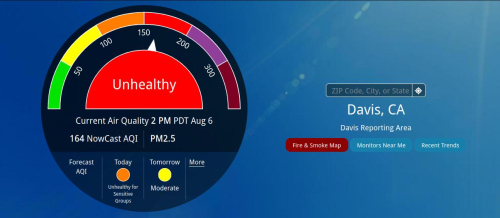
     

    AirNow08062021

    Leaf blowing prohibited on this day?…

    AIR QUALITY and wildfire fallout:

    Todd Edelman: There is no explanation of why the air quality-based restriction due to wildfire fallout  is based only on official AQI according to current City policy. For example, the very popular and relatively inexpensive Purple Air system could be used.  And Purple Air isn’t only used at private residences: The UC Davis environmental engineering dept has one on its roof for experiments. Lake County Air Quality Management District (AQMD) uses them for official monitoring outside of wildfire situations. The New Jersey Transit Authority seems to also use them for official purposes. Sutter Davis Hospital has them on their roof and inside. The elementary school at Beale Air Force Base has one, as does the Yolo Solano AQMD office in south Davis – they say they use it to recognize “trends”.

    But perhaps the most important use of Purple Air is to determine local impacts of leaf blowing…

    Previewonleafblowerstoryno2

    Nope… no new restrictions if the air's bad AFTER 7:30am…

    Darell Dickey: I have trouble with the concept that we can only ruin our air quality when the air is otherwise pretty good. We’re going to avoid dirtying the air when it is already bad? And then there’s my favorite part: Blowing will always create a local situation of AQI over 100, which should result in an immediate ban on blowing. 

    I’m thinking that a good, logical way to present this is that if we’ve all agreed that 100 AQI is “bad enough” for us to ban activities that make it worse, then we should never be allowing the use of devices that make the AQI 100+. And this circles back to local air quality vs. relying entirely on one spot of data that’s outside of town to determine what we’re breathing in our neighborhoods at any given moment. 

    If AQI 100+ is bad anywhere, then stop creating AQI 100+!

    TE: There is nothing about how they determine how much ash is on the ground, though this is a condition of the lift of any AQI-based restriction according to current City policy. I have voiced this concern many times.

    There were several times when the official AQI went over 100 during the day but not before 9AM; this was not mentioned in the memorandum, though I brought it up repeatedly in August in emails to the NRC.

    LEAF-BLOWING, WILDFIRE SMOKE AND COVID-19

    The proclamation from October 2020 that resulted in temporary leaf-blower restrictions mentions “COVID-19” 10 times, yet the current memorandum only mentions it once, and not directly in relation to smoke effects on those with who have COVID. Further, the October 2020 mentions no specific research at that time on wildfire smoke and COVID, but there’s new research not mentioned in the memorandum. 

    AIR QUALITY, general:

    TE: As far as I can tell leaf vacuums distribute lots of dust, and as they pick up inorganic matter as mentioned in the memorandum, I don't see how they will be allowed. But still, do people think that these things work as HEPA interior vacuums?

    DD: True. But “lots of dust” from a vacuum situation is still way better than any blowing. It all needs to be in perspective as we’ll never arrive at “perfect.” Same way that electric cars aren’t perfect, but are better than gas cars, etc.

    TE: Well, I think at least all the most dangerous and invisible stuff comes out the back…

    DD: “Most dangerous” is not easy to defend. If the crap being stirred up produces a violent health reaction (allergies, asthma, etc), then the acute “most dangerous” thing is probably coming out the front. At least for those people who are severely affected.

    The only way to call any of this “better” is if less crap is being put into the air…. As compared to doing it another way. And IMO, a vacuum is better than a blower. And leaving stuff where it is, is better than all of it.  The timing of the device usage is also important. I vacuum up deep leaves to mulch them and put them where they’ll help the yard vs. choke the plants. And I do it when the leaves are not dusty. It is a relatively benign activity.
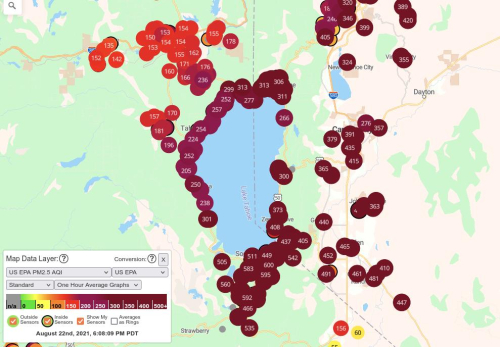
    Tahoe08222021

    Purple Tahoe


    LABOR:

    TE: There's no suggestions related to the labor issue except for what may eventually be affected by a ban on gas-powered blowers. What are their wages, by the way? This is a basic question for labor related actions or studies.

    DD: I hate the question where they ask the company how much it will financially destroy them. Of course the answers are all opinion, but it is presented and answered as fact. 

    TE: Yes they should give figures or something. Is there possible funding from AQMD to transition out of all leaf blowing?

    DD: Also, a significant percentage of landscaping businesses do not use any blowers. 

    TE: Why is this? How is this influenced by opinions of consumers and of workers or their managers/companies?

    DD: From what I can tell, the biggest concern from the citizenry is that they may have to pay more to the poor, under-paid folks. You know… the folks that they’re really concerned about harming with…. low wages.

    Asking the yard-care business owners how bad it will be if blower use is restricted is like asking El Macero drivers how bad it will be if Mace loses one of its travel lanes. It is a total guess. It is based on everything else not changing. And they simply have no idea what the result would be. Might be higher health and better hourly wages for everybody. But of course most claim that it will just be devastating to their business. I didn’t hear one response about how it would be better for the workers who might get paid more for doing healthier work.

    TE: I’ve repeatedly brought up this part of the issue, not only with the NRC, but also the Social Services Commission — it needs to agree to provide feedback. Though leaf-blowing is not a job based on sustainable practices, there are many related jobs which are, and they require a higher skill-set. Tree trimming, building on-site composting facilities, triage of soil situations? No one should lose their jobs. 


    LABOR AND PHASE-IN:

    TE; There seems to be no scientific reasons for only phasing out gas blowers in City properties except for protecting some companies. Nothing about increasing wages, etc. The proposed start date Jan 1 (2023) is after most of the "leaf season", and over two years since the temporary regulations came into effect. This seems to be about giving enough time to buy new equipment, but this seems like a tiny expense compared to labor.
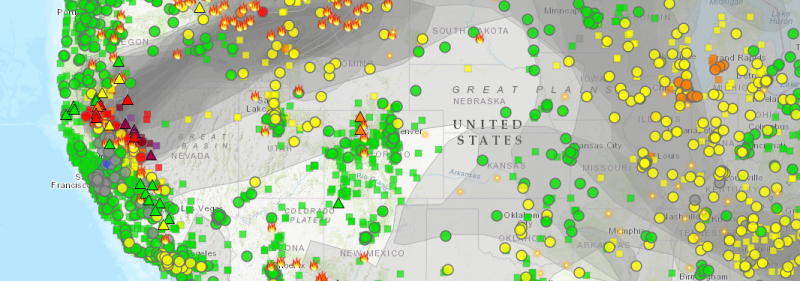
     

    Screenshot from 2021-07-24 05-43-02

    Purple Nation

    VIBRATION (Sound):

    Roberta Millstein: You two are rightly focused on the air quality. But for a broader audience, you might also mention that these things are f*cking loud. Really f*cking loud. And that is for some a big part of why they are hated.

    TE: I know that traffic noise is very bad for human health. One thing that’s worse about leaf blowing noise is that it can be unpredictable, especially if one’s neighbor is doing it — but then also who memorizes the leaf blowing schedules of their neighbors or their yard sterilization services?

    While most electric leaf blowers are quieter than gas-powered ones, it’s not guaranteed. And if an electric leaf blower is less powerful than a gas one, people may use it for longer.


    OTHER:

    DD: And the main reason that some give for the “need” of leaf blowers? No other practical way of clearing large paved parking lots. 

    TE: Exactly, what are uses of LB's in terms of square footage or acres, etc?


    CULTURE: 

    TE: Yard work is good exercise if the air is clean. It connects one to their yards – even in a rental property – that other exercise outside cannot.

    Leaf blowers and vacuums didn't exist in significant numbers until what, the 1980's? What did people do before that? Die, in their yards, under piles of leaves?


    EFFECT ON TREE AND SOIL HEALTH:

    TE: In the Memorandum there's nothing from the Commission or Staff in the recommendations about the benefits of leaving leaves where they fall, even though it’s already recommended on sources linked from the City's Tree pages and others.

    The Tree Commission will hopefully offer feedback.


    EXAMPLES / Best Practice in Other Places:

    TE: There is mention of the other jurisdictions which have done partial to full bans, but not by name. They clearly have this list. There is no indication how many suffer significant wildfire fallout, though as many are in California certainly some have, and there's an assumption about why most didn't respond. Two have complete bans… who are they?


    EFFECT ON OTHER USERS OF ROW (street, greenbelt, or another public space):

    TE: There's nothing about how use of blowers contributes to the always non-permitted piles of yard waste in bike lanes. At the October meeting of BTSSC we need to pressure them into agreeing to providing an opinion on this, especially as a related item on yard waste in bike lanes has been sitting in the long-range calendar for many months as TBD. This issue has been going on for many years.

    Proposed ban during the week is only til 8AM, even though many are commuting to school or work by then, by pedal or foot. So then they will be exposed full-on as they traverse the City.

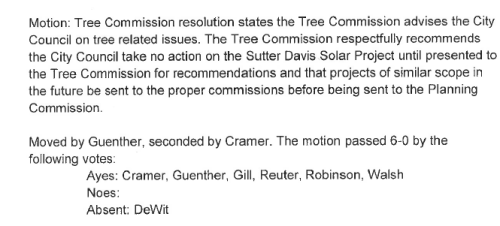
  • Letter & motion from Tree Commission concerning Sutter tree cutting

    Treecommissionmotion

    This motion was approved unanimously at the Tree Commission's August 21, 2021 meeting.

     The following letter was approved by a unanimous motion of the Commission at their September 16, 2021 meeting and sent by staff to the City Council on September 17.  This issue will be in front of the City Council tonight.

    From: City of Davis Tree Commission
    To: Davis City Council

    We are writing to request clarification and revision of the process for approval of tree removals from commercial property.

    The resolution creating the Tree Commission (06-187) states that the purpose of the Davis Tree Commission is, "to act in an advisory capacity on tree related matters, including review and approval of tree removal requests."

    Three large projects have recently had large numbers of trees removed without input from the Tree Commission. 205 trees in a two-phase project, currently in process (Sutter Hospital expansion & solar addition); 83 trees in a project to replace these trees with PV solar panels (Cousteau Pl.); 103 trees as site preparation for a new development (Bretton Woods).

    These requests were never brought before the public or the Tree Commission, prior to being heard by the Planning Commission. They were also not brought before the Natural Resources Commission, or the 2-by-2 subcommittee between the Tree Commission and the Natural Resources Commission that is currently looking at the parking lot portion of the Tree Ordinance and how to maximize both solar arrays and tree canopy.

    These three events alone total a loss to the City of 391 mature trees. These trees took one to several decades to reach maturity.

    Tree Davis, working with the City of Davis, planted 379 new trees between October 2020 and April 2021. It took a lot of hard work by a lot of people to make that happen during the Pandemic.

    Thus, in a year when a record number of trees were planted by the City and the community, the City of Davis has a net loss of trees for the year. It is especially disheartening in a time of Global Warming and in a city that prides itself on its tree canopy – a city that has qualified as a "Tree City USA" for decades. Add to this that the trees in these applications are mature trees, while the replacement trees will be small, and the loss to the community canopy is staggering. The Tree Commission believes strongly that we will not reduce our environmental impact by removing mature, established trees and reducing our tree canopy.

    Surely there is a problem with our process when a community member is required to go before the Tree Commission to remove a single tree, but a corporation can remove any number of trees -including trees that were required for the approval of a development – without any Tree Commission or community input.

    The Tree Commission respectfully requests that tree removals of twenty Trees, one Landmark Tree, or a project greater than, or equal to, five acres be subject to a similar process as for removals of City Trees. This request is consistent with recommendations made by this Commission regarding the update to the Tree Ordinance. The Tree Commission also respectfully requests that a process for tree removals by property owners be developed that is aligned with the City's goals regarding its urban forest and that the process emphasize transparency, accountability, and community engagement.

    With respect,

    City of Davis Tree Commission

  • Part 2 – Déjà Vu – Council and Staff Collude to Limit Review of the DISC 2022 Project by the City’s Advisory Commissions…Again!!

    Staff's and Council's Current Scheme to Limit Analysis and Input from the Commissions include Artificial, Arbitrary Deadlines Imposed on Citizen Advisory Commissions.

    By Alan Pryor

    Introduction

    Readers will remember one of the primary complaints surrounding DISC 1.0 on the November 2020 ballot as Measure B was that the Commissions were intentionally and systematically excluded from fully participating in the review of the project through scheduling manipulations imposed by City Staff with Council approval. It appears that history is repeating itself which is the subject of this series of articles. Part 1 of the series (see https://newdavisite.wordpress.com/2021/09/15/deja-vu-council-and-staff-collude-to-limit-review-of-the-disc-2022-project-by-the-citys-advisory-com/) discussed the history of City Staff and Council ignoring input by both the Advisory Commissions and the public in many other important City matters.

    This Part 2 in the series discusses the recent Council decision that greatly limits Citizen Advisory Commission input and recommendations for Baseline Features for the newly proposed DISC 2022 project now heading for the June 2022 ballot in Davis. The article is a detailed examination of the means by which the City Council and Staff are intending to again limit analysis and input from the Commissions by hamstringing the Commissions' ability to hold multiple meetings to review the DISC 2022 project.

    (more…)

  • DISC is back… and so is bad process

    8E95805A-8A18-4D60-AE6F-0C4FDE0CA708
    Staff and City Council favor developer interests over citizen input

    By Roberta Millstein

    This past Tuesday (Sept 7), the City Council formally set in motion the process to evaluate the twice-reborn industrial park/hotel complex on prime farmland outside the Mace curve, now dubbed DISC 2022. Readers will recall that this project was handily defeated at the polls less than a year ago. Now it is back again with half the acreage, fewer amenities, and a smaller proportion devoted to revenue-generating commercial uses. 

    Also back again is staff acquiescing to the developer's extremely short requested timeline. 

    There have been some improvements in process this time around. The project was made a regular agenda item, allowing for greater citizen awareness and discussion, though apparently a number of people were still caught by surprise. And all of the relevant commissions are scheduled to be consulted from the outset, something that citizens had to fight for the last time. 

    However, staff's Tuesday proposal was that each commission can only evaluate the project once. Why? The developer wants this on the ballot by June 2022 and staff wants to comply with that, stating there is not enough time for commissions to have more than one meeting concerning the proposal. Why do they want to go along with the developer?  Well, you will have to ask them, but it is certainly not a timeline that favors citizen input, remembering that commissions are intended to be a conduit for citizens to give feedback to the City.

    (more…)

  • Seeds of Justice lecture and workshop series

    (From press release) What is our responsibility as people who live, work, or worship in Davis to the original inhabitants of this land? What is the legacy of environmental racism? How can we heal and repair the harm? These and other critical questions guide a new educational opportunity being offered to the community this fall.

    The Episcopal Church of St. Martin will bring a series of lectures and workshops, Seeds of Justice, to Davis to highlight the work of scholars and cultural practitioners in this region – the ancestral homeland of the Patwin-Wintun people.

    St. Martin’s developed the Seeds of Justice program to understand the racialized history of the land here in the epicenter of gold, greed and genocide. Through storytelling, discussions and hands-on workshops, participants will study the resistance and resilience of Native Californians to the ongoing social and environmental impacts of settlers in this region.

    “We hope this will be a safe, honest and transformative space for our community to grapple with the legacy of injustice to this land and her people,” said Ann Liu, Chair of St. Martin’s Care for God’s Creation Committee. “Everyone is invited to come and learn with an open heart and mind.”

    (more…)

  • We need critical thinking from our City Council on climate change

    By Mike Corbett

    Given an understanding of what’s in the recent IPCC 6th report what would you expect a rational city council to do in response? Humans evolved because of our critical thinking abilities. So if a current city council possessed those abilities what would they be doing right now?

     You would expect them to convene a special meeting so the city could begin taking urgent steps to stop greenhouse gases from entering the atmosphere as well as steps to sequester carbon from the atmosphere. They would make it a priority for their staff and commissions to find ways to take immediate steps to accomplish these crucial actions. 

     Since the Davis City Council declared a climate emergency two and a half years ago, little has been done. And as we approach the completion of the current climate action plan (CAP), our City's approach seems to be falling far short of what it should be. The recent survey of our citizens has revealed a very weak City understanding of all our options and what we should be doing today.  We need to employ more critical thinking.

     Critical thinking must first address the ability to find the most important thing or issue to focus on in any given moment or situation, from personal choices to issues within the global realm.  Additionally, critical thinking must start with the work of understanding a problem’s core by analyzing its depth and breadth. That means understanding the full context around the issue (in this case the IPCC report), and that means looking past biases or views that obscure the core of the problem.

    (more…)