Davisite Banner. Left side the bicycle obelisk at 3rd and University. Right side the trellis at the entrance to the Arboretum.

Category: Environment

  • Council bamboozled at 6/6 meeting

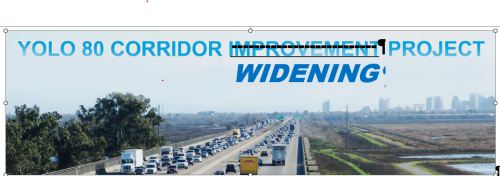
    I-80I-80 Widening rated last for funding by Caltrans.

    By Alan Hirsch

    Preface: Just 46 hours after Davis Council was forced into a shot gun wedding with Caltrans on the Yolo80 freeway widening, the gate keeper organization on transportation projects, the California Transportation Commission (CTC) staff made public a: “do not fund”  recommendation. The next chance for making up these state matching funds is in 18 months. It would be unusual if the staff recommendations are overturned at the June 28th CTC meeting.

    * * *

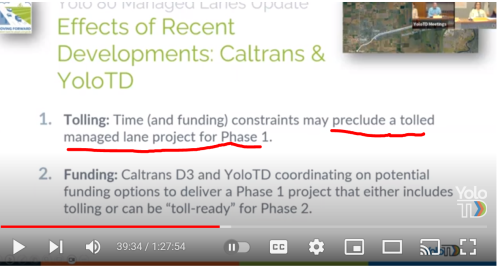
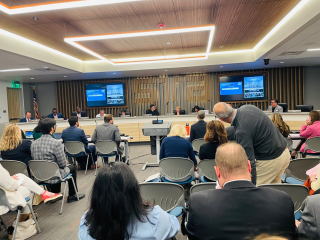
    On January 6th, ignoring 21 public comments unanimously opposing it, the Davis City Council voted 3-1 to take the first step to go along with the I-80 widening project. The majority decided to listen to YoloTD Vice Chair Josh Chapman and it’s staff. This vote supports the city partnering with Caltrans to sell out our goal of zero carbon for Davis: Caltrans will get to use our “good” GHG-reducing projects to justify the additional GHG caused by the freeway widening. Caltrans’ carrot was to offer funding (amount unknown) to help developers of both the Nishi housing development and the housing proposed in downtown Davis.

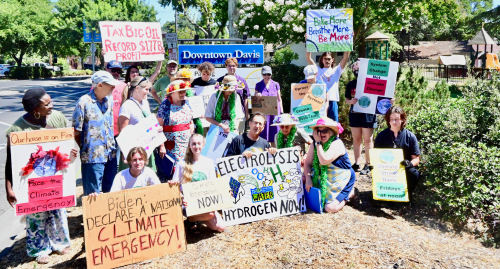
    As reported in the Enterprise article 6/10, the council voted this way even though they were uncomfortable with how the widening undercuts our local climate change plan. Among the complaints made by public were calls to remember the city’s climate emergency resolution.

    Only Councilperson Bapu Vaitla remained skeptical of what was represented to council and voted no — i.e. to protect the city’s plan to go to zero carbon.

    (more…)

  • 5 City/County Climate Commissions Are Being Sidelined

    Best way to handle inconvenient truth is to not talk of it

    Image003 323

    By Alan Hirsch

    This week the well-meaning volunteers of Yolo County’s Climate Action Committee will be hosting three open houses to collect public input.

    However, I think these volunteers, like climate committee volunteers on 4 other Yolo County cities, are being distracted from the elephant in the room.

    Image001 1516

    Is the Davis CAAP just performative if freeway widening can’t be discussed in Davis by our climate committee?

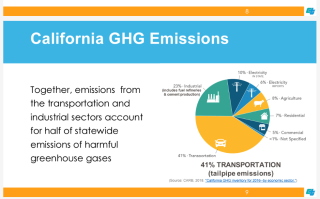
    Each of the five Yolo government’s Climate Act Plans note we need a plan to dramatically reduce auto driving if we want to address our greenhouse gases (GHG), the source of 65% of Woodland  and 69% of Davis’s GHG. For example, the city of West Sacramento plan set a goal of reducing driving 40% by 2045 by a shift to transit and active modes.

    Yet, the proposed widening of the I-80 Freeway is projected by UC Davis researchers to do the opposite: encourage more driving and longer commutes forecasting 177.9 million more miles of driving each year. This means an increase in the county’s carbon footprint by 3%- larger than the entire City of Winters.

    UC Davis research also demonstrated, like all past widening, this $380 million project one won’t fix congestion for long: the freeway is 100% certain to re-congest after a few years due to more car travel the widening it itself encourages.

    Yet not one of these five climate commissions have discussed this project and its tradeoffs or have a plan to provide input to Draft Environmental Impact Report (DEIR) in July.

    It is not the volunteers on these committee’s fault: it about city and county staff who haven’t put it on their agendas.

    This is accomplished by the freeway advocates embedded in government who claim to want public input but actually discourage it by spin:

    (more…)

  • Managing the mismanagement

    Should Mayor Will Arnold recuse himself tonight from an I-80 project discussion because he's Media Affairs Manager at Caltrans?

    ArnoldArnoldImage left: Councilmember Arnold's official Facebook Page & Caltrans / Image right: City of Davis

    Tonight's City Council Agenda item on the 80 Yolo Managed Project was already covered critically and nearly exhaustively last weekend in the Davis Enterprise and yesterday here in the Davisite and in the Davis Vanguard.

    It’s no secret that Mayor Will Arnold is the Media Relations Manager for Caltrans.  Should he recuse himself from the discussion for ethical reasons?  Should he be signing a letter to support a project he would then have to (continue to) work on at Caltrans? I don’t think he can recuse himself from the communications hierarchy there. Based on the linked articles above, consider how Caltrans communicates things about the project: The spin, the lack of backstory, obfuscations to the point of dishonesty… disrespect. (At a public presentation hosted by Cool Davis a couple of months ago, Autumn Bernstein of Yolo Transportation District – who is co-presenting this evening at City Council – said that her agency had convinced Caltrans to do the managed lanes variant with VMT mitigation. The linked articles tell me Caltrans had already decided to do this some time ago, and I would not be totally surprised if they try to re-include the new bike-ped crossing of the Yolo Bypass as a carrot.) 

    Arnold’s job description at LinkedIn is:  “Caltrans Headquarters Public Affairs, Office of the Director – Duties include managing media inquiries and press relations, designing and executing effective communications strategy, and writing/editing communication plans, press releases, talking points and social media content.”

  • A Tale of Two Crossings: Nothin’ from nothin’ leaves nothin’

    * If Nishi can't be built, there's nothing to trade as a mitigation
    * Dedicated bike-ped crossing of the Yolo Bypass was quietly cancelled after years of promises.

    NishiPLcomparison1


    Tonight's City Council Agenda item on the 80 Yolo Managed Project was already covered critically and nearly exhaustively last weekend in the Davis Enterprise and yesterday here in the Davisite and in the Davis Vanguard.


    A Bridge That Can't Be Built…

    I arrived in town after Nishi 1.0 (retroactively supported a concept that would involve a complete redesign of the 80-Richards interchange inclusive of a parking structure and Park & Ride for regional buses which would have minimal impacts on Richards) and was against Nishi 2.0 because I don’t think that there should be housing (buildings with windows people open!) so close to the noisy and arguably otherwise-polluting interstate, but it’s not why I am suggesting that the proposed “multi-modal” mitigation is a fallacy. I agree with others that no VMT mitigations should happen with this project, and am trying to make clear that the plan of Caltrans and its erstwhile partners are also a mess from a technical point of view. (There's also the sheer ironic delight of trying to facilitate the construction of a project using these VMT credits – as it were – to make the Nishi space noisier and more polluted next to a widened interstate.)

    The 80-railway corridor is a wall for people on bikes, but so is the railway on its own.  See Pole Line over 80 at lower right in the illustration above. It’s incredibly long because it has to go very high over the railway tracks, more so than to get over 80 itself (to better understand this, picture the crossings over 113 which are much lower as they only need to accommodate trucks.) First of all, this – and all the over-crossings of 80 in town – are simply not comfortable and suitable for people on normal bicycles, especially carrying children, and especially if they can make the journey by private motor vehicle or e-bike.   The over-crossings have around a 6 to 7% grade, nearly twice as high as the Dutch standard: So to make it comfortable for hundreds of people to go from Nishi to campus it would have to be nearly twice as long. Look again at the view of 80 at Pole Line: There’s no space for this unless it’s very circuitous and indirect and lands behind the Shrem Museum or just by the entrance to Solano Park from Old Davis Rd. (The red line in the top of the image is only as long as Pole Line, and it needs to be much longer.) And that’s just for cycling. Imagine walking this at least twice a day. Motor vehicles including buses can obviously do this, but that's no one's definition of "multi-modal".

    I feel confident in saying that since a motor vehicle, bus, bicycle and walking connection is part of the agreement for Nishi, and as Union Pacific forbids an under-crossing, there’s no way to build Nishi unless it’s returned to the voters. There’s nothing to mitigate here as nothing can be built for mitigation.

    ***

    A Cancelled Crossing…

    For years a dedicated and new bicycle-pedestrian bridge across the ‘Bypass was promised in the project. In 2020 – when I was still on the Bicycling, Transportation and Street Safety Commission (BTSSC) – the notification that it was dropped some months earlier was only indirectly mentioned in a summary for a BTSSC meeting by the primary liaison for the City of Davis at the time, Brian Abbanat (former City of Davis Senior Planner; now he’s in a similar role for Yolo County and co-presenting Tuesday evening.) A couple of years later when this was mentioned to the other co-presenter, YCTD head Autumn Bernstein, she said it was not funded: I believe that the aggregate truth – to be precise as possible – is that Caltrans dropped it, never told any of the local interested groups about it (e.g. Bike Davis, Davis Bike Club) through their liaison Abbanat and that it wasn’t part of the initial, funded proposal to the Federal Government. Our City, County and State government representatives were silent about this betrayal in our so-called "USA cycling capitol".

  • Make transit & walkable communities a priority, not just a mitigation for freeway widening

    I-80TO Mayor Will Arnold and Members
    Davis City Council

    From: Judy Corbett, Professor Steven Wheeler, Alan Pryor, Professor Mark Huising, Professor Roberta Millstein, Jim Zanetto, Colin Walsh, Alan Hirsch, Robert Thayer

    Our group supports walkable, bikeable, compact infill development near transit, shopping, community amenities, and jobs. Building a wider freeway to increase the auto capacity is contrary to our over-arching goal of reducing greenhouse gas (GHG) emissions.

    It is well established science that wider freeways do not fix congestion but do increase driving and greenhouse gas emissions (GHG), as noted in the well researched Davis Enterprise article of June 3th. The travel forecast model developed by the UC Davis Institute for Transportation Studies (and accepted by Caltrans and the Yolo County Transit District) estimates that the I-80 freeway widening will generate enough car travel (178 million miles a year !) to  equal the GHG emissions that would be generated by adding a new auto centric city the size of Winters.

    Will Davis Decide to Ignore Climate Emergency?

    On Tuesday June 6 Caltrans will ask the Davis City Council to make use of our GHG-reducing projects to justify the additional GHG that would be caused by the I-80 widening.

    (more…)

  • Sutter Davis Hospital Farmers Market opens for the season

    (From press release) The Sutter Davis Hospital Farmers Market is back for the season, celebrating its 13th year bringing farm-fresh produce and local foods to employees and visitors. The market is open from 10 a.m. to 1 p.m. Thursdays through Sept. 28.

    Since 2010, the Sutter Davis Hospital Farmers Market has brought regional foods and produce to the hospital’s main entrance, 2000 Sutter Place in West Davis. Its soft opening was May 4.

    Tammy Powers, chief administrative officer for Sutter Davis Hospital, said, “We know how greater access to nutritious foods can improve one’s overall health. Having fresh and wholesome options available right here on our campus makes healthy choices even easier and more convenient for the community.”

    (more…)

  • Continued concerns regarding the Village Farms site including toxics, traffic, floodplain, unaffordable housing, unsafe bike/pedestrian access, and infrastructure costs issues

    By Eileen M. Samitz and Pamela S. Nieberg

    There can be no assumption that the Village Farms site is safe for development. It is surprising and disappointing to see a recent article attempting to dismiss the significant concerns that have been raised in the past and recently regarding toxics contamination from the former City landfill site and the former City sewage treatment plant which are immediately adjacent (north-east) to the Village Farms property.


    (more…)

  • Will local electeds ignore UCD and buy into Caltrans’ Science Denial on VMT & GHG?

    Inconvenient truth

    Open letter to Davis BTSSC (Transportation Commission)

    To: Chair Jessica Jacobs and members, Davis BTSSC

    From: Alan ‘the Lorax’ Hirsch

    RE: Potential Endorsement of I-80 Yolo widening before Draft EIR released

    BTSSC will be asked tonight (item 6b) to endorse a letter to partner with Caltrans to endorse I-80 widening by supporting a new and untested program of mitigation that could negate local cities’ greenhouse gas reduction programs (CAAP/CAP).[i]

    You will be asked to sign before even seeing the draft Environment Study (DEIR) or the mitigation plans. This is not due out for 30 days.

    I urge caution based on the study by Professor Susan Handy’s group at UC Davis Institute of Transportation Studies. (ITS)

    The below bar chart from that UCD ITS study[ii] compares induced travel projections by Caltrans to the forecast by the National Center for Sustainable Transportation model. Caltrans’ lower forecasts in the EIRs were used to justify spending hundreds of millions of dollars on these five projects. The study shows Caltrans consistently understates the amount of travel & GHG to be mitigated. And in two projects Caltrans assumed no induced demand.

    Induced demand has been accepted science in the transportation world for over thirty years now. The science was upheld in the 1990 California case Citizens for a Better Environment vs Deukmejian, et al. [iii]  It was an inconvenient truth Caltrans has worked three decades to get around. It was not until the beginning of 2020 after the 2013 passage of Bill SB 743[iv] that EIRs had to focus on reducing Vehicle Miles Traveled (VMT).

    Caltrans has been in denial of the science on traffic, which has been confirmed by hundreds of studies out of UC Davis, UC Berkeley, and the Texas Transportation Institute, among many other places worldwide.[v]

    (more…)

  • The Proposed Village Farms Davis Development Project is NOT Threatened by Groundwater Contamination from the Former Davis Landfill Site

    By Alan Pryor

    Executive Summary and Conclusions

    This article reports on potential groundwater contamination beneath the former Davis Landfill site north of the City of Davis on Poleline Rd. and the adjacent site proposed for the Village Farms Davis development project immediately south and southeast of the old landfill site.

    During the contentious Measure X election in November, 2005 in which the proposed Covell Village project (on the same site as the current proposed development, Village Farms Davis) was rejected by voters, allegations were made that the site’s groundwater was contaminated by leaching of pollutants from the former Davis landfill site just north of the project. In particular, it was alleged that a carcinogen, vinyl chloride, was in the groundwater beneath the project site rendering the project unsuitable for development in as much as a deep well was proposed for the site to add to the City of Davis potable water supply.

    In a recent City Council meeting (April 4, 2023) in which the possible timing of bringing peripheral projects before the voters were discussed, one public comment again stated that vinyl chloride was in the groundwater beneath the old Davis landfill and the proposed site for the Village Farms Davis project.

    The parcel itself has so many problems. It has toxics in the north end from the land fill site. The old land fill site was not lined so there is vinyl chloride leakage from the old land fill and it’s substantial. Vinyl chloride does not go away.

    These claims of vinyl chloride and other toxic compounds in the groundwater were based on data from the early 1990s though 2005 which showed some intermittent groundwater contamination (including some tests showing the presence of vinyl chloride) in shallow groundwater test wells beneath the old landfill and immediately to the south beneath the then proposed Covell Village project. These earlier monitoring well test results were reported in the EIR issued in the Covell Village EIR issued in 2005 and are further discussed below in the section entitled Summary of Well Monitoring Findings.

    These reported findings were considered important at the time because, as stated above, the Covell Village project proposal included a new deep well on the project site to provide drinking water capacity for the proposed project and connecting into the City’s potable water supply network. Concerns were expressed that the shallow water contamination could worsen and impact the deep aquifer from which potable water would be drawn. Potentially compounding the problem was the discovery that the groundwater plume was migrating from the landfill toward the south and southwest in the direction of the proposed Covell Village project.

    Annual testing of the monitoring wells subsequently occurred in the period since the Covell Village EIR from 2012 – 2019. These later tests showed a substantial reduction in groundwater contamination in the intervening years and the report from consulting engineers engaged by the City to evaluate the groundwater contamination showed the following results;

    1. NO Vinyl Chloride was found at all in any sampled groundwater from 2012 – 2019 nor were there ANY other VOCs (Volatile Organic Compounds) or metals found in any of the test well samples above the EPA's Primary Maximum Concentration Levels (MCLs) for drinking water.
    1. There were some measurements of nitrate (probably from past agricultural fertilization on the site) in the monitored wells that were in excess of Primary MCLs and some other naturally occurring minerals (selenium, manganese, and sulfate) that were intermittently in excess of Secondary MCLs but not hugely in excess of other well waters in the area.

      However, these are NOT a human health concern because the groundwater beneath the Village Farms Davis project site will NOT be pumped and used for drinking water purposes. Instead, the project will rely on City of Davis municipal drinking water supplies as delivered to the rest of the City.

    1. The plume of groundwater beneath the former landfill site and the proposed development project site was most recently determined to be moving toward the northeast away from the Village Farms Davis project site as a result in changes in groundwater extraction rates in the area. Thus, even if there was very unlikely leaching from the landfill site future in the future it would NOT migrate in the direction of the proposed development project.
    1. Based on the sampling results from 2012 – 2019 indicating no detectable amounts of vinyl chloride and no amounts of volatile organic hydrocarbons (VOCs) or heavy metals in excess of established EPA MCLs, it was recommended that the City discontinue annual testing and request a No Further Action letter from the Regional Water Board thus confirming the area is no longer considered a threat to groundwater contamination.

    These later test monitoring results from 2012 – 2019 are also further discussed below in the section entitled Summary of Well Monitoring Findings.

    (more…)

  • Letter: Make the Wright vote

    We are fortunate to have two good candidates for Davis City Council. I will vote for Francesca Wright because I see her as better able to think outside the box and be a results-oriented activist. I value her demonstrated strong commitment to address racial inequities. I appreciate that she is an experienced group facilitator as we need to have difficult conversations, especially with financial issues looming. She has demonstrated a need to help people before they are in crisis with the Department of Social Services. I appreciate her innovative ideas for dealing with climate change such as developing storage capacity with neighborhood microgrids and encouraging small farm food production and eco villages. She is committed to speaking up for renters, half of our Davis population and I respect that. I experience her as being a person with skills and heart.

    Jean Jackman
    Davis