Davisite Banner. Left side the bicycle obelisk at 3rd and University. Right side the trellis at the entrance to the Arboretum.

Category: Agriculture

  • Village Farms…Is It The Right Time? 

    By Georgina Valencia

    There is no perfect project and there is no perfect time.  But, there are good projects that come at the right time.  Such a project is Village Farms.  There are a few reasons I will vote YES for Village Farms. 

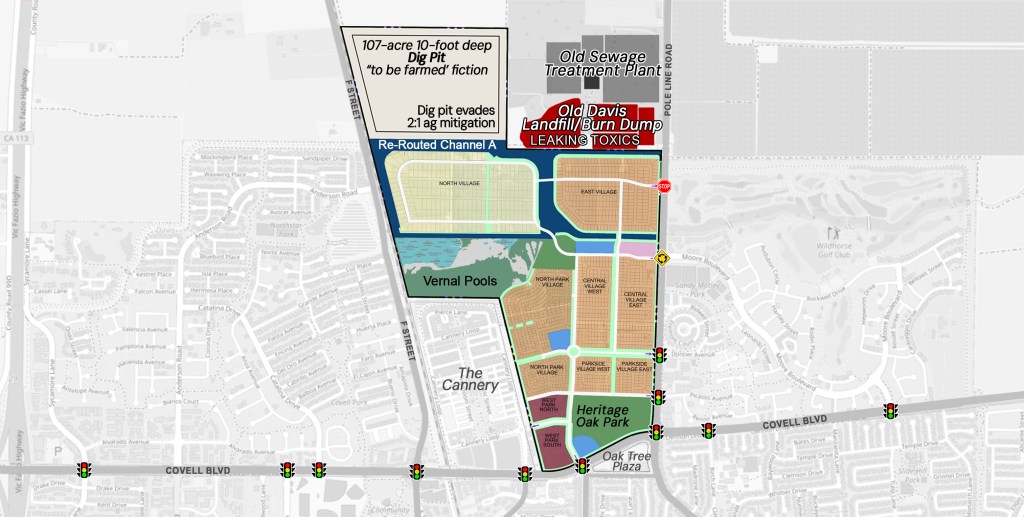
    First, Village Farms is contiguous with the City and I would label this site infill.  It is surrounded by The Cannery, F Street, Covell Blvd and Poleline Road.  While this land is farmland and has been planted under tomatoes, wheat, corn over the years.  It is surrounded by our community on three sides and is ideal for development.

    Second, the property that Village Farms sits on is in the sphere of influence created in 2008.  What is the Sphere of Influence?  “The legislature created the mechanism a “’sphere of influence’ (SOI) as a means for planning of probable physical boundaries and service areas within a local agency…SOIs are designed to both proactively guide and respond to the need for the extension of infrastructure and delivery of municipal services to areas of emerging growth and development.”  Village Farms (formerly Covell Village) is largely within the City’s SOI.  This means we as a community, former Councils as well as City Staff, have thought for decades about the areas of future growth and this is one of them.

    (more…)
  • Davis Deprives Younger Adults of Longterm Housing: Population Demographics

    by Hiram Jackson

    Introduction

    Davis has followed a policy of restrictive growth since 2000 when Measure J passed, which allowed city voters to approve of new projects on the margins of the city.  Since then, Breton Woods, designed for older (55+ years) residents, and the Nishi project, designed for UC Davis students, both passed in 2018. 

    Apart from that, every other proposed project, which notably would have been available for younger adults less than age 54, has been rejected.  This quarter century drought on peripheral developments for younger adults has consequences in our current demographic makeup.

    City of Davis census data show a local declining young adult population

    From 2000 to 2020 U.S. Census data show that Davis grew from about 60,000 to 66,000, an annualized growth rate of about 0.5%.  Within that time the population of 20- to 29-year-olds, which includes mostly UC Davis students, grew by about 2500.  The population of Davis adults aged 50 and older grew by 8,000, reflecting good health and the desirability of our community.  Meanwhile, the number of young adults aged 30 to 49 has shrunk by 2,000 during the same period (See Census chart). 

    Figure 1 – City of Davis Population – 2000 v. 2020 U.S. Census

    This last age cohort, specifically, includes parents who are likely to enroll students in the local public schools.   Based on the 2020 U.S. census, the 30 to 49 age cohort is proportionally larger, statewide and nationally, than either the Baby Boomer or older Gen X population, demonstrating that the Davis decrease is anomalous in not accommodating this age cohort.

    (more…)
  • The ballot arguments in favor of Village Farms are extremely misleading about affordable-by-design housing

    Arguably, they are downright deceptive

    By Roberta Millstein

    In a previous article, I explained how it is only the Baseline Features of a project that are guaranteed to be built.  I further explained that the Affordable Housing that Village Farms claims to provide is not part of the Baseline Features, i.e., the features that we will vote on as part of Measure V — it seems to be, but then by referring to the Development Agreement where it says only that the City “may elect to request Developer to construct the units” (emphasis added), it becomes clear that there is no guarantee of Affordable Housing at all. (Please refer back to that article for details).

    In this article, I will explain that the “commitments” to affordable-by-design housing that proponents tout in their ballot arguments and elsewhere are similarly ephemeral.  Voters should be aware that the project may not include much affordable-by-design housing at all.

    First, let’s clarify.  In California, capital ‘A’ Affordable Housing has a specific legal definition, with classifications based on income as a percentage of Area Median Income (AMI).  In order to qualify to occupy an Affordable Housing unit, one has to fall into the requisite income class.

    But “lower case ‘a’”, affordable-by-design (also called “missing middle”) housing has no such income restrictions.  Anyone can purchase it, regardless of income.  However, as the name suggests, the point is that certain types of housing are likely to be less expensive, and thus more affordable: duplexes, triplexes, cottage courts, and multiplexes are examples.  They are still “market rate” — they will cost whatever the market will bear — but the hope is that they will be affordable to those who do not qualify for Affordable Housing but who do not earn enough money to purchase larger, single-family homes.

    So, what do the Village Farms proponents promise? 

    (more…)
  • Why I Now Support Village Farms Davis

    by Alan Pryor

    Introduction

    I have been a fairly consistent opponent of most peripheral development projects in Davis over the past decade. For instance, I was the Principal Officer, Treasurer, and Chair or Co-Chair of the No on Nishi 1 (Student Housing),  No on West Davis Active Adult Community (Senior Housing), and both the No on both DISC 1 and DISC 2 campaigns (primarily Commercial).

    All of those peripheral annexation measures failed except West Davis Active Adult Community. But none of these projects provided for family housing for modest income buyers. I think Davis desperately needs that type of family housing and I believe the Village Farms Davis project provides it so I support the Project.

    As a result, I recently both publicly endorsed the Yes on Measure V campaign and was a  co-signer of the Rebuttal to the Argument Against Measure V that will appear on the June ballot.

    Many folks that I had previously worked with opposing other projects have accused me of abandoning my slow-growth and/or environmental principles after hearing of my endorsement of Village Farms Davis or reading some of the articles I have published about various environmental aspects of the project. Some are saying it is inexplicable to them why I would make this seemingly sudden change in my views toward peripheral development and endorse this Project.

    Well, the reasons are actually pretty simple. I opposed past peripheral development projects because I did not feel any met all of the 3 primary criteria that I look at when considering supporting or opposing a project. And the reason I can now support Village Farms Davis is because I can now check-off each of the boxes for the same 3 criteria – 1) the Features of the Project itself, 2) the Location of the Project, and 3) the Quality of the Developers of the Project.

    Let me explain.

    (more…)
  • Letter: Why we need to talk about the word “may”

    Roberta, thanks for recently highlighting this huge legal loophole in the official language citizens will be voting on in Village Farms June ballot.

    “City “may” elect to request Developer (Village Farms) to construct the units”

    I asked Google AI for a description of the word “may”

    Google AI Overview
    “May” is a versatile modal verb used to express possibility/uncertainty (“It may rain”), grant or request permission (“May I leave?”), or express a polite wish (“May you be happy”). It signifies a ~50% chance of occurrence and acts as a more formal, slightly less certain alternative to “might” or “can”.
    Merriam-Webster

    It would appear that every lawyer can explain and defend the meaning of the word ‘may”. So clearly this housing may or may not be built. “May” has a very different meaning than “will” or “shall”.

    So rather than me saying , “I “may” not vote for the VF project, with “may” remaining in the language the citizens will be voting on I will “not” be voting for VF. The city council should not have approved “may” in the wording.

    David J Thompson

  • Let’s Talk Honestly About Village Farms Home Prices

    By Leslie Blevins

    There has been a lot of certainty lately about what homes at Village Farms will cost. Too much certainty compared to what the facts actually show.

    Project opponents continue repeating that every home in the development will “start at $740,000,” as if that number is locked in, guaranteed, and unavoidable. It isn’t.

    The $740,000 hypothetical figure being cited comes from a fiscal modeling assumption for a hypothetical average 1,740 sq ft home used in an economic analysis — not from a builder price sheet. The modeling assumption itself states that medium-density homes are projected at an AVERAGE sales price of $740,000 not starting sales price.

    But that number was used to estimate tax revenue. It was NOT a declaration of a minimum sales price. There is a big difference between a modeling input and a market reality.

    The truth is, we do not know what homes will cost in five to ten years when these units are actually built. Construction costs fluctuate. Interest rates change. The economy shifts. Lending standards evolve. Labor markets tighten and loosen. Anyone claiming certainty about 2029 home prices is speculating.

    (more…)
  • What are the guaranteed parts of the Village Farms project?

    Looking at Affordable Housing in particular

    By Roberta Millstein

    With the for and against ballot arguments for Village Farms and their rebuttals posted to the County’s website (as Measure V), and the campaigns starting to ramp up, I thought it was important to highlight what are technically known as the projects Baseline Features. These are available as part of the “Full Text of Measure V” on the County’s website, and I encourage Davisites to take a close look at them, but I wanted to point out a couple of things first.

    Most important to note is what it means to be a Baseline Feature. As the text of the Measure itself clarifies:

    Beyond the Baseline Project Features there are other additional requirements for the Project, including but not limited to, the mitigation measures set forth in the Village Farms EIR, and the Development Agreement that, while important to the Project, are not Baseline Project Features and may be modified with the approval of the City after the appropriate public process (emphasis added).

    Another way of saying this is to point out that only the Baseline Features are guaranteed parts of the project. Anything else can be changed with a vote of the City Council — and here one should keep in mind that membership of that future City Council could be somewhat or even substantially different from today’s City Council. Thus, anything that is not a Baseline Feature is not a guaranteed part of the project.

    And even then, it’s important to read the Baseline Features carefully, as some of us learned when Bretton Woods was able to jettison its promised memory care facility. Let me give an example that is tied to one touted feature of the project that is of great interest to many voters: Affordable Housing.

    The rebuttal to the argument against Measure V states that the project will have “360 units serving very low to moderate income households.” But is this true?

    (more…)
  • Rebuttals to for-and-against ballot arguments are now available

    Roberta Millstein

    In an earlier article, I posted the for and against arguments for the Village Farms project. The rebuttals to each of these arguments are now available on the County’s website, and I have pasted them below. Village Farms is subject to a Measure J/R/D vote of all Davis citizens and has been assigned as Measure V.

    Here is the rebuttal to the argument in favor of Village Farms that will appear on our ballots in June (the rebuttal to the argument against follows after that):

    (more…)
  • Ballot arguments for and against Village Farms now available

    By Roberta Millstein

    This post is to just let people know that the arguments for and against the Village Farms project are up on the County’s website. The rebuttals to the for and against arguments are due by March 3; I will post them at some point afterward. Village Farms is subject to a Measure J/R/D vote of all Davis citizens and has been assigned as Measure V.

    Here is the argument in favor of Village Farms, i.e., in favor of Measure V, that will appear on our ballots in June (the argument against follows after that):

    (more…)
  • Setting the Record Straight – Part 1

    Myths vs. Facts about Village Farms Davis

    by Alan Pryor

    I. INTRODUCTION

    Opponents of Village Farms Davis have made numerous misleading and/or outright false claims about the Project and its supposed adverse environmental impacts on Davis and its residents. Their allegations are made without almost no quantitative supporting data from independent, verifiable 3rd-party sources to support their claims. Unfortunately, these naysayers instead rely on speculation and innuendo to attempt to disparage and denigrate the proposed Project.

    This article is the first in a series that will present detailed information that factually refutes each of these untrue “myths” and false allegations made by project opponents . This first article summarizes the false claims and provides a brief summary response followed by a more in-depth discussion refuting some of the allegations that require additional information to refute them. Subsequent articles in the coming weeks will further address some of these false claims in much greater detail.

    (more…)