Davisite Banner. Left side the bicycle obelisk at 3rd and University. Right side the trellis at the entrance to the Arboretum.

Author: Tuvia ben Olam

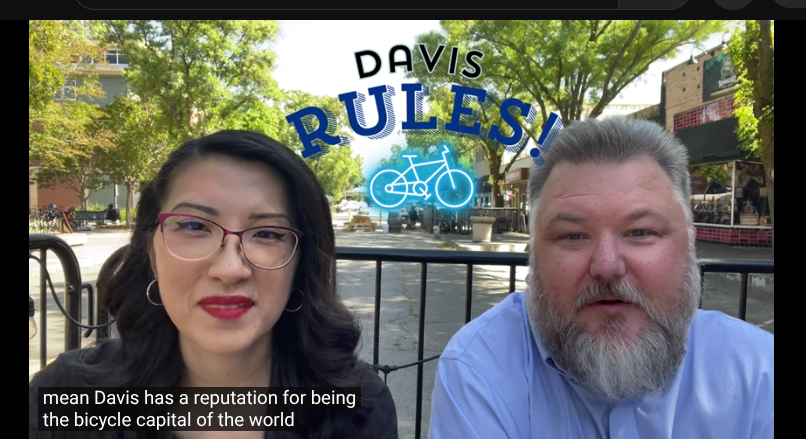
  • “… mean Davis has a reputation for being the bicycle capital of the world”

    Gas Station on 5th St

    From “What Do You Do”, the City of Davis Bubble Gum Channel

    ********

    The Transportation Commission is discussing the General Plan at their meeting starting late this afternoon.

    I am hoping that they, Staff and any Councilmember present focus on efficiency, joy, safety and sustainability rather than performative actions, feigned accountability, feigned powerlessness, being good soldiers and lying…

  • The General Plan won’t be a Genial Plan


    Screenshot 2025-07-30 8.22.55 PM"The goal is to manipulate

    Heavy hands to intimidate

    Snuff out the very idea of clarity

    Strangle your longing for truth and trust

    Choke wisdom sapience and prudence

    The war economy is inviolable violently

    Suppresses all intelligence that conflicts

    With the stakes of those who drive it."  - 

    From "Melodie is a Wound" by: Laetitia Sadier, Tim John Gane. Performed by Stereolab. Album: Instant Holograms On Metal Film. Released: 2025.  https://youtu.be/Nndpg90P2O8?

  • Fireworks Disaster in Yolo County? Cancel All 4th of July Fireworks in Yolo County!

    1000013809
    Late Tuesday evening (yesterday, July 1st) the following – minus the images – was sent to the Yolo County Board of Supervisors, the Davis City Council, Davis Fire, UCD Fir, Davis PD, Yolo County Sherriff, local and regional media, relevant Commissions and advisors, and individuals active in climate and climate equity… – TE

    "Hi, I don't want to take more of your time than necessary due to the ongoing situation.
     
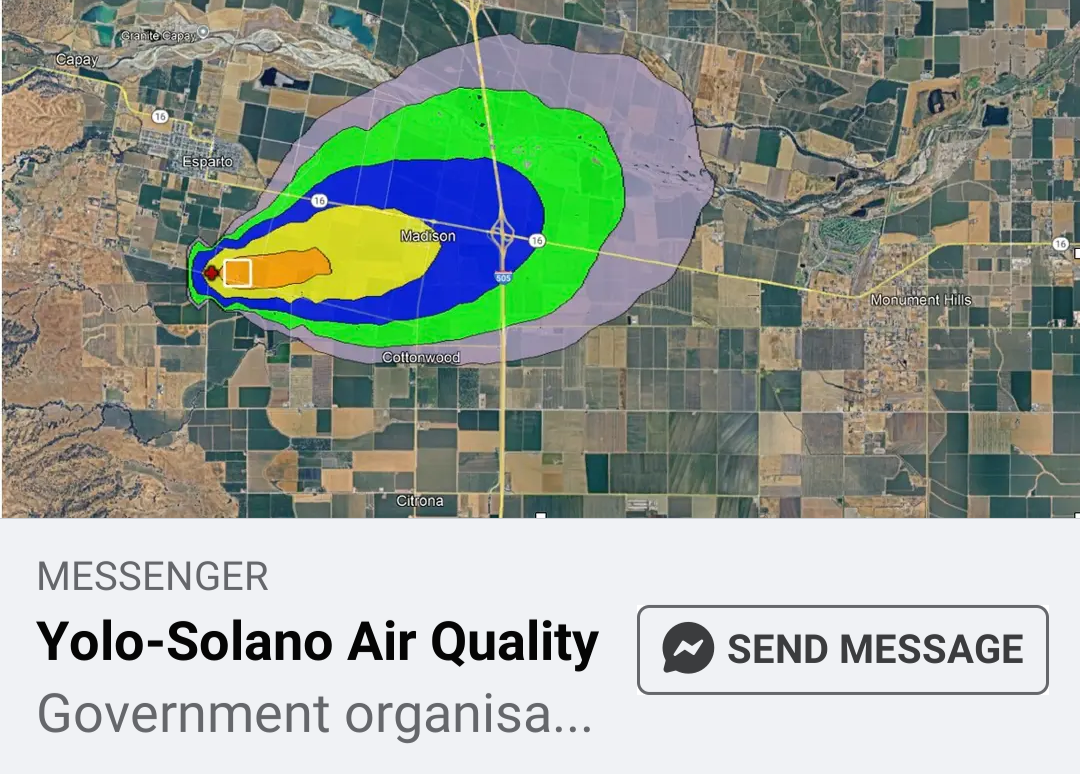
    People and property have been harmed. People have evacuated. First responders are taking risks – YSAQMD said that firework smoke is worse than wildfire smoke. First responders are and will be exhausted. 
     
    Do you think people who evacuated through toxic fireworks smoke will enjoy a show of toxic fireworks smoke?
     
    We already know the problems with fireworks shows: Danger to wild animals and pets, danger to people with PTSD. Pollution for everyone: The special colors in fireworks are not made of vegetable dye. 
     
    Screenshot 2025-07-02 8.51.34 AM
     
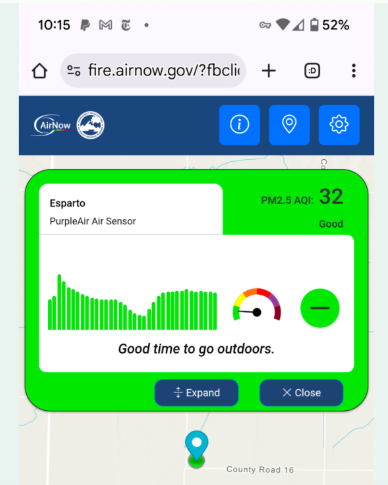
    We have an alternative going forward: Drone shows – such as at Celebrate Davis this year – or how about the money is used for true patriotism: I notice that Esparto has a single public Purple Air Monitor. (Compare this to Davis). What's the state of air equity in households there? Perhaps the money used to pollute can instead be used to clean the air of wildfire fallout and prescribed burns in households there.

    For now I call on all elected officials in Yolo County to immediately establish a complete ban of 4th of July fireworks shows in the County… and to not postpone them either! 

     
    Thank you,
    Todd Edelman,
    Davis
  • “Sitting-friendly” G St.

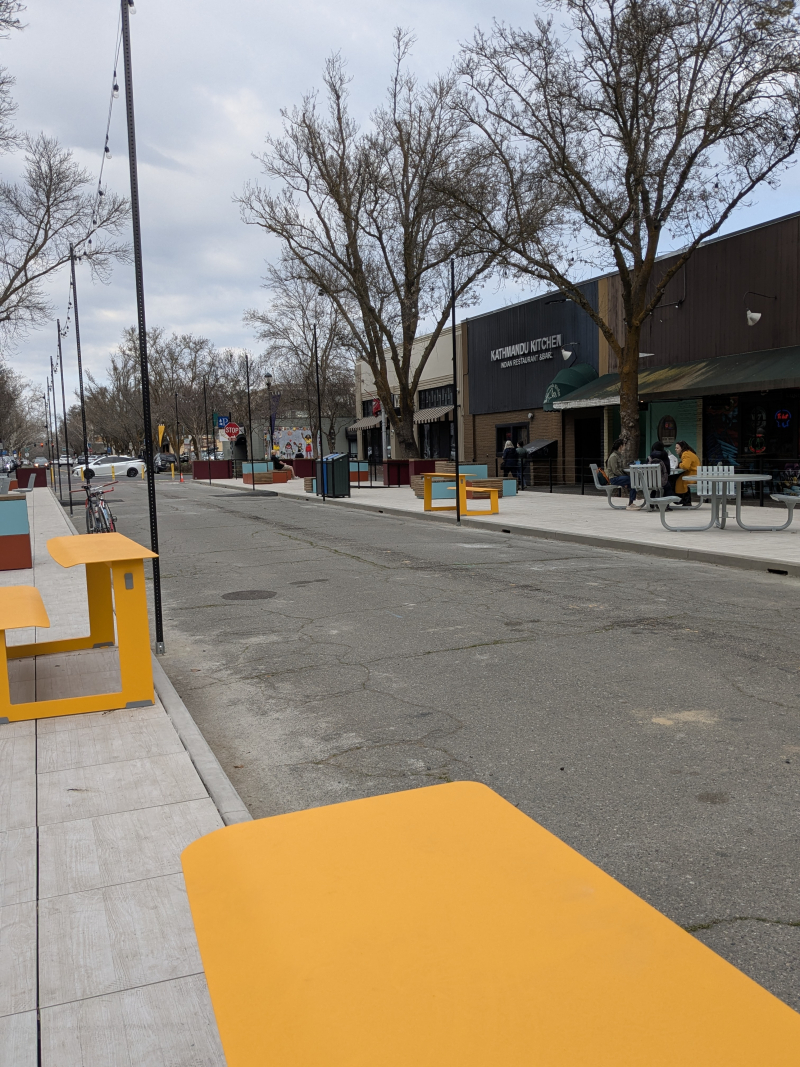
    PXL_20250125_214747637_exported_1737893470120Sitting-friendly does not mean the same thing as "Joy Priority, Expressed with Convivial Design".

    Join me on G Street…

    I'm not discussing here the fight to make it happen, the politicians who voted against it, the free car parking entitlement, and the process to get us to this point…

    I visited early on Saturday afternoon, January 25th, 2 days before the ribbon cutting..

    Please see photos with captions.  

    It's incomplete and it's not clear why they are doing an opening event at this time. But I will say that the only clear positive thing about it is that it's much quieter than the rest of Downtown at that time of day. At the time I compared it to the corner of 2nd St and E St, where one could barely hear the sound of a violin over all the engine noise. Nearly all of Downtown is like that, vibration pollution squashing any notion of genius loci.

    Unfortunately, a significant proportion or perhaps the majority of people will drive to get here.  The title of what I'm writing at you now refers to "bicycle-friendly", our City's delusional compliment about itself: It's designed for cars, but bikes are accepted in some places. 


    Comments:

    The varied types of seating seem to be well used, though demand is very low right now. 

    There's only two intentional ADA compliant seating spaces, in the typical 3/4 configuration, but it's not clear if people will be able to move to a free table if a space is needed and there's no space for a couple using wheelchairs, which may also be a oversight of ADA, but it reflects an ugly assumption. 

    The bicycle parking is reduced compared to the prior configuration and it's nearly all full now, which is a problem since there's hardly anybody here… Most of the bike parking is at the south end. There's nothing specifically for larger bikes such as cargo bikes or bikes with trailers.

    As I understand it, restaurants here will be able to rent spaces on the platforms and displace existing furniture and spots to sit in… If I have this correct, it means a lot less general public seating. This will create conflicts if the exclusive seating is empty and the public seating is full.

    The total number of proper seats at tables is well less than the number of Commissioners which were eliminated in the recent Purge led by the mayor. 

    Tables, for example, in Central Park allow groups of perhaps eight people to sit together. The tables here only allow four.

    The wood and cube formed feeding block things encourage climbing, which means that they'll be filthy very quickly and not very conducive to seating for many. Certainly, kids should not be discouraged from climbing, but there's not any climbing specific equipment here.

    There's no food available at windows on the sidewalks. There's a coffee shop and a tea place, but it's not clear if they or the restaurants etc. will platform-ize.

    There's a provision for sun shades only on the tables and it's not clear who will put these up and take them down everyday, or if they will be locked in place overnight during the summer… The other seating has no shading at all 

    It's not clear to me how the unshaded seating will perform when it's in the sun for hours during the summer. The platform material will likely create an issue.

    The existing street surface is incredibly ugly and actually forms a centerpiece for the whole thing. One of the videos at the link is 180° shot of the street street. From the perspective one of those yellow two-person one-sided tables. It's all ugly, asphalt and parked cars.

    The white colored pavers or whatever on the platforms show dirt really easily and will look like crap immediately. 

    Bright headlights from cars coming north from 2nd Street and turning left or right from southbound G Street at 3rd Street will all pierce the eyeballs of everyone sitting at both ends or actually most of the street. I had actually made a specific point about this to city staff months ago but got no reaction.

    There's an absurdly insufficient number of trash and recycling receptacles. 

    The vertical poles holding up the string lights are dark and may have insufficient contrast from the street etc. Especially at night. This might be an ADA oversight. Some high curbs were eliminated, which is positive.

    What's happening with the two empty store fronts?

    Thanks for reading!

  • City of Davis Prefers Chipotlanes to Bikelanes

    The east end of south Davis: No street refreshing for a "Farm fresh" business like Chipotle – and automobile dealers and other businesses here have been paying taxes for years, but to date not for any improvements to Chiles Rd and adjacent streets (Chiles Corridor).

    In addition to Chipotle, multiple projects have been completed or are in process on or near the Corridor over the past four years, while the City excuses itself  by requiring no mitigation fees or investment since there's no specific "project" to improve transportation conditions in the Corridor. 

    PXL_20240921_011306079.RAW-01.COVER

    Westbound Chiles just east of the site in question. Staff seemed to have interpreted my photo as a suggestion that sight lines could be problematic for people leaving Chipotle. My actual intention was to make clear how unsafe it is to cycle this way from the large neighborhood to the east…. explicitly parents telling e.g. younger teens perfectly capable of riding a bike that they can't go get their food. 

    Staff is recommending that the City of Davis Planning Commission – at their meeting on October 9th – approve the destruction of the building formerly used by Cindy's, following an earlier cancellation at their July meeting – so that the Historical Resources Management Commission could consider historical designation – and that Commission's vote against it on September 16.. The site would then be used by Chipotle Mexican Grill, for new building with its "Chipotlane" feature, a drive-thru – they call it a "pickup window" – designed to reduce idling by visiting motor vehicles. 

    If you have something to say on this matter which you would like to be considered by the Planning Commission, please write them by end of morning on Wednesday at planningcommission@cityofdavis.org, or – better yet – come to the meeting at 7pm at City Hall. 

    About the not-Historical part and Cindy's as an example of Googie architecture, I don't have a lot of professional experience, but a commenter at the mentioned meeting was a former HRM Commissioner (and current Yolo County Climate Action Commission member), Robin Datel. See the video starting at 16:15. Ms Datel commented that the Cindy's building represents a shift to suburban, automobile-focused planning, and that we lose something if it's destroyed.

    That continuing endeavor is murderous, but it's good to keep memories of horrors along the way, isn't it?  About interiors, I DO  like the traditional diner aesthetic…

    (By the way, the 'Enterprise article on that Commission meeting failed to mention that expert opposing comment.)

    The natural segue of, um, deconstruction here is that the Chipotlane is the next step in the "evolution" of automobile-centric planning, which Davis is increasingly known for! So, this 'pickup window" is at once the evolution and symbol of big car. 

    My precise position on this proposal is pragmatic: Leaving aside my justified criticism of car culture, while I think the best solution for I-80-focused businesses is some variant of the I-5-style multi-businesses that essentially form their own drive-thru, entrance and exit, for this location I question the absolute lack of any changes to the streetscape itself to make it safer for vulnerable users especially – but really, also people travelling by car. 

    Historical Designation Dismissed – Archaic Infrastructure Ignored

    It's widely known that the Davis automobile and RV dealerships and associated services – e.g. gas stations and car washes – on and adjacent to the long stretch of Chiles on both sides of Mace Blvd are one of if not the primary source of tax revenue for the City. But take a look at Chiles… what's been improved here since the whole area was first constructed, except perhaps some signal upgrades? It's so awful that it's logical to propose that the intensely old-school streetscape itself is worthy of historical designation!

    But fear not, the City is not interested in tearing it down! 

    The following from the Staff Report, starting on pg. 9. with my COMMENTS: 

    "Traffic Considerations

    Staff acknowledges that conversations regarding traffic operations along Chiles Road have taken place. Staff considered several alternatives to the proposed project, such as restricting turning movements at the project driveway, especially the eastbound left turn into the driveway. Staff felt that without a viable U-turn opportunity on Chiles to the west [do they actually mean "east"???], restricting turning movements at the driveway would increase cut-through traffic along Cowell Boulevard and El Cemonte Avenue, as this would be the shortest path of travel for automobiles. This route is not desirable since this portion of Cowell Boulevard is a residential neighborhood as well as a suggested safe route to school.

    BUT also there's a huge residential neighborhood to the east and the most direct connection to Chipotle is via these streets. The alternative via Cowell requires a trip through the Mace and Chiles intersection, and back through the same. 

    Additionally, there have been discussions about existing issues related to traffic on Chiles Road, such as existing congestion at the intersection of Chiles Road and Mace Boulevard and truck parking along Chiles Road near the project location. In this case, these issues are existing deficiencies. The City is not allowed to condition improvements on a private development project to address existing issues. If there were an identified project to address them, then the City could look at assessing a proportional share of the cost of that solution for the new traffic that would be created by this project; however, in this case, there is no such project in place.

    WHY is there "… no such project…" here? During the past three or four years to the present day the following six varied projects were completed or in development, on the Corridor:

    • 400 Mace Blvd: 7-11 & gas station re-construction (2020/21);
    • 3820 Chiles Road (The Celeste Apartments, opened early 2023)
    • Mace Blvd (South of Cowell; Re-design (2023 final version);
    • 4480 Chiles: ARCO/AM-PM (2022 status: Approved and Pending/Under Construction)
    • 4810 Chiles: Chiles Road Plaza (2022 status: Approved and Pending/Under Construction)
    • 480 Mace (Sunny's Carwash, opened spring 2024

    All of the development projects in the list have related transportation studies. The one done for 4810 Chiles – across the street from the proposed Chiptole – by Fehr & Peers – essentially the City's in-house external transportation experts – recommends features for Chiles to restrict turns and notes the hazards caused by the slip lane from NB Mace to EB Chiles. The study was done before Cindy's closed and likely before it was envisioned that it would, and that this possible variation of the restaurant model would be introduced. 

    Screenshot 2024-10-08 11.16.36 AM

    The Chiles Corridor: The Celeste is just west of Esmeralda Drive and the proposed Chipotle is next to – and to the east of – Taco Bell. Click on image to enlarge. (Sorry about formatting glitch)

    The Chipotle analysis, for its part, consists of pasted in projections about the Chipotlane from the applicant and references staff and external input – included in the appendices of the Staff Report. 

    However, the project – again, consisting in part of a transportation feature wholly new to Davis – was not brought to the Bicycling, Transportation and Street Safety Commission (BTSSC) prior to the cancelled July 2024 Planning Commission meeting, and the successor Transportation Commission (TC) did not see the project prior to the Planning Commission review this week. Fun Fact: Out of all the projects I mentioned above, only what came to be known as the Celeste was reviewed by the BTSSC (back in 2019 or so). The BTSSC/TC didn't see anything else, and so had no opportunity to, for example, suggest the Chiles Corridor needed the elusive "project". (I wrote the TC several times about this, including a link to these photos/videos. The only reaction was in September 2024: One Commission member suggesting a look into drive-thru's at a future meeting.) However, Chiles Road from the east frontage of the Celeste to the EB exit from I-80 will be part of the Cool Pavements project, so there will be new asphalt and universally-agreed-as-inadequate paint-only bike lanes just as there is all the way to the Cowell-Drummond-Chiles roundabout  (The project – and of course funding application to the Federal government – mentioned "progressive striping standards" which haven't been updated for eight years.) 

    PXL_20240728_010343990.RAW-01.COVER (1)

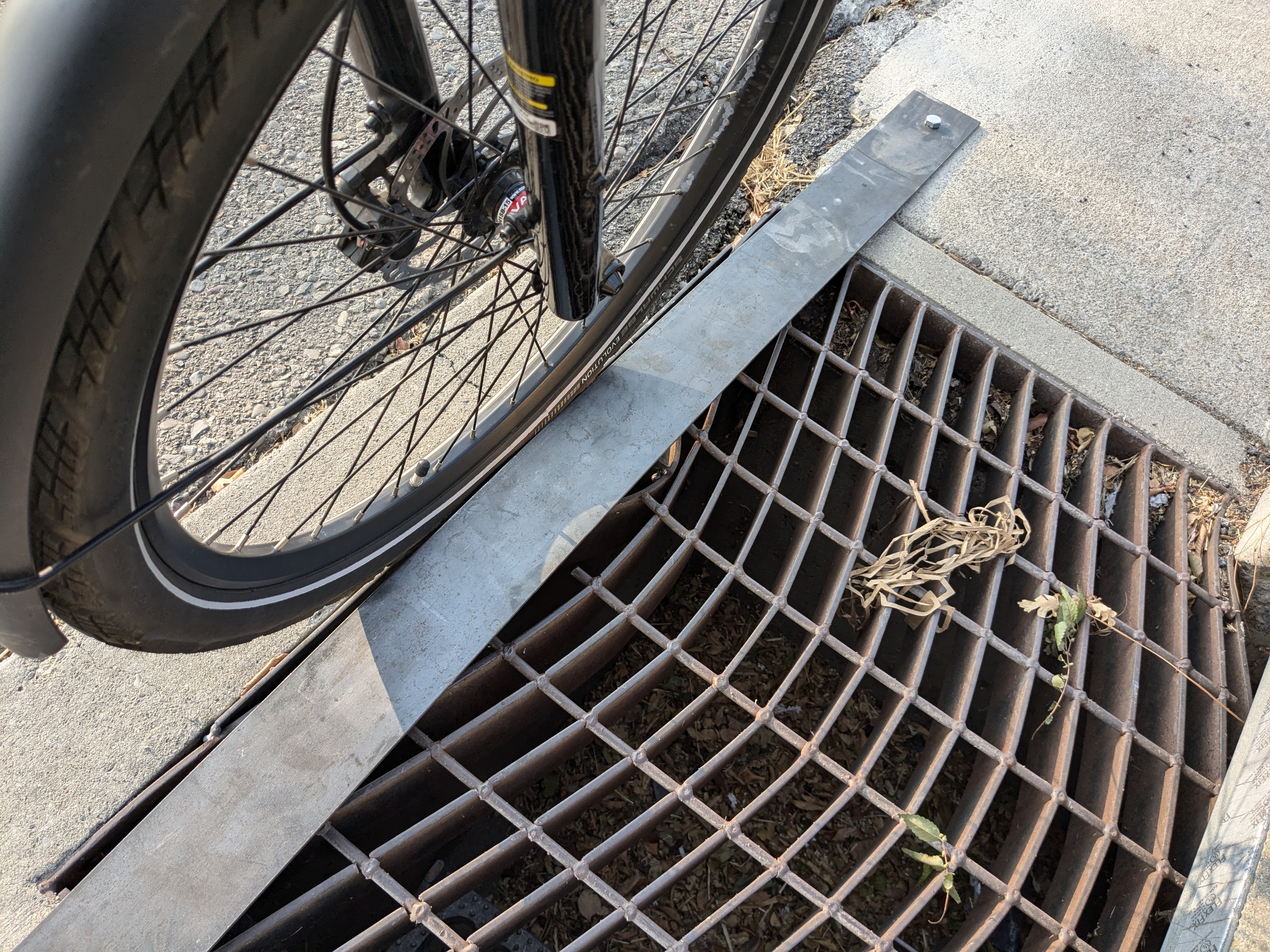
    Mace Blvd NB, about 1/3 of the way between the WB I-80 exit and 2nd St. This is the apparently acceptable solution from the City for a damaged drain grate that could literally grab a bicycle wheel. It took two months after my report for the City to bring it to this state. From a collection of related photos. 


    From the "Conditional Use Permit" section of the Staff Report, starting at the bottom of pg 3, again with my COMMENTS (starting in BOLD):

    "The proposed demolition and reconstruction project would continue the long-standing use of the site as a restaurant the with addition of a pick-up lane. The project site is located on a major collector street in proximity to freeway off ramps, and is well suited to serve travelers along I-80 and visitors to the nearby auto dealers. The restaurant also provides a convenience for the community as a whole with proximity to the businesses and recreation facilities east of the City limits and residents in the South Davis vicinity, where there are limited restaurant choices, and will be the first “pick-up” lane in Davis.

    ANOTHER "long-standing use" of this area is Mace Blvd as the most direct connection from El Macero, El Macero Estates and adjacent neighborhoods to the east end of Mace Ranch, including – most notably Target and its CVS pharmacy – there is currently no other pharmacy in the area, the closest might be at Safeway on Pole Line in the near future – the Ikeda fruit stand, University Covenant Church, the new businesses on Alhambra and Mace, etc.  (For me it forms part of the most direct route by bike to Sutter Davis on West Covell.) This "connection" has to be for all modes, and safely.  The sewer grate fix in the photo above is objectively, trash, and should have never been approved. It would not be tolerated in most other parts of Davis. "Recreation facilities east…" refers to the soccer fields, which have exactly zero safe official connections by bike – it's possible when dry to access from the east end of Cowell Blvd, but that's at least partly on private land. (It's a good candidate for an official cycling and walking corridor, but – as with Nugget Fields – cycling to soccer in Davis is overwhelmingly an alien activity.)  In other words, the convenience of people driving is paramount here, including those getting off and back on I-80 .


    SAFE cycling (and walking) for kids vs. Gig-driver Delivery

    Chipotle will have some bike racks and such, but given the described non-plan of Davis to make the areas safe for its peripheral #cycling capital activity, the racks will likely remain empty. If I lived east of here, I'd be nervous to allow any children to go by foot to Chipotle, i.e. to cross Chiles either east or west of Chipotle I would simply use Door Dash. 

    An expert friend remarked:

    “It is the opposite of progressive to purposefully avoid looking for ways to improve the existing infrastructure only because it has been determined that the new project isn’t expected to negatively impact the current, inappropriate, outdated infrastructure… '*IF* there is an issue with trucks….'  There is no if."

    I would assume that Chipotle would not want to be tainted by an "accident" (collision!) involving a child cycling to the new restaurant. But clearly they're not volunteering to go beyond any minimum requirements, and neither is Staff (and apparently not interested in that "project" ) and so let's see if the Planning Commission (and Council)  will intervene!

    Recommendations: 

    1) Cancel item for Planning Commission meeting on October 9th.

    2) Create a new item for the Transportation Commission, specifically a process for a project focusing on efficiency, joy and safety for the Chiles Corridor… ideally forming a sub-committee process inclusive of one or more public hearings, or at least implementing features recommended for 4810 Chiles, and also possibly involving the Fiscal Commission (in relation to e.g. the Chiles Corridor business tax disconnect with Chiles Corridor improvements) and the Climate and Environmental Justice Commission (in relation to climate goals and transportation equity in the Corridor).


  • Dangerous Bike Lanes: Automobile Normativity Breeds Neglect (Part 1 of 3)


    PXL_20240815_190057157.RAW-01.COVER

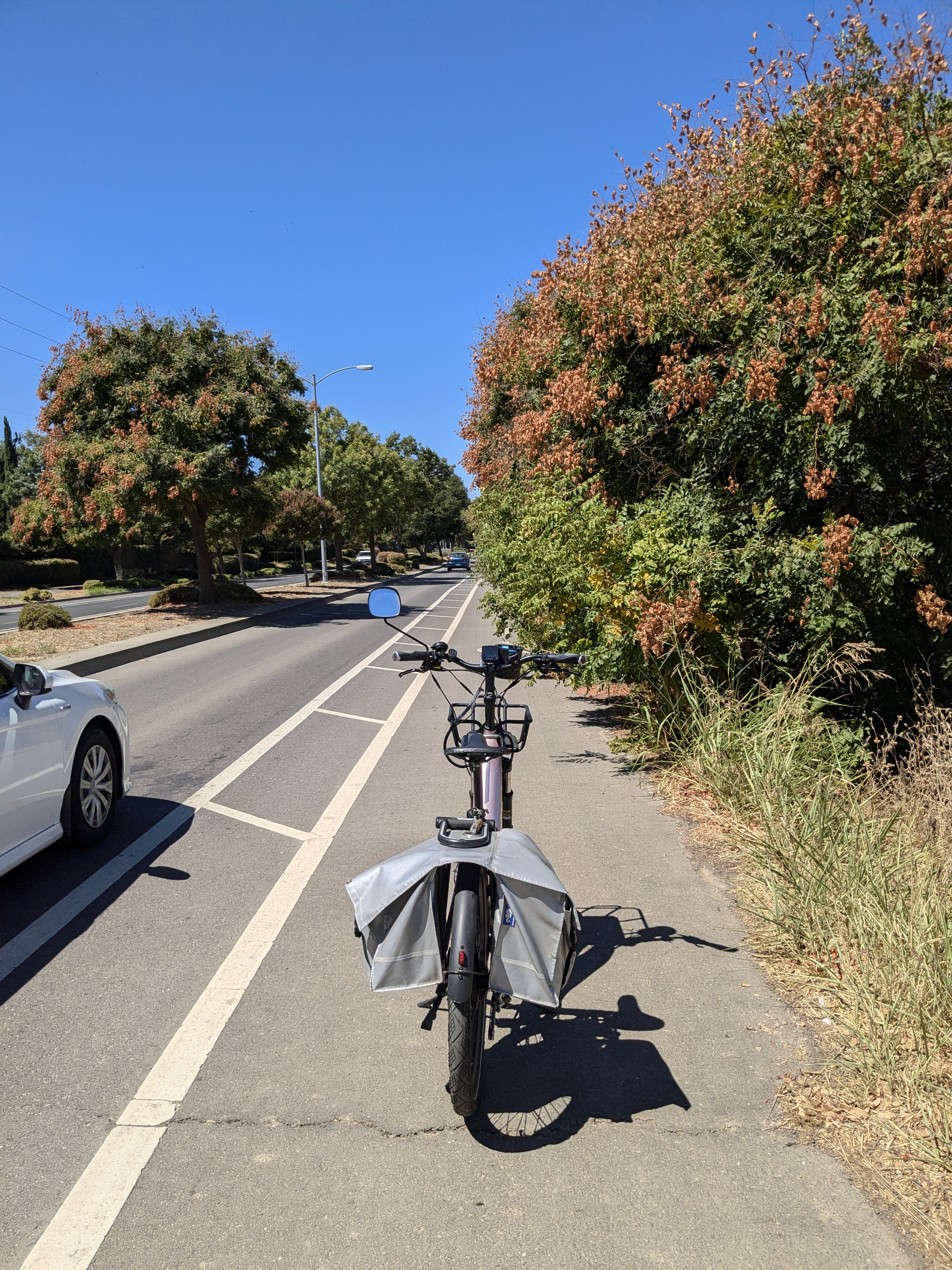
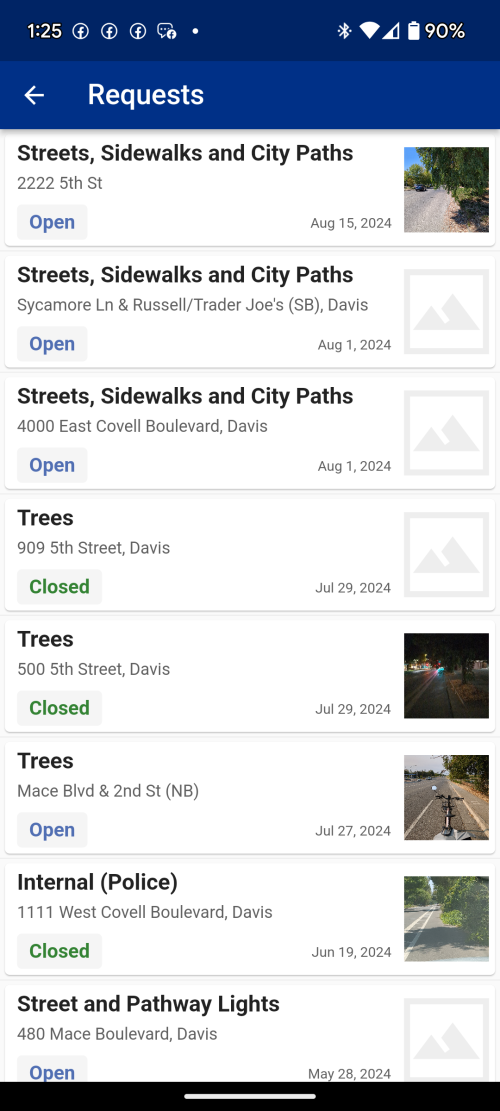
    East Covell, Westbound, between the Mace Curve and Alhambra. See Video. Reported on 8/1/2024. Based on my understanding of how My Davis Requests are processed, this has not even been evaluated at time of writing. 

    Davis, CA -  I've been riding a bike in cities for most of my adult life – that's forty years. As an example for others I don't often say that something feels safe; but when I feel a situation is dangerous it's a more valid perspective to share. 

    For the last six weeks or so I've had to travel two times a week from my home near Mace and Cowell to Sutter Davis. The fastest way there by car is via 80 and 113; by bicycle it's Mace to East and then West Covell.  I have an e-bike, and it takes about 23 minutes, a bit longer if I don't make the lights, and longer still if I have to slow or even stop to avoid hitting overgrowth of trees and bushes into the bike lane, and slower if I have to stop to let vehicles pass when the overgrowth extends all the way to the edge of the traffic lane. 

    "In some situations when the tree concern appears to be an immediate safety hazard [emphasis mine] the Street division will respond and put up barricades or traffic control to block off the area until tree work can be done. When the Urban Forestry division assesses the tree they determine the urgency of the concern and who the work will be assigned to. They also consider if the tree is the City’s responsibility to maintain. If a tree is blocking the public right of way per the clearance standards for that specific area they will assign pruning of the tree to meet clearance standards for the roadway, bike lane, sidewalk or path. Prune may be done but City Urban Forestry staff or by our contract arborist, currently West Coast Arborist. Work is completed based on the priority assessment conducted by one of the City’s Certified Arborist. If you have any additional questions please contact us …" – from a response to an earlier complaint. 

    How in this cornhole-tomato industrial apocalypse is the situation in the photo above  not an "immediate hazard"? As of time of writing,  along the westbound (WB) route between Mace and Sutter Davis, there are just over 30 bushes and trees which are "overgrowth" – the City's term – in the bike lane. Some require a diversion into the buffer (which is not a passing lane, and only part of this route has painted buffers), some require a diversion into the traffic lane,  some require ducking under possibly sharp branch ends (ironically, the by-product of earlier trimming….). 

    Along this route I first reported overgrowth on the NB Mace Blvd overpass on July 27.  It's still there, requiring a quick maneuver to avoid this punji stick, but – watch out! – not so far into the traffic lane! 

    What's curious is that "Closed" seems to only mean that the problem is solved in regards to potholes (and similar). "Closed" in relation to overgrowth on city property such as Covell indicates that the issue has been forwarded to the City's trees department, and with private property it means it went to the police for code enforcement.  I have mentioned this and suggested that "Closed" should only be used if the issue is resolved (or fixed, etc) or some kind of interim category should be created to show it's in process. While non-anonymous issue filers receive updates via email, it would be better if everything was more clear in the My Davis App. 

    So… a real question is what's a realistic timeframe for the City to respond to what is objectively an "immediate hazard"? BUT the better real question is:

    Would this be tolerated in [motor vehicle] traffic lanes for weeks at a time?

    What would people who drive motor vehicles do if their daily route required diversions, stopping, making sure a big truck wasn't going to ram into them, multiple times a week on the way to work or an errand?

    The answer is simple: The city would clear it immediately, or with a bit of delay during an exceptional weather event. They would clear the traffic lane or lanes. This is how it works here, and my personal experience for the last seven years I've lived here. 

    The roughly similar – but roughly more seasonal issue – is yard waste in bike lanes. It's explicitly completely illegal under city rules; "overgrowth" is not. Both are equally dangerous. 

    Reviewing City Hall minutes from ten years ago… many things regarding yard waste in bike lanes were promised. When I was on the BTSSC (RIP) – actually the night that Officer Natalie Corona (RIP) was killed  – the Commission supported my wording of a recommendation to City Council to improve things. (It's perhaps worth noting that the immediate sequence of events that resulted in a person with serious behavioral health issues killing Officer Corona started with a vehicle crash on 5th St – things like that with cars are seen as normal, and are forgotten). The Council watered it down and nothing improved, or changed (with the exception of a few signs in certain areas simply referring to the existing regulation.) 

    I have very little hope that the Council, Staff and relevant Commissions will do anything about it. Case in point: School starts today! Did DJUSD work with the City in the last weeks  to ensure that our City's safe routes to school (SRTS).. are safe? Beyond my ride to Sutter Davis I can say that they have not. There's lateral pot holes and overgrowth all over. 

    Measure Q?  It makes general promises about improvements, but why would Davis change now and target the needs of the most vulnerable road users? It's never been the priority: The City chronically builds infrastructure that's not compliant with the 2016 Street Standards  — while simultaneously referring to then as "progressive" when it is going forward on a street project. The BTSSC was never consulted about the ongoing 10-year pavement plan nor the overlapping Cool Pavements project. 

    The City's not making it feel safe for me to get around… my sense is that those who are younger or have less experience with bicycles simply don't consider the fastest routes if they feel unsafe on them. Do people who normally drive not take certain routes in town because they feel dangerous?

    *****

    In the following additional examples, there is also the before and after of a sewer grate on the Mace overpass damaged to the level where one could stand a bike up in it, and its "fix", a few months after being reported. Some fine craftsmanship, there!

    There's also a screenshot from the City's "What Do you Do?" video series of very light and uncritical portraits of city staff and their job duties. Why wasn't this slip up about "world" never corrected? 

    Additional photography and video from the Mace overpass on NB Mace to E. Covell just west of Pole Line.

    *****

    Parts 2 and 3 coming soon: 

    Part 2: What the City plans to do about yard waste and other materials in bike lanes – a ridiculous new tool. 

    Part 3: What the City should be doing (and why success of Measure Q might not help very much.)

    *****

    What can you do now? 

    * Write the Transportation Commission (copying to City Council, new Active Transportation Coordinator Sereena Rai and the City's tree department):  tc@cityofdavis org, citycouncilmembers@cityofdavis.org, srai@cityofdavis.org,citytrees@cityofdavis.org.

    * Ask the League of American Bicyclists if Davis deserves its "Platinum Bike Friendly" rating: bfa@bikeleague.org (there is not an application currently under review — this is just a cheeky way to get this corrosive garbage on their radar.)

    * Ask the Board of the Davis Joint Unified School District if the situation is safe for students, and if they got the City to check for obstructions – including potholes – on safe routes to schools in Davis before the first of day of class today: boe@djusd.net.

  • Dangerous Depot

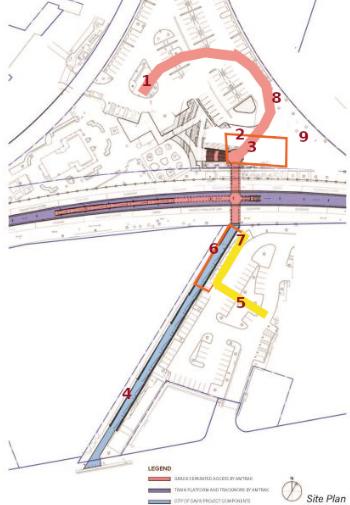
    Depot1

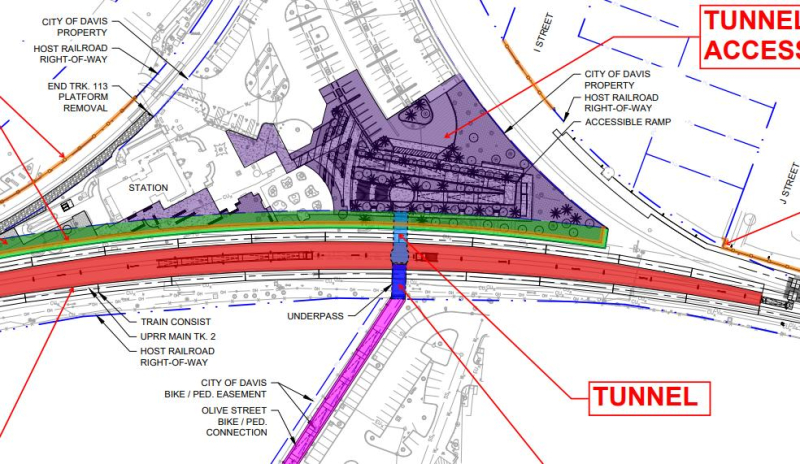
    The 30% Design (excerpt)


    Necessary ADA improvements at Davis Train Station are complicated by toxic over-promise of shared infrastructure.

    Facilities essential to support modern train-bike multi-modal travel a vague promise.

    City Council plans to sign an MOU with Amtrak at their meeting today; a update of the “30% design” for station modifications will also be presented. 

    Starting in around 2012 the City of Davis – in cooperation or partnership with Amtrak and Capitol Corridor – began to attempt improvements for multi-modal access to the Southern Pacific Railway Depot, aka. Davis Depot, Davis Amtrak etc. In 2018-2020 this continued with an outreach program to determine desires and consider possibilities. (There are some bad links there, here is the Final Study). In subsequent years and through the present day Amtrak and Union Pacific made the City aware of a national program to ensure that Amtrak stations are ADA-compliant.

    I fully support the Americans with Disabilities Act (ADA) and related ideas in mobility equity, and have actively done so for a long time. I applied the general principles to a train station optimization concept I worked on when I lived in Prague nearly 20 years ago, and – back in the USA in the past ten years for a water shuttle in the Estuary between Alameda and Oakland, and in Davis in regards to continued lack of a sidewalk from Old East Davis east of L and more acutely as an overgrown lot forced people to walk on 2nd Street. 


    Depot1a

    Unfortunately, however, the absolutely late and totally necessary ADA improvements also planned for Davis Depot, while ostensibly improving the lot for people with mobility challenges will likely create not continual yet repeating complications for these users and people who use bikes or walk.

    And it’s all completely unnecessary. 

    While safe infrastructure for everyone moving not by private vehicle is a necessary entitlement, there’s only a Federal law for people with mobility challenges, not – yet – for people riding bikes. So while I will focus on what I now am coining as TOPoS – toxic over-promise of shared infrastructure – I will also highlight the lowlights of barely vaguely planned bicycle facilities at the train station. 


    TOPoS

    One doesn’t have to spend a long time on NextDoor forums focused on Davis to see a most often justified call for people to “slow down on Greenbelts” when riding bikes, and especially e-bikes and e-scooters. It’s anti-social when people do this, but what do we expect? Enforcement will never solve this, and technology fixes such as used on parts of UCD campus for shared micromobility devices don’t work with private micromobility devices, and may not for a very long time. The Greenbelt paths are in many parts of town the only active transportation (and dog walking etc.) corridors free from motor vehicles. While it’s an advantage that some go above or below arterial streets, I believe the actual physical and sound distance from motor vehicles that’s the biggest plus. Bike lanes do not provide this, slip lanes (free right turns) are especially good at encouraging people to take Greenbelt paths… to the detriment of other users.

    I formally considered that the Greenbelt paths are underbuilt – i.e. too narrow, in too many cases with unnecessary bollards at egress points to the street grid and some bad sightlines, too – but increasing width where possible may only serve to increase the velocity of users. 

    Please note that many are called “bike paths” when – technically-speaking – they are multi-use paths. More on that in a moment….

    Our current Class II bike lanes on most arteries are often not enough for side-by-side riding, an insult and more when many arteries have two lanes in the same direction.

    What’s necessary is protected bike lanes – cycleways – on major arterial streets, optimized for the two general cruising speeds of their users – slower bikes and some e-scooters & faster bikes and e-bikes and some e-scooters… approximately 13 mph and 20-23 mph. They need to be wide enough to permit someone a faster device to pass two riding side-by-side going slower. That’s a necessary way to get more people to cycle in Davis and do it safety. This won’t happen if we ask people on e-bikes that travel at 20 mph without much effort to be nice, etc, or some “bike lanes for everyone” campaign. 

    So, how does TOPoS relate to ADA-compliance at Davis Depot?

    Well, we’re not at the train station just yet….


    Depot2

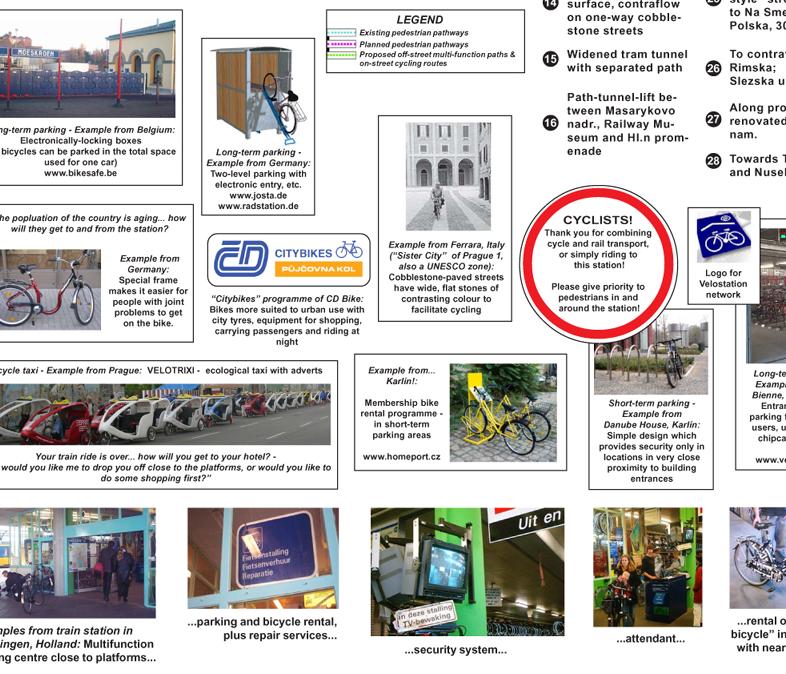
    From my 2007 Concept for Prague's Main Train Station


    The Davis Wall 

    While developers etc name many things (proposed) in Davis somewhat to fully-fictionally – e.g. “Village Farms” – not village and ex-farms, Oaktree Plaza – removed oak trees – “Village Homes” – sorry to go anti-sacred cow but where’s the cobbler?,  “Palomino Place”  – lack of horses, you know, like Wildhorse, ‘North Davis Creek” – like it as a wild feature but not as a development, whose creators seem to have created that name… what about the huge barrier to cycling and mobility device use running east-west across the lower third of Davis?

    Every existing grade-separated crossing of I-80 and/or the railroad tracks has approximately an 6.5% to 8%. The exception is the section of  the Putah Creek Parkway multi-user path going under the train tracks and up to the Arboretum.. The section going up from under I-80 to Research Park Drive is steep too, but fortunately short.

    The new section of the multi-user path that’s part of the 80-Richards interchange project and which goes under its new ramps will have a 4.2% gradient. This is a standard design practice for multi-use paths, though some go to 5%. To be ADA-compliant everything above 5% needs railings and repeating short sections of max 2% gradient.  Thus, the existing over-crossings on Pole Line and even the Dave Pelz bridge are not compliant. The new over-crossing of SR-113 in Woodland is 5% or less

    The planned campus side of the Promenade over-crossing will be 4.2%, but the project side – the City side – will be 8%.  

    Why 8%? Because there’s apparently no space for a longer route on the project side. Why 8%? Because the full City Council brought what was then generally known as “Nishi 2.0” forward to a citywide vote without an agreement with Union Pacific that there would be an undercrossing (that would be under 5%). Why 8%? Because pro-Nishi 2.0 materials showed a visual of an undercrossing, whereas the actual text of the development agreement said “grade-separated crossing”. It was a con-job, and so sloppy and apparently embarrassing that it was not officially-revealed by the City until May 2023 that Union Pacific officially-rejected the undercrossing proposal that the developer and partners made in the fall of 2018, a few months after the Nishi 2.0 vote. The gradient is so unusable that City staff agreed months ago that likely nearly everyone traveling by foot, mobility device or bike from Promenade towards campus (and Downtown) will use the existing under-crossing mentioned above on the Putah Creek Parkway. (A proposed mitigation of the I-80 “Improvement Project” is a widening of the multi-user path along the Downtown side of the Arboretum, but the undercrossing (tunnel) will not be widened, so it will remain a pinch point.) 

    The 'Davis Wall" is nor necessarily above-grade. It's a barrier caused by both infrastructure and institutions. Minor walls in Davis could also include the H St "Bike Tunnel" towards F St, or a lack of active transportation crossings of SR-113 – even though they are at-grade and level – or even the noise produced by all road infrastructure


    Are we almost at the train station?

    Going back around ten years, the City performed an audit and outreach process related to walking and cycling access to schools in the City. Amongst other things, it correctly and wisely revealed that children living on East Olive Drive had a huge barrier to get to Montgomery Elementary, closest as the bird flies (and to other schools such as Peregrine or in East Davis, etc).

    The solution was a ramp from the east end of Olive Drive to Pole Line, thus forming an aggregate multi-path towards Montgomery heading down and under Pole Line, under Cowell Blvd, past Playfields Park, etc.

    The ramp had to get up to Pole Line BUT also leave room for the Olive Drive off-ramp from WB I-80 to remain open. To be clear, the latter was not stated at the time, not when it was finally decided by Caltrans to close the exit – though it’s not yet structurally-closed: This may be an innocent contingency in case there’s a complication in construction of 80-Richards, or Caltrans may decide to change its mind.

    The resulting ramp is ADA-compliant, no more than 8%. As mentioned above, everything else in the region and beyond – I scoured recent, relevant recipient designs from the Active Transportation Program, a Federally-funded program administered by the State of California and provider of most of the funding for the Olive-Pole Line connector – is 5% or less. 

    From my unfortunately non-conclusive research on the issue, I provisionally-conclude that it was never, ever the intention of ADA to result in 8% ramps that are about 400 long and shared with people on bikes. The gradient and length creates multiple issues:

    • It’s difficult to control speed whilst heading down on a bike, and above 12 mph or so the ADA-required undulations cause a bike and its human to nearly jump. 
    • The relative lack of width combined with mentioned speed doing down makes collisions between users going in opposite directions a possibility.
    • The gradient makes it difficult for people on non-e-bikes to travel up; this is made worse by the undulations which make it hard to get any kind of rhythm IF one can muster the strength and stamina. 

    It’s not really good for anyone except for people on e-bikes, and more or less impossible for e.g. parents taking children to school with non-electric cargo bikes. This is the epitome of non-equitable infrastructure, especially in a “family”, “bike” etc etc. Davis. 

    (Why did this happen? I will take part of the blame, as I was on the Bicycling, Transportation and Street Safety Commission at the time. But I am not a licensed etc. traffic engineer. The licensed etc. traffic engineering firm that designed it didn’t say a thing… the licensed etc traffic engineer for the City of Davis… didn’t exist at the time. There was no senior-level traffic engineer in Davis from 2017 until 2022.  I also think that the funder should have noticed these technical issues, and returned the grant application for revisions.)

    Please think about these issues when you observe people using the Connector – How many people get off their bikes to go up? How many are actually using it at all?


    Station Access from Olive

    It’s worth noting that the approval for what was then called Lincoln40 and is now Ryder Apartments included both a below-Street Standards width for the newly-built sidewalk on the project side of Olive as well as a hard “no” to bring the bike lane up to the Street Standards minimum, and the same for the bike lane on the south side of the street. This would have resulted in less land for the Apartments. 

    (As part of the promised closure of the on-ramp, there’s been some vague promise of a shared street concept for Olive. It’s also worth noting that the bike lane-ish space on most of the EB side, east of In & Out has cars parked in it. Staff has refused to change it and the police have not enforced a thing).

    The easement on the west end of Ryder – is it too short to allow for a 5% grade from the sidewalk at Olive Dr to the underpassage? It’s not clear: The 30% seems to show a path that’s two-thirds 8% grade closer to the station and then level in its remaining third to Olive. The original concept back during the Lincoln40 approval process had some kind of corkscrew-based overcrossing. A better approach – well, from Pole Line – would have been a long ramp with a mild gradient situated in what’s now the back of the Ryder property, circling to the undercrossing. Sigh. I think a good traffic engineer could have identified it as a partial solution. 


    OK, we’re finally at the train station!

    Lack of Specific Design Experience?

    WSP – designing the station improvement for Amtrak -  is a huge, multinational engineering firm with a massive portfolio even just in the train station/mobility hub sub-sector, with many prominent examples that will facilitate the expansion of sustainable mobility across the country and beyond.  That’s not up for debate. 

    Based on a short discussion with its engineers present at the outreach event earlier this year, they’ve worked with Amtrak on many ADA-improvement projects. That’s great. 

    What I don’t see on their website is a lot of… bikes. Cycling is just one part of a robust sustainable mobility program, but I just don’t see any highlighted examples for cycling infrastructure nor for ADA infrastructure for train station access combined with cycling infrastructure not necessarily focused on train station access. I am happy if I am in error about this… but the bottom line perhaps is that I don’t see any evidence of an earlier or under-construction WSP project relevant to our specific needs in Davis. 

    I’ve not had time to research it in detail, but I don’t think Amtrak has a coherent, strategic plan for bicycle and rail multi-modality. (Again, prove me wrong!). If there’s not much there, then it’s fair to assume that WSP didn’t have a lot of direction on the matter. 

    If no one cycled in Davis, and everyone arrived at Davis Depot by car or bus and walked or went by mobility device etc to the platforms, things would be okay. (As the entire station is not being rebuilt – this could include a large plaza with a very, very gradual gradient leading to bicycle parking and above that the platforms accessed by escalator or elevator – things would be amazing. This is basically the template for new or rebuilt train stations in the Netherlands. )

    But okay is good. Great would be a 100% elevator path option for people in mobility devices from both sides of the station; the current plan only has an elevator between the underpassage and the new center platform. The “okay” is ADA-compliant, and for this and other reasons if I was only walking to the train I would not mind that it takes more time than in the current design (rail services will have shorter delays while approaching the station that might make up for that). 

    But not everyone who is arriving at Davis Depot is coming by car or bus and foot and mobility device etc, and many people traveling this way in both directions – from Downtown or Olive Dr, South Davis, Promenade – are not going to or from the trains at all.

    Their 30% Davis Depot design, however and sadly, builds upon the TOPoS qualities of the Olive to Pole Line Connector. It contains:

    • An undulating ramp on both sides of the station. 
    • A bicycle wheel gutter on the wide, expressive stairs. (This solution should only be used to retrofit existing stairs, not in new builds. The best underground bike parking facilities have very long ramps which are sometimes cycleable; platforms are accessed as mentioned above in the Dutch example.)
    • In addition, the overall design contains:
    • No hint of bicycle parking on the Olive Dr side of the station
    • Only some kind of vague mention of bike parking on the Downtown side, and nothing for large, cargo bikes, or the more expensive e-cargo bikes. (Imagine if SUV’s couldn’t be parked at the station). 
    • No provision for eventually connecting toward J St (this would enable people walking or cycling from the east to avoid any freight train blockages and in aggregate with the crossing to Olive Dr would make illegal encroachment of the track areas less likely)
      No provision for eventually connecting under H St, and even to a below-grade entrance of the new apartment building in the old Ace home furnishings space).
    • Too much regret at “losing” car parking in a City that is supposed to prioritize active transportation. We’re not yet called Not the Car Parking Capital of the USA for nothing. 


    Here are some scenarios to illustrate the issues, with approaches from all directions and origins:

    A family from South Davis heads toward the train: an adult with two kids in a fancy e-cargo bike – manages the climb up Pole Line but struggles on the way down the Connector, fortunately mostly without any other traffic. After heading down Olive they make a more than hard right onto the ramp which has a similar gradient to the Connector. They share the ramp – train departure is approaching -  with a few people walking at one speed, a single person in a motorized mobility device going a bit faster and some people on bikes originating in Downtown headed towards Olive Dr from the opposite direction. They reach the Downtown side. The kids get out of the bike and the adult pushes the heavy bike up the long steep ramp. They walk to the short-term design bike parking (Varsity racks etc which are currently used), lock their bike, walking down the stairs, walk up the ramp to the platform. When they return to Davis Depot at the end of the day the bike is, quite obviously, not there. (Option is that what’s not there is a fancy adaptive bike). 

    An individual who uses a manual mobility device comes from South Davis by car via Richards Blvd. They are slowed by congestion in the Richards Tunnel, park in an ADA space and then take the ramp to the underpassage and attempt to take the elevator to the platform. The elevator is not working, so they have to take the ramp. They barely make the train. 

    Two UCD students who live in South Davis travel by bike from Downtown. They’ve had a beer each, are only a bit tipsy, below the legal limit. They head down the undulating ramp, perhaps a bit too fast, but it’s steep. They don’t notice that the train has just arrived.  At the hairpin turn, one loses traction but recovers a bit just before nearly slamming into someone with a guide dog who lives on Olive Drive, headed Downtown.  The other stops at the bottom just as people from the arriving trains start arriving at the bottom of the ramp. 

    A Ryder resident who uses a motorized mobility device exits their building via the west entrance, and has to immediately head to the left, using the sidewalk, turning right onto the sidewalk on Olive and then over to the ramp. Not direct and a waste of time. 

    These are all worst-case scenarios, and certainly more likely when there’s a concurrence of uses: People going to or from trains, people headed to or from Olive Dr with no train objective… and multiple user types: walking, mobility device, slow bike, fast bike, heavy bike etc.). It won’t be like this all day; it might be like this at peaks. It cannot be made un-toxic with enforcement, signage or slogans. It makes the Depot more dangerous than it should be. 

    Language, language: Note that the 30% design shows a “bike/ped easement” and a “bike-ped connection” for what’s formally a multi-use path that’s optimized for people using mobility devices, ideally without the presence of people moving faster than them. 


    Depot3

    From my Concept for Davis Depot

    Solutions?

    I sent in comments and a design concept to the BTSSC in advance of their April 13, 2023 meeting that’s referenced in the Staff Report for tonight’s meeting. That meeting was not recorded. I saw no reference to my design or comments in the minutes and Commissioner comments apparently focused only on the underpass or overpass options, nothing about gradients, shared use, bike parking etc. 

    Following the outreach events earlier this year – which were quite informal and according to tonight’s Staff Report again focused only on over- or under- I drew up a more detailed concept for modifications, and discussed this in person with City of Davis Staff in March of this year. I’ve developed a bit further, so here goes nuthin’….

    The main strategic elements are:

    • Separate users on the most problematic sections of the project area.
    • Create a more direct path for target users using mobility devices covered by ADA.
    • Reduce unnecessary transits through the station whilst maintaining a desire to use active transportation through and to/from the station.
    • Reduce unnecessary visits to the platform by people meeting arriving passengers. 
    • Reduce unnecessary transits by motor vehicle through the Richards tunnel
    • Plan for likely significant demand from residents of Promenade, only one intersection and a short, mostly level ride away. 
    • Amend formal agreements as necessary related to provision of private vehicle parking at Davis Depot, and negotiate use of part of the parking at Ryder.

    The main implementation elements are:

    • Creating a continuous elevator choice for people with mobility devices covered by ADA. This will mean two more elevators: One on the plaza side and on the Olive Dr side.
    • Implement a 4.2% (ideal) or max. 5% grade max path on the Downtown (plaza) side prioritized for people on bikes, but as backup in case the plaza-to-underpassage elevator is out of service. It should include markings etc to maintain safety within the parking lot. 
    • Implement a 5% grade max path on the Olive Dr side, prioritized for people on bikes. (If the space is too short within the current easement, either extend the easement into Olive Dr or add length within (below the parking lot grade), or add a second back up elevator)
    • Create an ADA-compliant path directly from the west egress of Ryder Apartments to the Olive Dr side elevator. 
    • Create an inviting seating area oriented towards the elevator and stairs on the plaza side, so that arriving passengers – not heading to their cars – will know exactly where to meet. Include cover for shade and inclement weather, and space for e.g. a small food cart or two. 
    • Implement ADA-only parking on the existing Ryder lot (so people don’t have to drive through the Richards tunnel.)
    • Design under passages on plaza side to facilitate further phase under passages towards J St and G St. 


    Bicycle parking: 

    Strategy: Create an equal level of bicycle parking security for all train passengers, whether for all-day or overnight,

    Implementation:

    • A small amount of short-term parking, e.g. for people doing station business or waiting for arrivals. 
    • Group-room based parking based on technology and structures used by BikeLink (operator of the current bike lockers) at BART stations such as Ashby and Embarcadero. Include space for bikes of all reasonable sizes. These parking rooms will be expandable: They will have a fixed portal area but can be extended by addition of glass and metal as demand warrants: 
    • The plaza side group room will be located close to the elevator. 
    • The Olive Dr side group room will be built over the under-passage, with access from the Ryder parking lot (note that many private properties in Davis allow transit between the local street grid and e.g. Greenbelt paths). Build close to the elevator: People who use the bike parking, Ryder residents and mobility device users will be encouraged to use the elevator. 
    • Relocate short term parking racks to Downtown or other needed areas.
    • Relocate/sell e-lockers to local or regional Park(Bike)& Ride facilities. 

    Note on passive and other communication about likely under passage congestion: Users transiting the under passage will learn that if there’s no train on the platform or approaching it, there’s less likely to be users just getting off the train. While signage as a solution will not likely not be effective, it might be useful to consider some kind of active sign, e.g. a pictogram of a train etc, that is lit up during the a specific period of time, e.g. 5 minutes before every train departs and 3 to 5 min after it leaves. This may help normally better behaving people be more aware of possible issues. 

    Staff told me that the ideas for bike parking on the Olive Dr side of the station were appreciated and they promised to ask some questions about gradients on the Olive side. They said they would look into a design that would allow for further undercrossings towards J St and under H St. 

    In early April I corresponded about the issue with staff from Capitol Corridor. It was made clear to me that ADA-access was Amtrak’s priority, not cycling, and that funding could not be used for improving cycling, at least not as a priority of the project, but that further cooperation was possible between all the partner

    My response at this juncture – which I hope I have made clear by now – is that if the station and approaches do not respect the true and equitable limits of shared space, barrier will remain for the user of mobility devices, and for ADA compliance. A lack of optimization in this area will also improve bike & rail multi-modality less than it could, and will improve conditions for cycling and walking in Davis less than it could.

  • Council to Commit to De-Commissioning Commissions?

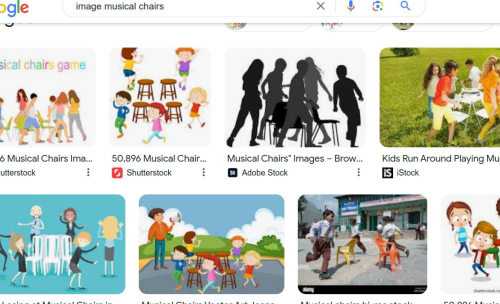
    MusicalChairs

    There's some metaphor here… ask the Council about it?


    Today, January 30th, the City of Davis City Council will “Consider Recommendations Related to Commissions”. Please show up this evening – item 5 is scheduled for 7:20pm – or call the comment line at (530) 757-5693 before 4pm.

    Let's look at some recent history first… and then tonight's meeting:

    June 3rd 2021

    “City Council Subcommittee and All-Commission Chair Meeting”. Video. 

    This was a two-hour meeting between all Commission Chairs with then City Council member Lucas Frerichs – who chaired the meeting – and Gloria Partida.

    It’s worth noting that two of the Commission Chairs – Bapu Vaitla and Donna Neville – are now on the City Council. Vaitla does not reference this meeting in the Council sub-committee proposal scheduled for this evening.

    While the meeting is certainly worth a focused viewing, for now I will focus only on statements made at the meeting related to future activity (e.g. further similar meetings with Chairs, Council agenda items, etc):

    “Hopefully not the last meeting” (Lucas, earlier in the meeting)

    “Update to the City Council Coming shortly” (Frerichs @ 1:59:40 – it’s not clear if this meant any minutes from meeting would be passed along to Council)
    “Hopefully on a regular basis” (Frerichs @ 2:00:00 – Referring to an intention for similar meetings with Chairs.)
    “I’m sure that Kelly [Stachowicz] and Zoe [Mirabile] also will […] put together some minutes.” (Partida – 2:01:00 – As no publicly-distributed minutes are taken, it’s not clear what this referred to. )

    At the end Colin Walsh – the Chair of the Tree Commission -  asked about when there would be another similar meeting “in the not too distant future”.  Partida responded:  “It was pretty clear that that’s one of the main takeaways here… we will be setting that up”. She also said  “…What I heard was that people are we really wanting twice a year to meet this way…so I can [should or will be able to] confirm that”  (Walsh, Partida from 2:04:25)

    Despite what Frerichs and Partida said or intended, there were no meetings – between Chairs and a Council non-quorum or in City Council – until February 2023, 20 months after the 2021 meeting. 


    February 7th 2021

    City Council Meeting. Community comments start at about 2:34. Some highlights:

    * Alan Hirsch. gives a good comprehensive look at the overall poor state of things regarding respect for Commissions. 

    *John Johnson – a member of the NRC -  talks about NRC not having enough time to do what it needs to

    * Alan Miller suggests a great, truly-democratic and also streamlined idea for organizing the Council and Commissions. 

    * Roberta Millstein makes clear the paternalistic functioning of Council and Staff

    * Colin Walsh criticizes the generally low-quality process

    Based on Colin Walsh's observation at the meeting, there were very few members of the Public at the meeting. This would indicate a likely lack of communication about the agenda topic. I also don’t understand why it was called a “workshop”, as it didn’t have this form.


    Present Day:

    Two pieces earlier this week in Davisite:

    Council to Eliminate Tree Commission Tuesday

    City Commissions Merger Proposals are Ill Conceived – Testify Tuesday


    In the sub-committee report for today’s meeting: 

    "The Council Subcommittee spoke with all AVAILABLE chairs (or vice-chairs) [emphasis mine] of existing commissions to receive their feedback on what is working in the present structure and what could be improved." [page 4]

    "In reviewing the scopes and structure of each of the City's 14 advisory commissions, the subcommittee undertook the following research: […] * Met with [ALL?] chairs and vice-chairs of each commission to gain a better understanding of what works well and areas of potential improvement, especially with respect to Council direction about what areas of commission activity would be most valuable; [page 7].

    What actually happened? Did the Chairs and/or Vice Chairs coordinate with each other? Did they have the opportunity to e.g. get questions from Chapman and Vaitla and then get input from their Commission before speaking with Chapman-Vaitla?Are there minutes of these meetings?

    The proposal would – in the long-run – have a total of approximately 28 fewer Commissioners than the current 98, so just under 1/3 less participation from the same city (and possibly expanding) population, with similar low to mid level staff, same senior staff and same council numbers, and still minimal involvement from youth (see below)

    While there would be less staff hours, it's not clear if this will reduce staffing expenditure (I don't fully understand how staff gets paid when working evenings, etc)

    The new language comes from state-mandates on General Plans, but it's clear that the "Element" names don't have to be included in the names of the related Commission.

    We then have the proposed "Circulation and Active Mobility" – and they don't get the correct name for the BTSSC again!  – but I think that Circulation is a somewhat old-fashioned term which I believe – and not only superficially – relates to LOS (Level of Service)

    The archaic and unusual name of "Circulation…" as the new name for what’s unfortunately and informally oft-referred to  as the "bike commission" with "….and Active Mobility" which in aggregate is… poor English (just like the current BTSSC, as “Bicycling” is a subset of “Transportation” (outside the sporting context) and “Street Safety” is mostly a quality of the situation, 

    I would prefer e.g. “Efficient, Joyous and Safe Mobility Commission”, as it covers all forms of transportation using conveyances, walking, other means of travel, resources/climate change issues and the social sphere!

    "The required Noise and Safety elements [of the Consolidation] are not listed; community engagement for these will be led by Staff.)" (page four) Seriously, what the actual f*ck?? Is there any actual logic for this or a similar and official mechanism in any other part of the proposal

    There's a promise at the end that no one will have to leave, presumably Commissions will change as people term out, but will there will perhaps be more split votes for a long time due to math: 7 to 7, 6 to 6, 5 to 5, 4 to 4 votes (before Commissions "settle" again at 7 members.

    There's NO proposal for a Commission of Youth Members/Youth Commission. About 90 cities and towns in California have these!  At the very least, there's no proposal for more youth OR age of minority-age ex-officios for ALL Commissions

    There’s NO promise of more communications – via social media, the City’s website, etc – to encourage more attendance and attention of Commission meetings and ongoing work, inclusive of biographies of Commission members. One should not have to Google a Commissioner’s name to see their affiliations, job, a bit about their experience, etc.

  • YES, Mayor Arnold needs to recuse himself again

    Arnold80Mace

    Back in June I strongly suggested that Mayor Will Arnold recuse himself from City Council discussion/support of the I-80 Managed Lanes Project – The mayor's main gig is a key role in communications at Caltrans. 

    He did recuse himself.

    Tonight the City Council is voting for approval for one of two variants for re-reconstruction of Mace Blvd (see my opinion on that below). 

    While it's not a Caltrans project, per se, the continued problem of operators of private motor vehicles using county roads and Mace to try to bypass traffic on I-80 is in large part due to the sad negligence of Caltrans in supporting anything but nice but expensive-to-use and proportionately symbolic commuter-regional railway service (Capitol Corridor), to focus on induced travel as a healthy strategy (the aformentioned Managed Lanes project) and to seemingly ignore any serious consideration of solutions to the awful I-80/CA-113 interchange, modifications to certain on-ramps to permit entering vehicles to get up to the prevailing speed before merging or any kind of substantial long-distance bus service to complement Capitol Corridor (and more…)

    The so-called "restoration" of Mace will not solve the I-80 problem, but since Caltrans won't either, and since Caltrans won't help solve the Mace problem… the discussion and vote tonight is very, very much connected with Caltrans and so the Mayor should again recuse himself. 

    ***

    Sprayingmap8292023As an hopefully not so itchy or worse aside in my favor regarding aerial and other spraying for mosquitoes (specifically to counter the threat of West Nile Virus) in relaton to highways workers at Caltrans and private travellers – and in relation to agenda item 4 also in this evening's Council meeting. missing any attachments!  – I have repeatedly called via social media – and finally, acknowledged comments from staff for Supervisor Provenza – to ensure better outreach to workers busy on the I-80 pavement rehabilitation project and to people transitting the region by its highways who are unlikely to see or hear local (social) media announcements about the spraying. Some of this is immediately adjacent to I-80 – including tonight, during the Council meeting – and CA-113.

    ***

    Back to the Mace Re-re-design: It's a betrayal of the Commons and of the City's symbol and oft-repeated climate change and related goals to prioritize traffic lanes above bike lanes, and to sacrifice (median, in this case) trees instead of traffic lanes for bike lanes… the latter, in other words, is putting people on bikes – or really kids on bikes riding to elementary school  – against trees, really, the Greater Arboreal World. It's a sad, sad day… There's no "restoration" — the four lanes of Mace are no exiled monarch, and they certainly ain't democracy – automobilist entitlement is getting its way, once again. Look around: Davis is not getting better for walking and cycling. Anyone who has encouraged this motorized farce will have to face their own conscience.

  • Ageist, Racist… and not the only collective bicycle solution we need

    OBISinclusion

    From a presentation I did about bike share in Germany the year after my team's first place win in an international bike share design competition with more than 100 competitors.

    The authorities in Greater Davis* (City of Davis and UC Davis) plan to introduce a shared micro-mobility system starting this September (the introduction of e-scooter share and re-introduction of e-bike share). It is the topic of an informational item today at the July meeting of the Bicycling, Transportation and Street Safety Commission (BTSSC) at Davis Senior Center, 530pm in the Activity Room. The planned operator is Spin. (The staff report mentions Lime, a lot — they are the operator in Sac and West Sac and seemed to have been the operator-in-waiting here through at least the end of 2022).

    There was e-bike share in Davis and UC Davis from 2018 until 2020, when Jump, its operator, cancelled it due to lack of use due to COVID-related UCD class cancellations and remote learning. Non UC-users were not considered, or at least were left in the lurch. (It's worth noting that during this time bike share use in other cities increased due to aversion to public transport…)

    Following I will address the issues mentioned in my headline, and then briefly will comment on some other features of the draft agreement. There's way too much to address in one article – hopefully the Commission is able to sort through the staff report in a holistic way.  If you want to skip to my juicy accusations of ageism, racism and far from ideal use as a mobility solution, see the sections below entitled 18 and Where's the Fleet?

    To step back a bit – and also to educate Commissioners because there's now been 100% turnover in the BTSSC since 2018 and only one of two key City staff members still on board since then – and turnover also at UC Davis TAPS – here's a list of issues for micro-mobility share in our region from the beginning, and also some stuff about my professional history with bike share. Some of the following is anecdotal – as indicated – not due to lack of trying, and mostly because discussions with the private entities involved in operator (and sponsorship) are private, and apparently e.g. NDA's come into play.):

    2000s: The advertising and street furniture giant JCDecaux approached the authorities in Lyon, France about sponsoring a new bike share system – there were earlier ones in other European cities, but this was the first one with technology broadly similar to what we have today – in exchange for an exclusive on their main business, a mentioned. This set a template for corporate sponsorship of bike share, especially in the USA, where we have – for example – bike share in NYC sponsored by Citicorp, and in many general east-of-the-Mississippi cities by Blue Cross-Blue Shield (BCBS) associated entities.  In my view, this marriage to corporate sponsors has had some negative impacts, which I don't consider as in any reasonable trade-offs: Citicorp controls banks and real estate loans, and thus directly affects the lives of many of its users outside of their bike share monopoly; BCBS-associated companies have in a rather insidious (ironic) way have healthwashed-with-bikes their opposition to Medicare for All-type plans. This reliance on direct corporate funding is wholly unique to micro-mobility share in the USA, and locally (Capitol Corridor, Regional Transit, Unitrans and Yolobus are mostly supported by passenger fares, government subsidy… including Unitrans by the City) and a small amount by advertising on properties, and in some cases gives control to a private entity with no related regulation, no way for citizens – aside from shareholders – to have a democratic influence.

    2003: While leading a study visit to Germany from Prague we were introduced to the bike share system run by the German National Railway Operator. It was early technology, e.g. a staff person told me that the put on pretense that the bikes could be found via GPS trackers, but there were actually none in place.

    2009: A team consisting of myself (I was based in Berlin at the time, operating as Green Idea Factory), a Swedish mobility consultant and a Swedish industrial design firm won one of two first prizes for a detailed concept for a dockless bikeshare system in an international competition in Denmark. The concept is articulated further in a presentation I created in 2010.

    2017: Sutter and Kaiser were both asked to be main sponsors of bike share in the Sacramento region. Anecdotally, Sutter objected because it wouldn't want Kaiser-branded bikes on its properties, and Kaiser objected because vice-versa. So….no sponsorship happened. Without naming these companies by name, this information came from at the time City Councilmember Frerichs and the now former head of JUMP.

    2018: Before the pilot started in the region, the operator JUMP was purchased by UBER. The pilot started in Davis without input from the BTSSC, because Staff wanted to start by "bike month" in May of that year. Also around this time West Sacramento started negotiations to work with a different operator, but were talked out of it.

    2019: The BTSSC was only allowed to formally review the system after a year. At the time  I was on the BTSSC and I wrote a critical report, mentioning age and weight limits and other issues.

    2019: Since the beginning, throughout this year and into 2020, there was a issue about bikes being parked in a way which would encumber or threaten others. Leaving aside how this compares to what car and delivery truck drivers do, it was something that needed to be addressed. Staff was very resistant for a time  to the idea of parking bikes in the street "like a motorcycle" – and people were doing this on their own, but it was not officially-sanctioned -  but then when I came forward with a detailed proposal – at the time I was still on the BTSSC – but was then told that staff had already decided to do it. See also. Unfortunately this was never officially put into practice by the time that JUMP ended bike share operations in spring 2020. Spin operates on the campus of UCSD, and their parking instruction video is over five years old, and hardly anyone has watched it. Rules need to be intuitive.

    2019: OK, possibly in 2018? The City had BTSSC members and others tested perhaps six different types of e-scooters in anticipation of their possible allowance for general use by City Council.

    Early 2020: JUMP cancelled bikeshare through the region, as mentioned. The staff report doesn't mention that a  great deal of its bikes and supporting technology was simply and literally trashed.

    2022: Bikeshare and scootershare started again in Sacramento and West Sacramento, operated by LIME (who purchased JUMP from UBER) with government financial sponsorship (something not happening with Davis/UC Davis.)
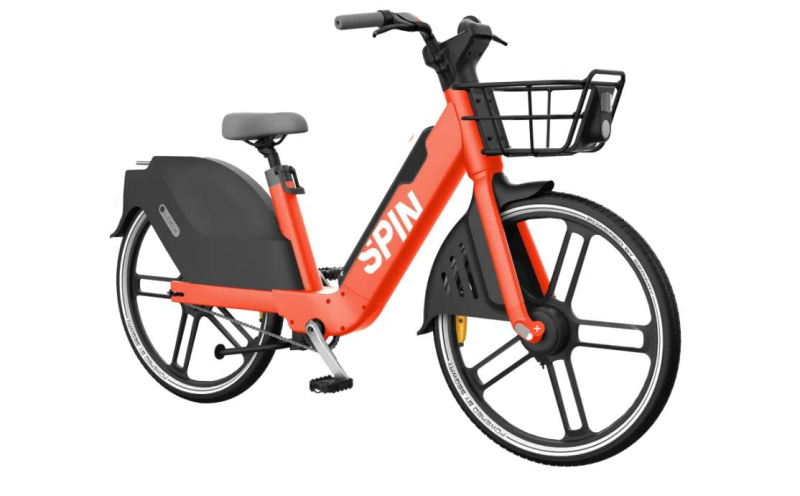
     

    Spinbike

    Is this the bike they're planning to use here? Can't tell if there's a way to secure something in the rack… if not, that's a deal breaker! https://www.spin.app/s-300


    18

    From its beginning as a pilot just in Sacramento, bike share in the region (this plan joins non-connected systems in Sacramento and West Sacramento), has had a minimum age limit of 18.  It's critical to understand that there is no state regulation preventing anyone who is able to ride a bike from using the type of e-bike – a Class 1 e-bike – that Spin will provide, and e-scooters require only any classification of driver's license (so at lowest, 16 for the latter, and perhaps state ID's do not count.)

    Lower-income families have fewer mobility options, generally-speaking (e.g. fewer cars, prohibitively expense train tickets, etc.) and youth members of these households even more so. Brown and Black people are disprotionately-represented in these households. So not only is the proposed agreement between the City of Davis, UC Davis and SPIN ageist, it's also racist.
     

    Unanimousv

    Violation of Federal Law (in the previous bike share system), Elected Official and Staff hijinks

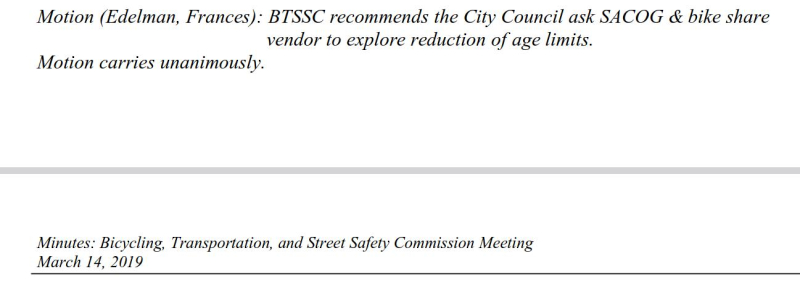
    Around the time of my 2019 critical report – linked above, and mentioned in it – I suggested that the lower-than-18 age limit – not supported by State regulation on the utilized Class I e-bike – was in violation of the Age Discrimination Act of 1975, a Federal Law that is, in a way, an age-related version of Title VI of the Federal Civil Rights Act of 1964, as the City of Sacramento – a partner in the regional bike share system – was receiving Federal money to install bicycle parking racks as these were determined to be necessary to account for the increase of bicycles. The response from SACOG was that as the rule was that of the bike share operator and not the City of Sacramento or its government partners – they were off the look. A brazen loophole, in their view, obviously to intimidate me into not pursuing the matter! (Lucas Frerichs was aware of this or perhaps even helped direct SACOG staff on this matter.) At the time, former City of Davis senior planner Brian Abbanat – now working for Yolo Transit District – even wrote me as a BTSSC member an email – responding to my article in Davisite – telling me to not spread implications etc that the City was in violation of the law. Despite all of this – and to their great credit – the BTSSC unanimously supported my motion to recommend that the City Council ask JUMP and SACOG to consider lowering the age limit. The City Council did put this on their long range calendar but never acted on that, and dropped it once JUMP pulled service, and left it off once bike (and scooter) share discussions starting again. Some Councilmembers – perhaps Arnold and Partida – did ask about the issue during a meeting in 2022, but around the same time the City of Davis and UC Davis were already planning to go it alone on micromoblity share, though at that City Council meeting a now former representative of SACOG, Kirk Trost, said based on in his experience in developing bike over the region over the previous decade, there were essentially no operators who allowed people under 18. This is false on a national level (NYC, Philadelphia…) and in California (Los Angeles, Long Beach…) all allow people to use e-bikes from under 18.

    Institutionally-speaking, not only SACOG and the City of Davis are blocking youth mobility, but also the board of DJUSD. Back in 2019 I met with Cindy Pickett when she was President – or just a member: She was willing to support a min. 16 age limit, BUT no one else on the Board was interested.  Thanks for trying, Cindy! (Also about bringing back school buses…)


    Peerage

    My concept has for a few years been not simply that the entry level for bike share is under 18 (and for scooter share from license-accquisition) but that that it's peer-based. In other words, that one can use bike share – again, no government age restrictions apply – at the same time as their peers. My specific example would be that it start with ascending 10th graders, i.e. from the first week or so – pending administrative processing, etc – of the summer before 10th grade.

    How is this better than strict temporal demarcations? For a start, 15 year-olds are likely to be friends with people both older and younger: Not everyone is the same age at the beginning of summer before 10th grade, nor during the school year, etc. So – in theory – with peer-based mobility share – a 14, 15 and 16 year-old who are good friends could all ride bike share bikes together from the start of the mentioned ascending period. A peer-based system wouldn't split friends up: Consider the extreme alternative: A group of students all under 18 who can't use bike share but CAN drive, or a mixed group, all of whom can't use bike share but CAN drive.

    Wow, what a great reward, mobility milestone, etc… and perhaps before they're already (emotionally-invested) in getting a driver's license (which apparently they need to use the scooters, irony!). Right? Unfortunately: Crickets. This would be a first in the country, or perhaps anywhere.


    The RFP

    In the end the Request for Proposals (RFP) – see pg 66 – made a very, very soft ask for below 18 age limits. Way too soft for a city and university that chronically self-congratulate in regards to equity and inclusion. Srsly, are we applying Hate-Free too narrowly?

    20. How do you intend to serve users who are less than 18-years of age? The City of Davis would like to provide shared bicycles to community members 16 and up, which could include non-electric devices as part of the device mix. […]

    The answer to this (see pg 3.):

    Age. All users must be 18 and over. In accordance with state and federal law, this policy protects the best financial interests of Spin’s customers and their organization since the minimum legal age of consent in most contracts (including user agreements) is 18 years or older. Staff understands the strong interest in allowing for people 16 and over to use these devices, however, all of the vendors had a minimum age of 18 years old.

    • It's not clear to which "state and federal law"(s) they refer to. Adults (who are also guardians of minors) can sign off for them on any number of things, including marriage. There's only a state law requiring a driver's license for e-scooters and being at least 16 to operate a Class 3 e-bike (again Spin bikes are Class 1)
    • Spin's "customers" (the parents and guardians) are fully capable of deciding how to protect their financial interests, and those of their children/charges.
    • It's not clear who are "all of the vendors": It's not mentioned in the staff report, i.e. there's no listing of who submitted bids or proposals aside from Spin (Operators of the systems mentioned below all allow under-16's: Philadelphia, Bicycle Transit Systems; NYC and Washington, D.C., Lyft; Long Beach, Social Bicycles (who split off from what became Jump), Los Angeles, B-Cycle.)  That Lime only allows 18 and over's is only their decision… call it a "business decision", you know, like making cluster bombs…  or we can call it's: Lawyers 1; Davis youth, 0.

    Other Cities Better than Davis / UCLA 1; UCD: 0

    As mentioned above, under 18's can use shared e-bikes in major cities such as Philadelphia and NYC, the nation's capital, and in California in Long Beach and Los Angeles. All require some form of parental or guardian permission and formal responsibility. In sum these systems provide tens of thousands of electric assist bicycles to minors.

    What's significant about the bike share system run by Metro, the public operator in L.A. (inclusive of Hollywood, Venice, etc.)  is that it is also expanding to cities such as Culver City, is already in Santa Monica, and – significantly – the UCLA campus. (How is a university campus relevant to under 18's? Well, many so-called child prodigies and other very high achievers skip a grade or more and enter university before age 18. Some also participate in summer programs, or use various facilities during the year, such as I did at UCLA when I had an AP history class in high school near the university. Do we want 16 and 17 year-olds visiting our city for serious academic reasons to be denied shared micromobility?)


    Icing on the Cake of Anti-Equity

    As many – including micromobility share – operators know well, users frack with age limits. What this means is that, for example, there are technical limits to how they can prevent anyone using a smartphone with their app on it connected with a credit card. Spin seems to hint at new countermeasures in the staff report, BUT this might partly bluster, similar what the Germans did nearly 20 years ago, as mentioned above.

    More important, let's see how this likely works in practice: In most cases parents/guardians know the rule but allow their child to 'cheat" for any number of reasons. It seems likely that parents who tend to do this are less risk averse in regards to some financial issue that comes up as a result. So this would indicate a further anti-equity bonus in the form of a bias  in the system for wealthier families. To be clear, I've not done research on this, but it seems like common sense.
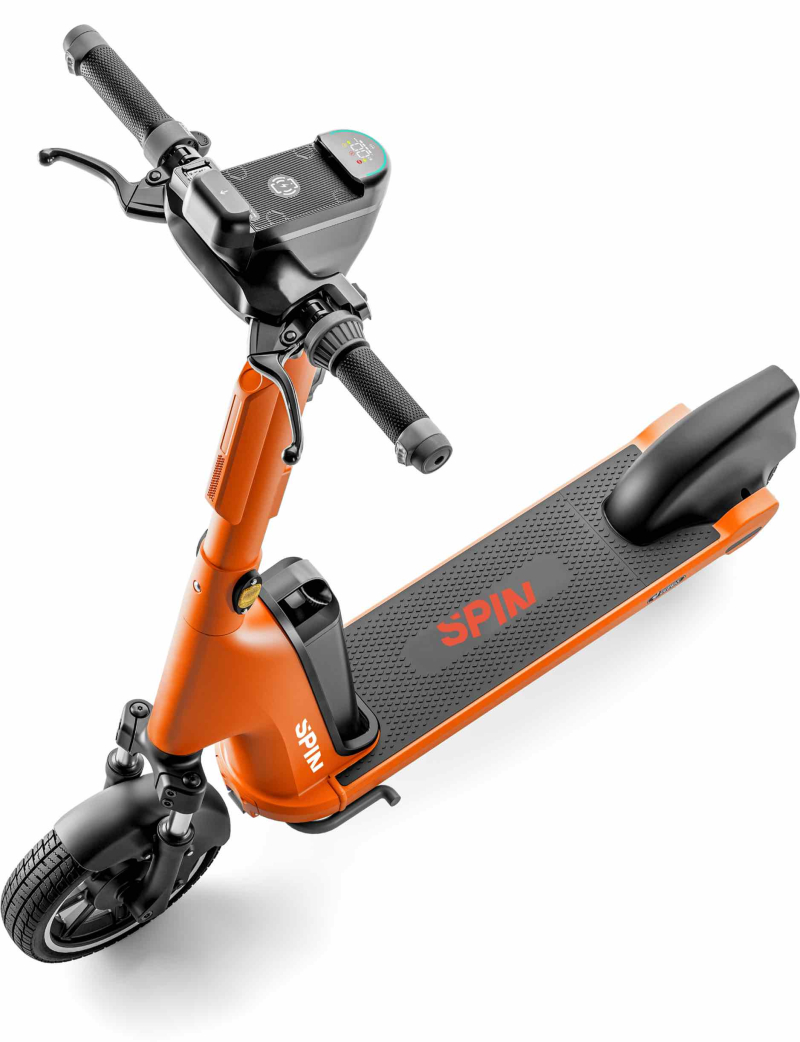
     

    Spinscooter

    Is the scooter Spin will be bringing here? It's worth noting that about four years ago several operators brought scooters to town for staff and commissioners to test out. That didn't happen again… https://www.spin.app/rides/spin-6

    e-Scooters

    "Micromobility" – my blog engine can't decide if it needs a hyphen – is a bit of a new term, so I've perhaps conflated some things above between e-bikes and e-scooters. BUT as mentioned above, one only has to be 16 with a driver's license (from other states and countries?) to use an electric-assist scooter in California. So the ascending thing doesn't apply.  Otherwise most of  the planned to be codified ageism and racism applies! Hooray! YES, from what I have seen all operators have a min. age 18 limit for scooters…. and Davis and UC Davis are refusing to take a stand about it. #equitydeferstotheman


    Where's the Fleet?

    Is the planned system what we really need to get a very, very wide range of people and campus in the city on comfortable, fast enough, well-built and appropriately designed bikes?

    Nope.

    Every year… thousands of faculty, staff and especially students appear in Davis. Some have not ridden a bike in some time, some don't know to ride… these and many more don't actually know what is a useful bike for Davis, many don't have time to research and pick one out. Useful bikes are also hard to get, though selection is getting better – I think that some Dutch academic-related people are warned about this in advance: I have two Dutch-built bikes which were never sold retail in the USA… left by former Aggies…)
    1872B826-001A-4966-87D7-6BE4AC9633F5

    The bike pictured above -  or ones like it – is a poster child for absolutely not the bike to offer to students or others in Davis:

    Cons: 

    Loud, inefficient tires, bad for cornering on pavement and in rain

    No fenders

    No semi-built in lights or built in lights

    No way to carry cargo

    No bell!

    Pros: 

    Not a big loss of money if it breaks down or is stolen (A newer model is only $300)

    Nevertheless, this is a type of bike that's extremely common on campus. Many also don't fit well, even if purchased new. 

    Note that aside from the one thing in the Pro column, I am not talking about the quality of the bike, likely warranty or lack of local bike shop support. This is about design. 

    What the UC Davis campus (and probably many other UC and CSU campuses) really, really need is a fleet system of some sort. There are various business models, but the main criteria could be:

    1) Suitability for local terrain and surface conditions: This means a relatively narrow gear range, or perhaps one relatively low gear, and therefore only 3 to 5 speeds. This means tires suited best for streets and possibly a bit of gravel, so that a student bike can fulfill at least a bit of a spontaneous recreational need. 

    2) Cargo equipment suitable for carrying a large student backpack and two bags of groceries, possibly even some kind of low security (for groceries, not laptops)

    3) Built in lights with power from other than batteries 

    4) Low step, with three sizes to accommodate nearly all rider heights

    5) Security system consisting of a tough main lock, front wheel security nuts and Dutch style frame lock for the rear. 

    5a) Possibly some dedicated locking design based on typical bike share, but the bikes will still need to be parked in random places, so that only goes so far. Unfortunately these bikes probably can't be unique enough  in a way which facilitates locking-to-itself.

    This system would be a complement to normal bike share (um, non-ageist, non-racist bike share!)

    Though as mentioned the business model may vary, one idea would be that every student is assigned a bike by request at any time which will be of the appropriate size for the individual, and easy to identify with a color, a number and some tech-facilitated means connected with a smartphone app. This bike would be maintained by some outgrowth of the Bike Barn etc, or even farmed out to local bike shops (who would, after all, be dealing with a set design with the same parts etc. The bikes would have to be un-lockable by related staff so that can be picked up where they parked, broken down etc 

    Cost? Yes, this will be expensive, though not relative to the existing costs of tuition and fees. 

    The advantages cannot be over-stated:

    Reliable bikes, optimized for student and related close urban lifestyles.

    Predictable lighting.

    A slow downsizing of chronically under-lit, poor fitting (size and use) , mechanically and pneumatically-sub-optimal crap bikes that fill every possible nook and cranny in the city and campus… wasting space, wasting time, avoiding safety, making it easy for driver-identified people to complain…. filling the city and campus bike racks with rusting junk that takes a huge amount of capacity, time and money to deal with.

    WHY has this not been discussed to date in Davis?

    Examples from the region and abroad. Some of the fleets are designed for a particular locale, such as a corporate campus, others are designed for an entire country, still others for long-term use:

    Google campus bikes

    Swapfiets

    OV-Fiets

    This is a new sub-topic for a longer discussion, but it very BADLY needs to happen.