Davisite Banner. Left side the bicycle obelisk at 3rd and University. Right side the trellis at the entrance to the Arboretum.

Author: Roberta Millstein

  • Thinking like a Little Tomato

    What should Davis's Climate Action and Adaptation Plan focus on?
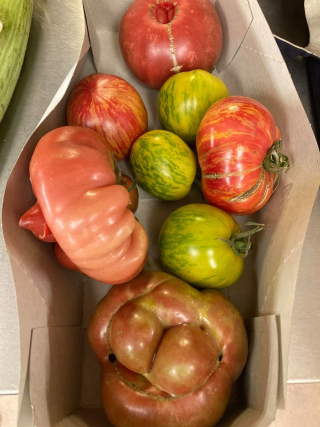
    TomatoesBy Roberta Millstein

    In March 2019, Council adopted the Resolution Declaring a Climate Emergency and Proposing Mobilization Efforts to Restore a Safe Climate which states that “the City of Davis commits to taking significant action to move toward net municipal and community carbon neutrality in the short term with maximum efforts to implement carbon reduction actions by 2030; and accelerate the existing 2050 Davis carbon neutrality goal to a 2040 target. The City of Davis and City Council will…accelerate a robust update to the Davis CAAP and integration with the City’s updated General Plan.” (emphasis added). https://www.cityofdavis.org/sustainability/2020-climate-action-and-adaptation-plan-caap

    The City has asked for our input into a set of 29 draft action items for the Climate Action and Adaptation Plan (CAAP) that City could take to achieve its Climate Emergency Resolution.  Which should our top priorities be?  Should any of the draft actions be modified, eliminated, or combined?  Should any of the proposed actions that didn't make it into the "top 29" be promoted? 

    I suggest that in order to answer this question, we must "Think Like a Little Tomato."[1]  In A Sand County Almanac, conservationist (ecologist, forester, hunter, professor) Aldo Leopold famously urged us to "Think Like a Mountain." In that essay, Leopold was concerned with the consequences of focusing solely on preserving deer population numbers, something that turns out to be at the expense of everything else on the mountain (the wolves, the plants and trees, the mountain itself).  Instead, he implies, we need to think about the entire land community. 

    Now in Davis and surrounding areas, deer and wolves are not so much in play, but tomatoes (and other agricultural crops) are, as well as the other plants and animals who live in and around our urban and agricultural areas, some with dwindling numbers, like burrowing owls and Swainson's hawks.  This land community – our land community, since humans are very much a part – is increasingly threatened by severe climate change impacts: hotter summers, hotter and bigger and longer-lasting fires, smoky air, drought, flood.  Arguably, ignoring our land communities and their habitats is exactly the attitude that has brought on our climate emergency, and as we address climate change, it is the attitude that needs to change.
    (more…)

  • Letter in praise of Anne Ternus-Bellamy

    Thank youAs we "two steps forward, one step back" our way out of the pandemic, a number of people have been rightly praised for their contributions to the community. Today I write to thank Anne Ternus-Bellamy for her outstanding coverage of the pandemic. 

    She has kept us up to date on all of the latest statistics; explained complicated facts about testing, vaccines, and best pandemic practices; and put that information into local, state, and national contexts.  She has explained a massive amount of information to us in a clear and accessible way. 

    Having such a wealth of information available has meant that we could make informed decisions, decisions that may have even saved lives.  It hasn't always been good news, but there is nonetheless a comfort to knowing what is going on. 

    I should add that she has found the time to fit in local political coverage as well, coverage that presents different perspectives on controversial issues in a fair and accurate way. 

    The Davis Enterprise is lucky to have her and so are we.

    Roberta Millstein

  • Comments to the Tree Commission concerning DiSC 2022

    Screen Shot 2021-10-19 at 9.55.57 AMThe following was emailed to members of the Tree Commission this morning.  The Tree Commission is scheduled to discuss the revised MRIC/ARC/DISC project, now dubbed DiSC 2022, at its meeting this Thursday, Oct 21.  If you wish to comment on the project yourself, see instructions on the agenda for the meeting, located here.

    Dear members of the Tree Commission,

    I am writing to you as a former commissioner (10+ years) and Chair of the Open Space and Habitat Commission (OSHC), having completed my term last December. I was involved in analyzing what is now being called the DiSC 2022 project in all of its iterations, so I hope you find my comments helpful in your discussions.

    I think it's great that you appointed a subcommittee to review all the materials, given that the changes are more extensive than the City has stated – this is not just a project that has been cut in half, as your subcommittee's analysis shows. I endorse your subcommittee's recommendations and encourage you to adopt them as a body in the strongest possible language, remembering that the only way to guarantee that a promised feature will be in the actual project is for it to be designated as a "baseline feature." A cautious route would have you even recommend that the relevant ordinances be satisfied (this was something that the OSHC did last time), since there is a history of the City Council bending its ordinances, including ordinances concerning trees (it is my belief that they did this in the recent Sutter parking lot decision).

    (more…)

  • Bicycling, Transportation, and Street Safety Commission needs a DiSC 2022 Subcommittee

    Screen Shot 2021-10-12 at 9.28.28 AM

    The following letter was emailed to the BTSSC this morning.

    Dear members of the Bicycling, Transportation, and Street Safety Commission,

    I am writing to you as a former commissioner (10+ years) and Chair of the Open Space and Habitat Commission (OSHC), having completed my term last December. I was involved in analyzing what is now being called the DiSC 2022 project in all of its iterations, so I hope you find my comments helpful in your discussions.

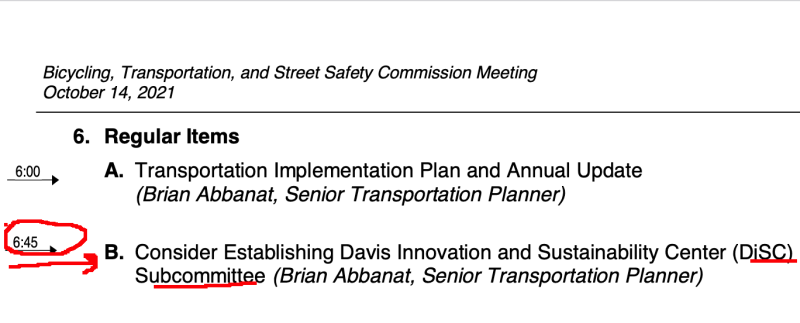
    I understand that at your meeting this Thursday, Oct 14, you are only deciding whether to establish a Davis Innovation and Sustainability Center (DiSC) Subcommittee, with the meeting to discuss the project as a commission to come later.  I am writing to strongly urge you to establish a subcommittee now.  The OSHC reviewed the project last week and expressed frustration that there were many issues that they did not have time to discuss; see this report of the meeting.

    Given the changes in the project – which you have not been fully presented with, but I believe that they are more extensive than you might imagine – and your commission's thoughtful and considerable recommendations from the last time, a subcommittee is absolutely essential for sorting through all the documents to figure out what has changed and how your recommendations might change as a result. 

    I note that your packet for this meeting only includes a two-page description of the project.  The OSHC was given a more extensive project description that you might find helpful; see Attachment 2 of this document.

    Here is an example of one large change that the BTSSC might be interested in commenting on and that a subcommittee could consider. The original proposal stated that "DISC will construct a grade-separated bicycle and pedestrian crossing on Mace Boulevard connecting to local and regional trails (see p. 14 of this document).  This was to be a baseline feature, meaning it was a guaranteed part of the project; indeed, the only way to guarantee that a promised feature will be in the actual project is for it to be designated as a baseline feature. 

    However, in the current DiSC 2022 proposal, the developer promises only to "acquire and dedicate land to accommodate a future grade-separated bike/ped crossing of Mace Blvd to be located north of the Mace Drainage Channel" (see p. 18 of the document given to the OSHC that I linked to above).  As I read this – and I encourage you to ask the developer about this directly – if the project were to go forward, there may or may not end up being a grade-separated bike/ped crossing of Mace Blvd as part of it, since they are only promising to acquire land to make a crossing possible in the future, and it's not even clear that the acquisition of land is a baseline, i.e. guaranteed, feature.  If I am right, this would be a loss of a significant feature of the project, one that I expect your commission would want to weigh in on.

    Again, this is just an example – I imagine that there are other such changes that a subcommittee could find, but that it would be difficult to discover if only one meeting is allocated to the issue, with materials appearing just a few days before.

    So again, I urge you to vote now to form a subcommittee, to look at the materials I have provided, and to ask if there are other relevant materials that would help you in your decision making.

    Sincerely,

    Roberta Millstein

  • Comments to the Open Space & Habitat Commission concerning DiSC 2022

    Screen Shot 2021-10-03 at 8.45.43 PM
    The following was emailed to members of the Open Space and Habitat Commission (OSHC) on Sunday.  The OSHC is scheduled to discuss the revised MRIC/ARC/DISC project, now dubbed DiSC 2022, at its Monday Oct 4 meeting.  If you wish to comment on the project yourself, see instructions on the agenda for the meeting, located here.

    Dear members of the Open Space and Habitat Commission,

    I am writing to you as a former commissioner (10+ years) and Chair of the OSHC, having completed my term last December. I was involved in analyzing what is now being called the DiSC 2022 project in all of iterations, so I hope you find my comments helpful in your discussions.

    To begin, I am pleased to see in the minutes from your last meeting the following: "[Ms. Reynolds] said the Commission also had the option of agendizing the Addendum to the project's Environmental Impact Report ("EIR") later this year if the Commission wanted to provide comments on the Addendum to the EIR. That meeting would have to happen before December when the project is scheduled to go before the Planning Commission, she said." I strongly urge you to do this. The OSHC has a history of productively discussing and giving comments on EIRs, as it did with earlier versions of DISC as well as Nishi and other projects, with the comments thoughtfully crafted from the Commission carrying more weight than comments from individual members. For example, you might wish to ensure that the biological surveys have been properly updated and that greater awareness of approaches to climate change are being taken into account, such as the lost opportunity for regenerative agriculture on the property if the project is built.

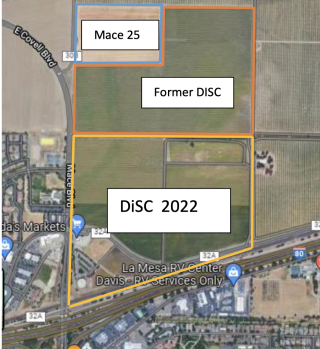
    Another important piece of background: in the last iteration of the project, the developer kept insisting that Mace 25 was not part of project, even though it clearly was. This led to mistrust in the community. Because of that mistrust, people are now concerned that this smaller project without Mace 25 is just a foot in the door for the already rejected larger project to come later. I urge you to recommend that the developer state, as a sign of good faith, that this is not their intention — designating the ~100 acres to the north of the project as ag mitigation would be the clearest way to do that.

    The rest of my remarks will focus on the Staff Report and related attachments, located online here.

    (more…)

  • DISC is back… and so is bad process

    8E95805A-8A18-4D60-AE6F-0C4FDE0CA708
    Staff and City Council favor developer interests over citizen input

    By Roberta Millstein

    This past Tuesday (Sept 7), the City Council formally set in motion the process to evaluate the twice-reborn industrial park/hotel complex on prime farmland outside the Mace curve, now dubbed DISC 2022. Readers will recall that this project was handily defeated at the polls less than a year ago. Now it is back again with half the acreage, fewer amenities, and a smaller proportion devoted to revenue-generating commercial uses. 

    Also back again is staff acquiescing to the developer's extremely short requested timeline. 

    There have been some improvements in process this time around. The project was made a regular agenda item, allowing for greater citizen awareness and discussion, though apparently a number of people were still caught by surprise. And all of the relevant commissions are scheduled to be consulted from the outset, something that citizens had to fight for the last time. 

    However, staff's Tuesday proposal was that each commission can only evaluate the project once. Why? The developer wants this on the ballot by June 2022 and staff wants to comply with that, stating there is not enough time for commissions to have more than one meeting concerning the proposal. Why do they want to go along with the developer?  Well, you will have to ask them, but it is certainly not a timeline that favors citizen input, remembering that commissions are intended to be a conduit for citizens to give feedback to the City.

    (more…)

  • How to vote in the gubernatorial recall election? Step one – vote!

    Wheretovote

    By Roberta Millstein

    If you are registered to vote in CA, you should have received your ballot for the election to recall Governor Gavin Newsom by now.   If for some reason you aren’t registered, August 30 is the last day to register to vote; after that, you can “conditionally” register and vote at your county elections office or polling location after the voter registration deadline, up to and including Election Day (Sept 14).

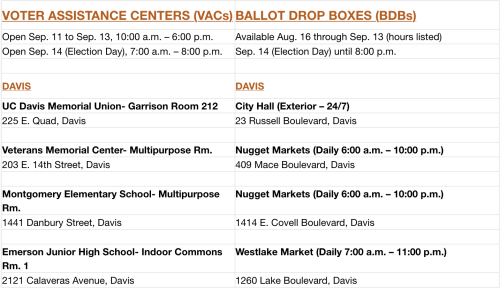
    Voting is easy!  In Davis, there are several voting assistance centers and ballot drop boxes.  See the graphic at the top or this page for details.  Or you can mail in your ballot – it has to be postmarked by Sept. 14. Each ballot will come with prepaid postage. So no excuses not to vote.  If you're not in Davis, check out your local options.

    And your vote really matters in this election – even more so than usual – so please take the time to vote!

    The biggest challenge that Governor Newsom has to overcome is voter apathy – people thinking they don’t need to vote because Newsom is a slam dunk (how’d that work out for Gray Davis?) or who just aren’t that excited about Newsom.  Well, I have to admit I’ve not always been happy with his decisions, either.  But then again, I can’t think of any politician in my lifetime I’ve been totally happy with. 

    Governor Newsom has done nothing bad enough to deserve a recall and the candidate everyone thinks will most likely win, Larry Elder, would be terrible.  Elder thinks that people who are concerned about climate change are “alarmists,” he supports overturning Roe v. Wade, and he wants to eliminate the minimum wage (link).  He would be terrible for California, especially if he had the opportunity to appoint a Senator if Senator Feinstein were to retire.

    Davis tends to overwhelmingly vote Democratic, as does California as a whole.  So if we mobilize to vote “NO” on recalling Governor Newsom, we can help make sure that California doesn’t head down a dangerous path.  So please vote “NO” on question 1 on the ballot.

    (more…)

  • Three petitions = three frustrated and unheard constituencies

    Three-petitions

    By Roberta Millstein

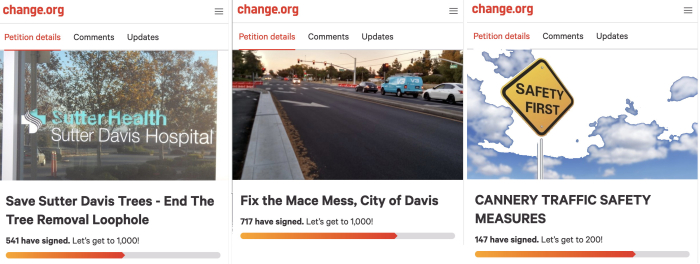
    What do trees being cut down at Sutter Davis Hospital, the Mace Mess, and Cannery traffic safety have to do with one another?

    At first glance, not much.  They are in three entirely different parts of town.  Two of them do have to do with traffic and safety in part, but each has its own features.  For example, residents near Mace Boulevard are concerned about the addition of over-engineered road structures they were not consulted on, and in light of increased traffic and other problems, would like them removed.  And neither traffic safety at the Cannery nor the Mace Mess seems to relate to the removal of mature trees done without any input from the relevant City Commissions.

    But those who have been following the Davisite might have noticed a commonality: in all three cases, citizens felt strongly enough about the issue to create a petition, as described in the following articles:

    When citizens are moved to create and sign petitions, it’s a signal that they feel that their voices aren’t being heard through normal channels, such as comments at the City Council or letters to the editor of the local newspaper. With a petition, citizens are trying to speak loudly, with one voice.

    (more…)

  • WWJTD?

    How to take back some control in the COVID era

    IMG_0530

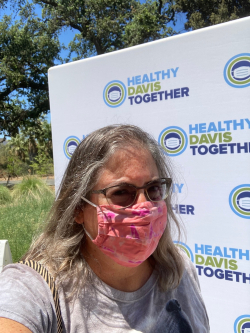
    Your author, walking the walk

    By Roberta Millstein

    With COVID cases re-surging in California and locally as a result of the highly transmissible “delta variant”, it is hard not to feel powerless.  Maybe you got vaccinated (I hope so – if not, please do).  Maybe you are still wearing a mask when indoors in public places (I hope so – if not, please do – Yolo County is now recommending it).

    And yet, we sit here and watch the numbers rise yet again, the product of yet again opening too soon even as the voices of many epidemiologists told us not to.  Our political leaders bowed to public pressure and who suffers?  Well, everyone, individuals and businesses alike.  We’ve taken the shortsighted route and with numbers trending up again we’re headed back to the bad scenarios we thought we left behind.

    What can we do?  I ask myself, WWJTD?  That is, What Would John Troidl Do?  In these times I am especially missing the wise guidance of John Troidl.

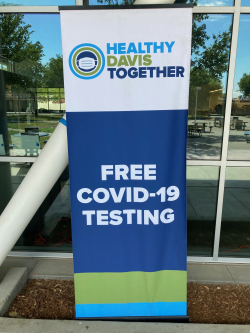
    IMG_0515I don’t know for certain what he would say, but as he did so many times while he was still alive, I expect he would urge us to get tested regularly.  Yes, even if you’ve been vaccinated.  Being vaccinated dramatically reduces your chances of contracting COVID, but it doesn’t eliminate the possibility entirely, and I don’t think it eliminates the possibility of transmitting the virus, either.

    (more…)

  • Surprising outcome and a few oddities at Planning Commission meeting

    Housing-ElementBy Roberta Millstein

    This is just a short update to follow on the Davisite’s earlier articles concerning the Housing Element Update (see here, here, and here).

    This past Wednesday (June 9th), the City of Davis’s Planning Commission met for a second time to discuss the recommendations of the Housing Element Committee (HEC)– the first meeting was May 26.  At the earlier meeting, most of the comments from the public concerned 10 recommendations that the HEC had passed.  And a good number of the comments came from UC Davis students who were apparently reading from the same script, since their comments were identical or nearly so.

    So, one might have expected that the June 9 meeting would be more of the same.  But that was not the case.

    (more…)