Davisite Banner. Left side the bicycle obelisk at 3rd and University. Right side the trellis at the entrance to the Arboretum.

Author: Roberta Millstein

  • Response to Rich Rifkin: Not all species are created equal, but all deserve our concern

    In a recent post, I pointed out that the Endangered Species Act is under threat, and that responding to that threat requires our attention at the national, state, and local levels.  As if on cue, in a recent op-ed in the Davis Enterprise Rich Rifkin dismisses potential effects on three species at the Field & Pond site: the tricolored blackbird, the valley elderberry longhorn beetle and the golden eagle.

    Blackbird_tricolored_male_summer_california_monte-m-taylor

    Picture attribution: By Tsuru8 – Own work http://www.tsuru-bird.net/image.htm, CC BY-SA 3.0, https://commons.wikimedia.org/w/index.php?curid=8708549

     I don’t really have an opinion about whether there should be a B&B and regular parties on the Field & Pond site.  It strikes me as a classic land use conflict, and I can see both sides of the argument.  But regardless of the merits of either side, and regardless of the motivations of either side, the impacts on those three species need to be examined. 

    Rifkin states that all you need to do to assess impacts is ride a bicycle and look.  When he went, he saw “a few structures, native trees, a large pond” as well as a doe and a fawn “chilling,” and he thinks that’s enough to determine that the blackbird, beetle, and eagle species won’t be affected.  Well, sorry, but that’s not how you evaluate impacts on endangered species (or threatened species, or species of special concern).[1]

    (more…)

  • A response to Tanya Perez on the purpose of the Davis Enterprise

    Perez-and-Beckett In Sunday’s paper, Tanya Perez writes a spirited and mostly reasonable defense of the Davis Enterprise, but she doesn’t quite get it.

    Lamenting the loss of eagle-eyed editor Debbie Davis, AP news stories, and the like, Perez writes:

    The Enterprise aims to give you the information you cannot get elsewhere. We know you have Google, so you can look up the recipe sections we no longer carry. You can Google comic strips you miss, or AP News stories or national headlines.

     We are trying to give you context for local issues. And we are working to tell you what people in our immediate area want to know. That is our core mission [emphasis added].

    Right on.  This is certainly why I subscribe to the Enterprise – why I subscribed as soon as I moved here and why I continue to subscribe.  I am always a little baffled when people say they don’t read the local paper.  I think it’s important to know what is going on around us, even more so than what is going in the state or nation.

    Where I think she misses one of the core missions of a local paper, however, is where she writes:

    (more…)

  • Thinking Globally and Acting Locally (and Beyond) for Endangered and Threatened Species

    British-Columbia-eagleThere are important lessons to be learned from the case of the bald eagle.  The Endangered Species Act (ESA) – now under threat itself – is important, but as the bald eagle shows, we have to use all the tools available to us at the local, state, and national levels to protect endangered and threatened species.

    The iconic bald eagle is considered a success story of the ESA, although the truth is a bit more complicated than that.  Before the ESA was passed in 1973, the bald eagle was covered by preceding legislation such as the 1918 Migratory Bird Treaty and the Bald and Golden Eagle Protection Act of 1940.  Two other actions are considered crucial to the recovery of the bald eagle in the U.S.: the banning of the pesticide DDT in 1972 and the subsequent importing of eagles from Canada to the U.S. in the 1970s.  Together, these protections and actions allowed the bald eagle to be removed from the list of endangered species. 

    Although the bald eagle still has some protections within the U.S., its delisting under the ESA does present some challenges; for example, prime bald eagle habitat can be developed on without facing legal challenge.  Thus, we should not rest on our laurels too much, even for a success story like the bald eagle.

    Moreover, at the national level, the ESA is under attack.  As the New Yorker summarizes:

    (more…)

  • Women for Water Research swim Trans Tahoe Relay

    On Saturday, July 21, I had the opportunity to join five other UC Davis-affiliated women to swim the Trans Tahoe Relay.  The Trans Tahoe Relay serves as a fundraiser for Keep Tahoe Blue, but we also swam to support the  Tahoe Environmental Research Center (TERC) and the Center for Watershed Sciences (CWS).  The day was sunny, the water was cool, clear, and refreshing, the mountains ringing the lake were beautiful.  It was an exhilarating, fun, tiring, and fulfilling day.

    Tahoe-overlook

    Just to give a sense of size of the lake and its surroundings, here I am with my guard poodles at a Lake Tahoe overlook in August 2014.

    The Trans Tahoe Relay is a race that crosses the northern end of Lake Tahoe from east to west at a part of the lake where it is 10 miles wide.  (The lake overall is approximately 22 miles long and 12 miles wide – it’s a very large and deep lake!).  Teams are composed of six swimmers each, with a support boat.  (We owe big thanks to TERC for providing us with a boat and to TERC’s director, Geoff Schladow, for piloting the boat).  The rules are that each swimmer swims for 30 minutes, and then takes turn swimming 10 minutes each, until the 10 miles is completed.  On our team, after our first leg each of us did two 10-minute legs, with two members of the team doing a third 10-minute leg.  So, we didn’t break any speed records, but we were happy with our result anyway!

    (more…)

  • Bad process leads to mediocre decision on pesticide use in Davis, and not without wasted time and effort from staff and citizens

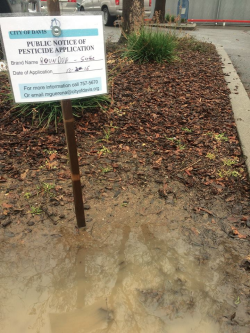
    PesticideapplicationAt its November 7, 2017 meeting, the City Council voted to change its Integrated Pest Management (IPM) policy, as well as ban the use of neonicotinoids (implicated in colony collapse disorder in bees) and a phase-out of glyphosate (often sold as Roundup, listed by the State of California as a probable human carcinogen). The decision was a mixed bag, containing some good elements and some bad.  This article describes some of the events that led up to that decision.  I write now because, with a new Council just seated, I hope that some of the bad process chronicled here can be avoided for future decisions.

    This piece will of necessity be a bit lengthy.  And that is part of my point.  It took far too long for this issue to come to the City Council for a vote.  At every turn certain staff members[1] sought to delay and subvert the will of commissioners, of citizens, and even of City Council members.  As Jon Li says, sometimes one has to ask, “who is in charge in Davis?”

    (more…)

  • Preserve our right to be heard at City Council meetings

    GaggedIf you want to preserve your right to speak in general public comment at City Council meetings, come to the City Council meeting today (Tuesday, July 10) at 7:15 PM and express your concerns about the proposal to shunt some of general public comment to the very end of the meeting.  Maybe you’ve never spoken at a Council meeting.  Maybe you don’t think you would. But it’s exactly when our concerns are the greatest that we find ourselves doing things that we didn’t expect we’d do and when we most need to preserve our right to speak.

    Although I’ve spoken at Council meetings a number of times, I don’t believe I’ve ever spoken at general public comment at the beginning of the meeting (exception: my first time when I didn’t understand how things worked).  But I have heard others give general public comment.  They speak of issues that the Council might not yet know about or has yet to take up and place on the agenda.  Or they speak to items that are on the agenda, but for which they cannot stay to speak. They speak with passion and conviction.  Maybe the issues aren’t important to me.  But they are important to the speaker.  In a democracy, all voices should be heard, even those we disagree with or those who speak about things that we ourselves do not care about, because when it’s our turn, we will want to be heard.

    (more…)

  • Has the City Council already made up its mind concerning the proposed Mace Ranch business park?

    Coming-soon-screenshotWill the new City Council listen to its commissions and its citizens?

    This morning, I learned of a new proposed Mace Ranch business park from a Facebook post from Councilmember Lucas Frerichs, a post that tagged the soon-to-be other four members of the Davis City Council (among other people).  The proposal seems reasonable to me on its face in terms of its size, purpose, and location, although I reserve judgement until I have heard more about it.  What shocked me, however, was Councilmember Frerichs’s proclamation that the project was “Coming soon!!” with “approval expected,” as captured in the screenshot at the beginning of this post.

    I find this shocking because the proposal hasn’t even gone to the Planning Commission yet (as Councilmember Frerichs notes), nor has the City Council had an opportunity to hear from citizens. Will any concerns be raised that make the City Council think twice about the proposal?  It would seem that Councilmember Frerichs, at least, does not think so. 

    (more…)

  • On building new pools for DHS and the City

    DAM-poolAs was probably obvious from my earlier article, I’m pretty pro-swimming.  The science backs me up, with numerous documented health benefits from swimming, especially cardiovascular benefits but also muscular and psychological benefits.  It’s a sport that people often take up after they have been injured from some other sport, and it’s a true lifelong sport, with active participants into their 90s and beyond.

    In light of that, with various proposals on the table for building new pools in Davis, you might think I am also pro-pool.  And generally speaking, I am – but I also recognize that any proposals for new pools must be weighed against other priorities, and those are complicated conversations.  So, what I’d like to do here is much more minimal, namely, to just point out the extent of the need for pools in Davis, because I think there has been some confusion as to how many “private” swim group workouts there are and whether those groups could make use of a high school pool.

    (more…)

  • Democracy and general public comment: A reply to Jon Li

    Brett_LeeI want to thank Jon Li for his thoughtful response to my earlier article, an article that objected to the recent proposal to limit the time for general public comment at the beginning of Council meetings, shunting the rest of general public comment to the end of the meetings.  His remarks provide the opportunity for me to reflect more on the nature of democracy as it pertains to our humble town.

     Jon asks us to think about the real purpose of public comment and about the nature of a representative democracy, and rightly so.  It is my view that recent events, both regionally and nationally, have shown us that just showing up to the polls and voting during elections is not enough.  Citizens can and should be more engaged than that.  Of course, ultimately we do rely on our elected representatives to make decisions.  But it is incumbent on us to let them know where we stand on issues, to raise concerns that they may not have thought of, to give them the information that they need in order to be able to properly represent us.

    (more…)

  • Problematic changes proposed for Davis City Council meeting comments

    Brett_LeeThe City Council is considering some changes to its meeting format, according to the Davis Enterprise:

    One suggestion was to limit general public comment at the beginning of the meeting — requiring that it end at a specific time — and continuing it for those who still wish to speak after all other agenda items have been dealt with.

    The reason for the possible change?

    “The idea is that as we start with a new council in July, that we find a way to make the meetings more accessible for the public and make them function more smoothly,” [Brett] Lee said.

    So, meetings will be more accessible for the public if we force some members of the public to wait until the very end of the meeting to make general comments?  No. That would make meetings less accessible.

    (more…)