

By Janet and Joe Krovoza
On Tuesday, August 27, 2023, Yolo County Superior Court judge Timothy Fall ruled that the City of Davis is not required to complete any additional environmental review under the California Environmental Quality Act (CEQA) before proceeding with relocation of the Sky Track from its original location. The ruling isn’t final yet. A formal order will be issued in a few weeks.
The case turned on Judge Fall accepting the city’s use of the “small accessory structures” categorical exemption of CEQA. The CEQA guidelines provide examples for this category of exemption as “garages, carports, patios, swimming pools, and fences.” The guidelines describe accessory uses as: “(a) On-premise signs; (b) small parking lots; and (c) Placement of seasonal or temporary use items such as lifeguard towers, mobile food units, portable restrooms, or similar items in generally the same locations from time to time in publicly owned parks, stadiums, or other facilities designed for public use.”
We disagree that such an exemption is appropriate. Unlike the CEQA guidelines’ examples, the Sky Track is permanent, not “temporary or seasonal,” and creates an inescapable abrasive industrial sound that ports sound directly into homes whenever it is in use, interrupting sleep, rest, and concentration, and impacting physical and mental health. Accessory structures aren’t known to have moving mechanical parts proven to violate a noise ordinance standard.
Under CEQA, even when an exemption is applicable there can be exceptions. Stay with us here. Yes, there are exceptions to the exemptions. One exception is for “unusual circumstances.” We argued that even if the court agreed that the “small accessory structure” exemption was appropriate, a structure such as the Sky Track would merit an unusual circumstances exception. And yet, even as the loudest and largest play structure in Davis currently shuttered because it violates the City’s noise ordinance, Judge Fall ruled that the unusual circumstances exception would not apply.
The City was successful here. The upshot is that the City will not be required to prepare an EIR, which would have included consideration of alternatives (such as locations further from homes) and mitigation measures (though we acknowledge the City has tried these and none work).
Before moving to what’s to come, one interesting aspect of CEQA is that the law is only about process — specifically when an EIR or other additional environmental documentation will be required before a decision is made. Even if an action will violate a city or county ordinance or a state law, that doesn’t necessarily mean an EIR is required. The City’s outside counsel at the hearing (not the city attorney) correctly emphasized this point to help their CEQA case. However, this same issue foreshadows that the City’s compliance with its own noise ordinance remains in contention.
Thus, with the CEQA issue addressed, the City still faces an enormous legal cloud should it proceed with locating the Sky Track in Arroyo Park. If the City decides to spend tens of thousands of dollars to move the Sky Track within Arroyo Park nested between homes, all neighbors will still be free to measure the noise day and night and take actions against the City when violations occur. (Quick review: the Sky Track is disabled now and must be moved because it’s unquestionably non-compliant using both the City’s raw data and the City’s distorted interpretation of the noise ordinance.)
Remaining Issues
The new “Location B” adopted by the city council on August 30, 2022, has already been acknowledged by the City as infeasible due to its proximity to multiple mature sycamores. While the city’s sound engineer identified Location B (a small point on the northern tip of the grass east of the pool) as compliant by .5 dBA Leq and .8 dBA Leq to homes on the south and north respectively, that location can’t actually be used. With Location B out, staff have identified an area we believe is 16 meters to the south and that will further reduce the last open grassy area of the park.
Obviously, this all raises points we have made before: Why was the City Council asked by staff in August 2022 to approve an infeasible location? Why did the city spend precious city dollars to defend its right to place the Sky Track at a location it doesn't plan to use?
The charts below were prepared by a friend. The “Approved Location B Impacts…” graphic shows the city’s predicted narrow compliance with the lower nighttime limit of 50 dBA using Leq (average) measurements and no compliance using Lmax (peak) measurements. This illustrates the narrow band of possible compliance at the site they can’t actually use. The second chart “Realistic Location Impacts…” demonstrates that the revised and not yet approved location to the south will move the Sky Track out of compliance by 1.1 dBA and .8 dBA Leq for residences to the south and north respectively, and far more out of compliance for the Lmax levels. Correspondence discovered during the CEQA case between city manager Mike Webb, staff, and noise consultant Robert Woo confirms that the Realistic Location will exceed the 50 dBA Leq nighttime noise limit by 1.9 dBA Leq (even more than our estimate) for the nearest home to the south. The Lmax levels for the Realistic Location will be in clear violation day and night.
[insert charts] If possible with these titles added:
Projected Noise Impacts from City’s Approved “Location B” that can’t be used
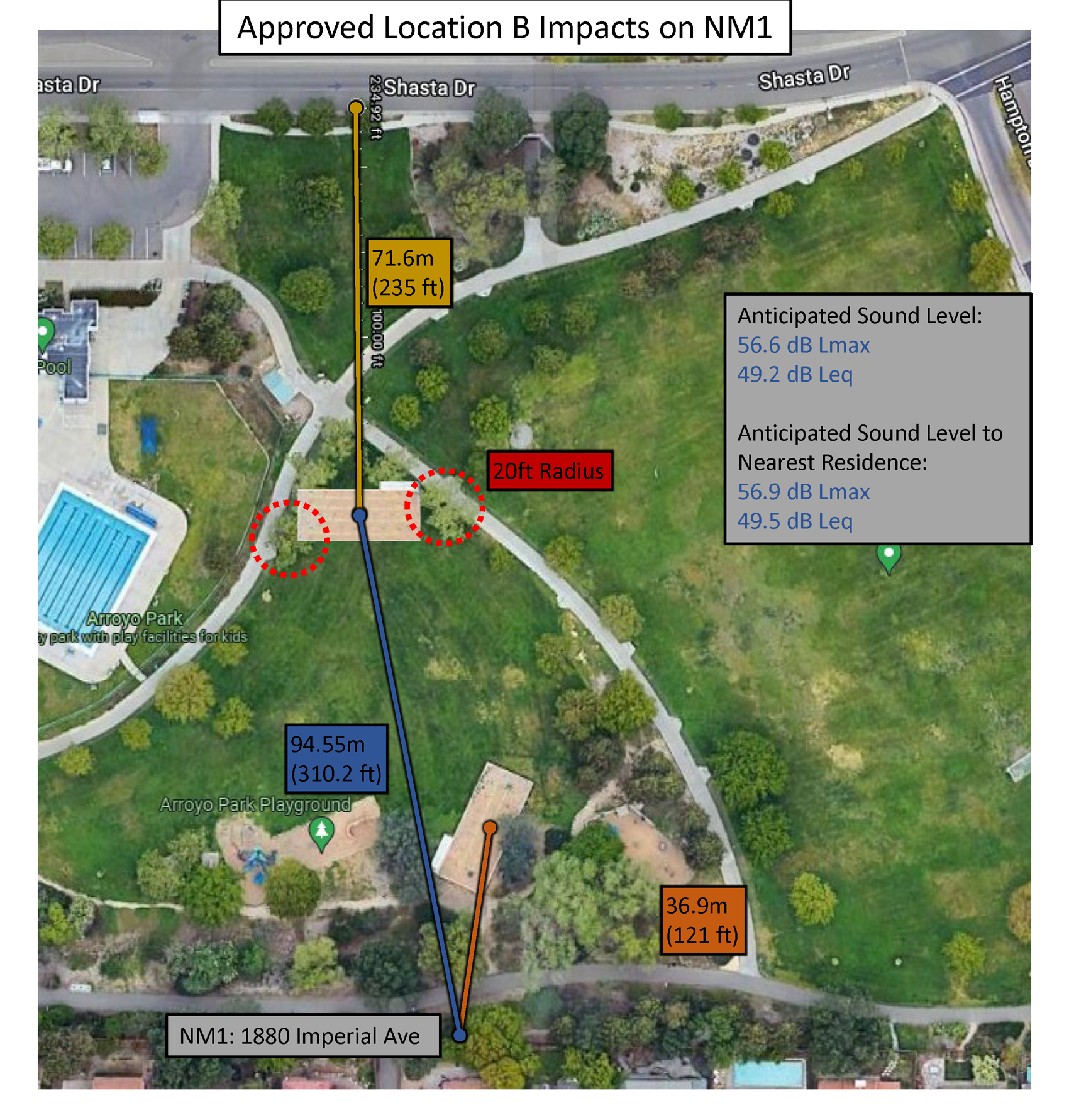
* Values are calculated using simple sound attenuation methods (Inverse square law)
Projected Noise Violations from City’s Realistic Location (not approved by City Council)

* Values are calculated using simple sound attenuation methods (Inverse square law)
At a bare minimum, if placed in the Realistic Location the Skytrack will require night locking and morning unlocking, a process that failed repeatedly in the past due to management or staffing missteps and that was thwarted by vandalism. The hard costs – not management time – for locking/unlocking was approximately $15,000 per year when the Sky Track was in operation. Further, the Realistic Location would require a new city council approval and that decision would be subject to new challenges and public scrutiny.
Perhaps the most important looming issue is that if the City proceeds it will face challenges to its insistence on using Leq (average) noise numbers to attempt to establish compliance instead of the Lmax numbers the ordinance calls for. As those following this know, the City’s noise ordinance clearly defines noise to include “repetitive peak level” noise and sets limits of 55 dBA day and 50 dBA night for “Maximum Noise Level (dBA).” “Repetitive peaks” and “Maximum Noise Levels” simply must be measured using Lmax (maximum) readings or some equivalent, not Leq (averaged) readings. Averages hide peaks and maximums and will effectively increase noise levels throughout the City, not just for the Sky Track. Imagine how difficult or impossible it would be to manage the noise from a neighborhood party if an officer must stand out front with a noise meter for some period of time to determine the Leq/average noise level. The City has proposed that Leq averages be measured over the course of an hour.
In 2021, realizing that the noise ordinance on the books would prohibit the Sky Track from being operated near residences, City staff proposed to the City Council that the ordinance be changed. The proposed changes were: exempting itself, changing Lmax to Leq and using hourly averaging, and removing “repetitive peaks” from the definition of noise. This staff-driven effort – which came out of the blue on the Friday night before the Memorial Day weekend – was soundly rebuffed by the public and was withdrawn by an apologetic Mike Webb the night of the Council meeting. But now what they couldn’t do in the proper way with a transparent suite of amendments via an appropriate public process, they are trying to do by staff subterfuge. We aren’t making this up!
This is where we are. No EIR is needed and future compliance at any location in Arroyo Park is either highly questionable (with Leq) or impossible (with Lmax).
What’s Next?
This case was about what CEQA might or might not require during the decision-making process. It wasn’t about the city ignoring its own guidelines for park improvements before staff unilaterally placed the Sky Track in the park – not even consulting the Recreation and Park Commission. It wasn’t about skirting the competitive bid process due to a cozy relationship between staff and the successful vendor GameTime’s representative, even though at least six other companies submitted concepts. It wasn’t about staff directing the installer (the husband of the GameTime sales rep) to change his bid to avoid a competitive bid for the installation contract. And it wasn’t about the City’s ongoing attempt to use a wishful staff interpretation of the noise ordinance to justify placing the Sky Track in Arroyo Park.
The City prevailed on CEQA, but it has painted itself into a corner where more money and staff time will be wasted for no good reason. Time will tell whether our current City Council will continue to force the Sky Track into Arroyo Park, or whether they might conclude that the park was designed just fine, has been enjoyed as is for years, that open space is a valued amenity along with the numerous existing play structures, and limited resources are better spent maintaining the landscaping, upgrading the old BBQ pits and picnic tables, and repairing the dangerous cracked paths.
We continue to hope the City will move on from its perplexing obsession with keeping the Sky Track in Arroyo Park and will find another location where the public can access and enjoy it freely.

 Davisite
Leave a reply to David L. Johnson Cancel reply