

How the Son of Robert McNamara Coped with Vietnam War; Wrote Painful, Revealing Book About His Father
By David L. Johnson
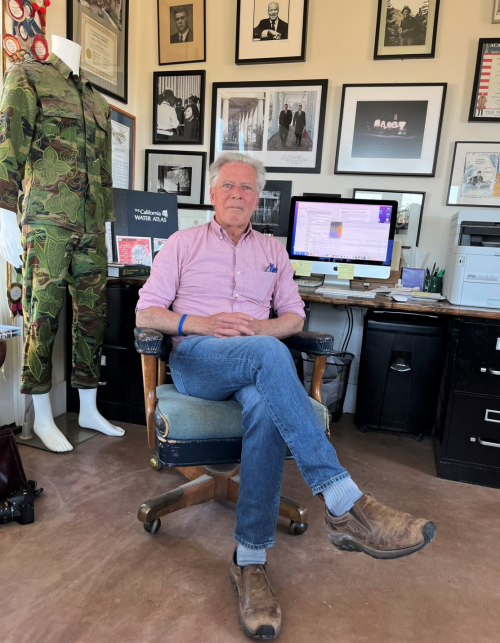
“My father loved me to the end of the earth and I loved him. But in any relationship, there are huge caverns, crevices and dysfunctions. I had so desperately wanted to learn about Vietnam from my father, but it never happened.”
The father is Robert McNamara, the Secretary of Defense under Presidents John F. Kennedy and Lyndon B. Johnson in the 1960s. McNamara is known as one of the chief architects and defenders of the Vietnam War. The quote is from McNamara’s son, Craig McNamara, an organic walnut farmer in Winters, who in 2022 wrote the book “Because Our Fathers Lied, A Memoir of Truth and Family, from Vietnam to Today,” a heart wrenching indictment of his father’s integrity and actions on the Vietnam War.
The following article is based on a June 2023 interview with Craig McNamara in his office overlooking his 450-acre farm.
*****
After being appointed by President Kennedy, Robert McNamara, his wife Margaret and their three children moved in 1961 to Washington D.C. Previously, McNamara had been president of the Ford Motor Company and was part of the company’s “Whiz Kids” a group of World War II veterans who focused on statistics, management control systems and logistical and operational information.
Craig McNamara writes in his book, “The draw of the Kennedys and the excitement of Camelot must have seemed to present a dynamic and bright future.” In Washington, Craig attended Sidwell Friends School in Washington for four and half years where he was taught lessons of compassion, which has carried through into his adult life.
As early as 1963 when he was 13, Craig had questions about his father’s integrity. His suspicions were partially confirmed a few years later when he was involved in a “Teach-In” against the Vietnam War at his boarding school, St. Paul’s, in New Hampshire. Craig phoned his father and asked for information about the war and arguments supporting it. His father agreed, “Sure, Craigie, I’ll have my secretary get on it.” The information never arrived.
In our interview, Craig expanded on why his father failed to provide him with information supporting the war. While writing his book, Craig became extremely close with Daniel Ellsberg, meeting him on about 20 occasions in Ellsberg’s home near Berkeley. In 1971, Ellsberg leaked portions of 7,000 pages of classified documents known as the “Pentagon Papers” about the history of the Vietnam War. The release of the Pentagon Papers, commissioned by Robert McNamara, ultimately helped end the war.
Because of his lengthy meetings with Ellsberg, Craig said,
“I now know through Dan’s research, his books, and other historical research that my father knew that the war was not winnable as early as 1965. By 1966 how many people had died? How many tons of napalm and Agent Orange had we dropped? How many lives had been disrupted? I have come to realize that this must have been in the forefront of my father’s thought process. Is he going to send his son information that’s false, falsely building support for the war, when he knows it’s unwinnable? Could he lift the veil of dishonesty about the war that he engineered? In reflection, I believe he just felt he couldn’t do that and it never arrived.”
Perhaps one of the most significant reasons why Robert McNamara supported the war was his loyalty to Kennedy and Johnson. During our interview Craig showed me a May 10, 1968, issue of Life Magazine which had a 14-page detailed article on Robert McNamara. Craig became aware of the article after he had written his book.
In the article, McNamara surprisingly states,
“Around Washington, there is this concept of ‘the higher loyalty,’” he says with just an edge of contempt. “I think it’s a heretical concept, this idea that here’s a duty to serve the nation above the duty to serve the President, and that you’re justified in doing so. It will destroy democracy, if it’s followed. You have to subordinate a part of yourself, a part of your views.”
According to Craig, this passage,
“…sums up my father’s thinking of service, loyalty and duty. I always remember that my father took the same loyalty oath that our congressmen and women take, that our city council members take. When you take that loyalty oath, you take it to serve the nation, not to serve a president.”
Craig continued,
“I wish I had formulated my opinions about (loyalty) during his life time. I really would have liked to talk with him about it. I wish that my book had been finished before his death. I think as difficult, as painful for him to read the book, and as challenging for us to discuss it, I fully believe with all my heart, it would have opened up a passage in his life in our lives, for him to relieve his wounds and his pain.
As importantly, to seek some sort of ability to correct some of the damage he did in Vietnam, to correct the damage that he did with our own veterans, to ensure their health is his primary focus both in this country and the health of families that are still suffering from Agent Orange both in the United States and in Vietnam and unexploded ammunition. Had he been able to fully embrace his duplicity, he could have moved towards helping other people.”
Besides the misdirected loyalty that Robert McNamara advocated, there was a more sinister plan being plotted inside the Pentagon which only a handful of persons knew about it.
General William Westmoreland, who was Chief of Staff of the U.S. Army and previously commander of all forces in Vietnam, approved a secret plan in 1968 to transfer nuclear weapons to South Vietnam for possible tactical use at Khe Sanh, a key battle site in the war. The plan, code-named Fracture Jaw, was not known to the public until 2018 when Michael Beschloss, a presidential historian, broke the news which was published in The NY Times.
In reference to the Vietnam War, Robert McNamara once told his son, “I made mistakes, Craigie.” But the nuclear weapon plan was not one of them. According to Craig, his father was holding off the Joint Chiefs of Staff to stop the transfer of nuclear weapons to Vietnam. Ultimately the plan had a short life span. President Johnson was furious when he learned about it from National Security Advisor Walt Rostow in an “Eyes Only” memo and immediately cancelled its implementation.
Despite the chaos in Washington D.C. in the 1960s, there were light-hearted moments in the McNamara home. Craig’s mother, Margaret Craig McNamara, who created the oldest and largest non-profit children’s literacy organization in the U.S., “Reading is Fundamental,” was a good friend of Lydia Katzenbach, wife of Nicholas Katzenbach, then Attorney General under President Kennedy. Margaret McNamara was also involved in civil rights demonstrations in Washington D.C. in the 1960s.
Margaret and Lydia were talking on the telephone one day when all of a sudden on the line a band started playing the Star-Spangled Banner. Of course, neither of the two women were near any band. Most likely, the McNamara phone was tapped and probably by the FBI. Margaret may also have been followed at a civil rights demonstration in Washington D.C.
In response, Margaret and Lydia would create wonderful stories, embellished stories to whoever was listening. But there is a darker side to this episode. Long time FBI director J. Edgar Hoover established a secret program in 1956 called COINTELPRO allowing agents to tap phones, infiltrate organizations, follow people and perform other dirty tricks – mostly illegal and unconstitutional – on persons who were legally advocating for civil rights or against the Vietnam War. Given that Hoover was paranoid about certain changes to the status quo, it’s no surprise that the McNamara telephone might have been tapped by the FBI.
In spring of 1971, Craig, who was an anti-war activist, dropped out of Stanford University and left with two friends on a motorcycle trip to South America, which morphed into a two and one half year life-affirming journey. I asked Craig why he dropped out given the military draft was in affect and there was pressure to stay in college and succeed, at least in the traditional sense, and it took a degree of independence and unconformity to drop out and explore.
Craig responded by saying that in 1969 he received an induction notice to report to Oakland for a military physical. During the physical, he told a psychologist that he suffered from ulcers brought on by family issues and Vietnam. Nonetheless, he received a 1-A “available for military service” rating. After a year he was able to prove through medical records that he, in fact, had ulcers and obtained a 4-F “not qualified for military service” rating. Like many other young men, Craig found the process a humiliating experience.
“I was not proud of that experience at all. I think it contributed to my disenfranchisement and disillusionment with our country and my desire to understand why we were at war. And I left the country because of that. And it really was the journey, living with subsistence farmers, of living in poverty, and working diligently in agriculture, that gave me the understanding of the beauty of our country, the beauty of the people and the injustice of the war. I decided to grow food as my contribution to help disadvantaged people have nutritious healthy food. And that journey brought me to UC Davis at age 24 to study plant soil science that would launch the farm where we are sitting on right now.”
Craig’s trip to South America culminated in Chile’s Easter Island, also known as Rapu Nui, which had about 1,500 inhabitants. At one point, he lived in a tube cave carved from lava flows, without water or electricity. This is where he discovered farming. Craig realized that local inhabitants were drinking powdered milk from Denmark while at the same time there were cows roaming around the island. So he organized a dairy cooperative delivering milk by horseback in 5-gallon glass and wicker containers, yelling out “Fresh Milk!” in the Rapu Nui Polynesian language. Craig recently learned from an anthropologist that what he was actually yelling to locals was “Breast Milk For Sale!”
After returning to California and having decided to become a farmer, Craig hitchhiked from San Francisco to Davis to enroll at UC Davis. As he needed a place to live, he started knocking on doors asking if there was a room to let. Craig’s long hair and beard probably did not help, but he finally found a woman willing to rent him a room in a cottage on J Street, fifty feet from the railroad tracks. They are still friends to this day. Craig graduated from UC Davis in 1976, with an Integrated Crop Production Science major, which he designed himself.
Robert McNamara passed away on July 6, 2009. His will strangely stipulated that all of his possessions and personal affects were to go to his second wife and not to his three children. (His first wife, Margaret, passed away in 1981.)
But his second wife wasn’t there when most of these historical and personal possessions were acquired, including love letters between Margaret and Robert McNamara from World War II and two presidential cabinet chairs, John F. Kennedy’s and Robert McNamara’s, which were gifts from Jackie Kennedy just eight days after President Kennedy was assassinated.
These historical possessions also included a gift to McNamara from Jackie Kennedy of a silver plaque paperweight with an October 1962 calendar – commemorating the 13 days of the Cuban Missile Crises – engraved with the initials “R.S. McN” and “J.F.K.” Craig grew up with these items in the family’s home and they were a strong emotional connection with his father.
The lessons Craig learned about compassion from the Sidwell school in Washington were clearly evident in his response about his father’s will,
“We all have complicated families. That decision was wrong. But my focus is on wellness. It’s important to look at the Vietnam War and to bring health to ourselves and the men and women who suffered in that war. What I’ve tried to do is to turn (my father’s decision) into something that I can learn from and that is a legacy for change.”
Robert Crumb, the counter-culture cartoonist who signs his work as R. Crumb, visited Craig in June 2023 to discuss Craig’s book. Crumb conveyed several astute thoughts on why Robert McNamara acted the way he did towards his son by not discussing Vietnam. What was Robert McNamara protecting Craig from? Initially, both Craig and Robert believed it was a protective mechanism. In the end, they both agreed it was the pain and shame over McNamara’s decisions about escalating the war. How do you share that with your son?
Craig concluded,
“Given his generation, how was he going to reveal to his son the decisions he had made. The fear from my father’s part that I would see, the veil would be lifted and exposed, the veil of his duplicity, his dishonesty, his errors, his violence. And he was not able to do that.”
Craig McNamara wrote an extremely poignant sentence in his memoir that encapsulates his life, the book he wrote and the strong emotions behind it. Craig wrote, “For years I couldn’t utter the word Vietnam without wanting to cry.”
The Vietnam War ended on April 30, 1975. According to Craig McNamara’s research, our presidents and leaders knew it was unwinnable in 1965.
David L. Johnson managed legislation and public information for a state agency in Sacramento. Now retired in Davis, he works periodically as a freelance journalist.

 Davisite
Leave a reply to Eileen Samitz Cancel reply