

By Aaron Wedra, Marketing Coordinator for the Hattie Weber Museum
In 1864 it was determined that the California Pacific Rail Road would extend eastward from Sacramento over the Donner Summit route to become part of the transcontinental rail line.
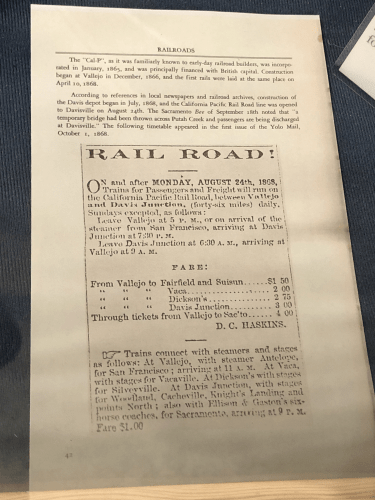
The “Cal-P”, as it was familiarly known to early-day railroad builders, was incorporated in January 1865, and was principally financed with British capital. Construction began at Vallejo in December, 1866, and the first rails were laid at the same place on April 10, 1868.
Planners for the California Pacific Rail Road Company decided to build a line from South Vallejo to Sacramento which would also connect Marysville and Woodland at a junction in Davisville. Construction and grading of the rail bed began in Vallejo in December 1866 and the first rails were laid in April 1868.
The construction of the first Davis depot began in July 1868 and the first passenger and freight service between Vallejo and Davis Junction began on August 24th, 1868. The fare was $3.00.
In the 1850s, the area of Davisville was primarily used for agriculture and raising livestock. In November 1867 private promoters of the California Pacific Rail Road line purchased about 3,000 acres of the Jerome C. Davis and Isaac Davis farm along Putah Creek. They planned to establish a train station and junction on the slightly higher side of Putah Creek which remained dry during the rainy season. Calling themselves “The Proprietors of Davisville,” they laid out a speculative town with a grid of plots and streets next to the junction of the railroad line from Vallejo to Sacramento and from Davisville to Woodland and points north.
The California Pacific Railroad line put Davisville on the map in 1868. Once the original train depot was built and rail service began, businesses, homes and the first post office appeared near the railroad tracks and the town of Davisville was born.
The advantage of trade and the availability of convenient passenger service played a major role in the development of Davis – not the least of which was the selection of Davisville as the site for the University Farm in 1906.
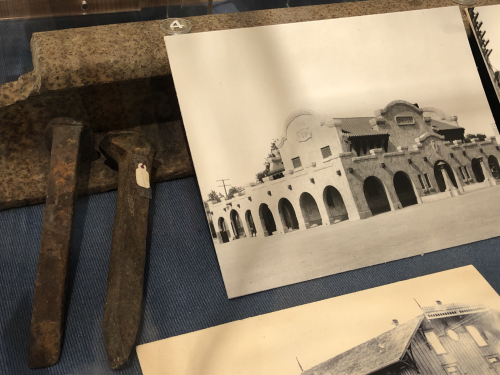
In 1871 the Cal-P was taken over by the Central Pacific Railroad; a fire later burned down the 19th century-style station. In 1914 a mission revival station was built by Southern Pacific to replace the original Davisville depot. The station is currently listed in the National Register of Historic Places and is located at 2nd & H Streets.
The revival station saw its 75th anniversary in 1988. On June 4th of that year the City of Davis was acknowledged with the George Falcon Golden Spike Award by the Train Riders' Association of California for the renovation of the train station that had recently taken place in 1986.
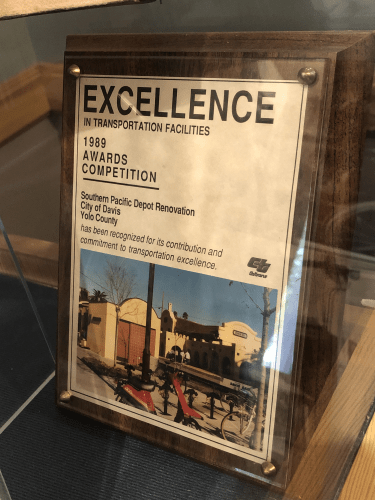
In 1989 the City of Davis and Yolo County were again recognized for the depot's renovation by Caltrans.
Today Amtrak offers two types of train service from the Davis train station: the "Capitol Corridor" service with trains about every hour east to Sacramento and west to Oakland/San Jose, and the Long Distance service with one departure daily of the Coast Starlight (north to Portland and Seattle, south to Los Angeles), and the California Zephyr (east to Reno, Salt Lake City, Denver, Omaha and Chicago). Capitol Corridor trains are the ones commonly seen in Davis, with blue orange and silver cars, about 5 cars long. Long distance trains are silver with red and blue stripes, have 2 engines, and 7-11 cars.




 Davisite
Leave a reply to Aaron Wedra Cancel reply