

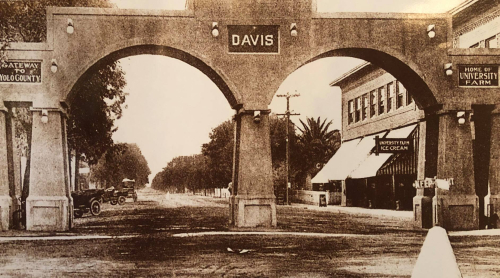
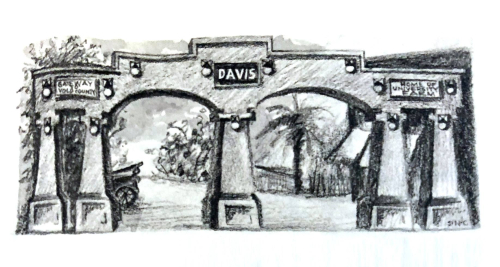
(From press release) Enjoy a rare compilation of photographs and images of the historic Davis Arch. When scrolling through the images, please pay attention to the captions for each.
Included below is a brief history of the creation and ultimately the destruction of the Davis Arch that includes the establishment of the Chamber of Commerce and the Women's Improvement Club. It is interesting to note that the Chamber still puts on occasional cleanup days, a tradition as old as the chamber itself.
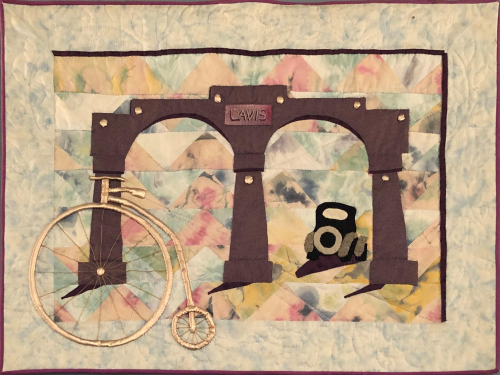
See the individual photo captions to learn more about the rise and fall of the arch as well as its revival in multiple murals and other media.
An excerpt from "Davisville '68 The History and Heritage of the City of Davis":
On May 20th, members of the Chamber of Commerce served as local hosts to Governor Pardee and State Farm Commissioners on a tour of six proposed sites in Yolo County. Representatives from Woodland and Davisville, united by the desire to bring the University Farm to their County, cooperated in providing an escort to the visiting dignitaries. An additional stop at LaRue's Arlington Farm, though not a prospective site, emphasized the potential of the Davis area for diversified agriculture.
The board of Directors of the Chamber of Commerce met in the following week and called for the community to support a new sewer system, new sidewalks, and a general clean-up of the town. June 3rd was set as the first of many community "Cleanup" Days. The Chamber also urged the ladies of Davisville to form a Women's Improvement Club, which they did on June 16, 1905, headed by daughters of two pioneer families. Jennie Drummond Lillard Read served as chairman, and Miss Maude Russell was named secretary. This early organization enjoyed a long history of community service.
Foremost among their accomplishments was construction of the Davis Arch, originally planned in 1906 as a welcoming beacon to students at the University Farm. A shortage of funds delayed completion of the archway at Second and G Streets until the fall of 1916, when Cal Aggie students themselves helped to finish it. Presiding over dedication ceremonies, in October, 1916, Forrest A. Plant referred to an earlier time when students and townspeople were not in too close sympathy, but stated, "Those old days have passed, the reverse in now happily true, and the unity of action in the building of the arch was a demonstration of the new spirit of good will—a monument dedicated to the town and UC Farm students alike." This symbol of unity of campus and community soon became an extreme hazard to increasing automobile traffic, however, and was removed in the 1920's.
Submitted by the Hattie Weber Museum.







 Davisite
Leave a reply to Ron O Cancel reply