

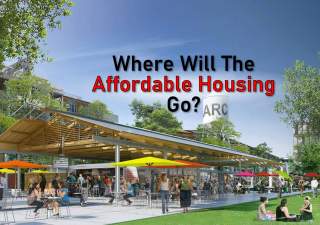
 Business Park Developer makes late offsite affordable housing disclosure.
This is a letter sent to the City of Davis on January 6, 2020 regarding the the developers disclosure at the Social Services Commission that affordable housing will likely be built at another location separate from the ARC project. This disclosure could mean the project could actually build 1,000 to 1,308 new housing units, not the 850 units in the ARC project description. The difficulty is where the several hundred affordable housing units will be built is yet to be disclosed, and their likely off-site construction has not been accounted for in the Environmental Impact Report.
January 6, 2020
Dear Ms. Metzker, City of Davis Principal Planner,
I am writing regarding new information about the developer’s plans for the ARC business park that came to light during the City of Davis Social Services Commission meeting the evening of December 16th. This new information was not provided to the public until after the 5PM December 16th deadline for ARC EIR scoping comments, but the information is directly relevant to the supplemental EIR process and needs to be considered in the new environmental evaluation of the site. Since the developer was late in providing this new information, it is incumbent upon the City to include this new information in the SEIR process.
Specifically, the new information is different than what was stated in the project description used as the bases for the MRIC EIR or for the MRIC Mixed-use Alternative included in that EIR. It is also different than any information in the previously provided ARC project description. Because this new information shows a change, it needs to be considered in the SEIR process. Since the developer did not bring this information to the public until after the closing date for scoping comments, this new information needs to be considered even though this comment has been submitted past the scoping deadline.
At the Social Services Commission meeting, the Social Services Commission and Mayor Lee expressed a preference for integrating required affordable housing into the ARC project.
When asked about this, the developer stated some willingness to include affordable housing in the multifamily housing, but also stated that, “I think that if I had a magic crystal ball here… I think that chances are we are going to have to identify sites other places and team up with affordable developers and help to finance an affordable developer product.”
It was clear in the meeting the developer intends to locate affordable housing in a location other than the proposed ARC site. This additional offsite development was not considered in the MRIC EIR and must now be considered in the SEIR. As of the Social Services Commission meeting it has become clear that ARC is only part of the new construction the developer will bring to Davis, and the additional induced growth needs to be considered.
The current ARC proposal includes 850 housing units at the ARC site east of Mace Boulevard. The current interim affordable housing ordinance would require 15% affordable housing. Under the current ordinance this could result in 150 units built off site at a yet to be identified location in Davis. These 150 new units would be in addition to the 850 units on site for a total of 1,000 housing units built in Davis. These 150 new units are in addition to anything that was included in the MRIC EIR Mixed-use alternative and therefore must be considered in the SEIR.
One difficulty is that the current affordable housing ordinance is only an interim ordinance, and the actual required housing could be much more. The Social Services voted to recommend applying whatever ordinance is in place when more specific project proposals come forward. The previous ordinance would have required 35% affordable housing. The previous ordinance would have required an additional 458 housing units if they are built offsite. 850 units at ARC plus the offsite 458 units would result in 1308 total units being built as part of the ARC project. Since the Social Services Commission has expressed a desire to increase the amount of affordable housing required in new developments in Davis, it is reasonable to believe that as many as 458 more units will be built by the developer offsite. Analysis of these potential additional 458 offsite units must be done since they are tied to the ARC project and were not considered in the MRIC EIR or the MRIC EIR Mixed-use Alternative.
For comparison purposes, the Cannery is 547 units and Sterling apartments is 198 units. 150-458 new units is a very sizable new development to add to Davis and all the impacts must be analyzed in the EIR.
This becomes more complicated by the fact that the Social Services Commission went on to pass a recommendation that included, “The commission strongly recommends onsite affordable housing.” The difficulty is that this is incompatible with the MRIC Mixed-use EIR report that assumes there will be, “1.62 employees per household,” in other words, that “approximately 1,215 to 1,377 of the innovation center employees are anticipated to live and work on the Mixed-Use Site.” (Table 8-18)
With 1.62 ARC employees on average per household is a high number already. It assumes many couples would both work at jobs located in the ARC development and/or that people who work together would be likely to share apartments. That high requirement already assumes that all or nearly all of the apartments would be filled with employees, so where would the affordable housing go? Or would there be employees who qualified for affordable housing? What about very low affordable housing? The closer scrutiny of the need for employees to live at ARC to meet the EIR goals, and the need for affordable housing makes it clear how unlikely it is the developer can achieve both on site at the same time. Or that to obtain this the resident selection process would have to be very restrictive and would likely not be legal. Thus, it is very unlikely the developer can meet the affordable housing requirement and the very high MRIC EIR goals for employees living in the ARC project at the same time. This reinforces the developer’s statements that affordable housing would be built at a different location. The induced growth at another location needs to be considered in the EIR.
But to make this even more complicated, on July 19, 2017 the City of Davis Planning Commission passed a resolution recommending certification of the MRIC FEIR that included a clarification that the Mixed Use Alternative is only environmentally superior assuming a legally enforceable mechanism regarding employee occupancy of housing; specifically that at least one employee occupies 60 percent of the 850 onsite units. City Council Resolution 17-125 to certify the MRIC FEIR on September 19, 2017, included this language, “the Mixed Use Alternative is only environmentally superior assuming a legally enforceable mechanism regarding employee occupancy of housing; specifically that at least one employee occupies 60 percent of the 850 on-site units.”
If 15% of on-site units were to be put aside for affordable housing, that leaves even fewer units to be filled by employees, unless the employees happen to qualify for affordable housing. And since there is no mechanism to give employees housing preference over non-employees, it becomes that much more unlikely that the promised average number of employees in on-site units can simply occur on its own.
Given the developer’s already stated preference for off-site affordable housing, it seems highly suspect to believe the developer will be able to house so many employees on site AND have affordable housing also on site. It seems beyond unlikely that both will happen, but there is a real lack of information at this time because the project application offers absolutely no detail on the affordable housing plan, and absolutely no detail on how the developer will attract such a high percentage of people employed in ARC to live in ARC. In either case, this is different than what was included in the MRIC EIR and therefore must be analyzed.
With this lack of information, the SEIR will just have to analyze the likely outcomes. The induced growth of offsite affordable housing will need to be analyzed and the possibility that few or no people employed at ARC will live at ARC both need to be analyzed. All of these possibilities are different from what was included in the MRIC EIR and the MRIC EIR Mixed-use Alternative and therefore must be analyzed.
Sincerely,
Colin Walsh
CC: Davis City Council, City Manager Web, Assistant City Manager Feeney, City of Davis Planning Commission, City of Davis Social Services Commission

 Davisite
Leave a reply to Ron O Cancel reply