

 By Matt Williams
In a May 31 Vanguard article and its comments the word of the day was “Crisis.” Over the past 12 months another political hype word has been in vogue … “maxi-dorm.” What do “crisis” and “maxi-dorm” have in common? They have a resonance when used as sound bites in political hype.
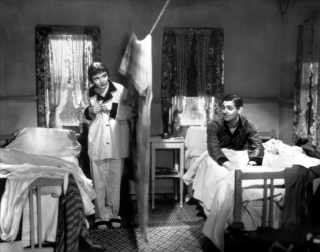
The article didn’t stop with the label “crisis.” One of the verbal images used was “We had another person describe living in a house and having to share the living room for $400 per month, with a sheet partition for privacy.” The metaphor that image tries to invoke has several interesting flaws, one of which was ironically displayed in the lead image of the article, which shows a dormitory room, where the student residents are sharing a single room for living. The second was the remembrance is stirs in most Davis viewers of the adventure and excitement of their college days, sharing a dorm room with a roommate assigned by the university. Getting to know that random stranger, sharing war stories, but without the sheet. Those were good times … anything but a crisis. Lastly, the sheet. For me it conjured up the Colbert comedy skit shown in the picture at the beginning of this article.
The “crisis” theme continued in the comments section with the following
You apparently don’t have much contact with UCD students at this point in your life. I frequently hear about difficulties in finding housing and a prevalence of “couch surfing.” We know that there is a housing CRISIS for renters in this community NOW. Why are you trying so hard to dismiss this situation?
That comment illustrates two important points. First, the use of second-hand anecdotal evidence of the experience of an unknown number of individual examples of “couch surfing” from a sample population of over 35,000. Second, that the commenter clearly hasn’t been reading my past comments on the personal research I am engaged in to better understand the problem, rather than dismiss it.
Let’s talk about that work-in-process research, which has focused on the housing supply/demand data from UCD's historical records.
What the data shows is that difficulties in finding housing in Davis have existed for the past 23 years, unabated, since the end of the four-year 1992-1996 period where the Apartment vacancy rate for Davis dropped from 8.7% in the Fall of 1992 to 5.1% in the Fall of 1993 to 2.9% in the Fall of 1994 to 1.3% in the Fall of 1995 and to 0.5% in the Fall of 1996.
Since the Fall of 1996 the median Vacancy Rate in Davis has been 0.8% and the most frequent annual Vacancy Rate has been 0.2%. In 7 of the 23 years since 1996 Davis has had a Vacancy Rate of 0.3% or below. As I have said in past comments and articles the Davis housing shortage is the status quo. It is a very serious long-standing problem, but when it comes to labeling it as a crisis, the expression that comes to my mind is one that hangs by many an Administrator’s desk …
“A failure to plan on your part should not constitute an emergency on my part.” (see also Failing to Plan Means You Are Planning to Fail!).
But the depth of the problem does not stop with a simple reporting of the historical Vacancy Rate trend. I have been saying for a long time that the Davis apartment vacancy rate “is not 0.2%, but rather minus 30%.” By that I mean that Davis has a substantial number of people in the market for an apartment who simply can’t find one to rent, which is simply another way of saying the commenter’s statement, “I frequently hear about difficulties in finding housing.” He and I are in full agreement on that.
How big is the difficulty? I’ve used the following logic to come to my minus 35% vacancy rate … according to the US Census American Community Survey for 2017 there are 11,579 multi-family units in the City of Davis. The fiscal model presented by the City to the FBC in January shows an average occupancy for multi-family units of 3.14 persons. Putting those two numbers together you get a bit over 36,000 Davis residents living in apartments. 30% of 36,000 is a bit over 10,000, and I have for a long time felt that Don Shor’s often stated claim that “Davis is short 10,000 apartment beds” is a pretty good guess.
But Don’s estimate and my concurrence still only make it a guess. Some would even say it is a wild ass guess … a WAG if you will. My work-in-process research has been directed not at dismissing that WAG, as yesterday’s commenter accused me of, but rather to move it from a WAG to a SWAG. It will always be an estimate, but an estimate with some substance to it (or better yet a range of reasonable possibilities).
What have I found thus far?
Since 1996 the 3-Quarter average student enrollment at UCD has grown 14,363 students, and as a result Faculty has grown by 2,000 and Staff has grown by 4,000. That is a combined Housing Demand increase of over 20,000 beds … and that 20,000-bed increase in demand doesn't even include the impact on demand from the spouses and children of the Faculty and Staff, nor does it include the impact on demand from people who are not students, Faculty or Staff at UCD, nor does it include the impact on housing demand from the 7,500 employees of UCD Medical Center.
UCD is still working on gathering for me the year-by-year data on the supply of on-campus beds, so any increase in housing supply that will partially offset the 20,000 bed increase in demand is still a work-in-process, but we do know from the UC Housing in the 21st Century report that the Total On-Campus Housing Supply in Fall 1996 was 4,332 and in Fall 2001 was 5,552. If you count up the number of beds on the UCD Student Housing page http://housing.ucdavis.edu/housing/ the number does not exceed 9,332, So it is not unreasonable to see an increase in supply of less than 5,000 that partially offsets the 20,000 increase in demand
Bottom-line, if David Greenwald and the commenter are correct when they say "there is a housing CRISIS for renters in this community NOW," that crisis has existed for two decades, and we have done nothing about it. It has been the status quo, and labeling it with a new sound bite doesn't change that.
Which brings me back to the argument I made in Public Comment at the October 17th Council meeting when this incarnation of Nishi was formally resurrected, it needs to be designed with at least the same density as the Nishi 2016 project. That way, we will make real progress toward addressing a serious problem that has existed in Davis for the past 23 years … a problem that has grown by 1,000 students and 500 faculty and staff each year for the past 6 years, and will continue to do so by similar amounts for each of the next 5 years according to UC Davis projections.
To do any less is simply a failure in planning on the part of the developer, the City and the University, which brings us back to “A failure to plan on your part should not constitute an emergency on my part.” (see also Failing to Plan Means You Are Planning to Fail!).
If housing demand has gone up by over 20,000 beds, what has happened to rental housing supply during that same 23-year period. The supply of off-campus Apartments has grown by only 2,800 Units. The supply of on-campus beds has
So we have a battle between the Davis taxpayer and student renters in this scenario and the winner here would be obvious as the taxpayer votes and the renter largely does not.

 Davisite
Leave a comment