

by Alan Pryor and Rick Heubeck
 Background
Four years ago three members of the Davis City Council (Lucas Frerichs, Rochelle Swanson, and Dan Wolk) voted to approve a Development Agreement between the City of Davis and the New Home Company (the Cannery site developer) that granted entitlements to the New Home Company to construct 547 residential units and a Commercial District on the 100 acre former cannery site. Then Mayor Joe Krovoza and Councilmember Brett Lee opposed the project
Part of that Development Agreement was the construction of a "grade separated " bike and pedestrian access tunnel or bike bridge that would provide a safe crossing of Covell Boulevard. Then Mayor Joe Krovoza, and Councilman Brett Lee in part opposed the project because they had advocated for two "grade separated " crossings.
After the City Council voted for the final agreement, the Davis Enterprise reported that the developer agreed to provide two million dollars for completion of a single grade-separated crossing which was the estimated maximum cost at that time.
However, the council vote to approve the Development Agreement took place before completion of the Covell Corridor Traffic Study. Vehicle traffic from the new Cannery residents was to be mitigated through measures identified in the Covell Corridor Study which would identify upgrades to Covell Boulevard. These measures would improve traffic flows along Covell Boulevard. Unfortunately, the prior passage of the Development Agreement precluded requiring Cannery to completely fund these traffic improvements.
Further, the route and type of the "grade separated " crossing had yet to even be identified. Subsequently, the Davis Enterprise reported that the New Home Company was only obligated to pay up to 1.4 million dollars while the actual cost would be $7 million for an over crossing, and $10 million for and under-crossing of Covell Boulevard!
To date, the long promised grade separated crossing of Covell Boulevard to reduce vehicle traffic that was part of the original Development Agreement has never been constructed.
In 2016 the Cannery Developers submitted another modified proposal to amend their original Development Agreement with the City to construct 24 additional units to the 547 units and a "Marketplace Center" that were originally approved in 2013. Now they are back again with yet another significantly larger proposal for the “Leeland Marketplace” portion of the site. The current proposal also includes an additional 90 residential units in three three-story buildings. The Staff Report recommending approval of this current project is available on the City’s website at http://documents.cityofdavis.org/Media/Default/Documents/PDF/CityCouncil/CouncilMeetings/Agendas/20180220/05-Cannery-Marketplace.pdf
The Cannery project has been controversial from the beginning for many reasons. Many citizens opposed the first phase of the project because they thought the City rushed through a Development Agreement in 2013 that heavily favored the developer. Those opponents claimed, among other things, that the City Staff and Council were far too malleable and willing to accept both vague promises of future traffic mitigations (e.g. the long-promised grade-separated crossing) and the imposition of Mello- Roos taxation fees on new residents to the City’s financial detriment.
Subsequent piece-meal amendments to the original Development Agreement added more residential units to the Cannery and were dutifully approved by our Council with exceptionally lenient review from staff. Many complained this was an extremely poor way to entitle land use development and set a bad president for future large scale land use policy in Davis. Indeed, It was against this backdrop of broad citizen distrust of the City’s development entitlement process that the first Nishi project failed at the ballot box in 2016.
It seems that the great Cannery give-away continues with this current proposal. For instance, the current Leeland Cannery Partnership proposal exceeds the upper limit for both residential and commercial development proposed in the original Environmental Impact Report (EIR) that was prepared for the project and certified by the City Council in 2013. As a result, an addendum to the original EIR is now proposed as well as revision of the Neighborhood Design Guidelines, a Conditional Use Permit, and yet again amending the Development Agreement with the City of Davis. The Leeland Cannery proposal is now scheduled to go before the Davis City Council at 7:05 PM on Tuesday, February 20th.
Current Project Deficiencies
This current development scheme asks for much more than what was in the original Development Agreement yet offers precious little to the City in terms of financial compensation or mitigation for their impacts on the City. Consistent with their previous passive approach to hard negotiations with any developer, our City Planning Department appears functionally uninterested in even asking for modest additional concession commitments from the developer even though this development project has, on balance, gotten far more entitlements from the City than was originally granted in the original Development Agreement.
Unfortunately for the City, however, this project still has enormous deficiencies, as follows:
Still No Grade Separated Crossing Across Covell – Most notably, the long promised grade-separated crossing of Covell Boulevard to facilitate bicycle and pedestrian access and reduce vehicle traffic impacts by the project that was part of the original Development Agreement has never been constructed due to delays in funding. As it currently stands, it appears the grade-separated crossing will never be built unless the City makes a substantial monetary contribution or requires the Cannery to fulfill their original promises. These assurances are not addressed in the current development proposal.
Unmitigated Traffic Impacts Not Addressed in the Addendum to the EIR – The current proposal also will now generate far more traffic impacts that exceed those projected in the original EIR which used recession-level traffic counts to generate their original traffic baseline. These baseline counts are now far exceeded and the Leeland project itself will generate far more additional traffic than originally projected for this phase of the project. The addendum to the original Environmental Impact Report does not properly evaluate these new huge impacts based on current conditions and otherwise invites litigation because of these deficiencies and the adverse traffic impacts on the community.
For instance, the access to the Leeland Marketplace site is inadequate for a development of this scale. Market Avenue, its central access point, is not signalized and will only allow right hand turns into the marketplace from Covell and right hand turns to exit the Marketplace onto Covell. This will force 50% of the anticipated traffic to or from this development to “u-turn” at either the main Cannery entrance off of Covell to the east (if they are heading east on Covell and want to go to Marketplace) or at the F. Street intersection to the west (if they are exiting the Marketplace and want to head east on Covell). This has not been properly evaluated in the addendum to the EIR the Council is considering for certification nor proposes acceptable mitigation.
Further, the anticipated multimodal transportation center that was touted and promised before the Davis City Council in 2013 when the original Development Agreement was approved now consists of a single bus stop.
Existing Single Bus Stop
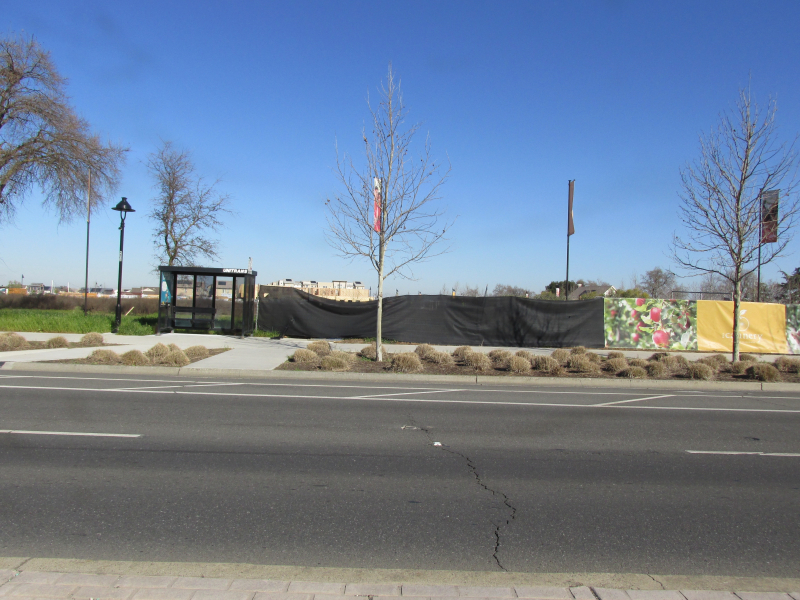
Now, the envisioned multimodal transportation hub has been completely removed from the site plan in favor of more commercial development on the anticipated multi-modal transportation center site.
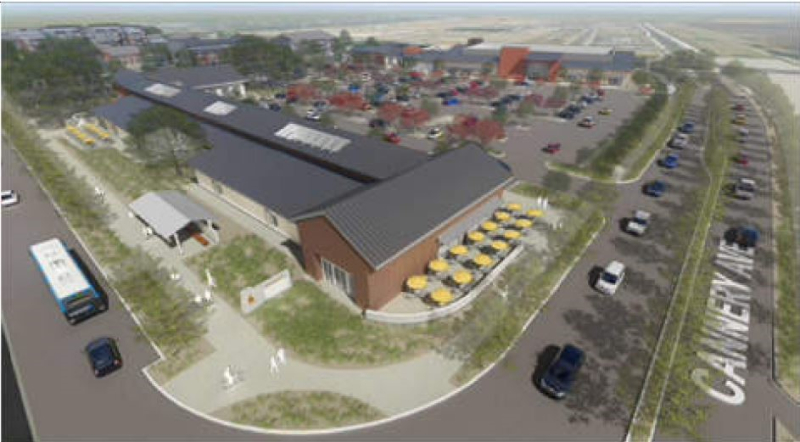
Instead of being centrally located and inviting and encouraging mass transit usage by residents and visitors, the single-bus stop currently in the plans is not even centrally located but instead faces the long blank back wall in back of one of the commercial buildings thus forcing bus users to walk around an entire building to get access to any of the project’s buildings. This was proposed by the developers for the sole purpose of building additional profitable buildings at the project to the disbenefit of non- automobile-using residents and visitors.
Proposed New Single Bus Stop
The new developer-sponsored traffic study now estimates nearly 10,000 daily motor vehicle trips to the Leeland Center. However, this estimate is based on the assumption that the grade separated bike crossing (that currently is inadequately funded) is in place when the Leeland Center is complete. There are no assurances that this will occur.
Further, the original baseline traffic analysis that was completed during the Great Recession is sorely out-of-date and does not adequately account for currently higher anticipated traffic both on Covell and to the development itself. The entire Cannery development, when fully built-out and occupied, will have Davis residents clamoring for additional traffic enhancements that will improve traffic flow on Covell.
In addition to signalizing the Market Dr. intersection into the Cannery and allowing two way traffic flow on Covell into and out of the project, it is likely that Covell Blvd may need to be widened impacting the adjacent Covell Blvd overpass of the railroad tracks.
Additional modifications to F Street and/or Cannery Dr on Covell will also probably need to be prioritized to reduce congestion further increasing the City's infrastructure deficit. These improvements are only needed because of the Cannery project. Yet the Cannery’s traffic impact fees are substantially inadequate to fund these necessary changes.
Access by bicycle will also be less than optimal due to the inadequate funding to complete the grade-separated crossing and failure by the City Staff and Cannery project developers to identify and provide the easements which are necessary for construction to complete connection with the rest of the City neighborhoods. Students that could bike to Holmes Junior High and Davis High School from the Cannery will probably instead be transported by their parents by automobile further increasing congestion at these school sites and neighborhood streets. Mass transit access will also be diminished by the poorly-placed single bus stop at the project.
Insufficient Affordable Housing -In December, 2017 the Social Services Commission reviewed the Addendum to the Cannery Project's Affordable Housing Plan with the proposal for only two additional affordable units to meet the Project's affordable housing requirement. The Social Service Commission voted 6-1 to instead recommend that the applicant provide 9 affordable units, consisting of 5 low income units and 4 very low income units.
The Commission specifically noted that additional low income housing should be provided because of the extra considerations otherwise requested by the project in terms of density and exceptions to the original Development Agreement.
Entitlement of a newly proposed “Big Box” Chain Fitness Center May Decimate Locally-Owned “Mom-and-Pop” Neighborhood Fitness Centers – The current proposal also entitles a new 34,000 sq ft Fitness Center rumored to be a new LA Fitness facility. This proposed Fitness Center will be far larger than any in town and exceeds the 25,000 sq foot limitation for building size in the original Development Agreement.
Indeed, it will dwarf the locally-owned Get Fit Davis facility nearby on Picasso Drive. This functional equivalent of a “big box” store will be extremely predatory to the many small locally owned “mom and pop” neighborhood fitness centers painstakingly built-up throughout the City. These facilities provide local convenient exercise opportunities to many residents and gainful employment to many more employees than will be provided by a minimally-staffed, large-scale, “big-box” fitness center.
Amazingly, however, the Staff report touts their recommended approval of this aspect of the project, as follows;
“Staff finds that the Cannery Marketplace is an appropriate location for a large fitness center. The site is centrally located in City and is convenient to nearby residential neighborhoods. It provides adequate access and parking with convenient transit access and connections to the City's bicycle network. To the extent that commercial recreation uses may gravitate to the City's existing light industrial or business park areas because of space and building square footage needs, this site helps to ease that pressure on those job and business centers.”
Firstly, for all practical purposes this fitness center is on the very edge of town (as is the entire Cannery project) and is far from centrally located as otherwise claimed by Staff. Secondly, as we have discussed above, this Fitness Center will hardly be a convenient place to access via automobile due to the horrific traffic bottleneck that will ensue during commute hour as a direct result of project-generated traffic increases that are otherwise unmitigated.
Access by bicycle will also be less than optimal due to the inadequate funding to complete the grade-separated crossing and failure by the City Staff and Cannery project developers to identify and provide the easements which are necessary for construction to complete connection with the rest of the City neighborhoods. Mass transit access will also be diminished by the poorly-placed single bus stop at the project.
Additionally, it is completely speculative that this newly proposed largest Fitness Center in Davis may open up other commercial space that is now or otherwise would in the future be needed by other Fitness Centers. Staff implies that this newly proposed Fitness Center will allow other businesses to enter such space and generate jobs that might otherwise be available if a Fitness Center were put into any such commercial space.
Staff has also neglected to inform Council that all existing Fitness Centers in Davis can now accommodate more customers that they currently have which might otherwise be siphoned off (along with existing customers) by this newly proposed mega-Fitness Center. Thus, this imaginary new commercial space would only open up only if these existing neighborhood Fitness Centers were shut down thus eliminating their convenience to other Davis residents and eliminating existing paying jobs for dozens of employees and independent contractors.
Finally, Davis has a history of inviting and protecting stable locally-owned and home-grown businesses from predatory national chains. This practice must continue in this instance especially since the City essentially gets nothing in return for this entitlement.
Sustainability Features
According to the Staff report, “The Cannery Marketplace structures would be designed to meet equivalent U.S Green Building Council LEED® Silver standards.” This is a real step backward in terms of sustainability standards for new commercial development in Davis.
Every major proposed and approved commercial or multi-family development project in the recent past (including the Marriott Extended Stay Hotel on Mace and 2nd Street in east Davis, the Hyatt Hotel on Cowell in South Davis, Sterling Apartments on 5th Street., Lincoln 40 apartments on Olive Drive., and the recently approved Nishi 2.0 project) have proposed meeting building standards equivalent to LEED Gold in addition to agreeing to purchase all excess energy not produced by onsite photovoltaics from the local Valley Community Choice Energy at the fully renewable rate.
It is difficult to imagine why Staff and Council would otherwise agree to any diminishment of these standards by this new commercial/residential development.
Conclusions
We want to be clear on one point – A marketplace center that is appropriate in design and scale with proper developer-funded traffic mitigation would be an asset for the Cannery and Davis. However the subsequent amendments to the Development Agreement between the City and the Cannery Developers have gone in a negative direction for the City of Davis, particularly from a traffic management and financial standpoint in light of these very marked project deficiencies.
City Council should reject Staff’s recommended approval of this project and direct Staff to renegotiate a number of critical items before accepting future modifications to the Cannery's Development Agreement and other entitlements. The priorities must be:
1) To protect existing neighborhood business from predatory big box commercial development (as is the City’s long-standing practice) by conducting an exhaustive analysis of community Fitness Center needs through engagement and cooperation with the many Fitness Centers throughout Davis.
2) To demand substantial traffic-mitigation monies for Covell Blvd. to reduce the city's mounting infrastructure deficit and protect protect taxpayers from short and long term financial obligations that essentially subsidize the developers.
3) To provide significant funding to provide adequate grade-separated connectivity of the 100-acre Cannery site with the adjoining streets and neighborhoods and to provide the necessary Right-of-Way easements for this crossing.
4) To provide for the multi-modal transportation hub promised by the original Development Agreement
5) To increase affordable housing units to 9 units consistent with the recommendation of the Social Services Commission.
6) To demand LEED Gold (or equivalency) building standards and require all electrical energy not provided by onsite solar PV be purchased from the local CCE at the fully renewable rate
Our City Council must recognize that substantial distrust by residents exists with respect to how developers manipulate our Staff and the entitlement process for new construction projects. And the Cannery, in particular, has become the poster child for past failures to extract sufficient concessions to cover even minimum mitigation costs necessary to reduce adverse impacts to the City posed by these large new development projects.
It is ill-advised that the Council would approve further developer give-aways in this particular project which will otherwise cost the City millions of dollars to cure the resultant deficiencies while at the same time asking the residents of Davis to approve two parcel tax measures ($49 for Parks and $99 for Streets) in June to address our fiscal deficits. The optics of approving this project, as is and without any significant concessions from the developers, would not seem to be favorable to passage of these parcel tax measures in June.

 Davisite
Leave a reply to Roberta L. Millstein Cancel reply