 Please accept our apologies, but the Davisite needs to go down for maintenance. We hope to be back by the end of the weekend.
The weather is going to be lovely this weekend – we hope you are able to get out and enjoy it.


Please accept our apologies, but the Davisite needs to go down for maintenance. We hope to be back by the end of the weekend.
The weather is going to be lovely this weekend – we hope you are able to get out and enjoy it.

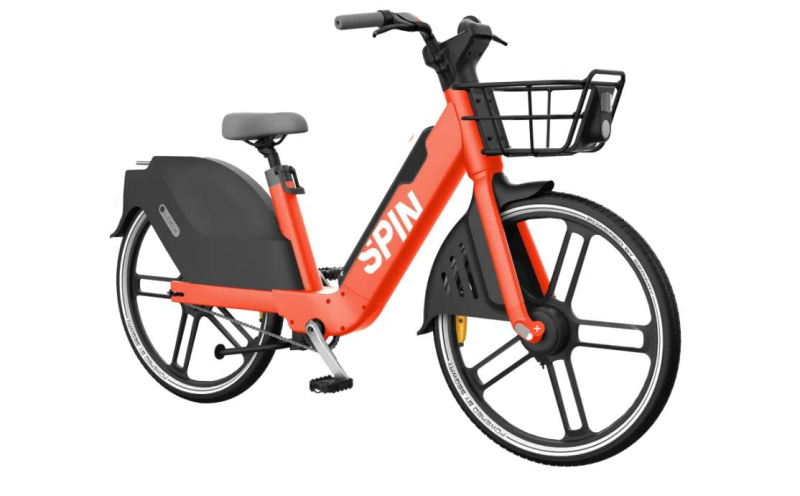
The authorities in Greater Davis* (City of Davis and UC Davis) plan to introduce a shared micro-mobility system starting this September (the introduction of e-scooter share and re-introduction of e-bike share). It is the topic of an informational item today at the July meeting of the Bicycling, Transportation and Street Safety Commission (BTSSC) at Davis Senior Center, 530pm in the Activity Room. The planned operator is Spin. (The staff report mentions Lime, a lot — they are the operator in Sac and West Sac and seemed to have been the operator-in-waiting here through at least the end of 2022).
There was e-bike share in Davis and UC Davis from 2018 until 2020, when Jump, its operator, cancelled it due to lack of use due to COVID-related UCD class cancellations and remote learning. Non UC-users were not considered, or at least were left in the lurch. (It's worth noting that during this time bike share use in other cities increased due to aversion to public transport…)
Following I will address the issues mentioned in my headline, and then briefly will comment on some other features of the draft agreement. There's way too much to address in one article – hopefully the Commission is able to sort through the staff report in a holistic way. If you want to skip to my juicy accusations of ageism, racism and far from ideal use as a mobility solution, see the sections below entitled 18 and Where's the Fleet?
To step back a bit – and also to educate Commissioners because there's now been 100% turnover in the BTSSC since 2018 and only one of two key City staff members still on board since then – and turnover also at UC Davis TAPS – here's a list of issues for micro-mobility share in our region from the beginning, and also some stuff about my professional history with bike share. Some of the following is anecdotal – as indicated – not due to lack of trying, and mostly because discussions with the private entities involved in operator (and sponsorship) are private, and apparently e.g. NDA's come into play.):
2000s: The advertising and street furniture giant JCDecaux approached the authorities in Lyon, France about sponsoring a new bike share system – there were earlier ones in other European cities, but this was the first one with technology broadly similar to what we have today – in exchange for an exclusive on their main business, a mentioned. This set a template for corporate sponsorship of bike share, especially in the USA, where we have – for example – bike share in NYC sponsored by Citicorp, and in many general east-of-the-Mississippi cities by Blue Cross-Blue Shield (BCBS) associated entities. In my view, this marriage to corporate sponsors has had some negative impacts, which I don't consider as in any reasonable trade-offs: Citicorp controls banks and real estate loans, and thus directly affects the lives of many of its users outside of their bike share monopoly; BCBS-associated companies have in a rather insidious (ironic) way have healthwashed-with-bikes their opposition to Medicare for All-type plans. This reliance on direct corporate funding is wholly unique to micro-mobility share in the USA, and locally (Capitol Corridor, Regional Transit, Unitrans and Yolobus are mostly supported by passenger fares, government subsidy… including Unitrans by the City) and a small amount by advertising on properties, and in some cases gives control to a private entity with no related regulation, no way for citizens – aside from shareholders – to have a democratic influence.
2003: While leading a study visit to Germany from Prague we were introduced to the bike share system run by the German National Railway Operator. It was early technology, e.g. a staff person told me that the put on pretense that the bikes could be found via GPS trackers, but there were actually none in place.
2009: A team consisting of myself (I was based in Berlin at the time, operating as Green Idea Factory), a Swedish mobility consultant and a Swedish industrial design firm won one of two first prizes for a detailed concept for a dockless bikeshare system in an international competition in Denmark. The concept is articulated further in a presentation I created in 2010.
2017: Sutter and Kaiser were both asked to be main sponsors of bike share in the Sacramento region. Anecdotally, Sutter objected because it wouldn't want Kaiser-branded bikes on its properties, and Kaiser objected because vice-versa. So….no sponsorship happened. Without naming these companies by name, this information came from at the time City Councilmember Frerichs and the now former head of JUMP.
2018: Before the pilot started in the region, the operator JUMP was purchased by UBER. The pilot started in Davis without input from the BTSSC, because Staff wanted to start by "bike month" in May of that year. Also around this time West Sacramento started negotiations to work with a different operator, but were talked out of it.
2019: The BTSSC was only allowed to formally review the system after a year. At the time I was on the BTSSC and I wrote a critical report, mentioning age and weight limits and other issues.
2019: Since the beginning, throughout this year and into 2020, there was a issue about bikes being parked in a way which would encumber or threaten others. Leaving aside how this compares to what car and delivery truck drivers do, it was something that needed to be addressed. Staff was very resistant for a time to the idea of parking bikes in the street "like a motorcycle" – and people were doing this on their own, but it was not officially-sanctioned - but then when I came forward with a detailed proposal – at the time I was still on the BTSSC – but was then told that staff had already decided to do it. See also. Unfortunately this was never officially put into practice by the time that JUMP ended bike share operations in spring 2020. Spin operates on the campus of UCSD, and their parking instruction video is over five years old, and hardly anyone has watched it. Rules need to be intuitive.
2019: OK, possibly in 2018? The City had BTSSC members and others tested perhaps six different types of e-scooters in anticipation of their possible allowance for general use by City Council.
Early 2020: JUMP cancelled bikeshare through the region, as mentioned. The staff report doesn't mention that a great deal of its bikes and supporting technology was simply and literally trashed.
2022: Bikeshare and scootershare started again in Sacramento and West Sacramento, operated by LIME (who purchased JUMP from UBER) with government financial sponsorship (something not happening with Davis/UC Davis.)
18
From its beginning as a pilot just in Sacramento, bike share in the region (this plan joins non-connected systems in Sacramento and West Sacramento), has had a minimum age limit of 18. It's critical to understand that there is no state regulation preventing anyone who is able to ride a bike from using the type of e-bike – a Class 1 e-bike – that Spin will provide, and e-scooters require only any classification of driver's license (so at lowest, 16 for the latter, and perhaps state ID's do not count.)
Lower-income families have fewer mobility options, generally-speaking (e.g. fewer cars, prohibitively expense train tickets, etc.) and youth members of these households even more so. Brown and Black people are disprotionately-represented in these households. So not only is the proposed agreement between the City of Davis, UC Davis and SPIN ageist, it's also racist.
Violation of Federal Law (in the previous bike share system), Elected Official and Staff hijinks
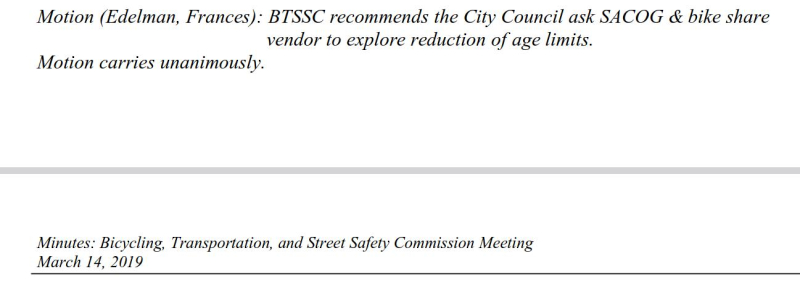
Around the time of my 2019 critical report – linked above, and mentioned in it – I suggested that the lower-than-18 age limit – not supported by State regulation on the utilized Class I e-bike – was in violation of the Age Discrimination Act of 1975, a Federal Law that is, in a way, an age-related version of Title VI of the Federal Civil Rights Act of 1964, as the City of Sacramento – a partner in the regional bike share system – was receiving Federal money to install bicycle parking racks as these were determined to be necessary to account for the increase of bicycles. The response from SACOG was that as the rule was that of the bike share operator and not the City of Sacramento or its government partners – they were off the look. A brazen loophole, in their view, obviously to intimidate me into not pursuing the matter! (Lucas Frerichs was aware of this or perhaps even helped direct SACOG staff on this matter.) At the time, former City of Davis senior planner Brian Abbanat – now working for Yolo Transit District – even wrote me as a BTSSC member an email – responding to my article in Davisite – telling me to not spread implications etc that the City was in violation of the law. Despite all of this – and to their great credit – the BTSSC unanimously supported my motion to recommend that the City Council ask JUMP and SACOG to consider lowering the age limit. The City Council did put this on their long range calendar but never acted on that, and dropped it once JUMP pulled service, and left it off once bike (and scooter) share discussions starting again. Some Councilmembers – perhaps Arnold and Partida – did ask about the issue during a meeting in 2022, but around the same time the City of Davis and UC Davis were already planning to go it alone on micromoblity share, though at that City Council meeting a now former representative of SACOG, Kirk Trost, said based on in his experience in developing bike over the region over the previous decade, there were essentially no operators who allowed people under 18. This is false on a national level (NYC, Philadelphia…) and in California (Los Angeles, Long Beach…) all allow people to use e-bikes from under 18.
Institutionally-speaking, not only SACOG and the City of Davis are blocking youth mobility, but also the board of DJUSD. Back in 2019 I met with Cindy Pickett when she was President – or just a member: She was willing to support a min. 16 age limit, BUT no one else on the Board was interested. Thanks for trying, Cindy! (Also about bringing back school buses…)
Peerage
My concept has for a few years been not simply that the entry level for bike share is under 18 (and for scooter share from license-accquisition) but that that it's peer-based. In other words, that one can use bike share – again, no government age restrictions apply – at the same time as their peers. My specific example would be that it start with ascending 10th graders, i.e. from the first week or so – pending administrative processing, etc – of the summer before 10th grade.
How is this better than strict temporal demarcations? For a start, 15 year-olds are likely to be friends with people both older and younger: Not everyone is the same age at the beginning of summer before 10th grade, nor during the school year, etc. So – in theory – with peer-based mobility share – a 14, 15 and 16 year-old who are good friends could all ride bike share bikes together from the start of the mentioned ascending period. A peer-based system wouldn't split friends up: Consider the extreme alternative: A group of students all under 18 who can't use bike share but CAN drive, or a mixed group, all of whom can't use bike share but CAN drive.
Wow, what a great reward, mobility milestone, etc… and perhaps before they're already (emotionally-invested) in getting a driver's license (which apparently they need to use the scooters, irony!). Right? Unfortunately: Crickets. This would be a first in the country, or perhaps anywhere.
The RFP
In the end the Request for Proposals (RFP) – see pg 66 – made a very, very soft ask for below 18 age limits. Way too soft for a city and university that chronically self-congratulate in regards to equity and inclusion. Srsly, are we applying Hate-Free too narrowly?
20. How do you intend to serve users who are less than 18-years of age? The City of Davis would like to provide shared bicycles to community members 16 and up, which could include non-electric devices as part of the device mix. […]
The answer to this (see pg 3.):
Age. All users must be 18 and over. In accordance with state and federal law, this policy protects the best financial interests of Spin’s customers and their organization since the minimum legal age of consent in most contracts (including user agreements) is 18 years or older. Staff understands the strong interest in allowing for people 16 and over to use these devices, however, all of the vendors had a minimum age of 18 years old.
Other Cities Better than Davis / UCLA 1; UCD: 0
As mentioned above, under 18's can use shared e-bikes in major cities such as Philadelphia and NYC, the nation's capital, and in California in Long Beach and Los Angeles. All require some form of parental or guardian permission and formal responsibility. In sum these systems provide tens of thousands of electric assist bicycles to minors.
What's significant about the bike share system run by Metro, the public operator in L.A. (inclusive of Hollywood, Venice, etc.) is that it is also expanding to cities such as Culver City, is already in Santa Monica, and – significantly – the UCLA campus. (How is a university campus relevant to under 18's? Well, many so-called child prodigies and other very high achievers skip a grade or more and enter university before age 18. Some also participate in summer programs, or use various facilities during the year, such as I did at UCLA when I had an AP history class in high school near the university. Do we want 16 and 17 year-olds visiting our city for serious academic reasons to be denied shared micromobility?)
Icing on the Cake of Anti-Equity
As many – including micromobility share – operators know well, users frack with age limits. What this means is that, for example, there are technical limits to how they can prevent anyone using a smartphone with their app on it connected with a credit card. Spin seems to hint at new countermeasures in the staff report, BUT this might partly bluster, similar what the Germans did nearly 20 years ago, as mentioned above.
More important, let's see how this likely works in practice: In most cases parents/guardians know the rule but allow their child to 'cheat" for any number of reasons. It seems likely that parents who tend to do this are less risk averse in regards to some financial issue that comes up as a result. So this would indicate a further anti-equity bonus in the form of a bias in the system for wealthier families. To be clear, I've not done research on this, but it seems like common sense.
e-Scooters
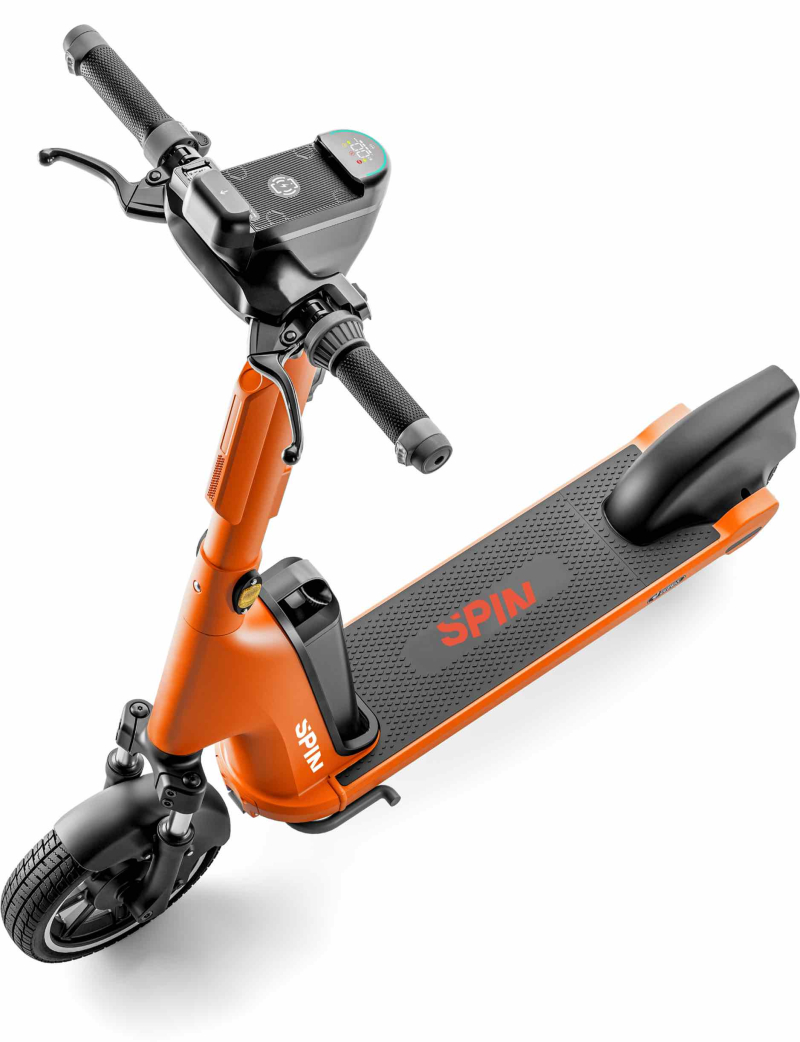
"Micromobility" – my blog engine can't decide if it needs a hyphen – is a bit of a new term, so I've perhaps conflated some things above between e-bikes and e-scooters. BUT as mentioned above, one only has to be 16 with a driver's license (from other states and countries?) to use an electric-assist scooter in California. So the ascending thing doesn't apply. Otherwise most of the planned to be codified ageism and racism applies! Hooray! YES, from what I have seen all operators have a min. age 18 limit for scooters…. and Davis and UC Davis are refusing to take a stand about it. #equitydeferstotheman
Where's the Fleet?
Is the planned system what we really need to get a very, very wide range of people and campus in the city on comfortable, fast enough, well-built and appropriately designed bikes?
Nope.
Every year… thousands of faculty, staff and especially students appear in Davis. Some have not ridden a bike in some time, some don't know to ride… these and many more don't actually know what is a useful bike for Davis, many don't have time to research and pick one out. Useful bikes are also hard to get, though selection is getting better – I think that some Dutch academic-related people are warned about this in advance: I have two Dutch-built bikes which were never sold retail in the USA… left by former Aggies…)
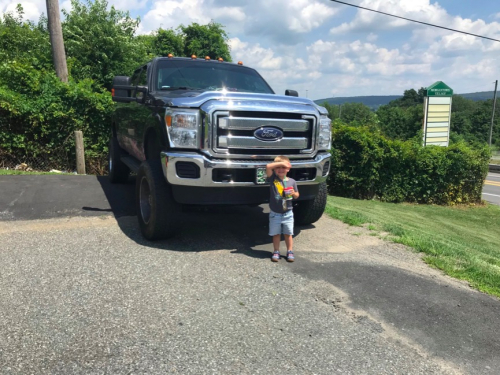
The bike pictured above - or ones like it – is a poster child for absolutely not the bike to offer to students or others in Davis:
Cons:
Loud, inefficient tires, bad for cornering on pavement and in rain
No fenders
No semi-built in lights or built in lights
No way to carry cargo
No bell!
Pros:
Not a big loss of money if it breaks down or is stolen (A newer model is only $300)
Nevertheless, this is a type of bike that's extremely common on campus. Many also don't fit well, even if purchased new.
Note that aside from the one thing in the Pro column, I am not talking about the quality of the bike, likely warranty or lack of local bike shop support. This is about design.
What the UC Davis campus (and probably many other UC and CSU campuses) really, really need is a fleet system of some sort. There are various business models, but the main criteria could be:
1) Suitability for local terrain and surface conditions: This means a relatively narrow gear range, or perhaps one relatively low gear, and therefore only 3 to 5 speeds. This means tires suited best for streets and possibly a bit of gravel, so that a student bike can fulfill at least a bit of a spontaneous recreational need.
2) Cargo equipment suitable for carrying a large student backpack and two bags of groceries, possibly even some kind of low security (for groceries, not laptops)
3) Built in lights with power from other than batteries
4) Low step, with three sizes to accommodate nearly all rider heights
5) Security system consisting of a tough main lock, front wheel security nuts and Dutch style frame lock for the rear.
5a) Possibly some dedicated locking design based on typical bike share, but the bikes will still need to be parked in random places, so that only goes so far. Unfortunately these bikes probably can't be unique enough in a way which facilitates locking-to-itself.
This system would be a complement to normal bike share (um, non-ageist, non-racist bike share!)
Though as mentioned the business model may vary, one idea would be that every student is assigned a bike by request at any time which will be of the appropriate size for the individual, and easy to identify with a color, a number and some tech-facilitated means connected with a smartphone app. This bike would be maintained by some outgrowth of the Bike Barn etc, or even farmed out to local bike shops (who would, after all, be dealing with a set design with the same parts etc. The bikes would have to be un-lockable by related staff so that can be picked up where they parked, broken down etc
Cost? Yes, this will be expensive, though not relative to the existing costs of tuition and fees.
The advantages cannot be over-stated:
Reliable bikes, optimized for student and related close urban lifestyles.
Predictable lighting.
A slow downsizing of chronically under-lit, poor fitting (size and use) , mechanically and pneumatically-sub-optimal crap bikes that fill every possible nook and cranny in the city and campus… wasting space, wasting time, avoiding safety, making it easy for driver-identified people to complain…. filling the city and campus bike racks with rusting junk that takes a huge amount of capacity, time and money to deal with.
WHY has this not been discussed to date in Davis?
Examples from the region and abroad. Some of the fleets are designed for a particular locale, such as a corporate campus, others are designed for an entire country, still others for long-term use:
This is a new sub-topic for a longer discussion, but it very BADLY needs to happen.

An Al’s Corner Special Report. Dateline Sacramento. Alan C. Miller Reporting on Alan C. Miller.
The Davis Vanguard (DV) held an event last Thursday night in Sacramento. The event honored some people for doing stuff. Entry into the event was $100 to $5000. Why? Do those contributing not realize that giving money to something perpetuates its existence?
As of last Thursday morning, there were 167 $100 tickets ‘available’. But one shouldn’t draw any conclusions as people often wait until the last minute on events. As one person did. As of 6:00pm last Thursday there were 166 $100 dollar tickets available. Not sure how many $5000 tickets were still available.
The entrance had no obvious signs of the event, though some A-frames advertised a food establishment within the becolumned ex-bank. I arrived at 5:45pm and found a spot near the A-frames across from the door where I could be seen but be out of the way of anyone who showed up. I held up my 11×17 protest sign which read, “The Davis Vanguard Sucks Donkey Balls” on one side and “$100 – $5000 WHY?” on the other.
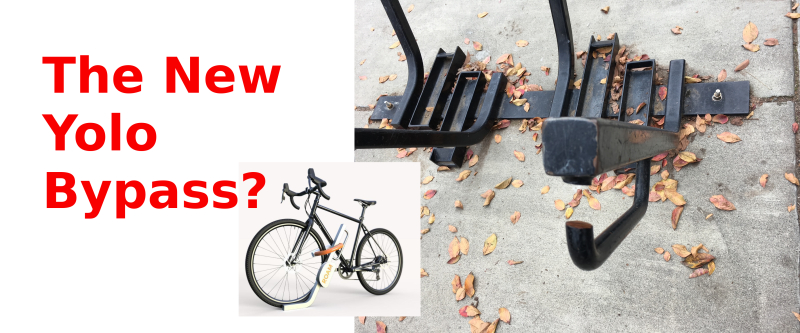
Tomorrow on UC Davis campus and at the monthly meeting of the Bicycling, Transportation and Street Safety Commission (BTSSC) a new shared public bicycle lock will be introduced, followed by pilots and local research…
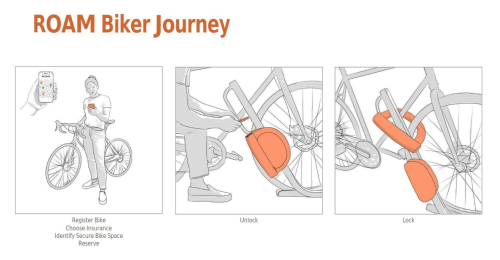
I'VE not seen the lock in use and the presentation doesn't contains imagery that's clearly actual photography – and not the much more helpful video – but for now have comments and questions for the lock developers, City and UCD partners….
ampus will end up having the same program, or if one body might accept it and the other not. (Despite the reality of the City-Campus Mobility District, transportation engineering and planning, organization and promotional activities and infrastructure standards of the City and Campus are mostly formally separate aside from cooperation on, for example, Unitrans and the Reimagine Russell visioning project. There's a plan to allow shared e-scooters on campus but not in the city — a big mistake in user-friendly transportation policy.)
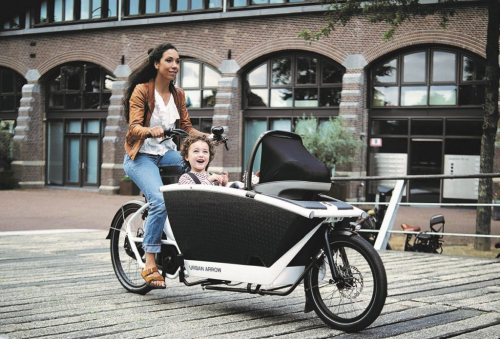
The Bike Lock design:
What makes it take “25 times” more time to breach than…. what? A cable lock, a top-of-the-line U lock? My chain and lock combo takes at least 3 to 4 minutes to cut in the field with an angle grinder – ROAM takes 90 minutes?
It’s “Cloud Connected”: What happens when it can’t connect for any number of reasons, as other systems can’t sometimes? Does it become unusable?
Right now the “Lightning Bolt” locks take less time to cut than the more expensive hardened locks. The main reason it’s not happened a lot is likely due to the psychological disincentive of damaging city or university property, as opposed to personal property. Will existing racks be modified to be more resistant to quick cutting?
Presumably the alarm sound comes from a small hole etc that’s also protected from water intrusion – have their been tests to seal this without setting off the alarm?
If the QR code on the lock is damaged how can the user disable the lock?
If the user loses their phone or its battery is dead, how the can the user disable the lock?
How many regular bicycle users don’t have mobile phones?
Is there a way for people who don’t have mobile phones to use the system?
What supplies the power to the locks? A separate battery on each holding piece that requires a swap for a recharged battery? How often does it need to be recharged?
Have there been tests where a unit’s alarm and lights were activated in the present of people not connected with the project? If so, what was their reaction?
All the visuals in the attached promotional brochure are visualizations – no photos. Presumably some exist as they are being introduced BEFORE the BTSSC meeting and before its members formally-reviewed it.
*****
I went through the entire staff report and interleaved comments and questions. It's long and it's here.
 Hello Davisites,
After months of discussion, the Davis City Council will decide whether to oppose or at least slow the arrival of 5G in Davis on Tuesday, January 28, at 7:00 pm.
You probably haven’t heard about these deliberations because, as the Davis Enterprise editor told me, worries about 5G are “fake news” and “conspiracy theories” that he won’t publish.
The hazards of wireless, and 5G in particular, are little known— which is no surprise when you consider that media alerts the public about tech risks but media is also the biggest beneficiary of 5G. The conflict of interest is obvious.
My understanding is that the major question in front of the Council is whether to continue to pursue a municipally-owned broadband network. The Broadband Advisory Task Force (BATF) says yes; staff says no. I am here to support the BATF recommendation.
I was astonished to see Dan Carson's editorial in the Davis Enterprise. It would seem that he has already decided, in advance of today's staff presentation and without hearing comment from the community and fellow Councilmembers that Davis should not control its own broadband network. I hope that he and other Councilmembers have an open mind on this.
Everyone seems to agree that having municipally owned broadband would bring great benefits to the City, spurring economic development and small business, bringing in needed revenue, and provide fast internet to schools and low income households. Given that, you would think that this would be a no brainer.
Yet Carson, following the staff report, worries about the costs. This seems to miss the point in multiple ways. To quote a recent article on the topic:
“Cities invest in many facilities that are not designed to make a profit, from sports stadiums and convention centers to airports and museums. Cities are not indifferent to the economics of such projects, but the bottom line is not strictly enterprise solvency. Especially for infrastructure like broadband, the network effects and spillovers should contribute to the economic and social life of the community.” https://www.vice.com/amp/en_us/article/a3np4a/new-municipal-broadband-map
Furthermore, as things stand now we are at the mercy of a monopoly. As coincidence would have it, Comcast raised its prices just this month. My household is now paying almost $80 for high speed internet. Our only “alternative” is to “pay less by paying more,” that is, by getting our internet bundled with other services we don’t want and wouldn’t use. We live in Central Davis, yet AT&T cannot provide high speed bandwidth to our household. We are at Comcast's mercy. This is not forward thinking.
Carson compared City owned broadband to the bullet train. A more accurate comparison would be SMUD, a lost opportunity for Davis to control its own electricity.
Let’s not make that same mistake again. Let’s do what over 750 communities have done <https://www.brookings.edu/blog/the-avenue/2017/06/29/new-report-swings-and-misses-on-communities-and-next-generation-broadband/amp/> and control our own broadband network.
Let’s be bold and act for the greater good of the community.
Davisites, please come to City Council this evening and let the Council know that this issue is important to you.
There are significant economic reasons to have a municipal fiber project
Published by Matt Williams in the Davis Enterprise, reprinted with permission of the author
I respectfully disagree with Dan Carson.
As a member of the BATF I would like to share with the public the following list of reasons that explain why BATF came to the official conclusion in writing that “the emotion and passion around the concept of a municipal fiber project could not be any more intensified."
BATF officially chose not to include the detailed list in the current recommendation memo because the focus of the memo was limited to the two additional tasks Council gave the BATF in 2018. These reasons cover what was learned during the whole BATF duration from 2016 to 2019. It is important to note that there are some BATF members who might not personally agree with some of the listed reasons; however ALL of the reasons were actively discussed by the BATF.
 By Robert Nickerson
Sometimes it seems this town is trying to find its get up and go. If we were taking an auto trip we are getting a lot of constituencies into the car, Ag and Seed, BioTech, New Downtown, Innovation Center, are all getting in and closing the door, putting on our seatbelts, turning the key and not getting anywhere. To our dismay, we look down and see no tires. We are missing an essential element that forms the vehicle that drives our economy to growth, to speed us along our way, that thing is cheap, abundant, ultra-wide Internet bandwidth. Businesses and their employees working in these fields that we are trying to bring to town, require access to the fastest and most reliable transport infrastructure available, fiber optic cable. For three years the City of Davis Broadband Advisory Task Force has been evaluating the feasibility of a community-owned fiber optic network. On June 4th they will deliver their recommendation that it is, and that the City should seriously consider pursuing this opportunity. We agree, and hope the City Council takes the next steps the Task Force recommends.
 GUIDING PRINCIPLES
By DavisGIG
The community owned fiber optic project will meet many specific economic and connectivity objectives of its community partners. More importantly its design is guided by certain principles and community values and brings direct substantial benefits to Davis residents. These benefits are referenced from and included in the Feasibility Study Report (FSR), the phone survey, and the DavisGIG online poll. Some of the current needs that the network is designed to address are:
Digital Inclusion – Currently in the marketplace there are areas where residents have no choice, or poor connectivity. There are three specific areas in Davis1 where only one wireline provider offers any service considered by the FCC to have “Broadband.”2 A community owned network that covers all parcels, and methodically expands to future parcels ensures that all residents, regardless of income level will be connected to the network.3
Digital Divide – The network, which will connect to every parcel in the community, can ensure that all residents regardless of income level have at least minimal level of wireline broadband service without data caps or restrictive transfer allowances that come with cell phone plans. Municipal ownership will ensure, through operational policy or specific vendor lease relationships to the municipal fiber, that a low income plan is available.4 Davis residents strongly believe Internet access on the fiber network should be available to all.5
On April 9, 2019 The Davis City Council took public comments on a proposed new contract for City of Davis broadband infrastructure.
The City Council discussion was held in closed session after comments. The City Council did not record or broadcast the public comments. Audio has been provided to the Davisite by Bob Fung of CivEnergy, photos by Roberta Millstein. Approximately 30 people were in attendance.
 v
v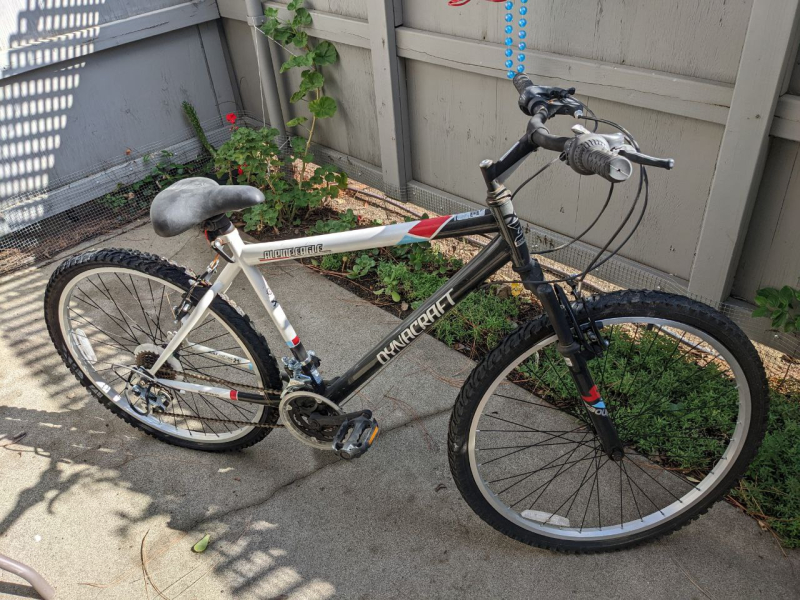
 Davisite